




















Evaluación cardíaca
Cardiology care for Laguna Niguel and south Orange County
The cardiologists at the Center for Advanced Cardiac and Vascular Interventions (CACVI) spend much of their working week inside catheter labs, opening coronary arteries that other teams have called too blocked, too branched or too risky, and working on the arteries and veins of the legs. That is the reason a Laguna Niguel patient ends up on our schedule. It is rarely about convenience. Our Los Angeles office at 8741 Alden Drive is 64.6 miles from Laguna Niguel City Hall by the shortest route Google Maps offers, so the drive has to buy you something you can’t easily get closer to Crown Valley Parkway.
What it can buy is a cardiac evaluation by interventional cardiologists who also perform the procedure they recommend, a reading of your angiogram by physicians whose published interests include total occlusions and bifurcation stenting, and one practice that handles heart, leg-artery and vein problems under the same roof. To book, call 310-652-2744 or request a visit online. If you have chest pressure, sudden shortness of breath or you have fainted, stop reading and call 911; the section on south county receiving hospitals below explains where that call takes you.
| Laguna Niguel essentials | Practical effect | Checked against |
|---|---|---|
| Nearest CACVI office: 8741 Alden Drive, Suite A, Los Angeles, CA 90048 | Orange County patients are seen at Alden Drive, so every visit means a trip north. | CACVI contact page |
| Phone 310-652-2744; fax 310-967-2140 | Book by phone, and fax reports ahead so they are read before you arrive. | CACVI contact page |
| Alden Drive keeps a Monday-through-Friday schedule (8:30 a.m. until 5:00 p.m.) | Saturday and Sunday are out, so you will be choosing between weekday traffic windows. | Google Maps listing |
| 64.6 miles from Laguna Niguel City Hall on the I-5 North; 68.2 miles via the I-405; 68.8 miles via the CA-73 toll road | Plan for about 130 miles of driving in a round trip. | Google Maps directions |
| Google range, Tuesday departures: up to 3 h 30 min at 6:30 a.m., 1 h 15 min to 2 h at 11:00 a.m. | Pick the appointment time first and the freeway second. | Google Maps directions |
| Parking: Lot 703 on Robertson Blvd charges nothing for 2 hours and caps the day at $12 | Testing on the same day can push you past the free period. | CACVI contact page |
| Laguna Niguel 911 calls answered by the Orange County Fire Authority (Stations 5, 39, 49) | Heart emergencies are handled in south county, not by our office. | City of Laguna Niguel: Fire |
| Nearest county cardiovascular receiving centers: Mission Hospital Mission Viejo and Saddleback Medical Center, Laguna Hills | These are where paramedics take a heart attack seen on their EKG. | OCEMS designation report, January 2024 |
Heart care from Laguna Niguel: the short version
Heart care needs in Laguna Niguel fall into a few groups. You may want a cardiologist in Laguna Niguel itself, or in Mission Viejo or Laguna Hills. You may need help with a specific condition close to home: heart failure in Mission Viejo, congenital heart disease in Laguna Hills, coronary artery disease near Laguna Hills, vein treatment or vein removal in Laguna Niguel. Or you may simply want a cardiologist close to home, somewhere between the 5 and the 73.
Here is what CACVI can and cannot offer in each of those situations:
- Laguna Niguel patients are seen at one of CACVI’s three offices, in Los Angeles, Tarzana and Victorville, and Los Angeles is the closest by a wide margin.
- Heart emergencies in Laguna Niguel are handled by Orange County Fire Authority paramedics and the county’s designated cardiac receiving hospitals. We are not part of that chain and never pretend to be.
- Where CACVI fits is a defined set of problems: a coronary artery that has been completely blocked for months, a blockage that sits at a branch point, an angioplasty that another team considered high risk, a hole in the heart found in adulthood, leg pain or a foot wound that threatens a limb, and varicose veins that cause real symptoms.
- Routine checkups, blood pressure adjustments and repeat monitoring usually belong with a doctor you can reach in fifteen minutes.
The rest of this page goes through each of those problems in turn, then the hospitals, the drive and the questions people ask before they call.
A Los Angeles cardiologist for a south county address: the cases that fit
Distance changes what a sensible first visit looks like. A patient from Beverly Grove can drop by for a blood pressure check; a patient from the hills above Niguel Road needs a reason worth two to four hours in the car. When people from south Orange County call us, the reasons usually fall into the groups below. Each one ties back to a procedure that a CACVI physician lists on his own biography, which is the only basis on which we’d suggest the trip.
A blocked artery someone said couldn’t be opened
A chronic total occlusion is a coronary artery that has been shut for months. Many catheter labs see these on an angiogram and send the patient back to medication or to a surgeon. Two of our physicians list total occlusion procedures among their interventions. If you have an angiogram report that uses the words “total occlusion”, “CTO” or “100% blocked”, that report and its images are the most useful things you can bring. The section on complex coronary blockages explains what the procedure involves and who is a reasonable candidate.
A stent decision with more than one moving part
Not every hard case is a total occlusion. Some blockages sit exactly where a coronary artery divides, so treating the main vessel can pinch off the side branch. Some patients have a weak heart muscle or several narrowed arteries at once, and the angioplasty itself carries more risk. Dr. Khorsandi’s listed interests include both bifurcation disease and high-risk coronary angioplasty, and CACVI’s service pages list support devices such as the Impella heart pump and the intra-aortic balloon pump that are used during that kind of procedure.
Legs that hurt when you walk, or a wound that won’t close
Pain in the calf or thigh that starts after a set distance and fades with rest can come from narrowed leg arteries. A foot sore that stays open for weeks in someone with diabetes or poor circulation is more urgent. Dr. Moinakhtar Lala started CACVI’s limb salvage and amputation prevention program, and the practice’s amputation prevention procedures page describes the catheter techniques used to restore blood flow below the knee. If anyone has mentioned the word amputation, call us the same day for an appointment rather than waiting for a routine slot.
A hole in the heart that turned up in adulthood
Patent foramen ovale (PFO) often turns up during the tests that follow a stroke. Closing one is part of Dr. Vasim Lala’s structural heart work. More complex congenital problems belong with a dedicated adult congenital heart program, and the section on adult congenital heart disease explains which programs in California carry that accreditation.
Varicose veins that ache, swell or bleed
Vein procedures are listed by all three CACVI physicians. CACVI’s vein pages describe them as in-office treatments under local anesthesia, and insurers attach specific conditions before they pay. That makes the vein visit one where it pays to know the rules before you drive; the vein section below sets them out.
The facility question to settle before a procedure date
Most of CACVI’s minimally invasive work is described on its office-based procedures page as outpatient: an office-based lab, an ambulatory surgical center or both, with patients going home the same day. The page doesn’t give a street address for either. Before you block out a day and arrange a driver from Laguna Niguel, get the facility name and address in writing, and ask whether anything about your case, such as kidney function or a weak heart, could move it to a different setting.
When the trip isn’t worth it
If what you need is a yearly review of stable blood pressure, a repeat cholesterol panel or a routine Holter monitor, a cardiologist in Mission Viejo, Laguna Hills or San Juan Capistrano will serve you better. The same applies to cardiac rehabilitation, which needs two or three visits a week. We would rather see you once for the question that matters and send a clear letter back to your local doctor than build a schedule of 130-mile round trips.
Holding an angiogram report? Call 310-652-2744, read the office the exact wording of the findings, and ask which images to bring on disc or through an image-sharing link.
Which CACVI physician lists the procedure you are asking about
The table below is built only from each physician’s own biography on cacvi.org. It is meant to help you ask for the right person when you call. It isn’t a ranking; all three manage general heart and vascular problems as well.
| If your question is about | Physician whose biography lists it | CACVI page |
|---|---|---|
| A coronary artery blocked for months (CTO) | Dr. Moinakhtar Lala; Dr. Vasim Lala | Complex coronary intervention |
| A blockage where an artery branches; high-risk angioplasty | Dr. Mehran J. Khorsandi | Dr. Khorsandi |
| Leg pain on walking, a foot wound, an amputation recommendation | All three physicians | Prevención de amputaciones |
| Varicose veins and venous insufficiency | All three physicians | Endovenous ablation |
| A patent foramen ovale (PFO) after a stroke | Dr. Vasim Lala | Dr. Vasim Lala |
| WATCHMAN for atrial fibrillation patients who can’t stay on blood thinners | Dr. Vasim Lala | WATCHMAN |
| A narrowed aortic valve (TAVR) | Dr. Moinakhtar Lala; Dr. Vasim Lala | TAVR |
| Pacemakers and defibrillators | Dr. Mehran J. Khorsandi | Pacemaker implant |
| Heart care during cancer treatment | Dr. Vasim Lala | Dr. Vasim Lala |
Dr. Mehran J. Khorsandi and the branch-point problem
Penn medical school came first; then Cedars-Sinai, where he did both his internal medicine years and his cardiology fellowship, and where he has stayed on the attending staff since 1993. In the Valley, Providence Cedars-Sinai Tarzana Medical Center has him running its catheterization lab. Count the credentials on his page and you get five: diplomate status from the boards for internal medicine, cardiovascular disease, interventional cardiology and endovascular medicine, and a separate cardiac device specialist credential.
For a south county patient, the detail that matters most is his focus on coronary bifurcation disease. He co-founded Advanced Bifurcation Systems, a company developing a platform for stenting at branch points, and his biography credits him with 50 issued patents in interventional cardiology. He also lists high-risk coronary angioplasty, pacemaker and defibrillator implantation, peripheral artery disease with limb salvage, and vein treatment. He takes part in training cardiology fellows in the Cedars-Sinai catheterization lab and was given an Excellence in Teaching Award there.
Dr. Moinakhtar Lala, from blocked coronaries to the foot
Leg-saving work is where he made his name at CACVI: arriving in October 2016, he set up the practice’s program for limb salvage and amputation prevention. He completed his internal medicine training at SUNY Downstate and Long Island College Hospital, where he served a year as chief resident, followed by cardiology, interventional and endovascular fellowships at Mount Sinai Beth Israel in New York. On paper that adds up to seven boards, among them echo, nuclear imaging and vascular ultrasound reading alongside the interventional ones.
His interventions list starts with complex coronary procedures, wrist-access (trans-radial) angioplasty and total occlusions, then moves to the legs: peripheral endovascular work, critical limb ischemia and vein ablation, plus transcatheter aortic valve replacement. His published work includes a paper on reaching leg arteries through the foot (a trans-pedal approach) and one on orbital atherectomy, a plaque-sanding device, delivered through the wrist.
Dr. Vasim Lala and the structural side of the practice
Dr. V. Lala joined in July 2022. His osteopathic degree is from Michigan State, and so are his internal medicine residency and, through McLaren Macomb, his cardiology fellowship; then completed interventional, endovascular and structural heart training at The Mount Sinai Hospital in New York. His six certifications run from internal medicine and general cardiology through catheter-based cardiology to two imaging fields, nuclear studies and echo, plus the vascular ultrasound reading credential.
He is the physician to ask for if your question involves a PFO, the WATCHMAN left atrial appendage device or heart care during cancer treatment (cardio-oncology), all of which appear on his biography alongside total occlusions, limb salvage, vein ablation and TAVR. He also lists the long-term management of hypertension, heart failure, cardiomyopathy and atrial fibrillation, and he has written for the American College of Cardiology and TCTMD.
Which physician will you see?
Scheduling depends on who is in the Los Angeles office on a given day, and the office can’t commit to a specific physician for every visit. Say which procedure or problem you are calling about, and the office can tell you who reviews that kind of case.
Complex coronary blockages: total occlusions, branch points and high-risk angioplasty
If you live in Laguna Hills or elsewhere in Orange County and have coronary artery disease or have been told you need heart stents, start here. For most people with a narrowed coronary artery, a standard stent at a nearby hospital is the right answer, and south Orange County has hospitals that place stents every day. This section is about the cases that don’t fit the standard pattern, because those are the ones where a second set of interventional eyes can change the plan.
What makes a coronary case “complex”
There is no single official definition, but interventional cardiologists tend to use the word for a handful of situations: an artery that is completely blocked and has been for a long time; a narrowing at the point where an artery divides; heavy calcium that a balloon can’t crack; disease in the left main artery, which feeds most of the heart; and a patient whose heart muscle is weak enough that even a short interruption of blood flow during the procedure is dangerous. CACVI’s own page on complex coronary intervention describes the first of these in detail. A single patient can have more than one, which is part of what makes planning harder.
Chronic total occlusions, explained
A chronic total occlusion (CTO) is an artery with no blood getting through the blockage, documented or estimated to have been closed for at least three months. That is the definition used by the CTO Academic Research Consortium in its 2021 consensus paper in Circulation. The heart often grows small collateral vessels around the blockage over those months, which is why some people with a CTO have only mild symptoms or none at all, while others get chest tightness or breathlessness every time they climb a hill.
Opening a CTO takes longer than routine stenting and uses specialized wires and microcatheters. Operators sometimes approach the blockage from the far side, through a collateral channel, rather than straight on. CACVI’s complex coronary page explains the basic steps: a catheter guided to the blockage under imaging, a balloon to widen it, and a stent to hold it open, followed by a period on blood thinners.
How a CTO procedure day differs from a routine stent
Expect it to take longer than a routine stent. A total occlusion often needs much more time in the lab, because the wire has to find a path through hard, old plaque or travel around it. Operators frequently place catheters in two arteries at once, one to work on the blockage and one to inject dye into the collateral vessels that fill the artery from behind, so both wrists, or a wrist and a groin, may be used. More contrast dye and more X-ray time are usual, which is why kidney function is checked beforehand and why the planning conversation should include the radiation dose. Ask in advance whether you are likely to stay overnight; that answer shapes how a south county family plans the trip.
Who is a reasonable candidate for CTO treatment
The international consensus paper “Guiding Principles for Chronic Total Occlusion Percutaneous Coronary Intervention,” published in Circulation in 2019, sets out its first principle plainly: the main reason to open a CTO is to relieve symptoms caused by poor blood flow. In practice that means a candidate usually has angina or breathlessness that medication hasn’t controlled, and a test showing that the heart muscle beyond the blockage is alive and short of blood. A CTO found by chance in someone with no symptoms is a different conversation, and often the answer is to leave it alone and keep the medicines going.
Useful questions to bring to a CTO consultation:
- How long has this artery been closed, and how do we know?
- Is the heart muscle beyond the blockage still alive? Which test showed that?
- What happens if we treat my symptoms with medication alone?
- Would you approach this from the front, from behind through collaterals, or decide during the procedure?
- If the procedure can’t open the artery, what is the next option?
Calcium that a balloon can’t crack
Older plaque often hardens with calcium, and a balloon inflated against a rigid ring of calcium may not open the artery enough for a stent to expand fully. An under-expanded stent is one of the known reasons stents fail later. Interventional cardiologists deal with this by preparing the vessel first, using devices that sand or drill through the calcium before the stent goes in. Orbital atherectomy is one of them: a small diamond-coated crown spins in an orbit inside the artery and smooths the hard plaque. Dr. M. Lala has co-authored a paper on the safety and feasibility of orbital coronary atherectomy performed through the wrist rather than the groin. If your report mentions “heavy calcification”, “severe calcium” or a stent that “did not fully expand”, raise vessel preparation by name at the consultation.
Blockages at a branch point
Coronary arteries divide like the branches of a tree. When plaque sits right at the fork, treating the main vessel can push plaque into the side branch and narrow it. Interventional cardiologists describe these lesions with the Medina classification, a three-digit code for the main vessel before the fork, the main vessel after it and the side branch, where each digit is 1 if that segment is at least 50% narrowed and 0 if it isn’t. A “1,1,1” lesion has disease in all three segments; a “0,0,1” lesion involves only the side branch.
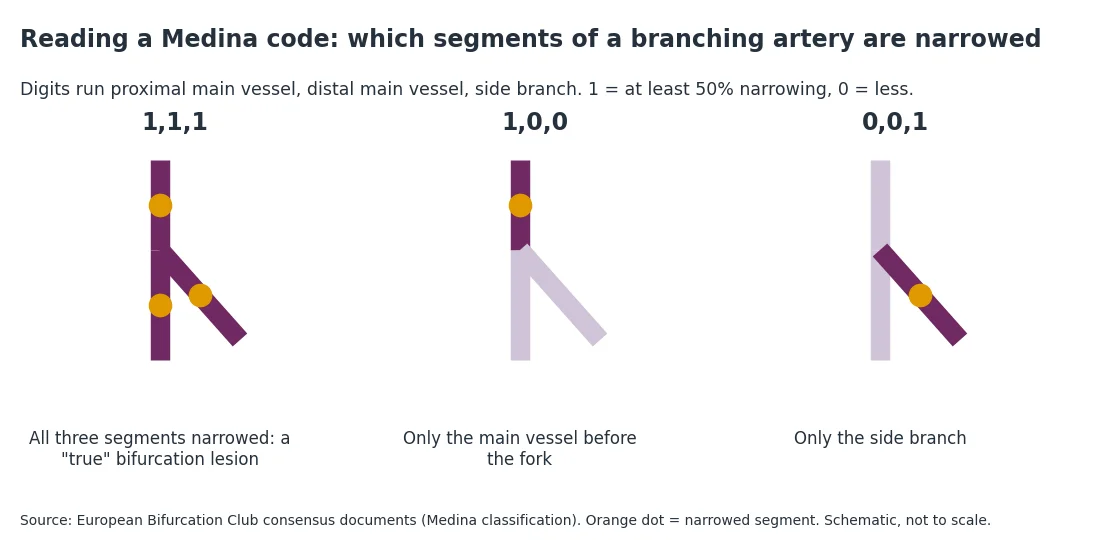
The European Bifurcation Club, a group of interventional cardiologists that has published consensus documents on this problem for more than a decade, treats a single stent in the main vessel with the option of treating the side branch if needed, called provisional stenting, as the default for most bifurcation lesions. Two-stent techniques are kept for selected cases, such as a large side branch with a long stretch of disease. Bifurcation work is the area Dr. Khorsandi lists first among his interests, and the medical technology company he co-founded is built around it.
High-risk angioplasty and heart support devices
Some patients have narrowed arteries and a heart that pumps weakly, or have been turned down for bypass surgery because of age or other illnesses. Angioplasty in that setting can drop blood pressure while the balloon is inflated. A temporary support device can carry part of the heart’s workload during the procedure. CACVI lists two on its services pages: the Impella, a small pump placed across the aortic valve through a catheter, and the intra-aortic balloon pump, which inflates and deflates in the aorta in time with the heartbeat. Whether either is needed depends on the anatomy and the strength of the heart muscle, and it is decided case by case.
Wrist or groin: where the catheter goes in
Coronary procedures can be done through the radial artery at the wrist or the femoral artery at the groin. The 2021 coronary revascularization guideline from the American College of Cardiology, American Heart Association and Society for Cardiovascular Angiography and Interventions favors the wrist approach when an operator experienced in it is available, because it is linked to less bleeding and fewer complications at the access site. Some complex cases still need the groin, or both, for larger equipment. Trans-radial coronary intervention appears on the procedure lists of both Dr. M. Lala and Dr. V. Lala. For a patient who lives more than an hour away, ask before the procedure which access site is planned and what that means for walking, lifting and driving in the days after.
What to bring for a complex coronary review
The most useful records are the angiogram images themselves, not only the written report. Ask the hospital that did your catheterization for the images on a disc or a secure download link, and bring:
- the catheterization report and any operative note;
- the most recent echocardiogram, with the ejection fraction;
- any stress test, nuclear scan or cardiac MRI done in the last year;
- a current list of medicines, including blood thinners and their doses;
- a short note of your symptoms: what you can no longer do, and when that changed.
Told the artery is “100% blocked”? Ask your cardiologist’s office or the hospital for the angiogram images, then call 310-652-2744 to set up a review in Los Angeles.
Below-the-knee artery blockages and procedures through the foot
Heart and vascular care for Laguna Niguel patients has two halves, and the vascular half is where CACVI’s work differs most from a typical cardiology office. Blocked arteries in the lower leg and foot are where amputations start, and they are also some of the hardest arteries to reach with a catheter.
Why the arteries below the knee are their own problem
Below the knee, the main leg artery splits into three smaller vessels that run down to the ankle and foot. In people with diabetes or kidney disease, plaque often settles in these small arteries rather than higher up, and it tends to be long and heavily calcified. Pain on walking is sometimes absent, because nerve damage dulls it, so the first sign may be a sore on a toe or heel that doesn’t close. CACVI’s amputation prevention page describes the practice’s focus as procedures on these small vessels below the knee, aimed at getting enough blood to a wound for it to heal.
Chronic limb-threatening ischemia, in plain terms
The most severe stage of leg artery disease is now usually called chronic limb-threatening ischemia (CLTI). CACVI’s page on critical limb ischemia lists the warning signs: severe pain in the feet or lower legs while sitting or lying still; sores or ulcers that won’t heal; shiny, dry skin; weak or absent foot pulses; and dry, blackened skin, which is gangrene. It doesn’t improve on its own.
Tests that confirm it
The 2024 guideline on lower extremity peripheral artery disease from the American College of Cardiology, American Heart Association and partner societies backs adding toe pressures, a toe-brachial index, or a skin oxygen or perfusion measurement to the standard ankle-brachial index when CLTI is suspected. The reason is practical: in diabetes and kidney disease the ankle arteries can stiffen so much that the ankle reading comes out falsely normal or high. Once a procedure is on the table, the next step is imaging that traces the arteries from groin to foot.
Revascularization comes before any amputation decision
The same 2024 guideline gives its strongest class of recommendation to restoring blood flow in CLTI to limit tissue loss, heal wounds, relieve pain and keep a functional limb. The American College of Cardiology’s summary of the guideline adds that a team covering several specialties should evaluate revascularization options before an amputation is carried out. If an amputation has been recommended and nobody has looked at whether the arteries below the knee can be opened, that question should be asked first.
Reaching the blockage through the foot
Most leg procedures start with a catheter in the groin. When a long blockage can’t be crossed from above, interventional cardiologists can approach it from below, through an artery at the ankle or on top of the foot, and meet in the middle. Dr. M. Lala has published on this trans-pedal approach, and CACVI’s peripheral angiogram and angioplasty page explains that a narrowing found on the angiogram can be treated in the same session or a later one.
Questions to ask before an amputation is scheduled
- Has anyone imaged the arteries below the knee and in the foot, by angiogram, CT or ultrasound?
- What were the toe pressures or the toe-brachial index, not only the ankle reading?
- Was an approach through the ankle or foot considered if the blockage couldn’t be crossed from above?
- Who reviewed whether blood flow could be restored, and was it an interventional or vascular specialist?
- If the wound is infected, can the infection be controlled while blood flow is assessed?
Wound care stays close to home
Opening an artery is one piece of saving a foot. The wound still needs regular cleaning, dressing changes, pressure relief and, in diabetes, close glucose control, often for weeks. That care is done by podiatrists and wound clinics, and for a Laguna Niguel patient it makes sense to keep it in south county. What we ask is that the wound team and our office share photos and measurements, so we can tell whether blood flow is doing its job.
Told a toe or foot may need to be amputated? Call 310-652-2744 the same day, say the word “amputation” to the scheduler, and have your most recent ABI or arterial ultrasound ready.
Vein removal, vein treatment and what insurers ask for first
If you are looking for vein treatment or vein removal in Laguna Niguel, the second phrase is worth unpacking, because in most modern vein practices, including ours, the problem vein is not taken out at all.
Why “removal” is usually the wrong word now
Vein stripping, the older operation, pulled the faulty vein out of the leg through incisions, often under general anesthesia. Endovenous ablation, which has largely replaced it, seals the vein from the inside and leaves it in place. A thin catheter is passed into the vein under ultrasound guidance, heat from a laser fiber or a radiofrequency probe closes it, and blood finds its way back to the heart through healthy veins. CACVI’s page on endovenous ablation describes it as a procedure done under local anesthesia, with most people back to normal activity within a few days; ask the office where yours would be performed. Over time the body turns the sealed vein into scar tissue.
CACVI’s own vein pages keep surgery that removes or ties off a vein for severe cases or for veins where other treatments have failed. Spider veins are closed with injections or light. So “removal” still happens, but for the large saphenous veins behind most symptoms, sealing has taken over.
Spider veins and varicose veins are treated, and paid for, differently
Spider veins are the fine red or purple webs just under the skin. Varicose veins are the larger, rope-like veins that bulge when you stand. CACVI’s spider vein treatment page describes sclerotherapy injections and laser treatment for the first group; the vein treatment page covers radiofrequency ablation for the second. The distinction matters well beyond the procedure, because insurers draw their payment line right between the two.
What Medicare in California requires before it pays
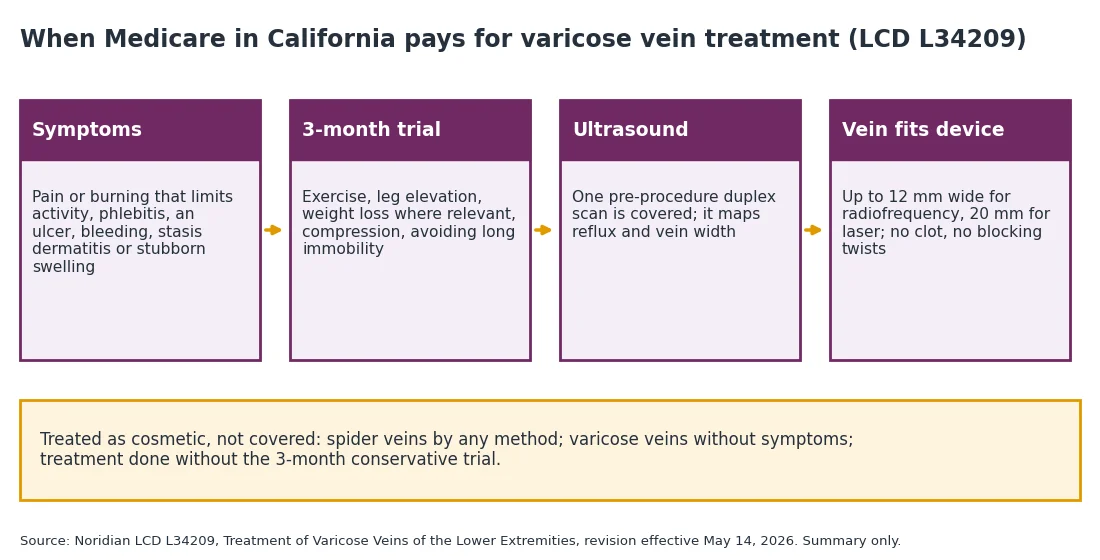
Medicare’s contractor for California, Noridian, publishes its rules in a Local Coverage Determination titled “Treatment of Varicose Veins of the Lower Extremities” (L34209). Its current revision took effect on May 14, 2026. In plain terms, it says:
- You must have symptoms. Qualifying problems include pain or burning that limits walking or daily activity, repeated episodes of superficial phlebitis, a skin ulcer that won’t heal, bleeding from a varicose vein, stasis dermatitis, and leg swelling that persists despite treatment.
- Conservative care comes first. The policy expects a three-month trial of measures such as exercise, leg elevation, weight loss where relevant, compression and avoiding long periods without moving.
- The anatomy must suit the device. For radiofrequency ablation the treated vein can be no wider than 12 mm, and for laser ablation no wider than 20 mm. The vein can’t contain a clot or twists that would block the catheter, and significant artery disease in the leg rules it out.
- One ultrasound before the procedure is covered.
- Cosmetic treatment isn’t covered. Treating varicose veins that cause no symptoms, or treating them without the conservative trial, counts as cosmetic, and so does any treatment of spider veins.
Commercial plans and Medicare Advantage plans write their own policies, but many follow a similar pattern: symptoms, a documented trial of compression, and an ultrasound showing reflux. Before you drive north for a vein visit, ask your plan whether it needs a referral and prior authorization for vein ablation.
Plans other than Original Medicare
Medicare Advantage plans and commercial insurers each publish their own medical policy for varicose vein treatment, usually under a title such as “treatment of varicose veins” or “venous insufficiency”. Ask your plan’s member services line three things before the first vein visit: the policy’s name or number, whether ablation needs prior authorization, and whether a doctor in Los Angeles County counts as in network for you. That last question matters more for a Laguna Niguel member than for someone who lives near our office, because the visit happens in a different county from your home.
Keeping a record of the three months
Because the policy treats ablation without the trial as cosmetic, the trial has to exist on paper as well as in practice. If you are wearing compression stockings now, keep a simple log:
- the date you started compression and the pressure printed on the box;
- days you couldn’t wear them, and why;
- what still hurts or swells despite them, and when in the day it starts;
- any skin changes, bleeding or phlebitis episodes, with photos;
- visits to your primary doctor where the legs were discussed.
Bring that log to the first visit along with any earlier vein ultrasound, even one done years ago.
The ultrasound is the deciding test
A duplex ultrasound of the leg veins, done standing or tilted head-up, shows whether the valves let blood fall backward (reflux), which vein segments are affected and how wide they are. That one study decides whether ablation is possible, which device fits and whether insurance criteria are met. Dr. M. Lala and Dr. V. Lala both hold the Registered Physician in Vascular Interpretation credential, which covers reading these scans, and CACVI lists vascular ultrasound among its in-office tests.
The days after an ablation
CACVI’s ablation page lists what to expect afterward: bruising and some swelling, aching along the treated vein, and occasionally an inflamed, tender cord under the skin (superficial thrombophlebitis). Less common problems include numbness or tingling where the vein runs close to a skin nerve and, with heat-based methods, a small burn or color change in the skin. Compression stockings are usually advised for a period after the procedure. Tell the physician about every blood thinner you take before the day, since some may need to be paused. If a follow-up ultrasound is planned to check that the vein has closed, ask at booking whether that scan can be done near home and the images sent to us.
Swelling in one leg is a different question
Sudden swelling of one calf, especially with pain or warmth, can be a deep vein clot, and that is an emergency department question the same day, not a vein appointment. Long-standing swelling with darkened skin around the ankle, on the other hand, can point to a narrowed vein higher up in the pelvis. CACVI’s venography and venous stenting page covers that problem.
Wearing compression and still hurting? Teléfono 310-652-2744 and say it’s for a vein evaluation. Ask the office to check your plan’s prior authorization rules before the visit.
Adult congenital heart disease and a hole in the heart found later in life
If you live in Laguna Hills with congenital heart disease, the first question is which kind. Congenital means present at birth, and the term covers everything from a tiny hole that never causes trouble to complex defects repaired in infancy that need lifelong specialist follow-up. Those two ends of the range need very different care, and CACVI fits only one part of it.
Most adults with congenital heart disease need a dedicated program
People born with complex heart defects now usually survive into adulthood, and many reach middle age with a repaired heart that still needs watching for rhythm problems, leaking valves or a failing pumping chamber. The 2018 guideline for adults with congenital heart disease from the American Heart Association and American College of Cardiology says that patients with moderate or complex lesions should be managed in collaboration with a cardiologist trained in adult congenital heart disease, and that catheter procedures and surgery on congenital lesions should be done by operators with congenital expertise. The same guideline advises women with congenital heart disease to have counseling with an adult congenital specialist before pregnancy.
Planning a pregnancy with a heart defect
For women born with a heart defect, pregnancy adds blood volume and workload that a repaired heart may or may not handle well. The 2018 guideline recommends that women with congenital heart disease see an adult congenital specialist for counseling before pregnancy, to estimate the risk to mother and baby and to review medicines that aren’t safe in pregnancy. That counseling belongs at an accredited program, and the planning works well when it starts long before the pregnancy does.
Repaired as a child, out of touch since
A common story is an operation in childhood, regular visits through the teenage years and then nothing once pediatric care ended. The 2018 guideline sorts adults with congenital heart disease by their anatomy and current condition and uses that grouping to set how often they should be seen and which tests they need, from echocardiograms to cardiac MRI and exercise testing. Someone who stopped being seen at eighteen may not know which group they fall into, and that is the first thing an adult congenital clinic will work out. Bring any old operative notes or discharge letters you or your parents kept; even a hospital name and a year help the program request the records.
Accredited programs within reach of Laguna Niguel
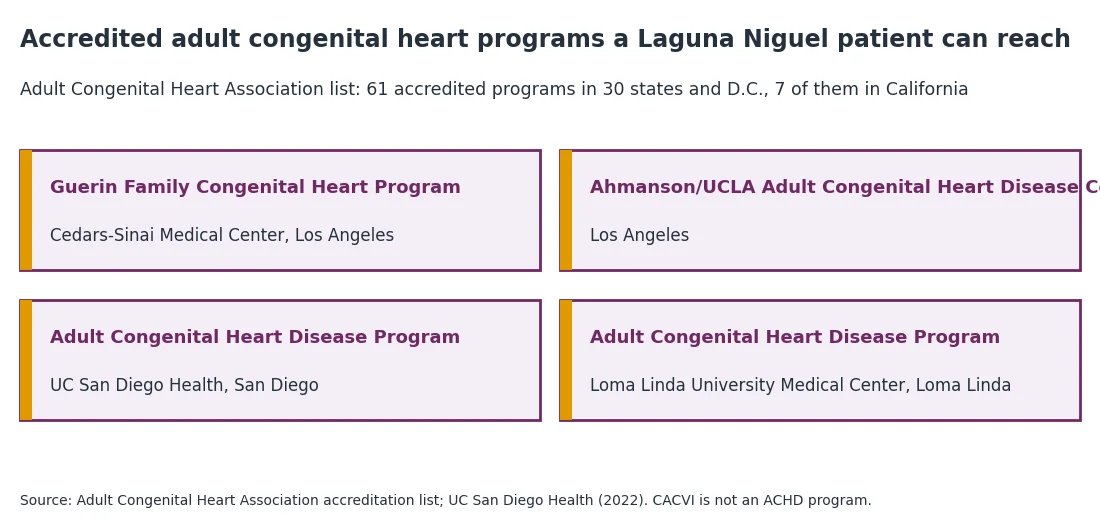
The Adult Congenital Heart Association accredits programs that meet its criteria. Its list shows 61 accredited programs in 30 states and Washington, D.C., including seven in California. For a Laguna Niguel resident, these four are within a day’s driving range:
- the Guerin Family Congenital Heart Program at Cedars-Sinai Medical Center in Los Angeles;
- the Ahmanson/UCLA Adult Congenital Heart Disease Center in Los Angeles;
- the Adult Congenital Heart Disease Program at UC San Diego Health;
- Loma Linda University Medical Center’s program in the Inland Empire.
UC San Diego Health described its program, accredited in March 2022, as the only one of its kind south of Los Angeles. So whichever way you drive from Crown Valley Parkway, an accredited adult congenital center is roughly an hour or more away. If you had heart surgery as a child and have drifted out of follow-up, one of these programs is the place to restart, and they don’t need a CACVI referral.
Patent foramen ovale: the common hole
Before birth, a flap between the upper chambers of the heart lets blood bypass the lungs. In most people it seals shut in infancy. In about one person in four it stays partly open, according to the American Heart Association. That opening is a patent foramen ovale, and in most people it never causes a problem. It usually comes to light by accident on an echocardiogram, or during the search for a cause after a stroke.
When PFO closure is discussed
The American Academy of Neurology’s 2020 practice advisory, published in Neurology, looked at people younger than 60 who had a stroke that was thought to be caused by the PFO, with no other cause found after a full workup. For that group it found that closing the PFO reduced the risk of a second stroke by 3.4 percentage points over five years. It also reported a 3.9% chance of procedural complications and a higher risk of atrial fibrillation after closure, about 0.33% per year. For people who decline closure, the advisory lists antiplatelet medicine or anticoagulation as options.
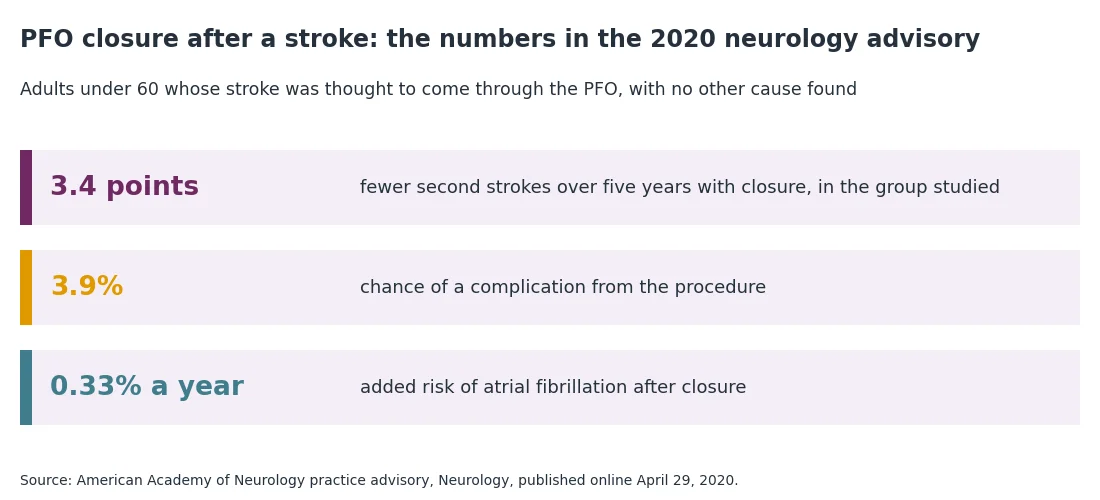
Those numbers explain why the decision is shared between a neurologist and a cardiologist. The neurologist judges whether the stroke really looks like it came through the PFO, and the cardiologist judges whether the hole and the surrounding anatomy suit a closure device. If a neurologist has raised closure with you, Dr. V. Lala is the CACVI physician whose page includes PFO work.
The devices used to close a PFO
PFO closure is done through a vein in the groin. A folded device made of two small discs is passed up to the heart and opened on either side of the flap, then left in place, where heart tissue grows over it. The U.S. Food and Drug Administration approved the first device specifically for this purpose, the Amplatzer PFO Occluder, in October 2016, for patients mainly aged 18 to 60 after a stroke with no other identified cause. In March 2018 it extended the GORE CARDIOFORM Septal Occluder’s approval to the same stroke-prevention use. Ask the physician how long you’ll stay after the procedure and how long antiplatelet medicine continues; both shape the plan for the drive home.
What a PFO consultation needs from you
- The stroke workup: brain MRI report, vessel imaging of the head and neck, and the neurologist’s note.
- The echocardiogram that found the PFO, ideally the bubble study, which shows whether blood crosses the hole.
- Any heart rhythm monitoring done after the stroke, since atrial fibrillation would point to a different cause.
- Blood tests for clotting disorders, if they were done.
- A list of current medicines, especially aspirin, clopidogrel or any anticoagulant.
Holes and defects CACVI does not treat
CACVI’s listed procedures don’t include repair of atrial septal defects other than PFO, ventricular septal defects, or surgery on repaired congenital hearts. If your problem is one of those, the accredited programs above are where we’d point you. That’s said plainly to save you a drive to the wrong office.
Had a stroke and been told about a PFO? Call 310-652-2744 and ask for a PFO consultation with Dr. Vasim Lala. Have your neurologist’s notes and echo report ready to send.
Heart care questions from Mission Viejo and Laguna Hills
If you live in Laguna Niguel, your heart care may already run through the two cities next door. This section covers a heart attack or heart failure in Mission Viejo, atrial fibrillation treatments, chest pain conditions, high blood pressure in Laguna Hills, and finding a cardiologist in Mission Viejo. The answers below tell you where each of those problems is usually handled in south county and what, if anything, a CACVI visit adds.
Heart attack care in Mission Viejo
Mission Hospital Mission Viejo, at 27700 Medical Center Road, is one of Orange County’s designated cardiovascular receiving centers, and a heart attack there or anywhere in south county starts with 911, not with looking up doctors online. The next section explains how that system works and why it matters which door you go through. If you have already had a heart attack and been sent home with a stent, the follow-up belongs with the cardiologist who did the procedure, unless something about it was left unfinished, such as a second blocked artery that was not treated.
Heart failure care in Mission Viejo
Heart failure care is long-term and visit-heavy: medicine adjustments, blood tests, weight checks and periodic echocardiograms. Every one of those is easier when the clinic is ten minutes from your door. Dr. V. Lala lists congestive heart failure and cardiomyopathy among the conditions he manages, and a visit to us can make sense when the cause of the weak heart may be a blocked artery that could be opened, or when a valve problem could be treated through a catheter. We’d expect your regular heart failure care to stay in south county.
Atrial fibrillation treatment
Atrial fibrillation treatment comes in layers: medicine to control the rate, blood thinners to cut stroke risk, rhythm drugs, and catheter ablation performed by electrophysiologists. CACVI’s listed procedures don’t include atrial fibrillation ablation. Dr. V. Lala’s list does include the WATCHMAN implant, which seals off the left atrial appendage, a small pouch off the upper heart chamber, as an option when long-term anticoagulants aren’t workable. If bleeding on anticoagulants is your problem, that is a question we can answer; if you need an ablation, ask your local cardiologist for an electrophysiology referral.
Chest pain conditions
Call 911 for chest pain while resting, pain that builds quickly over minutes or hours, or pain that comes with sweating, nausea or breathlessness. Chest tightness that comes on predictably with exertion and goes away with rest is still worth prompt attention, but it can be worked up in the office. That workup usually starts with a resting EKG and a stress test or a CT scan of the coronary arteries. If those tests have been done and point to a blockage that sounds complicated, that is when the complex coronary section above becomes relevant.
Coronary artery disease near Laguna Hills
Coronary disease is mostly managed with medicine and risk factor control. The procedure question arises when symptoms persist despite medicine or tests show a large area of heart muscle short of blood. If your Laguna Hills cardiologist has recommended bypass surgery and you want to know whether a catheter route exists, or has told you a total occlusion can’t be opened, a review of the angiogram images by an interventional team is a reasonable step before you decide.
High blood pressure care in Laguna Hills
Most high blood pressure is managed in primary care. A small group of patients have hypertension driven by a narrowed artery to the kidney. CACVI’s renal artery stenting page describes the procedure, and high blood pressure is one of the long-term conditions on Dr. V. Lala’s page. A visit can make sense if your blood pressure stays high on several medicines and a scan has shown a renal artery narrowing.
Cardiovascular services in Mission Viejo versus at Alden Drive
Mission Viejo and Laguna Hills have hospital-based cardiology services and private cardiology practices, and for most tests and follow-up they are the practical choice. Where CACVI’s offering differs is the combination of coronary, leg artery and vein procedures in one interventional practice. A patient with both chest symptoms and leg pain on walking, for example, can have both looked at by the same physician.
Orange County’s cardiac receiving hospitals and the south county ambulance route
When someone in Laguna Niguel calls 911 with chest pain, the response doesn’t depend on any cardiologist’s office, ours included. It runs through the Orange County Fire Authority and a county system that decides which hospitals may receive heart attack patients from an ambulance. Knowing how that system works helps explain why driving yourself to the closest emergency room can be the slower choice.
Laguna Niguel’s 911 provider and its three stations
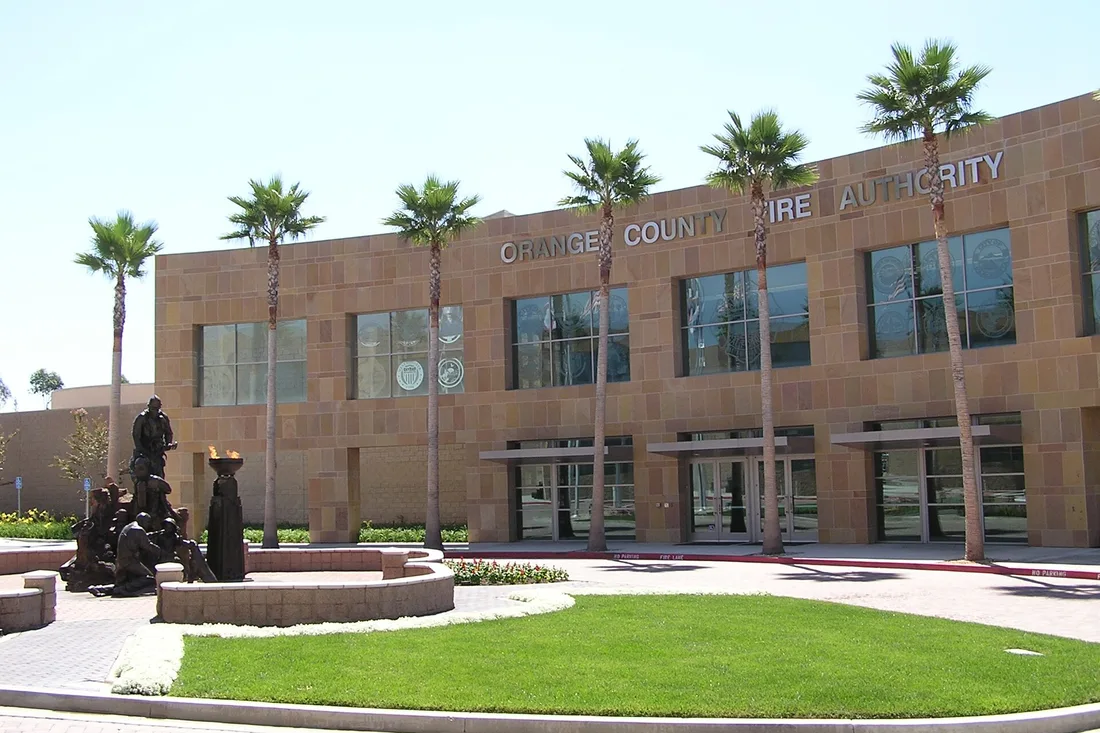
The City of Laguna Niguel contracts with the Orange County Fire Authority (OCFA) for fire and emergency medical services. The city lists three OCFA stations inside its limits: Station 5 at 23600 Pacific Island Drive, Station 39 at 24241 Avila Road and Station 49 at 31461 Golden Lantern. OCFA crews handle the medical response, and Orange County Emergency Medical Services (OCEMS), part of the county Health Care Agency, sets the rules for where patients are taken.

What a cardiovascular receiving center is
OCEMS designates specific hospitals as Cardiovascular Receiving Centers (CVRCs). A CVRC is approved to receive patients brought in by ambulance with an ST-elevation myocardial infarction, the type of heart attack in which a coronary artery is usually completely blocked and the standard treatment is to open it in the catheterization lab as fast as possible. Each designated hospital is reviewed on a cycle by the county’s Facilities Advisory Committee, and the committee publishes its findings.
The receiving hospitals nearest Laguna Niguel
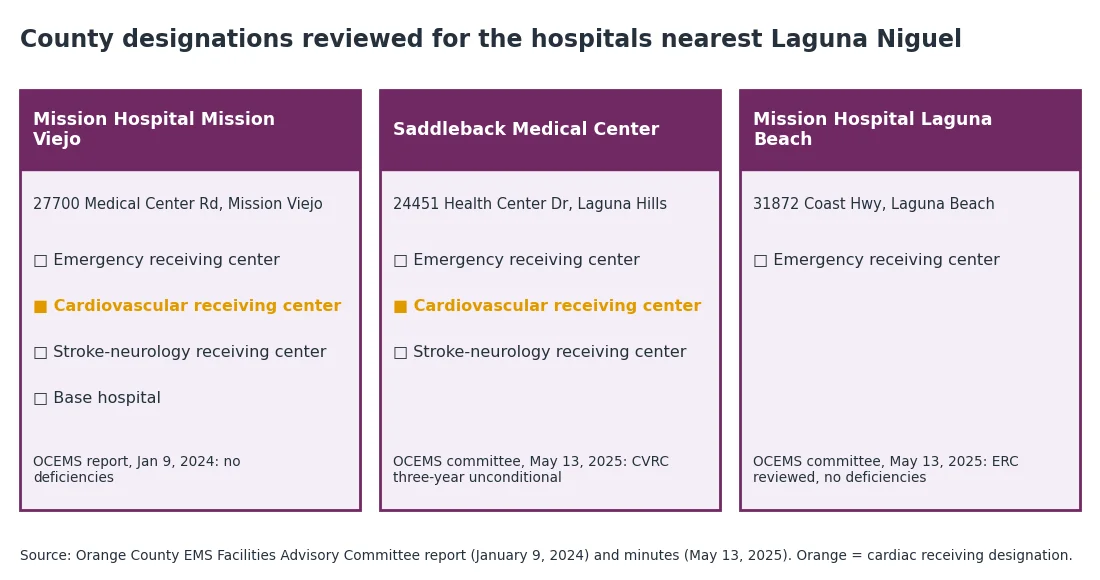
The county’s published reviews cover the two CVRCs closest to Laguna Niguel and the closest emergency department on the coast:
- Mission Hospital Mission Viejo, 27700 Medical Center Road. The January 9, 2024 OCEMS report continued its designations as an emergency receiving center, cardiovascular receiving center, stroke-neurology receiving center, base hospital and children’s emergency receiving center, with no deficiencies found.
- Saddleback Medical Center (listed by OCEMS as Saddleback Memorial Medical Center), 24451 Health Center Drive in Laguna Hills. At its May 13, 2025 meeting the committee recommended a three-year unconditional endorsement of its CVRC designation, with no deficiency found in that program.
- Mission Hospital Laguna Beach, 31872 Coast Highway. The same May 2025 meeting reviewed its designation as an emergency receiving center, with no deficiencies. The review of that hospital covered its emergency department; the cardiovascular designation sits with the Mission Viejo campus.
Stroke receiving centers in the same review
The county runs a parallel designation for strokes, the Stroke-Neurology Receiving Center. Mission Hospital Mission Viejo holds it, and the 2024 review found no deficiencies there. Saddleback’s stroke designation was endorsed at the May 2025 meeting for three years on a conditional basis, because the hospital did not yet take part in a stroke research program required by county policy and had to file a corrective action plan. This matters to readers of the PFO section above: the workup that finds a PFO often begins in one of these stroke centers, and the neurologist’s notes from that admission are the first records a closure consultation asks for.
Why calling 911 beats driving to the nearest ER
The 2024 OCEMS review of Mission Hospital Mission Viejo includes a recommendation that is rarely spelled out so directly: provide community education on using 911 to reduce the number of walk-in heart attack patients who arrive at Mission Laguna and then have to be transferred to the cardiac center. In other words, people with a major heart attack were driving themselves, or being driven, to the closer coastal emergency room and then waiting for a second transport. An ambulance crew that records a heart attack pattern on its EKG can take you straight to a receiving center and alert its team on the way. A family car can’t. The CDC’s heart attack page lists the warning signs, and its instruction is the same as the county’s: call 911.
If symptoms start on the drive north
A Laguna Niguel patient on the way to Alden Drive spends most of the trip in Los Angeles County, which runs its own system. The Los Angeles County EMS Agency designates STEMI Receiving Centers under its Reference No. 320 standards, and a hospital needs a catheterization lab ready for heart attacks, plus the ability to manage cardiac arrest and the care that follows it, to qualify. The practical rule doesn’t change at the county line: if chest pain, breathlessness or faintness starts on the I-5 or the 405, pull over safely and call 911. Don’t press on toward our office, and don’t detour back toward a south county hospital. The paramedics who answer will take you to the nearest designated center for where you are.
After the hospital: where CACVI might fit
Once you are home, most follow-up belongs with the cardiology team that treated you. A visit to us is worth considering in narrower situations: an artery left untreated because it was a total occlusion, a branch-point blockage that was deferred, or a recommendation for bypass surgery when you want to know whether a catheter approach exists. Bring the discharge summary and ask the hospital for the angiogram images before you call.
Discharged with an artery “left for later”? Call 310-652-2744 once you have the discharge summary and angiogram images, and ask for a complex coronary review.
Laguna Niguel to Alden Drive by the 5, the 73 toll road or the 405
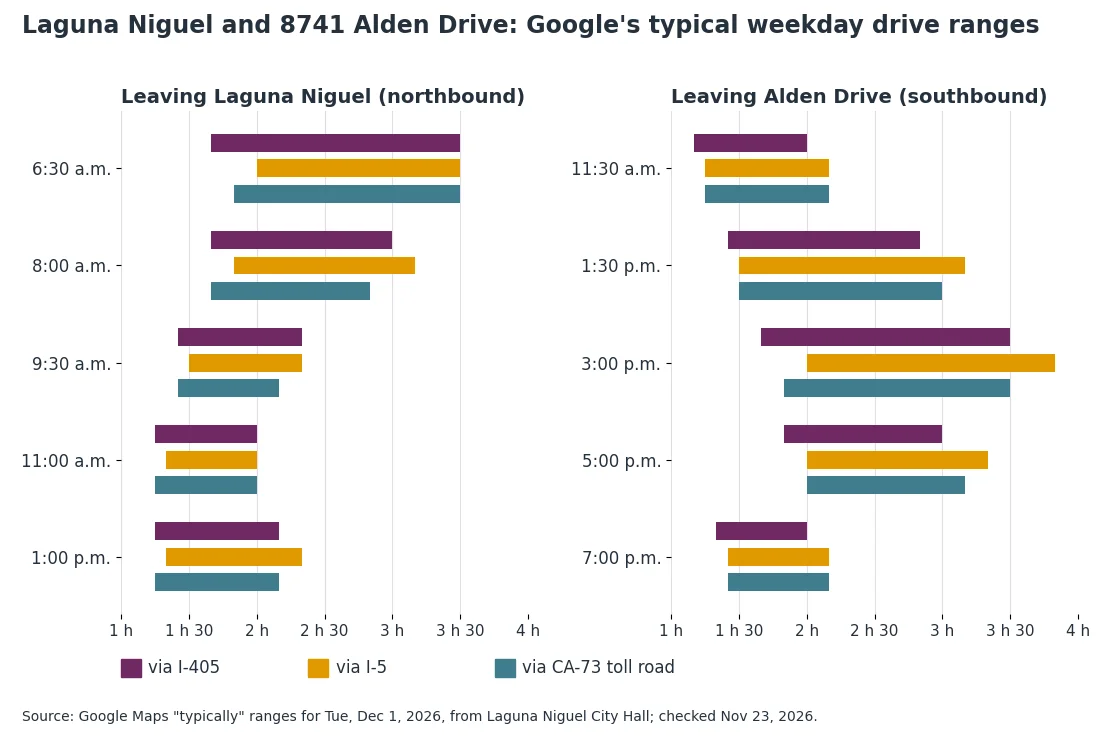
On a map the trip looks simple: north to Los Angeles. In practice, Google Maps offers three routes from Laguna Niguel, and on a weekday none of them is reliably fast. We checked each one for a Tuesday, December 1, 2026, at ten departure times, starting from Laguna Niguel City Hall at 30111 Crown Valley Parkway. The numbers below are Google’s “typically” ranges, which reflect normal traffic for that day and hour, not a forecast for any particular trip.

The three routes, side by side
Going north, the shortest option is the I-5 North at 64.6 miles. The I-405 North route is 68.2 miles and the CA-73 North route is 68.8 miles. The 73 option follows the San Joaquin Hills toll road from the north edge of Laguna Niguel up to the 405 near Costa Mesa. Coming home, the I-5 South is 63.9 miles, the I-405 South 66.7 miles and the CA-73 South 68.1 miles. Allow for about 130 miles of driving in a round trip.
| Departure time (Tuesday) | Via I-405 | Via I-5 | Via CA-73 toll road |
|---|---|---|---|
| 6:30 a.m. from Laguna Niguel | 1 h 40 min to 3 h 30 min | 2 h to 3 h 30 min | 1 h 50 min to 3 h 30 min |
| 8:00 a.m. from Laguna Niguel | 1 h 40 min to 3 h | 1 h 50 min to 3 h 10 min | 1 h 40 min to 2 h 50 min |
| 9:30 a.m. from Laguna Niguel | 1 h 25 min to 2 h 20 min | 1 h 30 min to 2 h 20 min | 1 h 25 min to 2 h 10 min |
| 11:00 a.m. from Laguna Niguel | 1 h 15 min to 2 h | 1 h 20 min to 2 h | 1 h 15 min to 2 h |
| 1:00 p.m. from Laguna Niguel | 1 h 15 min to 2 h 10 min | 1 h 20 min to 2 h 20 min | 1 h 15 min to 2 h 10 min |
| 11:30 a.m. from Alden Drive | 1 h 10 min to 2 h | 1 h 15 min to 2 h 10 min | 1 h 15 min to 2 h 10 min |
| 1:30 p.m. from Alden Drive | 1 h 25 min to 2 h 50 min | 1 h 30 min to 3 h 10 min | 1 h 30 min to 3 h |
| 3:00 p.m. from Alden Drive | 1 h 40 min to 3 h 30 min | 2 h to 3 h 50 min | 1 h 50 min to 3 h 30 min |
| 5:00 p.m. from Alden Drive | 1 h 50 min to 3 h | 2 h to 3 h 20 min | 2 h to 3 h 10 min |
| 7:00 p.m. from Alden Drive | 1 h 20 min to 2 h | 1 h 25 min to 2 h 10 min | 1 h 25 min to 2 h 10 min |
What the ranges show about the toll road
The 73 rarely buys much time in Google’s typical-traffic model. At 9:30 and 11:00 in the morning, it matched or beat the other routes by about five minutes at the low end. At 8:00 a.m., its worst-case figure was 2 hours 50 minutes against 3 hours 10 minutes for the I-5, which is the clearest case for paying the toll. The rest of the time the three routes landed within ten minutes of each other. The 73 is the route that hurts least when the 5 through Mission Viejo and Irvine jams; it isn’t a shortcut. Toll amounts change by time of day, so check the current schedule with The Toll Roads before you decide.


The hours to avoid
Leaving Laguna Niguel at 6:30 or 8:00 in the morning, Google’s ranges ran from about 1 hour 40 minutes to 3 hours 30 minutes. An 11:00 a.m. start cut that to between 1 hour 15 minutes and 2 hours on all three routes. The return leg is where afternoon appointments hurt: leaving Alden Drive at 3:00 p.m. produced ranges of 1 hour 40 minutes to 3 hours 50 minutes, and 5:00 p.m. was not much better. Leaving at 11:30 a.m. or after 7:00 p.m. gave the shortest return figures. Our office closes at 5:00 p.m., so in practice the choice is a late-morning appointment with an early-afternoon drive home, or accepting the evening rush.
Planning the day around the drive
A few practical points for a patient coming from south county:
- Ask for a mid-to-late-morning appointment when you book, and say you are driving from Laguna Niguel.
- If you are having a stress test or a CT scan, ask about food, caffeine and medicine instructions before you leave home, not at the front desk.
- Send records ahead by fax to 310-967-2140 so they can be reviewed before you arrive.
- If sedation or a procedure is possible on the same day, arrange a driver for the trip home.
- Keep the office number, 310-652-2744, in your phone in case traffic makes you late.
Coming up from Laguna Niguel? Tell the scheduler at 310-652-2744 where you’re driving from and ask for a late-morning slot.
What Laguna Niguel patients ask before calling
Is the Tarzana or Victorville office ever a better choice from Laguna Niguel?
Not for distance. Look at the addresses: Suite 102 at 18226 Ventura Boulevard is Tarzana (818-905-5904), and #A5 and #A6 at 12441 Hesperia Road is Victorville (760-706-7115). Tarzana sits beyond Los Angeles in the San Fernando Valley, and Victorville is in the High Desert past the Cajon Pass, so both add distance compared with 8741 Alden Drive. The only reason to choose one would be a schedule opening there that the Los Angeles office can’t match.
Can I walk in, or see a cardiologist the same day without an appointment?
CACVI sees patients by appointment, Monday to Friday from 8:30 a.m. to 5:00 p.m. at the Los Angeles office, and it doesn’t run a walk-in or urgent cardiology clinic. A same-day problem that isn’t an emergency is a phone call to 310-652-2744 first. Anything that feels like a heart attack, a stroke or a fainting spell is a 911 call, which in Laguna Niguel brings an OCFA crew.
Are new patients accepted, and what do I need to bring?
Yes. The new-patients page asks you to print and complete the New Patient Registration Form before the visit, arrive at least 15 minutes early, bring your insurance card and know your office co-pay if you can, and bring your medical records, imaging studies and every medicine, herbal product, vitamin and supplement you take.
Can I see a cardiologist without insurance?
You can book as a self-pay patient. CACVI’s new-patients page lists cash and credit cards (Visa, Mastercard, Discover and American Express) as accepted forms of payment. Ask the scheduler for the self-pay price of the visit and of any test planned for the same day before you make the drive, so there are no surprises at checkout.
Is there cardiac testing near me in south county, or do I come to Alden Drive?
Your primary care doctor or a local cardiologist can order these at south county hospitals and imaging centers, and that is usually the simplest route for routine testing. If you are coming to us anyway, CACVI’s service pages list the EKG, echocardiogram, pruebas de esfuerzo and mobile cardiac telemetry among the tests done in the practice. Whether a test can fit into the consultation day depends on the schedule, so raise it on the booking call.
When should someone with no symptoms start seeing a cardiologist?
Most people with no symptoms are well served by their primary care doctor’s risk assessment. Family history is one trigger worth acting on: the 2019 primary prevention guideline from the American College of Cardiology and American Heart Association treats heart disease in a father or brother before 55, or a mother or sister before 65, as a factor that raises your own risk. A murmur heard at a routine physical, an abnormal EKG or a very high cholesterol level are other common reasons for a referral.
How do I get angiogram images from a south county hospital to your office?
Ask the hospital’s medical records or imaging department for the catheterization images, not only the report, on a CD or through a secure image-sharing link. Reports can be faxed to CACVI at 310-967-2140 or sent to info@cacvi.org before the visit. Bring the disc with you as well, in case a download link expires.
Are CACVI’s physicians on staff at Mission Hospital or Saddleback Medical Center?
CACVI is an independent practice, and none of its physician biographies list a south Orange County hospital. The hospital roles they do list are in Los Angeles County: Dr. Khorsandi’s place on the attending staff at Cedars-Sinai Medical Center and his role directing the cardiac catheterization lab at Providence Cedars-Sinai Tarzana Medical Center. If you are admitted in south county, the hospital’s own cardiologists will look after you.
Blocked leg arteries: do I need a vascular surgeon or an interventional cardiologist?
No. Vascular surgeons operate on arteries and veins through incisions, for example bypass grafts in the leg, and many also do catheter work. CACVI’s physicians are cardiologists trained in catheter-based (endovascular) procedures. They open arteries and close veins from the inside through a small puncture, and their biographies list board certification in endovascular medicine or vascular interpretation rather than surgery. If an open operation is the right answer, that is a surgeon’s job.
Can CACVI replace a narrowed aortic valve without open-heart surgery?
Transcatheter aortic valve replacement (TAVR) appears on the procedure lists of both Dr. Moinakhtar Lala and Dr. Vasim Lala, and CACVI’s TAVR page describes it. Bring your most recent echocardiogram report, including the aortic valve area and gradient figures, and any CT scan done to measure the valve.
Does CACVI implant pacemakers and defibrillators?
Yes. Device implantation is on Dr. Khorsandi’s interest list, and his credentials include the cardiac device specialist certification. CACVI’s services include pacemaker implants, defibrillator implants and biventricular defibrillators. Routine device checks after implantation are often easier to arrange closer to home.
Can you review a calcium score that was done in Orange County?
Yes. Bring the full report, which shows the total score and how it is split between the coronary arteries, along with your latest cholesterol results and blood pressure readings. CACVI also offers the coronary calcium scan itself if one hasn’t been done.
Do you treat spider veins on their own?
Yes, as a cosmetic service. CACVI’s spider vein page describes sclerotherapy and laser treatment and gives an average cost range of $300 to $3,000. Medicare’s California policy treats spider vein work as cosmetic, so expect to pay for it yourself whatever your insurance.
My angiogram is more than a year old. Is it still useful?
Bring it. An older angiogram shows how long a blockage has been there, which matters for deciding whether it is a chronic total occlusion, and it lets the physician compare it with any newer test. Whether a new angiogram is needed before a procedure is a decision for the consultation, based on your symptoms and any tests done since.
Can my south county cardiologist keep my follow-up if I have a procedure at CACVI?
Yes, and for most patients from Laguna Niguel that is the sensible arrangement. Tell us at the first visit who your local cardiologist and primary care doctor are, with their fax numbers, so reports can go to them after the consultation and after any procedure.
Neighboring cities with their own CACVI cardiology page
Laguna Niguel shares city limits with Aliso Viejo and Laguna Hills to the north, Mission Viejo and San Juan Capistrano to the east, and Laguna Beach and Dana Point to the south. CACVI has cardiology pages for four of those neighbors: Aliso Viejo, Laguna Hills, Laguna Beach and Dana Point. The cardiac evaluation page explains what a first cardiology assessment at CACVI covers.
Sources for the Laguna Niguel facts on this page
| Document | Issued by | Used on this page for |
|---|---|---|
| CACVI: Appointments and office locations | CACVI | Office addresses, phone and fax numbers, parking options. |
| CACVI: New Patients | CACVI | Intake form, the documents to carry, and payment methods taken. |
| CACVI physician biographies | CACVI | Training, certifications and listed procedures for each physician. |
| City of Laguna Niguel: Fire | City of Laguna Niguel | OCFA contract and the three fire stations in the city. |
| OCEMS Facility Designations report, January 9, 2024 | Orange County Emergency Medical Services | Mission Hospital Mission Viejo designations and the recommendation on 911 use. |
| OCEMS Facilities Advisory Committee minutes, May 13, 2025 | Orange County Emergency Medical Services | Saddleback and Mission Laguna Beach designation reviews. |
| About Heart Attack Symptoms, Risk, and Recovery | CDC | Warning signs of a heart attack; CDC tells readers to dial 911. |
| Guiding Principles for Chronic Total Occlusion PCI (2019) | Circulation | Symptom relief as the primary reason to treat a CTO. |
| CTO Academic Research Consortium definitions (2021) | Circulation | Definition of a chronic total occlusion. |
| European Bifurcation Club consensus | EuroIntervention | Provisional stenting as the default and the Medina classification. |
| 2021 Guideline for Coronary Artery Revascularization: key points | American College of Cardiology | Preference for wrist (radial) access when an experienced operator is available. |
| 2024 Guideline for Lower Extremity PAD: key points | American College of Cardiology | Testing and revascularization in chronic limb-threatening ischemia. |
| Treatment of Varicose Veins of the Lower Extremities (L34209) | CMS / Noridian | Medicare coverage conditions for vein treatment in California. |
| 2018 Guideline for the Management of Adults With Congenital Heart Disease | American Heart Association | Care by adult congenital specialists and pre-pregnancy counseling. |
| ACHD Accreditation | Adult Congenital Heart Association | List of accredited adult congenital heart programs. |
| Adult congenital heart disease care accredited at UC San Diego Health | UC San Diego Health | Accreditation in 2022 and the only program south of Los Angeles. |
| Patent Foramen Ovale (PFO) | American Heart Association | How common a PFO is. |
| PFO closure practice advisory (press release) | American Academy of Neurology | Benefit and risk figures for PFO closure after stroke. |
| FDA approves PFO occluder device (2016) | American College of Cardiology | First FDA approval of a PFO closure device for stroke prevention. |
| GORE CARDIOFORM Septal Occluder, PMA supplement P050006/S060 (2018) | U.S. Food and Drug Administration | March 30, 2018 approval for PFO closure to lower recurrent stroke risk. |
| 2019 ACC/AHA Guideline on the Primary Prevention of Cardiovascular Disease | Circulation (PubMed record) | Family history of premature heart disease as a risk factor. |
¿Listo para hablar?