Cardiology care for Ojai and the upper Ventura River Valley
The nearest CACVI office to Ojai is on Ventura Boulevard in Tarzana, about 62 miles and a little over an hour from downtown by Highway 33 and the 101. Our cardiologists see Ojai Valley patients there six days a week for heart and circulation problems, from a first EKG to catheter procedures.
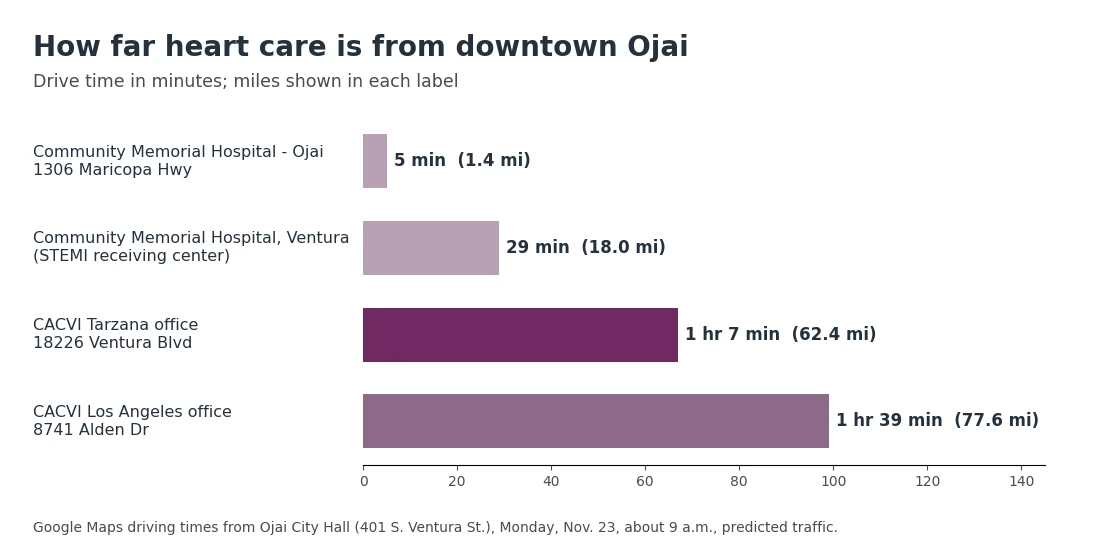
Ojai Valley patients book at our Tarzana office, 18226 Ventura Blvd, Suite 102 (818-905-5904), which Google Maps put at 62.4 miles and 1 hour 7 minutes from Ojai City Hall on a Monday morning. A heart attack or stroke is never a reason to make that drive: call 911, and Ventura County paramedics will route you to a STEMI receiving center such as Community Memorial in Ventura.
Ojai Valley heart care at a glance
If you live in the Ojai Valley and need a heart specialist, a heart doctor close to home or an interventional cardiologist, start with the practical facts. For someone in Ojai, Meiners Oaks, Oak View or Upper Ojai, the honest answer to "close to home" involves a drive, a hospital in town that does some things and not others, and a county emergency system with its own rules. The table below puts those facts in one place, each with its source, so you can decide how to use our office before you read any further.
What you need to know
The fact
Why it matters to an Ojai patient
Source
Nearest CACVI office
18226 Ventura Blvd, Suite 102, Tarzana, CA 91356; 818-905-5904
Every first visit, test and follow-up described on this page happens here unless we tell you otherwise
A heart specialist for Ojai, an hour down the 33 and the 101 in Tarzana
A cardiologist is the heart specialist most people have in mind when they need heart care. CACVI's physicians come from interventional training: the same doctor who interprets your echo can also be the one who threads a catheter if a blockage needs opening. For an Ojai patient, the practical question is simpler: can one office handle the visit, the testing and the procedure plan without sending you to three different places? For most conditions on this page the answer is yes, and that office is in Tarzana.
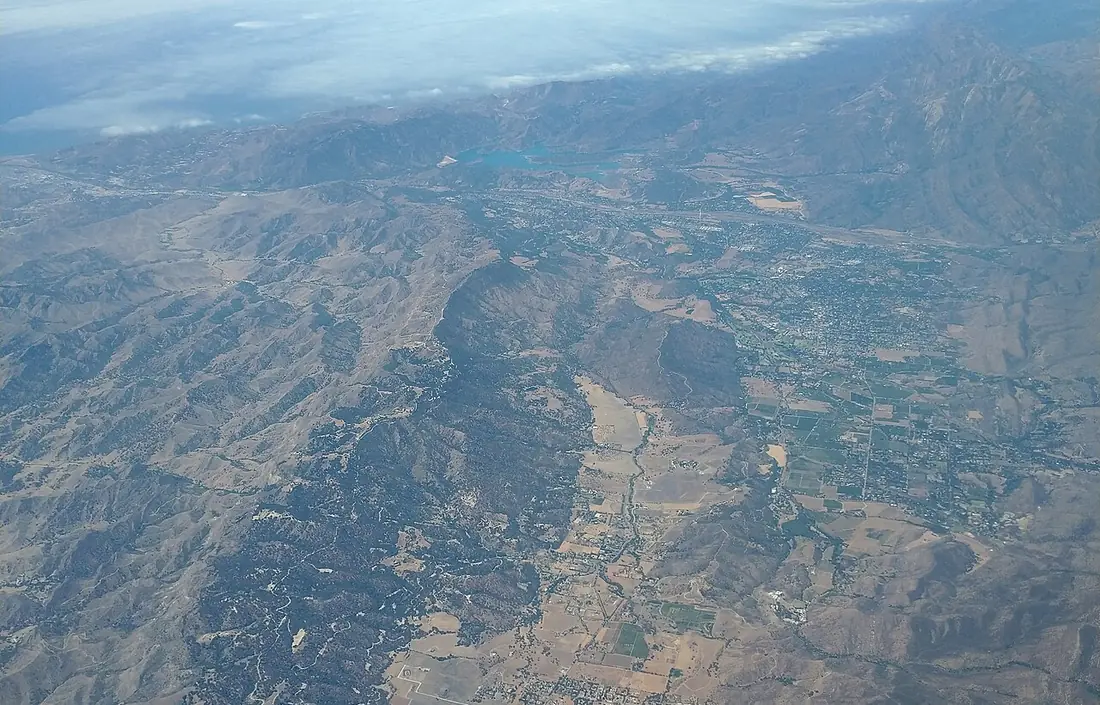
The Ojai Valley from the air, with Lake Casitas near the top. Mountains close the valley on most sides, so every trip to a cardiologist starts on Highway 33 south to Ventura or Highway 150 east to Santa Paula. Photo: Alfred Twu, July 2021, Wikimedia Commons, CC0. Cropped, resized and converted to WebP.
Who the Tarzana office sees from the Ojai Valley
The people who call us from Ojai tend to arrive by one of a few routes. Some were sent by an internist or family doctor in town who heard a murmur or saw an EKG they did not like. Some were seen at the emergency department on Maricopa Highway, or in Ventura, and left with discharge papers that say "follow up with cardiology". Others are looking for a second set of eyes on a test already done in Ventura County, or they want a cardiologist who also looks after leg arteries and veins, because the circulation problem and the heart problem often turn up in the same person.
We see adults. A child with a heart murmur or a congenital heart question needs a pediatric cardiologist, and the call to make is to your pediatrician for that referral.
The symptoms that usually start the referral
Most cardiology referrals from the valley start with one of a short list: chest pressure or tightness that comes with effort and fades with rest; breathlessness that is new or worse than it used to be; a heartbeat that races, flutters or skips; swelling in the ankles that leaves a dent when pressed; light-headed spells or a faint; or an abnormal test, often an EKG done for another reason. None of these needs a diagnosis from you before you call. Describe what happens, when it started and what brings it on, and the office will book the right kind of visit.
What one visit to the office covers
A cardiac evaluation at CACVI starts with history and an examination, then moves to the tests the physician thinks will answer your question. The resting EKG takes minutes. An echocardiogram, a treadmill or medication stress test, a Holter or event monitor and vascular ultrasound of the neck, leg or arm vessels are all listed among the procedures on CACVI's diagnostic procedures pages. Whether all of them can happen on the day you drive down depends on scheduling and on the preparation each test needs, which is why the next section lists them by how long they keep you in Tarzana.
The physician who orders a test also reads it, and the conversation about what it means happens with the same person. For a patient who has already sat through one visit in Ventura and another somewhere else, that continuity is a large part of why the drive makes sense.
What to have ready before you call
First visits run smoother with four things in the bag, per CACVI's new patient page: the completed registration form, the insurance card, prior records and scans, and the actual bottles of everything you take, supplements and herbs included. Plan to walk in a quarter of an hour before your slot. The office takes cash and the four big card networks.
From Ojai, the records are the part that takes planning. A disc of an echocardiogram or a CT scan done in Ventura is far more useful to the cardiologist than a one-page report, because the images can be read again. Ask for the disc when you request the records, not after you have booked.
Picking a day and time from the valley
CACVI publishes weekday hours of 8:30 a.m. to 5 p.m. for Tarzana, plus a Saturday window from 8 a.m. to 4:30 p.m. Mention Ojai in the first minute of the call. That one sentence changes how the visit gets planned: they can look at whether a test can be paired with the consultation, and whether a later morning start would keep you off the 101 at its worst.
Coming from Ojai, Meiners Oaks or Oak View? Call the Tarzana office at 818-905-5904, say where you are driving from, and ask whether your first test can be done the same day as the consultation.
Alden Drive as a second option
The second-closest option is the Los Angeles office, Suite A at 8741 Alden Drive (310-652-2744). Google Maps put it at 77.6 miles and 1 hour 39 minutes from Ojai City Hall on the same Monday morning, so for most Ojai patients it only makes sense when the day already includes something on the Westside. Both offices are listed on the CACVI appointments page with their parking details.
Heart tests in Tarzana, ranked by how long they keep you away from the valley
When home is more than an hour away, the length of a test and its preparation matter almost as much as what it measures. A test that needs you to skip coffee for a full day, or to wear a monitor and bring it back, changes how you plan the trip. The table below takes CACVI's own descriptions of each test and sorts them by the time they add to your day.
Test
What CACVI says it involves
Time it adds to the visit
What to plan from Ojai
Resting EKG
Electrodes on the skin record the heart's electrical signals; painless
A few minutes
Nothing special; it is usually part of the first visit
Ecocardiograma
A hand-held ultrasound wand on the chest shows the valves, the chambers and the pumping
Ask when booking whether it fits the same visit
Two-piece clothing helps; CACVI's page lists no food restriction
Vascular ultrasound (duplex)
Gel and a probe over the neck, arm or leg vessels; nothing injected
One appointment
Mention leg pain or swelling when booking so the right scan is planned
Treadmill or medication stress test
Treadmill, bike or a medicine that speeds the heart, with monitoring throughout
About an hour on the day
No heavy meal 2 to 4 hours before; walking shoes; ask about your morning pills
Nuclear or PET stress test
Images taken after a tiny tracer dose compare blood supply at rest and with exertion
Longer than an hour
No caffeine for at least 24 hours before, which includes the morning coffee on the drive
Holter monitor
Worn for one to two days, it keeps a record of each heartbeat
A short fitting, then you go home wearing it
Ask how the device gets back to the office before you leave Tarzana
Mobile cardiac telemetry
Your rhythm streams by cell signal to a center staffed day and night
A short fitting
Tell the fitter if your home has weak cell reception
Coronary CT angiogram
Contrast dye and a CT scanner image the heart arteries from outside
Separate appointment; CACVI's page refers to an outpatient imaging facility or radiology department
Expect to skip food for several hours beforehand and to avoid coffee and cigarettes that morning
The caffeine instruction for nuclear stress testing catches more Ojai patients than any other. For a nuclear study the practice wants a full day without caffeine, and its list is broader than coffee: tea, soda, chocolate drinks and energy drinks all count. Decaf is not always free of caffeine either, so the safest plan is to stop the afternoon before and pack water for the drive. If the drink you are giving up is your morning cup on the way out of the valley, set that expectation the night before.
Medicines on test day
Some heart medicines blunt the heart-rate response that a stress test is built to measure. CACVI's page is direct about this: stop a medication only if the provider tells you to, and otherwise keep taking it. Ask the question when you book, not in the car, because the office can tell you which pills to hold and for how long. Bring the bottles or a printed list either way.
Monitors you take home to the valley
A Holter or an event monitor is the one kind of test that follows you home. The useful part happens in Ojai: the palpitations on the evening walk, the light-headed spell in the kitchen. Keep a written note of the time and what you were doing when a symptom hits, because the cardiologist matches those notes to the recording. With mobile cardiac telemetry the data travels on the cell network, so if your house sits in a canyon with patchy reception, say so at the fitting.
Pairing tests with the consultation
If you are driving from Ojai, you may want everything to happen on one visit. Sometimes it can. A resting EKG and an echocardiogram often fit inside a first appointment. A nuclear test, with its caffeine rule and longer imaging time, usually needs its own slot. A CT angiogram depends on the imaging facility's schedule. Ask the scheduler to look at the whole list at once rather than booking each piece separately; one longer day in Tarzana usually beats two shorter ones on the 101.
When a test can be done closer to home
If you already had an echocardiogram or a stress test in Ventura County within the past several months, bring the images and the report. The cardiologist may decide that a repeat test adds nothing, which saves you a trip. If a test was done long ago, or your symptoms have changed since, expect it to be repeated, because the question it answers has changed too.
When the heart muscle is the problem: cardiomyopathy and HCM
If you live in Ojai and need a cardiomyopathy or HCM specialist, the problem is the heart muscle itself. You may already have a word for what is wrong from an echocardiogram report, and the question is what happens next. The American Heart Association defines cardiomyopathy as a disease of the heart muscle that makes it harder for the heart to pump blood to the rest of the body. Cardiomyopathy appears by name on Dr. Vasim Lala's list of conditions he follows.
The kinds you may see named on a report
The AHA groups adult cardiomyopathy into several types. In plain terms:
Dilated cardiomyopathy: the main pumping chamber stretches and weakens, and the ejection fraction on the echo report falls.
Hypertrophic cardiomyopathy (HCM): the muscle wall thickens, sometimes enough to narrow the path blood takes out of the heart.
Restrictive cardiomyopathy: the walls stiffen, so the heart fills poorly even if it squeezes well.
Arrhythmogenic right ventricular cardiomyopathy: muscle is gradually replaced by scar and fat, and rhythm problems come first.
Transthyretin amyloid cardiomyopathy (ATTR-CM): an abnormal protein builds up in the muscle and stiffens it.
Stress-induced cardiomyopathy: the "broken heart syndrome" that can follow a sudden shock or grief.
The AHA also notes that some cases cause no symptoms and need no treatment, that some are inherited, and that in many cases the cause is never found. A label on a report is the start of a work-up, not the end of one.
What the work-up looks for
The echocardiogram usually starts the story, because it measures wall thickness, chamber size and pumping strength. From there the questions are about cause and risk. Is the thickening from years of high blood pressure, or from a genetic muscle disease? Is a stiff heart stiff because of amyloid? Is the rhythm stable? A cardiologist uses the EKG, longer rhythm monitoring and sometimes cardiac MRI or other imaging to answer those questions, and blood tests to look for causes that can be addressed.
Bring every prior echo you can find. With cardiomyopathy, the trend over time often says more than any single study: a wall that was 13 millimeters thick five years ago and is 13 now tells a different story from one that has been growing.
When a thick heart turns out to be amyloid
Not every thickened heart wall is HCM or the result of high blood pressure. In transthyretin amyloid cardiomyopathy, a protein made by the liver misfolds and collects in the heart muscle, and on an echocardiogram the wall can look thick even though the muscle itself is not growing. The condition comes in an inherited form and a "wild-type" form that is not passed down. The distinction matters because ATTR-CM now has its own medicines. The FDA approved acoramidis (Attruby) for adults with ATTR-CM in November 2024 to reduce cardiovascular death and cardiovascular hospitalization, and its announcement notes that it belongs to the same drug class as tafamidis, which was already approved.
If a report describes thick walls that do not fit your blood pressure history, or the heart failure symptoms do not respond to the usual medicines the way your doctor expected, ask directly whether amyloid has been considered. Finding it takes specific tests, and it is easy to miss if nobody asks the question.
Hypertrophic cardiomyopathy and the rest of the family
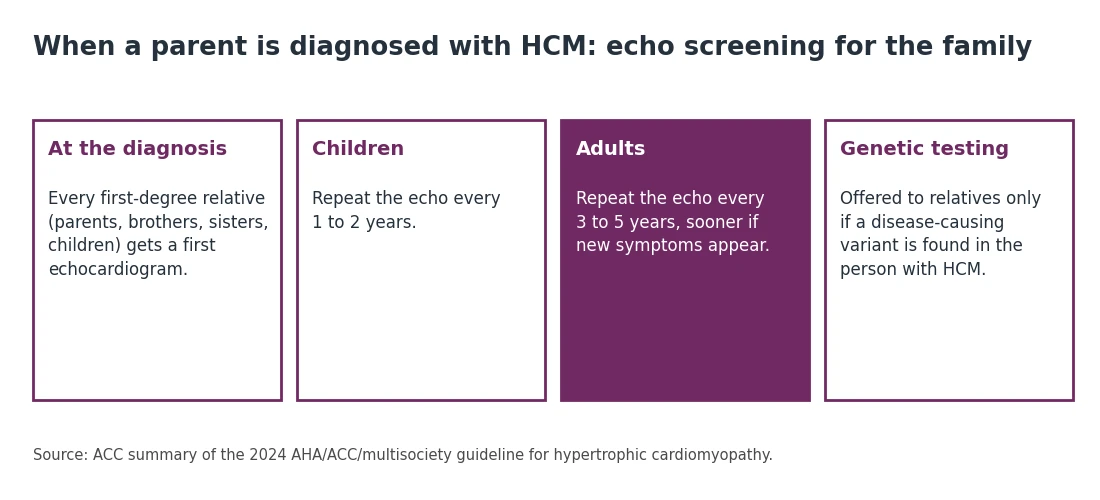
HCM often runs in families, and the 2024 guideline from the American Heart Association, the American College of Cardiology and other societies has specific advice for relatives. According to the ACC's summary of the 2024 HCM guideline, first-degree relatives (parents, siblings, children) should have an initial echocardiogram, with repeats every one to two years in children and every three to five years in adults. Genetic testing of relatives is recommended only when a disease-causing variant has been found in the person who has HCM, and the guideline advises referral to a genetic counselor.
Family screening after an HCM diagnosis, from the ACC summary of the 2024 HCM guideline.
For an Ojai family, this changes the conversation at the kitchen table. If a parent is diagnosed, the grown children in Ventura, Santa Barbara or further away each need their own echo on their own schedule, and the adult interval of three to five years means someone has to keep track. Ask the cardiologist who diagnosed HCM to write the recommendation for relatives in the visit summary, so the family has it in writing.
Treatment choices for obstructive HCM
When thickened muscle blocks the outflow of blood and causes symptoms, the guideline describes a stepped approach. Beta blockers or calcium channel blockers come first. If symptoms persist, the guideline says adding a cardiac myosin inhibitor, the drug disopyramide, or a septal reduction procedure should be considered, and that septal reduction should be done at experienced HCM centers.
Mavacamten, the first cardiac myosin inhibitor on the market, is available only through a restricted program. The CAMZYOS REMS program requires certified prescribers and pharmacies, screening for drug interactions before each dispense, and periodic echocardiograms, because the drug carries a risk of heart failure from weakened pumping. For someone in Ojai, that monitoring schedule is a real planning item: each echo is a trip, so ask where and how often it will happen before starting.
Exercise with HCM
Older advice told many people with HCM to stop exercising. The 2024 guideline moves away from that. The ACC summary says people with HCM should be encouraged to do mild to moderate recreational exercise, and that blanket restriction from competitive sports is not indicated; decisions about competitive sport are made jointly with the physician. That matters in a valley where many people's week is built around walking and riding. The details for your own heart are a conversation for the visit, not a rule from a web page.
Rhythm and sudden-death risk
Two rhythm questions run through every HCM follow-up. The first is atrial fibrillation: the ACC summary says that in HCM, clinical AF, or device-detected AF lasting more than 24 hours, should lead to blood thinners, with a direct oral anticoagulant as the first choice. The second is the risk of a dangerous ventricular rhythm. The guideline calls for risk assessment every one to two years in adolescents and adults, weighing factors such as a prior cardiac arrest, unexplained fainting, a family history of sudden death and the maximum wall thickness. An implantable defibrillator is indicated after a prior cardiac arrest or sustained ventricular tachycardia; for others, it is a shared decision based on that risk profile.
Device implantation, including defibrillators, is part of Dr. Mehran Khorsandi's work at CACVI; the physician section below has more.
Questions to bring to a cardiomyopathy visit
Which type of cardiomyopathy do I have, and how sure are we of the cause?
Has amyloid, an inherited cause or an old viral infection been ruled out?
What is my ejection fraction now, and what was it on the earlier studies?
Which of my relatives should be screened, and with what test?
Which warning signs mean a phone call to the office, and which mean an ambulance?
How often will I need an echocardiogram, and can any of it be done closer to Ojai?
Breathless since a viral illness: myocarditis, pericarditis and a slow return to the trails
One pattern worth a cardiology visit in Ojai is a flu or COVID-19 infection that cleared, followed by weeks or months of being short of breath on the same hill you used to climb without thinking. Most of the time that is ordinary slow recovery. Sometimes it is the heart, and two inflammatory conditions are the ones a cardiologist looks for first.
Myocarditis: inflammation of the muscle
The American Heart Association describes myocarditis as inflammation in the heart muscle, most often set off by a viral infection such as the flu, and less often by bacteria, fungi, medications, autoimmune disease or toxins. Its listed symptoms include fatigue or reduced exercise tolerance, shortness of breath, chest pain, a hard, rapid or irregular heartbeat, and light-headedness or fainting. Some people have no symptoms at all. On COVID-19, the AHA says health organizations continue to monitor the link, and that the CDC considers myocarditis after vaccination rare.
Pericarditis: inflammation of the sac around the heart
Pericarditis involves the thin two-layer sac around the heart. The chest pain has a recognizable pattern in the AHA's description: it can start suddenly, sits in the middle or left side of the chest, may spread to the shoulders, is usually worse lying on your back and often eases when you sit up and lean forward. Low-grade fever, weakness, cough and palpitations can come with it. Pericarditis can come back after it seems to have settled, which is why follow-up matters even after the first episode clears.
The tests that sort it out
For myocarditis, the AHA lists blood tests, an EKG, an echocardiogram, a chest X-ray and cardiac MRI, with catheterization and biopsy in some cases. For pericarditis, blood tests for inflammation such as C-reactive protein, an EKG, a chest X-ray, an echocardiogram, and cardiac CT or MRI. Several of these overlap with the first-visit tests in Tarzana; MRI and CT happen at imaging centers. Bring any results from an urgent care or emergency visit during the illness, because an EKG taken while you were sick is a useful comparison.
Getting back on the trail
The AHA notes that people with myocarditis are often told to avoid competitive sport while inflammation is active. For everyone else, the question is pacing: when to go back to the Shelf Road walk, the ride up Highway 150 or the tennis game, and how hard. That depends on what the tests show and how the heart recovers, so it is a question for the visit. Until then, notice the pattern. Breathlessness that improves week by week is reassuring. Breathlessness that worsens, chest pain, fainting or a racing heart at rest are reasons to call, and chest pain that is severe or new is a reason to call 911.
Writing down the timeline
The most useful thing you can bring is a short, dated timeline: when the illness started, when you tested positive if you did, when the breathlessness began, what you could do a month ago that you cannot do now, and any days you felt your heart racing. A cardiologist can do more with that one page than with a general description of "not feeling right since the flu".
Low blood pressure, light-headed mornings and the faint nobody can explain
Not every blood pressure question is about numbers that run high. Patients who want a doctor for low blood pressure usually feel faint, wobbly or washed out, and whose readings run low. The AHA describes hypotension as a reading below 90/60 mm Hg, and adds that one low reading on its own is usually not a cause for alarm unless it comes with symptoms.
Low on paper, or low with symptoms
Plenty of fit people live comfortably at 95/60. The reading becomes a medical question when it comes with dizziness, blurred vision, nausea, confusion, fatigue or fainting, the symptoms the AHA lists. A cardiologist starts by asking when the symptoms happen. A light-headed feeling every time you stand up suggests one set of causes; a faint that comes out of nowhere while sitting suggests another, and the second is the one that worries us more.
When standing up is the trigger
Orthostatic hypotension is the formal name for a drop on standing. The definition used in the medical literature comes from a 2011 consensus statement by autonomic nervous system researchers: a sustained fall of at least 20 mm Hg in systolic pressure, or at least 10 mm Hg in diastolic pressure, within three minutes of standing. It is measured simply, by checking blood pressure lying down and then again after standing.
A home cuff can gather evidence before the appointment. With a home cuff, take a reading after five minutes lying down, then stand and take readings at one and three minutes. Write down the numbers and how you felt. Do this only if you can stand safely, with someone nearby if you have fainted before.
Medicines that push pressure down
The AHA's list of medication causes reads like a typical older adult's pill organizer: water pills and other blood pressure drugs, beta blockers, some Parkinson's medicines, tricyclic antidepressants, and erectile dysfunction drugs, especially taken with nitroglycerin. Often the fix for a low reading is a medication review, not a new prescription. Bring every bottle, including the ones another doctor prescribed and the supplements, because the combination is usually the cause.
Dehydration on long, warm days
Dehydration appears on the AHA's list of causes of low blood pressure, and it combines badly with water pills and other blood pressure medicines. If your readings drop or you feel faint after a long day outdoors, a day of gardening or a stomach bug, mention it at the visit. The answer may be a change in how a diuretic is taken on those days, decided with your doctor rather than on your own.
Heart causes of low pressure
The AHA also names heart conditions that can lower blood pressure: a heart rate that is too slow, valve problems, heart attack and heart failure. These are the reasons a cardiologist gets involved. A slow pulse found on the EKG may point to the electrical system; a murmur may point to a narrowed aortic valve; a weak pump on the echo points to the muscle. Each has its own work-up and its own treatment, from adjusting medication to a pacemaker.
Fainting and the first evaluation
A faint, or syncope, gets a structured work-up. The 2017 syncope guideline from the American College of Cardiology, the American Heart Association and the Heart Rhythm Society, as summarized by the American Academy of Family Physicians, starts the evaluation with a detailed history, a physical examination that includes orthostatic blood pressures, and a resting EKG. Further testing, such as an echocardiogram, a stress test or a rhythm monitor worn at home, is chosen from what those first steps show rather than ordered as a blanket set.
What the history needs from you is detail: what you were doing, whether there was warning, how long you were out, what witnesses saw, and how you felt afterward. If someone saw the faint, bring them to the appointment or bring their written account.
A note on the faint in a remote spot
Fainting while driving the 33, or alone on a trail above the valley, carries risks that fainting at home does not. If you have had an unexplained faint, raise it before you plan long drives or solo outings, and ask what the cardiologist recommends while the cause is being worked out.
Light-headed when you stand, or fainted without a clear reason? Bring your home readings and your medication bottles to a Tarzana visit. Call 818-905-5904.
Ojai to Ventura Boulevard: the 33, the Conejo Grade and the ride without a car
The trip from the valley to our Tarzana office is one road after another with almost no choices in between. You leave Ojai on Highway 150 and Ventura Avenue, pick up the Ojai Freeway (Highway 33) through Oak View and Casitas Springs, join the 101 in Ventura, and stay on it for about 47 miles before leaving at exit 23, Reseda Boulevard. That routing comes from the OpenStreetMap-based OSRM router, and Google Maps chose the same 101 corridor.
Drive times from Ojai City Hall, from Google Maps on Monday, Nov. 23, about 9 a.m.
Drive times from three valley starting points
We checked Google Maps on Monday, November 23, at about 9 a.m., with traffic as Google predicted it at that hour:
Starting point
Distance to 18226 Ventura Blvd
Google's time
Route
Ojai City Hall, 401 S. Ventura St.
62.4 miles
1 hr 7 min
US-101 S
Meiners Oaks
61.3 miles
1 hr 6 min
US-101 S
Oak View, 555 Mahoney Ave.
57.8 miles
1 hr
US-101 S
A single snapshot is only one morning. Weekday afternoons heading north, accidents on the 101 and the occasional closure on Highway 33 all stretch the trip. The measured drive is closer to an hour and ten minutes, and that is the number to plan around.
Checking the road before you leave
A closure on Highway 33 or a crash on the 101 can add more time than any traffic jam. Caltrans publishes live closures, chain controls and incidents on its QuickMap, and it takes a minute to check the morning of a visit. If the road is blocked and you will be late, call the office at 818-905-5904 before you set out; it is easier to move an appointment than to arrive rushed and anxious for a stress test.
The grade between Camarillo and Thousand Oaks
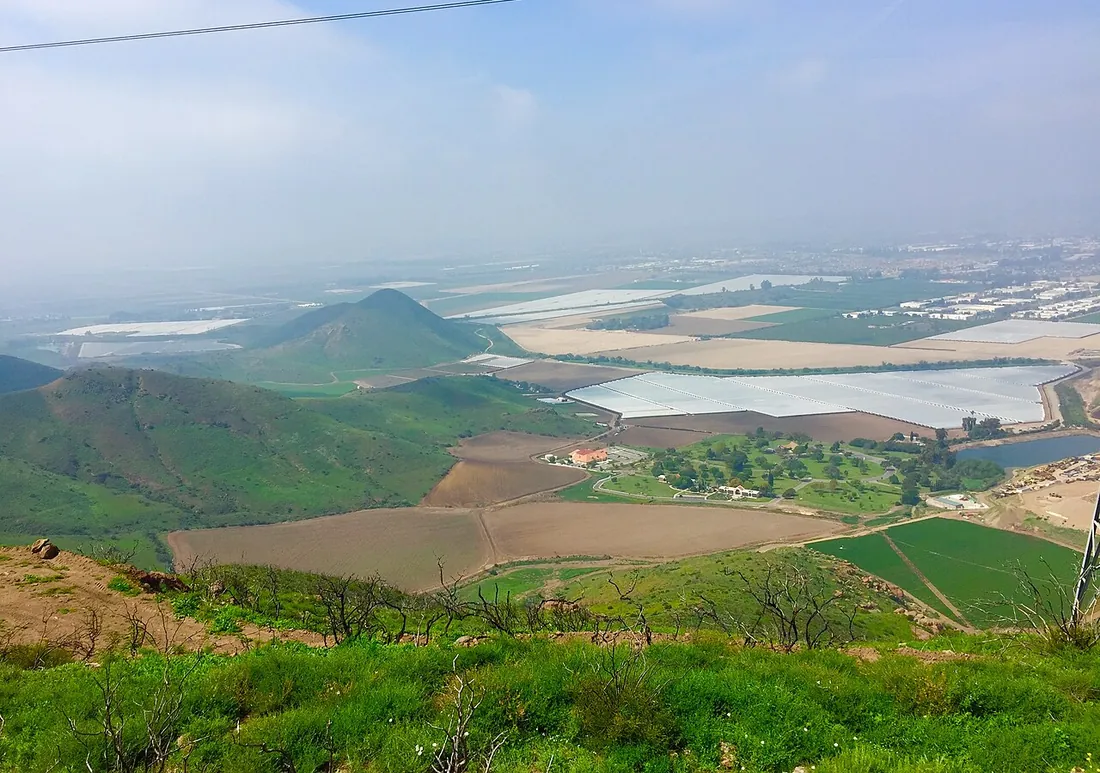
Camarillo and the Oxnard Plain seen from the Newbury Park hills at the top of the Conejo Grade, the long climb on the 101 between the plain and Thousand Oaks. Los Robles, a STEMI receiving center, is in Thousand Oaks, past the top of the grade. Photo: Bazzy11, Wikimedia Commons, CC BY-SA 4.0. Cropped, resized and converted to WebP.
About halfway, the 101 climbs out of the Oxnard Plain up the Conejo Grade into Newbury Park. For most drivers it is just a long hill. It is also the stretch with the fewest easy exits. If chest pressure, breathlessness or a racing heart appear while you are driving, pull off and call 911 rather than pressing on to the appointment. Thousand Oaks has a STEMI receiving center, Los Robles Regional Medical Center, a few miles past the top of the grade.
Parking at the office
Parking is free: a small lot at the building and the street around it, per CACVI's appointments page. Ventura Boulevard in Tarzana is a busy commercial street, so leave a few minutes for the search, and ask the office about drop-off if the patient has trouble walking.
The bus, the intercity coach and the Metro line
There is a public-transit path from Ojai to Tarzana. It takes three vehicles and most of a morning, so check every timetable before relying on it:
Gold Coast Transit Route 16 runs every day between downtown Ojai and the Ventura Transit Center at Pacific View Mall, with Ojai stops at the Y, Blanche, Signal and the Park and Ride, according to the City of Ojai. The Route 16 timetable marks the Ventura Transit Center as a transfer point to VCTC service.
VCTC Highway 101 Intercity runs from the Ventura Transit Center to Thousand Oaks. Its Route 55X continues to a Woodland Hills loop that includes Westfield Topanga Plaza, the corner of Victory and Topanga and the Metro G Line De Soto station, per the VCTC Highway 101 schedule. VCTC customer service is 800-438-1112.
LA Metro Line 150 runs between Chatsworth and Encino along Topanga Canyon Boulevard and Ventura Boulevard, and its timetable lists a Ventura & Reseda stop in Tarzana. Use a trip planner for the walk from the stop to Suite 102.
Budget for three fares: Gold Coast, VCTC and LA Metro are separate agencies, and VCTC prices Route 55X in its higher Zone 2 fare tier.
Rides for people who cannot use the bus
Two services cover Ojai residents who cannot manage fixed-route buses. ACCESS, run through Gold Coast, is origin-to-destination public transit for people whose disabilities keep them from using the bus; the City of Ojai says it serves the city and unincorporated areas and runs into and out of the valley (805-485-2319). HELP Transportation offers rides for seniors and people with disabilities within the Ojai Valley (805-646-5122). Neither page says either service travels to Los Angeles County, so ask before you count on it for a Tarzana appointment. For many families the realistic plan is a relative or friend who drives and stays for the visit.
Making the return drive easier
Some visits leave you tired, especially a long test day. Eat something before getting back on the 101, drink water, and if you were given medication during testing that left you light-headed, ask before you leave whether someone else should drive. A rest stop in Thousand Oaks or Camarillo costs ten minutes; driving the Ojai Freeway at dusk while drowsy can cost much more.
Community Memorial Hospital - Ojai or the Ventura campus: where a heart emergency from the valley goes
Read this part on a quiet day, not during an emergency. Ojai has a hospital with a 24-hour emergency department, and the county's emergency system treats it differently from the hospital in Ventura when a heart is involved. Knowing the difference helps you understand what the paramedics are doing and why they may drive past the nearer building.
The hospital on Maricopa Highway
Community Memorial Hospital - Ojai, at 1306 Maricopa Highway, was long known as Ojai Valley Community Hospital; it joined the Community Memorial Healthcare system in 2005 when it merged with Community Memorial Hospital in Ventura. The hospital's page describes a 25-bed hospital with a 24-hour emergency department, imaging, a laboratory, rehabilitation and skilled nursing, and it says patients are transferred when a higher level of care is needed.
In the county's emergency plan, the Ojai hospital is one of two rural hospitals designated as a standby emergency department. The Ventura County 2024 EMS plan says those hospitals serve areas more than 15 miles from the nearest basic emergency department and always have an emergency physician on site. The same plan lists the Ojai hospital as neither a STEMI center nor a stroke center.
Where a heart attack is taken
The 2024 EMS plan lists four STEMI receiving centers in Ventura County, the hospitals with around-the-clock teams to open a blocked heart artery:
Community Memorial Hospital, Loma Vista Road and Brent Street, Ventura
Los Robles Regional Medical Center, 215 W. Janss Road, Thousand Oaks
St. John's Regional Medical Center, 1600 N. Rose Ave., Oxnard
Adventist Health Simi Valley, 2975 N. Sycamore Dr., Simi Valley
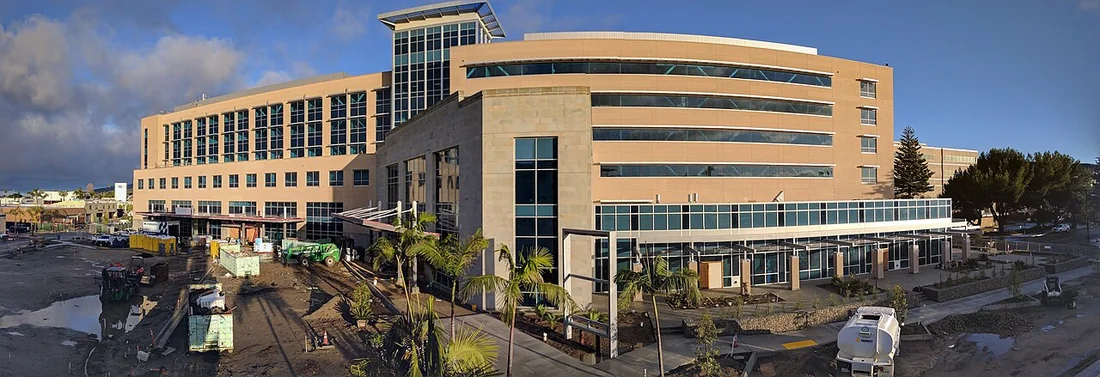
Most valley heart-attack patients end up at the Ventura campus, 18.0 miles down Creek Road and Highway 33, or 29 minutes in Google's Monday-morning estimate.
Community Memorial Hospital in Ventura, photographed in January 2017 while the new building was being finished. Ventura County's 2024 EMS plan lists it as a STEMI receiving center, 18 miles and about half an hour from Ojai City Hall. Photo: Fettlemap, Wikimedia Commons, CC BY-SA 3.0. Resized and converted to WebP.
How paramedics decide
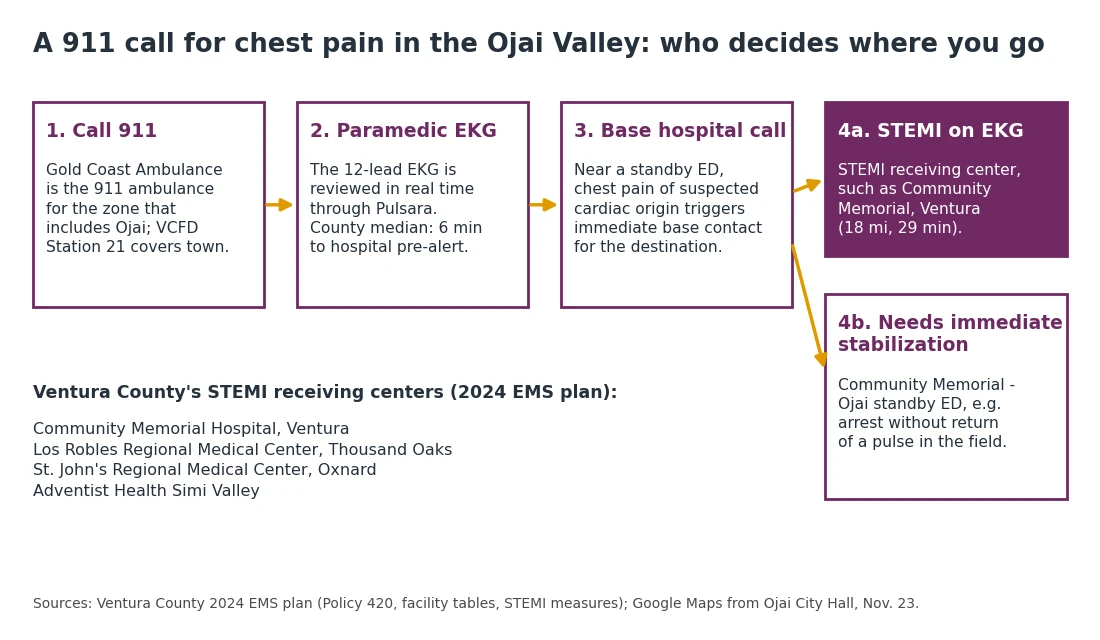
The county's receiving-hospital policy, Policy 420, is printed in the EMS plan. It tells paramedics working near a standby emergency department to call the base hospital for a destination decision when a patient has chest pain of known or suspected cardiac origin or a potentially significant heart rhythm problem. Patients who meet STEMI criteria are directed to the appropriate specialty hospital. The policy allows a standby department to receive patients who need immediate stabilization, such as someone in cardiac arrest whose heartbeat has not returned in the field, when a basic emergency department is not within a reasonable distance.
How a 911 chest-pain call from the valley is routed, drawn from Policy 420 and the STEMI measures in Ventura County's 2024 EMS plan.
The plan also reports that Ventura County uses the Pulsara system countywide for STEMI patients, with real-time review of the paramedic EKG. In 2024 the median time from a positive EKG to the hospital pre-alert was 6 minutes, against a goal of 10, and the median time from dispatch to opening the artery was 85 minutes. Those are county-wide figures, not Ojai's alone, but they explain why the paramedic's EKG matters so much: it starts the clock at the hospital before you arrive.
Stroke is routed differently
People with atrial fibrillation, a weakened heart or a recent heart procedure carry a higher stroke risk, so it helps to know that stroke has its own map. The same EMS plan lists the Ojai hospital as not a stroke center, while the Ventura Community Memorial campus, Los Robles, both St. John's hospitals, Adventist Health Simi Valley and Ventura County Medical Center are marked as stroke centers. Paramedics screen for large-vessel strokes with the Cincinnati scale and a Ventura County score and take those patients directly to a designated thrombectomy-capable center. Sudden face droop, arm weakness or slurred speech is a 911 call, just like crushing chest pain.
If Community Memorial sends you to another hospital
The Ojai hospital's page says patients are transferred when a higher level of care is needed. For a heart patient that usually means the Ventura campus, but it can mean any hospital with the service you need that day. Ask the transferring team where you are going and who will be your doctor there, and ask a family member to write it down. A transfer is also when records get split between two hospitals, so when you later request records for a cardiology visit, request them from both.
Who comes when you call 911 in Ojai
The EMS plan names Gold Coast Ambulance, a subsidiary of American Medical Response, as the exclusive 911 ambulance provider for the zone that includes the City of Ojai. It took over in June 2021 from Ojai Ambulance, which had served the area since 1935 and had operated as LifeLine Medical Transport since 2001. Fire service in town comes from the Ventura County Fire Department; its Station 21 serves the City of Ojai and the eastern valley and is staffed daily by three firefighters.
Why driving yourself is the wrong move
A private car has no EKG, no defibrillator and no way to tell the Ventura hospital you are coming. An ambulance crew does all three, and the plan's pre-alert figures show the hospital can be ready before the ambulance pulls in. If you think you are having a heart attack, call 911 from wherever you are in the valley and let the crew decide between Maricopa Highway and Ventura.
After the emergency: bringing the record to Tarzana
Discharge papers from either Community Memorial campus often say "follow up with cardiology in one to two weeks". When you call us, have the discharge summary in front of you, and ask Community Memorial's records department for the EKGs, the echocardiogram report and images, the catheterization report if there was one, and the list of medicines you left with. A hospital stay often changes several prescriptions at once; the first follow-up visit is where those changes get sorted out against what you were taking before.
Cardiac arrest in the valley: PulsePoint, AEDs and the minutes before the engine arrives
The two terms get swapped on the news all the time, but they describe different emergencies. A heart attack is a plumbing problem: a blocked artery, usually in someone who is still awake and talking. A cardiac arrest is an electrical failure: the person drops, gasps or goes silent, and what happens in the next few minutes decides whether they live. In a valley whose ambulance zone, by the county's own description, takes in rural and wilderness areas as well as town, the people already in the room matter most.
The numbers the AHA publishes
According to the American Heart Association, roughly 350,000 adults in the United States have a cardiac arrest outside a hospital each year, and more than 70% of those arrests happen at home. Each minute that CPR is delayed cuts the odds of survival by about 10%. When a bystander performs CPR, the chance of surviving doubles or triples, yet bystanders give CPR in only about 40% of cases.
Hands-only CPR, the version anyone can do
The AHA's instructions for an adult who collapses are short. Call 911, or have someone else call. Put the heel of one hand in the center of the chest, the other hand on top, and push hard and fast at 100 to 120 compressions a minute. Keep going until help arrives. If a second person is there, send them for an AED while you keep pushing; do not stop compressions to go looking for one yourself. The 911 dispatcher will coach you through it.
What PulsePoint does in Ventura County, and where it does not reach
The Ventura County Fire Department says the county's fire and EMS agencies have joined PulsePoint, a free app that alerts CPR-trained people when someone nearby is in cardiac arrest. There is an important limit: the department's page says CPR alerts are shared only when the arrest happens in a public place, and the app is not activated for residential addresses. With most arrests happening at home, PulsePoint is a help at the trailhead, the market or the post office, but the person most likely to start CPR on you is someone you live with.
AEDs and the registry
The same county page links to the PulsePoint AED registry app and a VCFD map of AED locations. Registered AEDs are visible to emergency call-takers and to people nearby during an arrest. If your church, club, office or hotel has an AED, ask whether it is registered; the AHA recommends registering devices with the local EMS system so dispatchers know where they are. A device in a locked closet no one knows about saves nobody.
For households with a heart patient
If someone in your home has heart failure, a weakened heart muscle, HCM or a history of dangerous rhythms, the rest of the household should know hands-only CPR. It takes a short class or a video, and the AHA keeps instructions on its site. Post your street address by the phone and make sure your house number is visible from the road; in canyon and ranch properties around the valley, the ambulance finding the driveway is part of the response time.
After a cardiac arrest: the cardiology follow-up
A person who survives a cardiac arrest leaves the hospital with questions that belong to a cardiologist. Why did the rhythm fail? Was it a blocked artery, a weakened muscle, an inherited condition or something else? Is a defibrillator needed to guard against the next one? And if the cause runs in families, as HCM can, which relatives should be checked? Bring the hospital's discharge summary, any device information and the names of first-degree relatives to the first visit, so the family question gets asked at the same time as the patient's.
Has a family member already had a heart rhythm scare? A cardiology visit is the place to ask whether their risk calls for a defibrillator. Call the Tarzana office at 818-905-5904.
Evacuation warnings and power shutoffs with a heart condition
Fire season in the Ojai Valley brings two disruptions that hit heart patients harder than most: a warning that tells you to leave, and a planned power shutoff that leaves the house dark. Both tend to arrive on the same windy days, and both are easier to handle with a plan made in a calm week. This section covers the parts that touch heart care; the city and county pages linked below cover the rest.
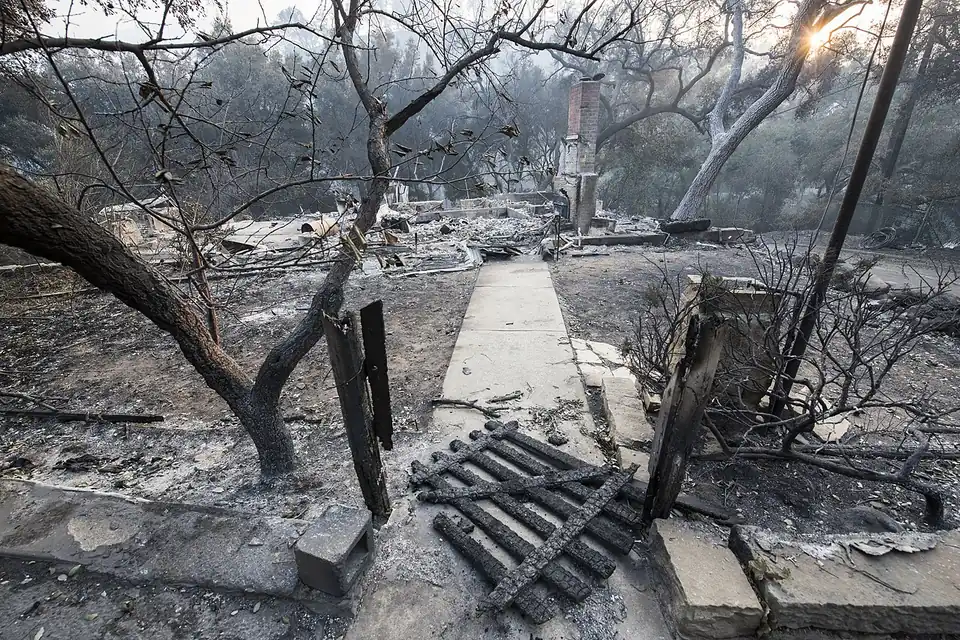
A home lost to the Thomas Fire, which CAL FIRE records as starting on December 4, 2017, near Highways 150 and 126 north of Santa Paula. Highway 150 is one of the two roads out of the Ojai Valley, which is why a fire-season plan for a heart patient includes the medicines and papers you would grab in minutes. Photo: U.S. government work via Wikimedia Commons, public domain. Resized and converted to WebP.
The highway behind the 2017 evacuations
CAL FIRE records that the Thomas Fire started on December 4, 2017, near Highway 150 and Highway 126 north of Santa Paula, and went on to burn 281,893 acres in Ventura and Santa Barbara counties and destroy 1,063 structures. Highway 150 is one of Ojai's two roads out of the valley. A heart plan for fire season starts from that geography: when a fire is moving, the roads you would use to reach a pharmacy or a hospital may be the roads that close.
Sign up for the county's alerts now
VC Alert is Ventura County's free emergency notification system. It sends evacuation warnings and orders, severe weather advisories and public health alerts by phone, text, email or TTY to the addresses you register, including the home of a parent you look after. The county's own page cautions against relying on VC Alert as your only source of emergency information, so pair it with local news and official social media.
Register both your own address and the address of any relative with a heart condition who lives alone. If an evacuation warning goes out for their street, you want to know at the same moment they do.
The go-bag items a heart patient needs
El Centro de American Heart Association's advice for heart attack and stroke survivors facing wildfires starts with medicines: keep a list of every medication and have a refill on hand. It also suggests calling ahead to learn the most reliable way to reach your doctor during a long power outage, and finding out early which shelter can accommodate special needs such as oxygen. Add the items a cardiologist would want you to carry:
A printed medication list with doses, including your blood thinner and when you last took it
The wallet card for any pacemaker, defibrillator, stent or valve, with the device maker's name
A copy of your most recent EKG and the summary from your last cardiology visit
Your cardiologist's office number, written down rather than stored only in a phone
A home blood pressure cuff with spare batteries if you have been asked to log readings
Low-salt food for a few days if you have heart failure and follow a sodium limit
At an evacuation shelter
If you end up at a shelter, tell the staff at check-in that you have a heart condition and which medicines you cannot miss, especially a blood thinner, a heart-rate medicine or a water pill. Shelter meals, unfamiliar beds and stress make it a poor week for skipping doses. Keep your phone charged and your cardiologist's number with you, and call the office if a medicine runs out before you can get home.
When Edison turns off the power
Southern California Edison can shut off power to circuits in high fire risk areas during dangerous weather, and the City of Ojai says SCE customers on potentially affected circuits are notified in advance so they can prepare. The city lists SCE's 24-hour outage line, 800-611-1911, and urges residents to register with SCE so the notices reach them.
For most people with heart disease, a shutoff is an inconvenience. For a smaller group it is a medical event: anyone with a left ventricular assist device, home oxygen from a concentrator, or other powered equipment their heart condition depends on.
Edison's programs for powered medical equipment
SCE's Medical Baseline Allowance gives qualifying households an extra 16.5 kilowatt-hours a day at the lowest baseline rate. The qualifying device list includes a left ventricular assist device (LVAD), the SynCardia total artificial heart, oxygen generators and concentrators, and CPAP machines, and the program also covers people who are sensitive to temperature and need air conditioning. A medical professional signs the application, and recertification is due every two to four years.
Customers who are enrolled in Medical Baseline, live in a high fire risk area and rely on powered medical equipment can qualify for SCE's Critical Care Backup Battery program. SCE says it delivers a portable rechargeable battery with a three-year warranty and a solar panel kit, sets it up and trains you at no cost, and that the battery can go with you if you evacuate. If your cardiologist manages your LVAD or another powered device, ask for the certification paperwork at your next visit rather than in the middle of a red-flag week.
Implanted devices during an outage
Pacemakers and implanted defibrillators run on their own batteries, so a power shutoff does not stop them. What a shutoff can interrupt is the bedside transmitter that sends device readings to the clinic, and the phone or internet line it depends on. If you lose power for days, let your device clinic know when service returns so they can check that the transmitter reconnected.
The cardiologists Ojai patients see in Tarzana
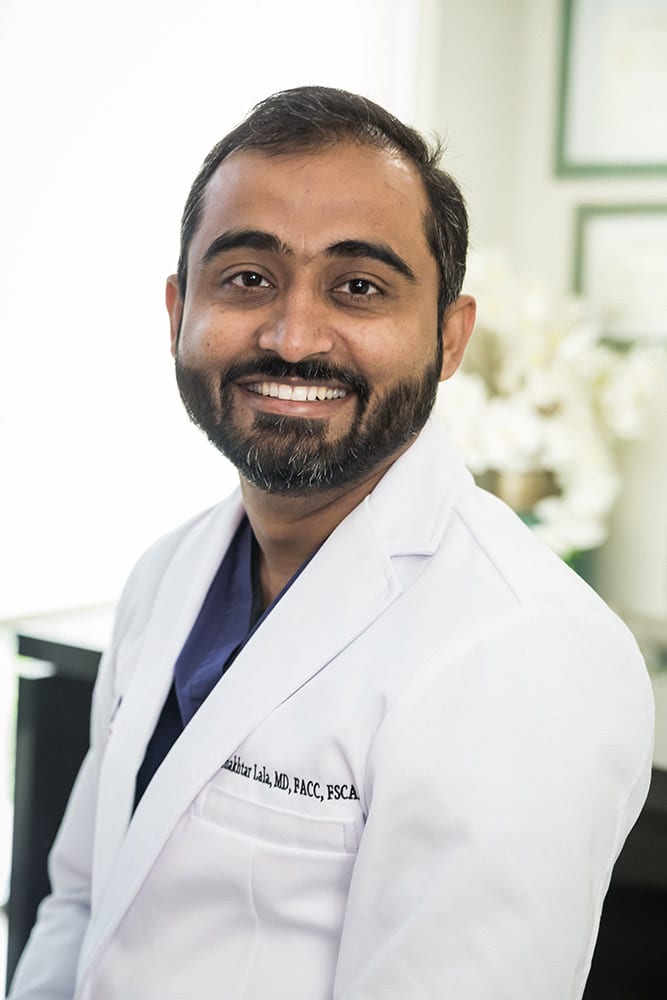
CACVI is led by three physicians, each with fellowship training in catheter-based cardiology. Their full profiles are on the CACVI about-us page. What follows is what each profile tells an Ojai patient about who might handle their question.
Mehran J. Khorsandi, MD
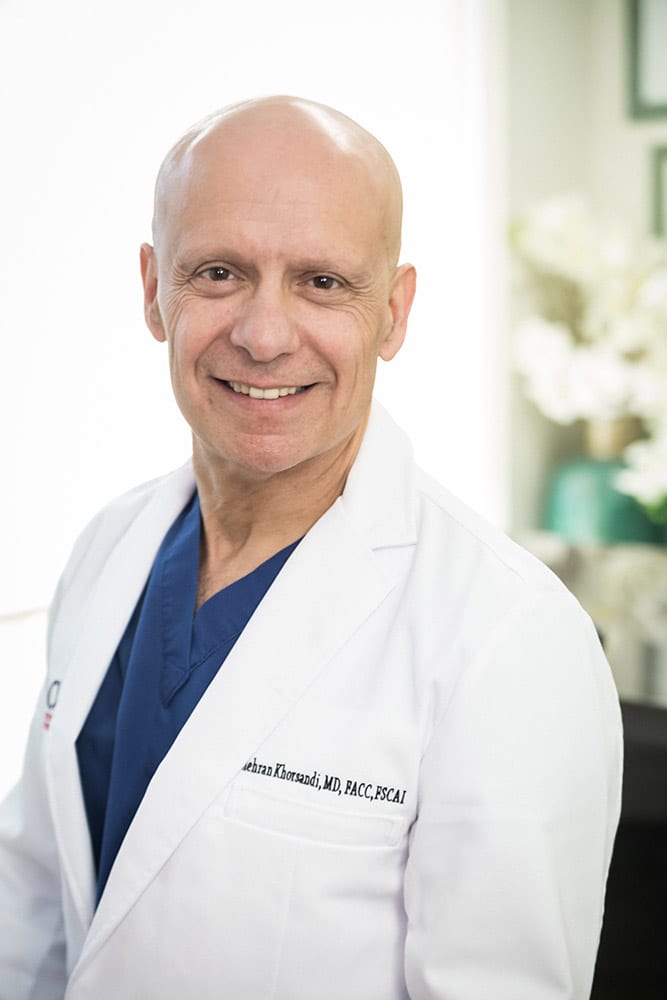
If the question from Ojai is a pacemaker, a defibrillator or a difficult coronary blockage, Dr. Khorsandi's profile is the one to read. Of his five board certifications, the cardiac device credential is the one most relevant to a patient deciding on an implanted device, and the coronary work he lists centers on high-risk angioplasty and bifurcation disease, where a blockage sits at the fork of two arteries.
Cedars-Sinai has been his hospital for most of his career: he trained there after medical school at Penn and has held an attending appointment since 1993, teaching fellows in its catheterization lab. Nearer to the Ventura Boulevard suite, the catheterization lab he runs is the one at the Tarzana hospital that Providence operates with Cedars-Sinai. Vein care and leg-artery work also appear on his list, and he is a named inventor on dozens of patents for stent technology.
Patients who arrive with a leg problem as well as a heart problem often end up with Dr. M. Lala. He built CACVI's limb salvage program after joining in the fall of 2016, and the leg-artery and vein procedures on his list sit beside complex coronary work done through the wrist artery, reopening of long-standing total blockages and catheter-based aortic valve replacement.
His seven certifications include two that bear directly on the testing earlier on this page: echocardiography and nuclear cardiology, the studies that show pumping strength, wall thickness and blood flow under stress. His residency years were spent in New York, finishing with a year as chief resident, and his heart and catheter fellowships followed in the same city at Mount Sinai Beth Israel.
For the long-running conditions this page spends the most time on, Dr. V. Lala is the natural starting point. His profile names cardiomyopathy, congestive heart failure, high blood pressure, atrial fibrillation and cardio-oncology among the problems he follows over time, alongside coronary, leg-artery and structural heart disease.
Before CACVI, which he joined in 2022, his last stop was an advanced fellowship at The Mount Sinai Hospital in New York. On the procedure side, his list includes TAVR, closure of a patent foramen ovale and the WATCHMAN device for stroke risk in atrial fibrillation. He is certified in nuclear cardiology and echocardiography as well, and has written for cardiology education outlets.
Reviews from patients of the Tarzana and Los Angeles offices
These reviews come from CACVI's Google listings for its Los Angeles and Tarzana offices. They are shown as patients wrote them and describe individual experiences, which vary from patient to patient.
Questions Ojai Valley residents ask before booking a cardiologist
Where do Ojai patients see a CACVI cardiologist?
The practice works from Los Angeles, Tarzana and Victorville. For Ojai, Tarzana is the nearest of the three.
How do I find a qualified cardiologist in my area?
Start with the physician's California license, which you can look up on the Medical Board of California's license search, and then match the doctor's listed work to your problem. A rhythm question, a valve question and a leg-artery question can each point to a different doctor. Your primary care doctor in Ojai can also tell you which cardiologists their patients have seen.
Is CACVI accepting new patients from Ventura County?
Yes. The registration form is on CACVI's new patient page. Call the Tarzana office at 818-905-5904 to check that your health plan works with the office before you book the drive.
Can I book a Saturday appointment?
Yes, Tarzana is open on Saturdays, 8 a.m. to 4:30 p.m. A Saturday visit avoids a weekday trip on the 101 and a day off work.
My child needs a heart evaluation. Can CACVI see them?
CACVI's physicians see adults. Ask your pediatrician for a referral to a pediatric cardiologist.
Does CACVI offer calcium score testing?
CACVI has a coronary calcium scan page describing the test, a CT scan that measures calcium-containing plaque in the heart arteries. Ask the office where the scan is done and whether your plan covers it.
Is CACVI part of Community Memorial's cardiology department?
No. CACVI is an independent practice in Los Angeles County. Community Memorial Healthcare runs its own hospitals in Ventura and Ojai. You can see a CACVI cardiologist after a Community Memorial stay; bring the discharge summary and the test results to the visit.
Where would a heart procedure take place?
Dr. Khorsandi directs the cath lab at Providence Cedars-Sinai Tarzana Medical Center, according to his profile, but where any specific procedure happens depends on what it is, so ask the physician who recommends it.
I get leg pain when I walk. Is that a heart doctor's question?
It can be. Calf cramping that starts partway through a walk and fades once you stop is a classic sign of narrowed leg arteries. CACVI has a separate page on leg pain care for Ojai patients.
Does Medicare cover cardiac rehab after a heart attack or stent?
Yes, if your history matches one of the qualifying events on Medicare.gov: stents and angioplasty are on that list, as is a heart attack within the past year, along with bypass, valve surgery, transplant, stable angina and stable chronic heart failure. Once the Part B deductible is met, your share for sessions in a doctor's office is 20% of the approved amount. Ask your cardiologist for a referral to a program closer to Ojai so the sessions don't mean a weekly trip to Los Angeles County.
Does CACVI see patients with atrial fibrillation?
Yes. Atrial fibrillation is on Dr. Vasim Lala's condition list, and WATCHMAN closure is one of his procedures. CACVI's atrial fibrillation page explains the condition.
Who looks after heart failure at CACVI?
Congestive heart failure is on Dr. Vasim Lala's list of chronic conditions, and CACVI keeps a heart failure page on symptoms and care.
Can CACVI read a test I already had in Ventura?
Bring the images on disc together with the report. The cardiologist will decide whether the earlier study answers the question or whether a repeat is needed.
CACVI pages for the towns along Ojai's two highways
Highway 33 takes Ojai traffic south to Ventura and the 101; Highway 150 runs east to Santa Paula. Every link below follows one of those roads or the 101 toward Tarzana.
Every local fact on this page traces to one of these sources. Drive times are from Google Maps on Monday, November 23, at about 9 a.m.; the exit and road sequence is from the OSRM route planner.
Google Maps driving directions, Monday, Nov. 23, about 9 a.m.
Google
OSRM route planner (OpenStreetMap data)
Project OSRM
Booking a visit from Ojai, Meiners Oaks or Oak View
One phone number covers everything on this page: 818-905-5904, answered on weekdays and Saturdays. Open with where you live, then the reason, whether that is a symptom, an abnormal test or a hospital discharge, with your insurance card in hand. Paper records can be faxed ahead (310-967-2140) or emailed (info@cacvi.org); imaging discs travel with you.
We use cookies to run this site, measure traffic, and serve relevant ads. Choose which categories you allow. You can change this any time. See our Política de privacidad.
Cookie preferences
Choose which cookies you allow. You can change these at any time from the "Cookie preferences" link in the footer.
Strictly Necessary
Required for the site to function (session, security, form submissions). Cannot be disabled.
Always on
Analytics
Help us see how people use the site. Google Analytics counts visits and page views. Microsoft Clarity may record how you move through pages, such as where you click and scroll. CallRail shows a tracking phone number so we can tell which pages lead to calls.
Marketing
Used to measure ad effectiveness and show you relevant ads on other sites (e.g., Google Ads).