




















Evaluación cardíaca
Need a cardiologist near Tustin?
If you are trying to find a cardiologist from a Tustin address, you probably want two answers quickly: who will actually see a new patient, and how far away that doctor is. Here are ours. Tustin patients of the Center for Advanced Cardiac and Vascular Interventions (CACVI) are seen in Los Angeles County. The nearest of our three offices is Suite A at 8741 Alden Drive in Los Angeles, next to the Cedars-Sinai campus, and Google Maps measures it at 45.3 miles from Tustin City Hall by way of the I-5. You can drive it, or you can take a Metrolink train from the Tustin station on Edinger Avenue and finish on the Metro D Line.
What sits at the end of that trip is a cardiology practice run by interventional cardiologists. The same physicians evaluate chest symptoms, rhythm problems, valve disease and heart failure, and they also open blocked arteries in the heart and legs and treat diseased veins. A first visit is a cardiac evaluation: a physical examination and a medical history, sometimes with blood or urine tests, usually requested by your own doctor.
To ask about a first appointment, call the Los Angeles office at 310-652-2744 on a weekday, or send a request online. If you have chest pressure, sudden breathlessness or you’ve just passed out, don’t call us. Call 911.
| Verified detail | What it means for a Tustin patient | Source |
|---|---|---|
| Nearest CACVI office: 8741 Alden Drive, Suite A, Los Angeles, CA 90048 | Tustin patients are seen at Alden Drive, so a visit means a trip into Los Angeles County. | CACVI appointments |
| Phone 310-652-2744; Monday to Friday, 8:30 a.m. to 5:00 p.m. | Call on a weekday to book; the office asks patients to request appointments by phone. | CACVI appointments |
| 45.3 miles from Tustin City Hall via the I-5 north | Plan on a round trip of about 90 miles if you drive. | Google Maps directions |
| Typical drive: 1 hr to 1 hr 40 min leaving at 10:30 a.m.; 1 hr 40 min to 3 hr leaving at 7:30 a.m. | The hour you leave matters more than the route you pick. | Google Maps directions |
| Train: 10:20 a.m. from Tustin station, at Alden Drive by 12:14 p.m. (Metrolink, Metro D Line, bus 105) | A car-free trip of under two hours that traffic doesn’t stretch. | Google Maps transit directions |
| Tustin station parking: 932 spaces, free for Metrolink riders | Leave the car in Tustin and ride; non-riders’ cars can be towed. | Metrolink: Tustin station |
| Metrolink fares: 50% off one-way for riders 65+, riders with disabilities and Medicare recipients | Medicare cardholders pay half fare on the Metrolink leg. | Metrolink everyday discounts |
| CalOptima Medi-Cal: care outside its service area needs pre-approval | A Los Angeles cardiologist has to be approved through your health network first. | CalOptima Health benefits |
Looking for a cardiologist from Tustin when the nearest CACVI office is in Los Angeles
Look at a map of Orange County cardiologists and it fills with offices in Santa Ana, Orange and Irvine, many of them a short drive from Old Town Tustin. Several sit beside the large hospital campuses that ring the city. For a lot of Tustin residents a local cardiologist is the sensible answer, and nothing on this page argues otherwise. The point of this section is narrower: what CACVI’s physicians do, so you can judge whether a 45-mile trip buys you something a closer office doesn’t.
The heart problems the Alden Drive physicians manage
The practice’s service pages and physician bios cover the full range of adult cardiology, with a heavy lean toward problems that may end in a catheter procedure:
- Enfermedad de las arterias coronarias, from chest discomfort on exertion to arteries that have already been stented once.
- Weak or stiff heart muscle and heart failure, including patients whose medicines are already at full dose.
- Aortic and mitral valve disease, with TAVR and MitraClip among the procedures listed.
- Atrial fibrillation when long-term anticoagulation is a problem, the situation in which a WATCHMAN implant gets discussed.
- Blood pressure that stays high on several medicines, where a narrowed kidney artery is one cause the practice looks for and treats with renal artery stenting.
- Leg pain on walking, wounds on the feet that won’t close, swollen legs and varicose veins.
That last group is less common in a general cardiology office. That group is why the first line of CACVI’s appointments page is a warning rather than a welcome: anyone told they need an amputation should seek a second opinion first.
Heart tests that can be ordered through the practice
If you need testing rather than a doctor, such as cardiovascular testing in Orange County, functional diagnostic testing in Tustin, or a CT scan for the heart, these are the diagnostic services CACVI lists, each with its own page:
- Electrocardiograma (EKG), the ten-second tracing of the heart’s electrical activity.
- Ecocardiograma, an ultrasound of the heart’s chambers, valves and pumping strength.
- Stress tests, which push the heart to a higher workload, on a treadmill or with medication, and record how it copes. These are the “functional” tests in the cardiology sense: they measure function under load, not structure at rest.
- Mobile cardiac telemetry, a wearable recorder that keeps sending your rhythm while you go about life in Tustin.
- Coronary calcium scan and coronary CT angiography, the two CT tests people usually mean when they ask for a heart scan.
- Vascular ultrasounds, plus a peripheral vascular disease evaluation when circulation outside the heart is the worry.
Same-day availability differs from test to test and week to week; the booking call is the place to settle it.
Procedures the physicians perform themselves
Many cardiology offices diagnose and then refer out for the procedure. At CACVI the physicians who see you in clinic are the ones who do the catheter work. The practice’s services list includes coronary stenting and complex coronary intervention, pacemaker and defibrillator implants, structural heart procedures, peripheral angioplasty, venous stenting, vein ablation and carotid stenting. The about-us page says its physicians direct the cath lab and structural heart disease program at Providence Tarzana and help teach Cedars-Sinai’s cardiology fellows. No Orange County hospital appears on that page or in the bios, which matters if a procedure is ever recommended: it would happen in Los Angeles County.
Who tends to make the trip from Tustin
The patients for whom the distance pays off usually arrive with something specific. A procedure has already been proposed and they want another interventional cardiologist to look at the same angiogram. Their legs and their heart are both involved. Or a family member already sees one of our physicians and they would rather keep one team. A Tustin resident who simply needs a first look at a borderline EKG may be better served closer to home, and we’ll say so if you ask.
If you’re in the first group, the section on second opinions below matters more than anything about the drive. A health plan often has to cover a second opinion, and how you ask for it affects how quickly you get an answer.
If you have already been told you need a stent, a valve procedure or a leg angioplasty, a second look from Tustin starts with one phone call to the Los Angeles office at 310-652-2744. Have the name of the hospital that did your angiogram ready, so the office can tell you how to get the images.
Checking “accepting new patients” before you start calling
Finding a cardiologist accepting new patients near Tustin sounds simple, but it hides a frustrating job. A directory lists a doctor, the office says the doctor’s panel is closed, and the next listing turns out to be out of network. California law gives you more help with this than most people realize, and it’s worth knowing what the rules require before you spend an afternoon on hold.
What a California plan directory has to show
If your coverage comes from a plan licensed by the Department of Managed Health Care, Health and Safety Code section 1367.27 requires the plan to publish a directory of its contracted providers, “including those that accept new patients”. The online version has to be open to anyone, with no member number, no login and no account required. It must also be searchable, at a minimum, by name, practice address, city, ZIP code, California license number, NPI number, hospital admitting privileges, product, provider language, provider group and hospital or clinic name.
Two of those search fields are especially useful for a Tustin patient looking for a cardiologist. Searching by hospital shows you which cardiologists can follow you into the hospital you’d actually use. If you already know you’d want any admission to be at a particular campus in Orange or Irvine, start the search there and work backward to the names, instead of finding a doctor first and learning later where they admit. Searching by provider group matters in Orange County, where many plans route specialist care through a medical group, and a cardiologist can be in your plan but outside your group.
Health insurers regulated by the Department of Insurance, rather than by the DMHC, carry a parallel duty under Insurance Code section 10133.15, written in almost the same words. Your card or your plan documents tell you which regulator you fall under.
How current the “new patients” flag is supposed to be
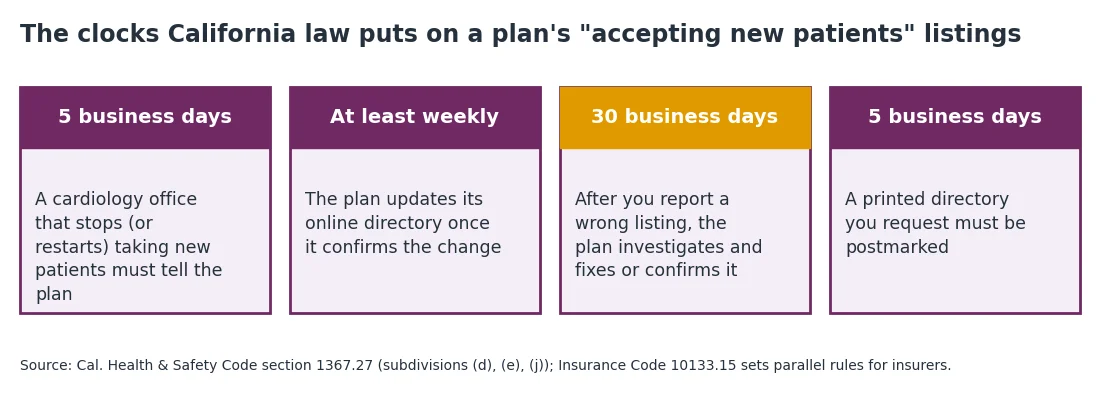
The statute sets a schedule. The online directory has to be updated at least weekly when the plan learns, and confirms, that a contracted provider has stopped accepting new patients for a product. A printed directory has to be refreshed at least quarterly. On the provider side, the plan’s contract must require the doctor’s office to tell the plan within five business days when it stops taking new patients, or starts again. And at least once a year the plan has to review its whole directory.
In practice that means a listing can still be a week or more behind the office’s real situation. Treat the flag as a strong hint, not a promise, and confirm by phone before you rearrange your week.
When the directory sent you to the wrong door
The law also says what should happen when a listing is wrong. Every directory must show a phone number and an email address for reporting errors, and the plan has 30 business days to investigate a report and either confirm or fix the listing. A doctor’s office that isn’t taking new patients and gets your call is supposed to point you both to the plan, for help finding someone else, and to the DMHC, so the bad entry can be reported.
The provision people rarely hear about is the money one. Under subdivision (q), if the department finds that you reasonably relied on materially inaccurate directory information, it can require the plan to cover the care and to reimburse what you paid beyond your normal in-network cost. So keep a screenshot of any listing you booked from, with the date. If a “network” cardiologist bills you as out of network, that record is what makes the complaint work.
The same directory rules carry one more useful line: every directory has to tell you that you’re entitled to interpreter services at no cost. If you’d rather talk through a heart problem in Spanish, Vietnamese or another language, that right belongs to you through the plan, whichever office you end up in.
Medicare’s own doctor search, and what “accepting assignment” means
People on Original Medicare don’t use a plan directory at all. Medicare’s Care Compare tool lets you look up doctors and clinicians by name, specialty and location. The detail that decides your bill is called assignment. According to Medicare.gov, a doctor who accepts assignment takes the Medicare-approved amount as full payment for covered services. A non-participating doctor can charge more, in many cases up to 15% above the approved amount, which Medicare calls the limiting charge. A doctor who has opted out of Medicare does so for at least two years. Asking “do you accept Medicare assignment?” gets a clearer answer than “do you take Medicare?”.
Medicare Advantage is different again. Those plans have their own networks and their own directories, so check the plan’s directory the same way you would for any other managed plan.
What to ask the scheduler, word for word
Most of the wasted calls come from questions that are too general. These ones get specific answers:
- “Is Dr. [name] accepting new patients under my plan’s product, [the name printed on your card]?” Networks are product-specific, and the statute requires plans to name them consistently for that reason.
- “Is the practice contracted with my medical group, or only with the health plan?”
- “Do you need a referral or an authorization number on file before the first visit?”
- “If the doctor orders a stress test or an echocardiogram, can it be done under the same contract?”
- “If I’m put on a waitlist, will you call me, or should I call back?”
Write down the name of the person you spoke to and the date. That note, along with the directory screenshot, is your file if something goes wrong later.
What a California health plan owes you on second opinions and refusals
The most common reason a Tustin patient ends up calling a cardiologist 45 miles away is a second opinion. Someone has recommended a stent, a valve replacement or a leg procedure, and the patient wants another interventional cardiologist to look before agreeing. California’s managed care law, the Knox-Keene Act administered by the DMHC, spells out what a plan has to do when you ask for that, and what you can do if the plan says no. It’s worth knowing the rules before the conversation with your plan, not after.
When a plan has to provide a second opinion
Health and Safety Code section 1383.15 requires a DMHC-licensed plan to provide or authorize a second opinion from an appropriately qualified professional when you or your treating doctor ask for one. The law lists reasons that qualify, and several fit heart care closely:
- You question whether a recommended surgical procedure is reasonable or necessary.
- You question a diagnosis or plan of care for a condition that threatens life, limb or major bodily function, including a serious chronic condition.
- The clinical picture is unclear, test results conflict, or your doctor can’t reach a diagnosis.
- The treatment plan isn’t improving your condition in the time it should.
“Appropriately qualified” has a specific meaning in the statute: a doctor acting within their scope of practice whose training and expertise relate to the condition in question. For a proposed coronary stent, that points to an interventional cardiologist. For a leg artery blockage, it points to someone who treats leg arteries.
Who gives the second opinion, and how far away they can be
If your question is about a specialist’s advice, the second opinion can come from any provider of your choice in the same or an equivalent specialty, from any medical group or independent practice association in the plan’s network. You aren’t limited to the cardiologists in your own medical group. When the second opinion comes from outside your group, the plan pays for it beyond your normal copayment.
If no qualified provider is in the network at all, the plan has to authorize one outside it. In either case, the statute says the plan must take into account your ability to travel to the provider. For someone in Tustin, that clause can help either side. A plan can reasonably prefer a qualified cardiologist in Orange County over one in Los Angeles, and you can reasonably point out a trip that would be hard for you to make. Your copayment for an approved second opinion is the same as for a similar referral.
How quickly the plan has to answer
The plan must decide “in an expeditious manner”. When your condition poses an imminent and serious threat, such as possible loss of life or limb, the decision is due within 72 hours of the plan receiving the request whenever possible. If the plan denies the request, it has to tell you why in writing and explain your right to file a grievance.
Once a second opinion is approved and given, the plan must require the second physician to send a consultation report, including any recommended tests or procedures, to you and to the doctor who gave the first opinion. The second opinion feeds back into your care rather than running alongside it.
Putting the request in writing
A phone request can work, but a written one leaves a record and starts the clock clearly. Keep it to one page:
- Name the section: a request for a second opinion under Health and Safety Code section 1383.15.
- State the recommendation you’re questioning, who made it and when, for example “coronary stent to the left anterior descending artery, recommended by Dr. X on [date]”.
- Say which qualifying reason applies, in the statute’s own terms.
- If you’re asking for a particular physician, give the name, the practice and why that background fits the question.
- Mention anything that limits how far you can travel, such as a recent fainting spell or no one to drive you, because the plan has to weigh it.
Send it through the plan’s member portal or by mail, keep a copy, and note the date. If the condition is urgent, say so in the first line and call as well.
When your cardiologist leaves the plan in the middle of treatment
Networks change, sometimes in the middle of a work-up. Health and Safety Code section 1373.96 lets you ask the plan to keep covering care from a provider whose contract ended, when you were already being treated for certain conditions. For heart patients the three that matter most are an acute condition, covered for as long as it lasts; a serious chronic condition, covered for the time needed to finish a course of treatment and arrange a safe transfer, up to 12 months; and a surgery or procedure the plan already authorized and that was documented to happen within 180 days of the contract ending. People who are new to a plan and already in treatment with a non-network provider can use the same section. Ask in writing, and name the condition.
When the plan refuses
A refusal isn’t the end of the process. Under section 1368.01, a plan’s grievance system has to resolve grievances within 30 days. When the case involves an imminent and serious threat to your health, the plan must review it on an expedited basis, tell you in writing right away that you can contact the DMHC, and give you and the department a written status no later than three days after receiving the grievance.
If the plan denied, delayed or changed a service because it decided the service wasn’t medically necessary, section 1374.30 gives you the right to an Independent Medical Review run by the DMHC. Outside physicians review the medical necessity question, and your own doctor is allowed to help you and to argue your case. Medi-Cal members in a plan aren’t excluded, although their reviews follow Medi-Cal rules, and Medicare members in a plan are included unless federal law says otherwise. When the threat to health is imminent and serious, the plan’s file has to reach the review organization within 24 hours of the review being approved.
None of this applies the same way to Original Medicare, which has its own appeal process, or to a PPO that already lets you see any specialist. Read the denial letter carefully: it should say which process applies to you.
Medi-Cal in Orange County runs through CalOptima Health
Finding a Medi-Cal cardiologist plays out differently in Orange County than in most of the state. Medi-Cal here runs through CalOptima Health, the county organized health system that local leaders launched in 1995, and CalOptima in turn works through health networks and medical groups. That structure decides how a Tustin Medi-Cal member gets to a cardiologist, how far that cardiologist can be, and who pays for the ride.
Your primary care provider and health network come first
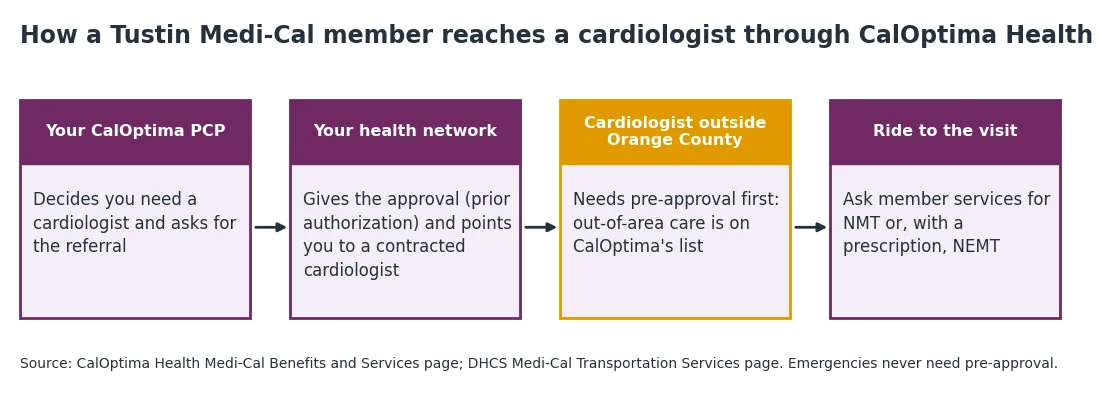
On the CalOptima Medi-Cal benefits page, prior authorization is described as “an approval for special medical services given by your health network.” For heart care, the usual path starts with your primary care provider (PCP), who decides a cardiologist should see you and asks the network for approval. The network then points you to a contracted cardiologist. A directory listing alone, without that step, often isn’t enough to book.
If your PCP has said “you need to see a cardiologist” but nothing has arrived, call the PCP’s office first and ask whether a referral was submitted and to which network. The second call is to CalOptima Health Customer Service at 1-888-587-8088 (TTY 711), Monday to Friday, 8 a.m. to 5:30 p.m.
Finding the cardiologists your network uses
CalOptima publishes its health network provider directory in two volumes, and the cardiologists are in the second one, “Specialist Health Care Providers”. Volume 1 covers primary care, hospitals and general providers. Both are linked from the CalOptima Medi-Cal page, along with an access standards document for Medi-Cal members. Look up cardiologists under your own health network rather than across all of CalOptima, because the network named on your card is the one that decides the referral.
A cardiologist outside Orange County needs approval first
The same CalOptima page lists the services that need pre-approval, and “services out of the CalOptima Health service area” is on it, alongside hospitalization and outpatient surgery. CalOptima’s service area is Orange County. A Tustin member who wants to be seen in Los Angeles, at CACVI or anywhere else, therefore needs that approval before the visit, not after.
This page can’t tell you whether a Los Angeles practice is contracted with your particular CalOptima health network. Your network can. If you are hoping to see a physician here, ask your PCP to request it and name the practice, the physician and the reason, for example a second opinion on a recommended procedure, or a leg circulation problem alongside a heart problem.
One exception matters more than any rule above. CalOptima states plainly that you never need pre-approval for emergency care, even out of network.
Rides to a cardiology appointment
Medi-Cal covers transportation to covered appointments, and the Department of Health Care Services describes two kinds:
- NMT, or non-medical transportation: a car or public-transit ride, available to full-scope Medi-Cal members with no other way to get there.
- NEMT, or non-emergency medical transportation: a wheelchair van, litter van or ambulance, for members whose condition rules out an ordinary car or bus. A licensed provider has to prescribe it.
For a Tustin member the request goes to CalOptima, by phone to customer service, for either type of ride. Ask when you book the appointment, not the day before, and tell them the destination is in Los Angeles County so the ride is planned for the distance.
Questions at night or on a weekend
CalOptima runs a nurse advice line at 1-844-447-8441 (TTY 1-844-514-3774), 24 hours a day. The plan describes it as a way to sort out symptoms, decide whether you need your doctor, urgent care or the hospital, and get a diagnosis explained. For a heart question that can’t wait for Monday but doesn’t feel like an emergency, that’s the call.
A change coming on January 1, 2027
CalOptima says a new federal rule will move some members who don’t meet certain federal immigration requirements from CalOptima Health to Medi-Cal Fee-for-Service starting January 1, 2027. For those members, the CalOptima network rules on this page stop applying. Medi-Cal transportation also works differently for fee-for-service members: the DHCS page explains that they request a ride through a form sent by DHCS staff rather than through a plan’s member services line.
If you have Medicare and Medi-Cal together
People who qualify for both programs often have a different arrangement. CalOptima offers a separate plan, OneCare, for members with both, and its rules for specialists aren’t the same as the Medi-Cal ones above. If both cards are in your wallet, ask CalOptima which plan you are enrolled in before you start looking for a cardiologist.
Comparing hospital heart programs near Tustin with state data
If you live in Tustin, you may want to evaluate the cardiology departments at hospitals near you. It’s a fair question, and California answers part of it better than most states. The Department of Health Care Access and Information (HCAI) publishes hospital-by-hospital outcomes for heart bypass surgery and for one kind of stent program. Tustin sits in the middle of a cluster of hospitals that appear in those reports, which makes the data more useful here than in many places.
The state’s bypass surgery ratings
HCAI’s Coronary Artery Bypass Graft (CABG) program collects data from every state-licensed hospital that performs bypass surgery. In its 2024 ratings, 120 hospitals performed adult bypass surgery during 2023 and 2024. Each one is rated on four risk-adjusted measures: operative death after an isolated bypass, operative death after bypass combined with valve surgery, stroke after surgery, and unplanned readmission within 30 days.
Risk adjustment is the part to understand. A hospital that takes sicker patients would look worse on raw numbers, so HCAI adjusts each rate for the health and risk factors patients had before surgery. A hospital is then rated “Better” only if its rate is statistically lower than the state’s, “Worse” only if statistically higher, and “Average” otherwise. Most hospitals land in “Average” on most measures. Statewide, the isolated bypass death rate was 2.2% in 2024, up from 2.0% in 2023 and down 24.1% since 2003, the first year reporting was required.
Bypass volume at the hospitals around Tustin
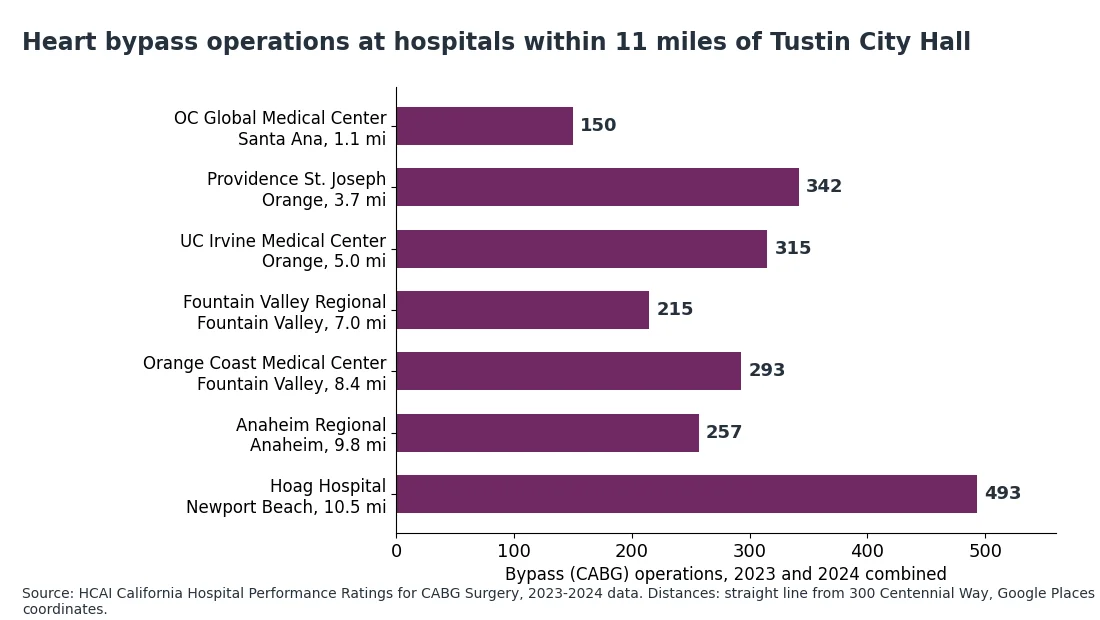
The same dataset shows how many bypass operations each hospital performed. Seven Orange County hospitals within about ten miles of Tustin City Hall reported cases for 2023 and 2024:
| Hospital | City | Straight-line distance from Tustin City Hall | Bypass operations, 2023 and 2024 |
|---|---|---|---|
| Orange County Global Medical Center | Santa Ana | 1.1 miles | 150 |
| Providence St. Joseph Hospital | Orange | 3.7 miles | 342 |
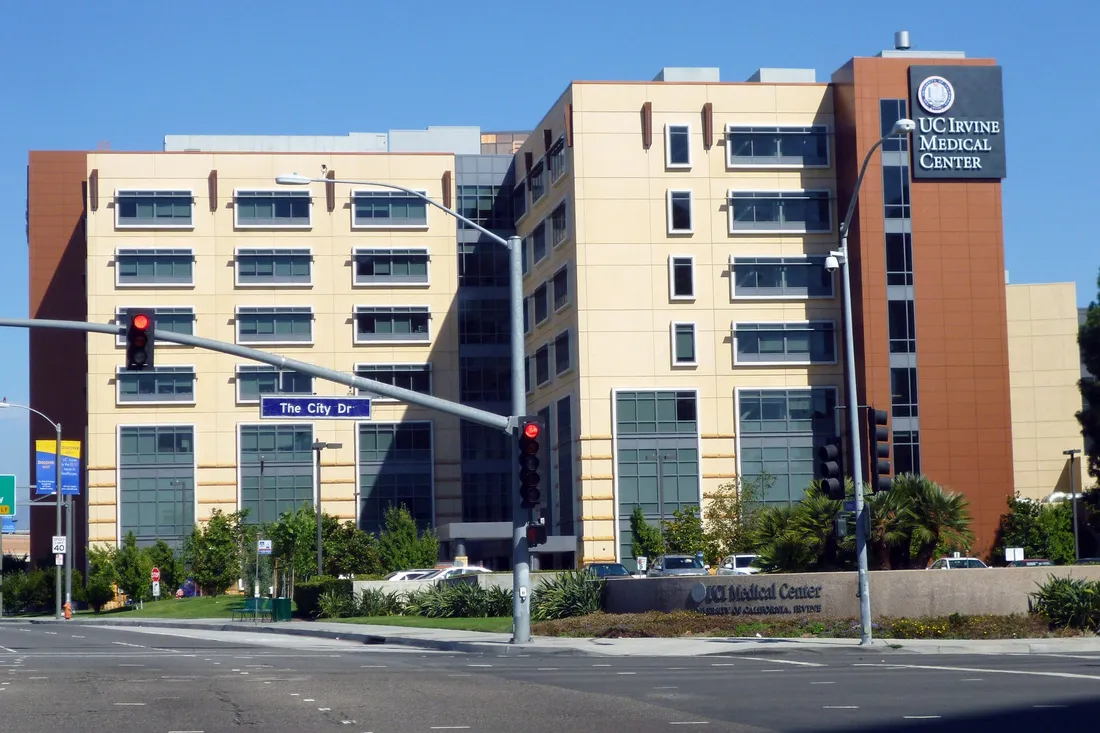
| UC Irvine Medical Center | Orange | 5.0 miles | 315 |
| Fountain Valley Regional Hospital and Medical Center – Euclid (now listed by Google as UCI Health – Fountain Valley) | Fountain Valley | 7.0 miles | 215 |
| MemorialCare Orange Coast Medical Center | Fountain Valley | 8.4 miles | 293 |
| AHMC Anaheim Regional Medical Center | Anaheim | 9.8 miles | 257 |
| Hoag Memorial Hospital Presbyterian | Newport Beach | 10.5 miles | 493 |
Reading one hospital’s line in the ratings
Here is how a row reads in practice, using Hoag Memorial Hospital Presbyterian, the busiest of the seven. In the 2023-2024 data, Hoag was rated “Better” than the state on two measures, stroke after isolated bypass and 30-day readmission, and “Average” on the other two, operative death after isolated bypass and after bypass combined with valve surgery. “Average” here means the hospital’s risk-adjusted rate wasn’t statistically different from California’s, which is where most hospitals sit on most measures.
Two cautions apply to every row. The combined bypass-and-valve measure rests on small numbers at most hospitals: Hoag’s rating on it came from 63 operations over two years, and smaller programs had a dozen or fewer. With so few cases, one or two outcomes swing the rate a long way, which is why most of those ratings land on “Average”. And a rating describes the hospital’s surgical program, not the cardiologist who referred you to it.
Volume is not a rating either, and a smaller program isn’t a worse one. What volume tells you is how routine the operation is for that team. If a bypass has been recommended, the ratings page shows how each of these hospitals did on the four measures. Read it for the specific hospital, and ask the surgeon how the hospital’s results compare.
Stent programs without on-site heart surgery
Most stent procedures in California are done at hospitals that also have cardiac surgeons. A smaller group of hospitals is certified by the California Department of Public Health under Health and Safety Code section 1256.01 to perform elective (scheduled) angioplasty and stenting without heart surgery on site. HCAI reports on those hospitals every year in its elective PCI program report.
In 2024, 24 hospitals held that certification, and HCAI recorded zero elective PCI deaths and zero strokes among them that year. Two of the 24 are in Orange County: Kaiser Foundation Hospital in Irvine and UC Irvine Health in Los Alamitos. If you’re a Kaiser member in Tustin and a scheduled stent has been proposed at the Irvine hospital, this report is the one that covers it.
The hospital-level file behind the report gives the scale. In 2024, Kaiser’s Irvine hospital reported 455 stent procedures in all: 202 elective and 253 primary, meaning done urgently for a heart attack. The Los Alamitos hospital reported 194, of which 54 were elective. Neither recorded a death, a stroke or an emergency bypass after an elective procedure that year. Across all its procedures, urgent ones included, Irvine reported one death, and the state’s file shows how that compares once the risk of each patient is taken into account. Numbers this small can’t separate a good program from a lucky year, so read them as a sign that the hospital does the procedure regularly, not as a score.

What the state reports leave out
These reports are narrower than they look, and it helps to know where they stop:
- They cover two operations. Valve procedures such as TAVR, pacemaker implants, rhythm ablations and leg-artery work aren’t rated hospital by hospital in either report.
- The stent report covers only the 24 certified hospitals, not the larger hospitals that do most of the state’s stents.
- Surgeon-level bypass ratings exist, but the most recent surgeon file on the state’s open data portal covers 2017 and 2018.
- None of it rates an office cardiologist. Whether a doctor explains things clearly, returns calls and follows up is something you learn from the visit itself, and from people who have been there.
Keep emergencies separate from all of this. In an emergency the choice isn’t yours to make by spreadsheet: paramedics take a suspected heart attack to a hospital Orange County has designated for heart-attack patients, and that is the right place to go.
From the Tustin Metrolink station to Alden Drive without a car
Tustin has something most Orange County cities don’t: a commuter rail station with a large free garage, a straight run into Los Angeles Union Station, and, since May 2026, a subway line from Union Station to within a short ride of our office. For a patient who would rather not drive the I-5 in traffic, or who has been told not to drive at all for now, the train turns a hard trip into a manageable one.


The station on Edinger Avenue and its garage
Metrolink’s Tustin station page puts the station at 2975 Edinger Avenue, served by two lines: the Orange County Line and the Inland Empire-Orange County Line. The City of Tustin owns the station. Parking is free for Metrolink passengers, with 932 spaces, 8 of them accessible spaces. Cars belonging to anyone who isn’t riding the train can be towed, so keep your ticket.
The station also connects with OC Bus and Station Link service, which helps if someone can drop you off but can’t wait with you.
Tustin to Union Station on the Orange County Line
We checked a sample weekday, Tuesday, December 1, in Google Maps transit directions. Orange County Line trains left Tustin at 7:20, 8:20 and 10:20 a.m. The 10:20 train reached L.A. Union Station at 11:20 after seven stops, an hour on the train. Schedules change, and Metrolink publishes the current timetable for each station, so check it for your own date before you book an appointment time around it.
Union Station to Wilshire/La Cienega on the Metro D Line
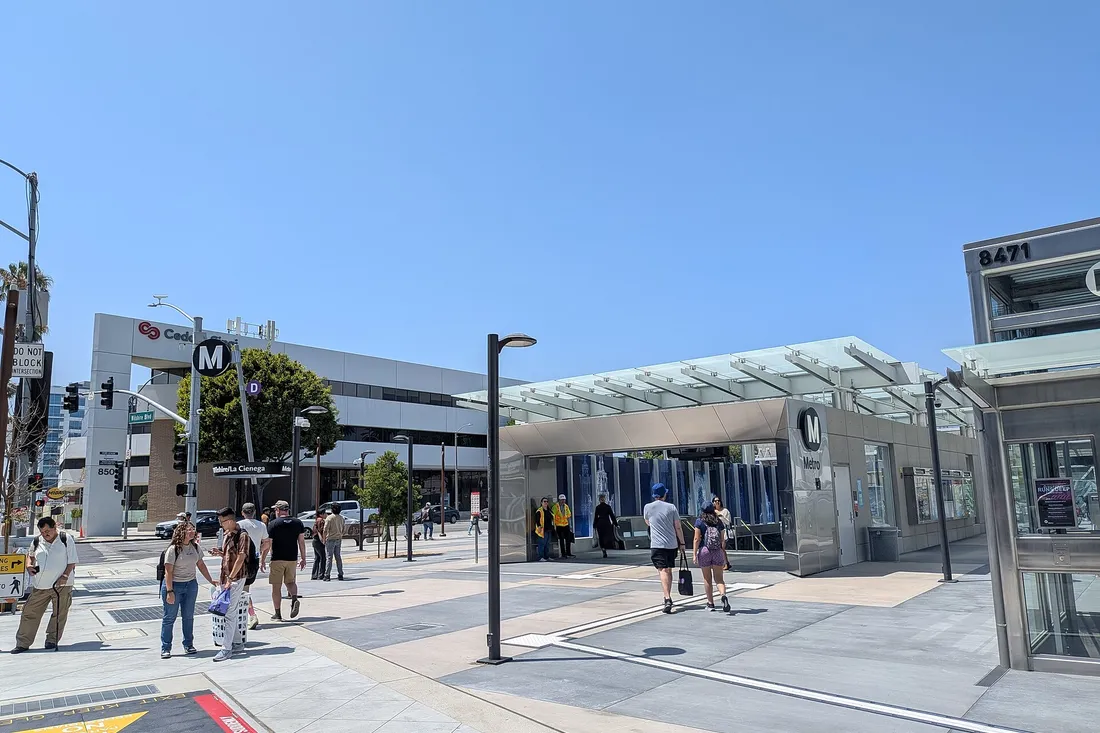
Metro’s D Line used to end in Koreatown. According to Metro’s project page, Section 1 of the extension opened on May 8, 2026, adding stations at Wilshire/La Brea, Wilshire/Fairfax and Wilshire/La Cienega. For a CACVI patient the last of those is the one that counts.
In the December 1 itinerary, the D Line train left Union Station at 11:31 a.m., eleven minutes after the Metrolink arrival, and reached Wilshire/La Cienega at 11:52, ten stops and 21 minutes later. The transfer itself was a two-minute walk inside Union Station.

The last stretch up La Cienega to Alden Drive
Above ground at La Cienega, the Google itinerary had riders board the northbound 105 bus for a four-minute, three-stop hop to the corner of Third Street. From there it is a walk of about half a mile, roughly eleven minutes, to 8741 Alden Drive. The itinerary reached the office at 12:14 p.m., one hour and 54 minutes after the train left Tustin.
If half a mile on foot is more than you can manage right now, say so when you call. A ride-hail for that last stretch from the station is short, and a family member meeting you at the station is another option.
Boarding with a wheelchair, scooter or walker
Metrolink’s accessibility rules are specific. Passengers who need help boarding wait at the top of the access ramp at the end of the platform. Wheelchairs, scooters and other mobility devices ride only on the lower level of the car that stops in front of that ramp, and a device can’t be wider than 32 inches, longer than 58 inches or heavier than 600 pounds with its rider. If you use a power chair after a heart failure admission or an amputation, measure it before the trip rather than finding out on the platform.
What the trip costs, and the discounts that apply
Google Maps priced the full itinerary at $15.25 at regular fares. Metrolink’s everyday discounts cut that for many cardiology patients:
- Seniors aged 65 and over, riders with disabilities and Medicare recipients get 50% off one-way tickets, the SoCal Day Pass and the 5-Day Flex Pass, and 25% off a monthly pass.
- You may be asked for a photo ID showing your date of birth, or other proof of eligibility. Metrolink’s accessibility page lists a Medicare ID card among the accepted proofs, along with a DMV disabled person placard receipt and reduced-fare cards from other transit systems.
- A personal care attendant rides free with a rider who has a disability, as long as they board and leave the train together.
- Trained service animals ride free.
The discount doesn’t apply to the L.A. Zone Day Pass.
On the Los Angeles side, Metro has its own reduced fares. Under Metro’s fare caps, a rider aged 62 or over, or a qualifying rider with a disability, stops paying after $2.50 in a day or $5 in a week, according to its fares page. Those caps apply when you pay Metro separately, for example if you ride the D Line on a day you drove to Union Station instead of taking the train.
Getting back to Tustin the same afternoon
The return is where an appointment time matters. On the same sample Tuesday, the routes Google offered from Alden Drive reached the Tustin station at 3:41, 4:41, 5:41 and 6:41 p.m., most of them pairing the D Line with the Orange County Line. The quickest took two hours and two minutes door to platform. In practice that means a late-morning arrival, an early-afternoon appointment and a train home before the evening rush is the pattern that works.
If you plan to come by train, tell the scheduler at 310-652-2744 which train you plan to catch from Tustin. An appointment that starts after about 12:30 p.m. leaves room for the 10:20 train and still gets you home before dark.
The train and the I-5 from Tustin, side by side
Neither option is always faster. Driving is quicker at midday and slower at dawn. The train is slower at midday but almost the same at any hour. Seeing them next to each other makes the choice easier.
What Google Maps expects on the road
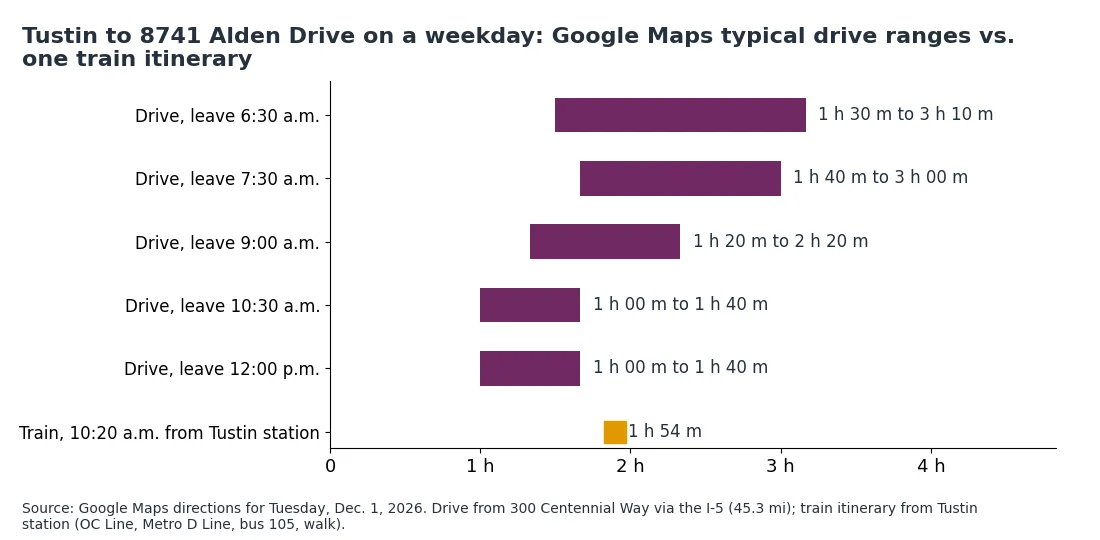
For the drive we used Tustin City Hall at 300 Centennial Way as the starting point and the same Tuesday, December 1. Google’s shortest route was 45.3 miles on the I-5 north, with alternatives via the I-405 and via the I-5 and I-105. These are the “typically X to Y” ranges Google gave for each departure time:
| Leaving at | Tustin City Hall to Alden Drive (I-5 N) | Leaving at | Alden Drive to Tustin City Hall (I-5 S) |
|---|---|---|---|
| 6:30 a.m. | 1 hr 30 min to 3 hr 10 min | 12:00 p.m. | 1 hr to 1 hr 50 min |
| 7:30 a.m. | 1 hr 40 min to 3 hr | 1:30 p.m. | 1 hr 15 min to 2 hr 40 min |
| 9:00 a.m. | 1 hr 20 min to 2 hr 20 min | 3:00 p.m. | 1 hr 40 min to 3 hr 20 min |
| 10:30 a.m. | 1 hr to 1 hr 40 min | 4:30 p.m. | 1 hr 50 min to 3 hr 10 min |
| 12:00 p.m. | 1 hr to 1 hr 40 min | 6:00 p.m. | 1 hr 30 min to 2 hr 20 min |
The spread is the problem. Leaving at 6:30 a.m., the I-5 trip could take anywhere from an hour and a half to more than three hours. Leaving at 10:30, the range shrank to one hour to one hour and 40 minutes. The train’s hour from Tustin to Union Station doesn’t move with traffic, which is why it’s the steadier choice for an early appointment, and the drive is usually the quicker one in the middle of the day.
Where the time goes on the train
The train trip isn’t one long ride. It’s four pieces: an hour on Metrolink, a short transfer at Union Station, 21 minutes on the D Line and about 15 minutes of bus and walking at the end. Each piece is short, which suits people who find a long stretch behind the wheel tiring. The catch is the transfers. If you use a walker or a wheelchair, ask Metro and Metrolink about elevator access at each station before the day, not on it.
A sample day built around the train
Put together, the December 1 itineraries give a workable shape for a car-free visit:
- Board the 10:20 a.m. Orange County Line train at Tustin.
- Change to the D Line at Union Station at 11:31 and get off at Wilshire/La Cienega.
- Bus 105 and a short walk put you at 8741 Alden Drive at about 12:14 p.m.
- A first consultation starting around 12:30 leaves about two hours before you need to head back.
- Leave the office area by about 2:39 p.m. for the D Line and the Orange County Line, and you’re back on the Tustin platform at 4:41.
If the visit runs long, the same pattern repeats an hour later, reaching Tustin at 5:41 and 6:41 p.m. Tell the scheduler you’re on the train so the appointment isn’t booked for 9 a.m.
Parking at our end
Drive yourself and you’ll want the structure at 141 Robertson, signed as Lot 703: it’s the one CACVI prefers, it’s three minutes from Suite A, and a short consultation fits inside its two free hours. Of the two other garages it lists, Robertson Plaza charges from the first 15 minutes, and the Steven Spielberg Building garage gives a free first hour on weekdays only.

When a heart condition means someone else should get you there
A 45-mile trip is a bigger ask when the reason for the appointment is a symptom that affects your ability to drive. This section is about the patients for whom the train, a family driver or a Medi-Cal ride isn’t a convenience but the sensible plan.
California’s reporting rule for lapses of consciousness
California has a law many patients have never heard of. Once a doctor diagnoses “a disorder characterized by lapses of consciousness” in anyone aged 14 or over, California expects a written report to go to the county’s local health officer, under Health and Safety Code section 103900. From there it goes on to the DMV. The statute keeps the report confidential and lets the DMV use it for one thing only: deciding whether the person should hold a license.
Not every faint qualifies. The state defines which disorders count, and the decision about a particular patient is a medical one made after an evaluation. Still, the law tells you how California sees the problem: an unexplained loss of consciousness and a driver’s seat don’t go together until the cause is known.
Fainting, near-fainting and a new rhythm diagnosis
If you’ve passed out, nearly passed out, or been told your heart rate drops too low or races out of control, ask the doctor who saw you whether you should be driving before you plan a 45-mile drive to see a cardiologist. Ask the question in those words. Many patients assume the answer is yes because nobody said no.
The same caution applies after a defibrillator shock, after a change to a medicine that lowers blood pressure or heart rate, and on the first days of a new rhythm drug. The answer may be “drive locally, but not on the freeway yet,” and the trip to Alden Drive can be planned around it.
Going with a companion
The simplest plan is a companion. On Metrolink, a personal care attendant rides free with a rider who has a disability. In a car, a second adult can take the wheel for the return leg, which is the part of the day when people are most tired. If you’re bringing a family member anyway, bring them into the exam room too. A second pair of ears catches details people forget once the appointment is over.
Getting to the Tustin station without driving there
The train only helps if you can reach the platform. Two Orange County programs cover that first leg. OC ACCESS, OCTA’s shared-ride service for people whose physical or cognitive limitations keep them off regular buses, runs within three-quarters of a mile of OC Bus routes during the same hours. A one-way trip costs $3.60, a companion pays the same, and rides are booked at least one day and up to three days ahead at 877-628-2232. Eligibility has to be approved first, so apply well before the appointment.
For older residents, OCTA’s Senior Mobility Program funds local rides for people 60 and over in participating cities, and Tustin is on OCTA’s list of participating cities. The details of each city’s program differ; OCTA’s program line is 714-560-5596.
A ride when there’s no one to drive
For CalOptima members, the Medi-Cal transportation benefit described above is the option to use. If the reason you can’t drive is the same reason you shouldn’t sit in an ordinary car, the van-or-ambulance version is the one to ask about, and it starts with a prescription. Raise it with your PCP or the cardiology office in the same conversation that sets the appointment date.
Monitoring that keeps working between trips from Tustin
Distance changes how a cardiologist gathers evidence. A patient who lives around the corner can drop in for a recheck. A patient 45 miles away can’t, so the tests that record the heart while you’re at home in Tustin carry more of the load. Two kinds matter most: monitors you wear for a while, and devices already implanted in the chest.
A heart monitor that reports from your own neighborhood
CACVI lists mobile cardiac telemetry (MCT) among its diagnostic services. As the practice’s page describes it, MCT is a small monitor you wear through ordinary days, errands, exercise and sleep. Every beat is captured, transmitted by cellular connection, and read by trained staff at a monitoring center that is staffed day and night. If they see an abnormal rhythm, they contact your physician straight away rather than waiting for your next visit.
For a Tustin patient this is the practical point: the monitor does its work on your street, at your job and in your bed, and the cardiologist in Los Angeles sees the result without you making the drive. Once the study ends, the monitoring service sends an end-of-study report to the ordering physician, and that report becomes the agenda for your next appointment.
Racing episodes that start and stop suddenly
Supraventricular tachycardia (SVT) and atrial fibrillation treatment in Orange County start with catching the rhythm. Both share a frustrating feature: the heart races, then settles before anyone can record it. An EKG taken in the office afterward is often normal.
Catching that kind of episode is the reason the telemetry monitor exists. CACVI’s MCT page says the device triggers automatically for slow heart rates, fast heart rates, pauses and atrial fibrillation, and that you can press a button to mark the moment you feel a symptom. The service also reviews the full recording for rhythms you didn’t feel and calculates how much of the time was spent too fast, too slow or in atrial fibrillation.
What you can add is a short diary. Each time you press the button, jot down the time, what you were doing, and how it ended: did it stop by itself, after you bore down, or after you lay down? That last detail is useful to the physician reading the report, because how an episode ends is part of the history they will ask you about anyway.
Pacemakers and defibrillators already in place
An implanted device that is overdue for a check is a real reason to call. The practice lists implants of pacemakers and defibrillators among its services, and one physician, described below, is certified as a cardiac device specialist. As the practice’s defibrillator page puts it, an ICD continuously monitors the heartbeat and delivers electrical pulses to restore a normal rhythm when it detects a dangerous one.
If you have a device implanted elsewhere and you’re thinking about moving your care, bring your device ID card and the name of the hospital or clinic that has been following it. Ask how device checks would be arranged once you’re a CACVI patient, and whether any part of that can happen without a trip to Los Angeles.
Making sure the data reaches the right doctor
Monitoring only helps if the results land in front of the physician who ordered them. When a monitor or device report comes from a company or clinic outside the practice, confirm that the office has it before your follow-up visit, and keep your own copy. A report that sits in a portal nobody opens is the most common reason a follow-up visit ends with “let’s repeat the test”.
What a video consultation can settle, and what needs the exam room
People want an online cardiologist consultation for good reasons, and from Tustin the appeal is obvious: no I-5, no parking, no lost day. The honest picture has two halves.
California’s rule on consent for telehealth
Under Business and Professions Code section 2290.5, a provider starting a telehealth visit has to tell you that telehealth is being used and get your verbal or written consent, and that consent has to be documented. The same section says agreeing to telehealth doesn’t stop you from receiving in-person care later in the same course of treatment. You aren’t locking yourself into video by trying it once.
What can’t travel down a video link
A cardiac evaluation, as CACVI’s own page defines it, is a physical examination plus a medical history. The history travels well over video. The examination doesn’t. Hearing a murmur through a stethoscope, comparing the pulse at your ankle with the one at your wrist, pressing on a swollen shin: none of that crosses a screen. So does every test on the list above that involves a machine: the EKG, the echocardiogram, the stress test.
That’s why a first visit for a new heart symptom is usually in person, and why it makes sense to bring everything to that first visit at once.
What your health plan has to pay for
For DMHC-licensed plans, Health and Safety Code section 1374.14 requires coverage of services appropriately delivered by telehealth on the same basis and to the same extent as the same service in person. The copayment or coinsurance for a video visit can’t be higher than for the in-person version, and the same deductible applies. Two limits matter for a Tustin patient looking at a Los Angeles practice: the law doesn’t make a plan cover telehealth from an out-of-network provider unless another law requires it, and it doesn’t change the plan’s duty to give you an adequate network of in-person providers. A video visit with an out-of-network cardiologist is out of network.
Where a video visit can fit
Some conversations work well on a screen: going over results that have already come back, reviewing a home blood pressure log, or deciding whether a medicine change has done what it should. CACVI’s website doesn’t describe a video visit service, so ask when you call whether a particular follow-up could be done that way. Don’t assume it can, and don’t assume it can’t.
The cardiologists behind the Alden Drive office
The practice’s about-us page names three physicians, and each one’s bio leans toward different work. A Tustin patient making a long trip may as well ask for the physician whose background matches the reason for the visit.
If the question is a device in your chest
For a pacemaker or defibrillator question, the most relevant bio is that of Mehran J. Khorsandi, M.D.. Of the three, only he lists the cardiac device specialist credential (formerly NASPE), which sits on top of four board diplomas: internal medicine, cardiovascular disease, interventional cardiology and endovascular medicine. Device implantation appears among his stated interests, alongside high-risk angioplasty, coronary bifurcation disease and saving limbs. Cedars-Sinai is where he did his residency and fellowship after graduating from Penn’s medical school, and his bio dates his attending appointment there to 1993. Today he also directs the cardiac cath lab at Providence Cedars-Sinai Tarzana, teaches fellows in the Cedars-Sinai cath lab, and holds 50 issued patents tied to a bifurcation stenting company he co-founded.
If the question involves your legs as well as your heart
When leg pain, a foot wound or vein disease travels with the heart problem, ask about Moinakhtar Lala, M.D.. His arrival in the fall of 2016 is when the practice’s leg-saving work became a formal program, and his bio names him as its founder. Before California, his residency (where he was also chief resident) was at SUNY Downstate and Long Island College Hospital, and his heart and catheter fellowships at Mount Sinai Beth Israel. On the heart side he takes on wrist-access and totally blocked coronary arteries; on the leg side, critical limb ischemia and vein ablation; and he lists TAVR too. He is certified to read echocardiograms, nuclear studies and vascular ultrasound (RPVI), and one of his published papers describes reaching blocked leg arteries through the foot, a trans-pedal approach.
If the question is atrial fibrillation, heart failure or a heart affected by cancer treatment
Vasim Lala, D.O. came to the practice most recently, in mid-2022. His medical degree and early training were in Michigan, at Michigan State’s osteopathic college and a McLaren Macomb fellowship, before structural and catheter subspecialty work at The Mount Sinai Hospital. Two procedures on his list are absent from the other bios: PFO closure and the WATCHMAN device. On the medical side his bio names hypertension, congestive heart failure, atrial fibrillation, the cardiomyopathies and cardio-oncology, which is heart care for people going through cancer treatment. Outside the clinic, his bio points to blog writing for the American College of Cardiology and TCTMD, plus authoring and editing work on StatPearls.
Booking your first cardiology visit from Tustin
The phone line for Alden Drive, 310-652-2744, is answered on weekdays during office hours, and the appointments page has a form for questions. Referral paperwork from a Tustin doctor’s office can be faxed to 310-967-2140.
A few things make a first visit from Tustin go better:
- Tell the scheduler you’re coming from Tustin and how. “I’m taking the 10:20 train” gets you an appointment time that fits it.
- Keep the insurance card, and any referral or authorization number your plan issued, beside the phone.
- Find out whether any test could be added to the consultation day, which saves a second trip up the I-5.
- El Centro de new patients page has a registration form to print and complete at home; arriving a quarter of an hour early is what the office asks.
Tustin cardiology questions, answered
Which CACVI office is closest to Tustin?
CACVI has three offices. Besides Suite A at 8741 Alden Drive in Los Angeles, there is a San Fernando Valley office at 18226 Ventura Boulevard, Suite 102, in Tarzana (818-905-5904) and a High Desert office at 12441 Hesperia Road, #A5 and #A6, in Victorville (760-706-7115). From Tustin, Alden Drive is the closest of the three.
Is any CACVI office open on Saturdays?
Yes, one. The Tarzana office opens Saturdays from 8:00 a.m. to 4:30 p.m., according to the hours on CACVI’s contact page. Alden Drive and Victorville keep weekday hours only, 8:30 to 5. It’s a longer haul from Tustin than Alden Drive, so it suits a patient whose weekday schedule has no give in it.
Is CACVI accepting new patients?
Yes. The practice keeps a new patients page with a registration form, and new patients book the same way returning ones do, by phone. Openings with a particular physician change week to week, so the scheduler at 310-652-2744 is the only reliable answer for a specific doctor and date.
Can I book an appointment by email or through the website?
CACVI’s contact page asks patients to call one of the offices to request an appointment. The online form and the info@cacvi.org address are there for quick questions. You can start with the form, but a phone call is what actually puts a date on the calendar.
Can I get a printed copy of my plan’s provider directory?
Yes. Under section 1367.27, anyone can ask a DMHC-licensed plan for a printed directory by calling its toll-free number, electronically or in writing. The plan has to mail it, postmarked no later than five business days after the request, and it can limit the copy to the region where you live or work. A printed list of Orange County cardiologists is easier to work through with a highlighter than a search page.
Can I change my CalOptima health network to reach a different cardiologist?
CalOptima’s Medi-Cal page includes an option to change your health network or primary care provider. Before you switch, ask customer service at 1-888-587-8088 which cardiologists the new network works with, and whether a referral that’s already in process would have to start over. Changing networks to reach one doctor only helps if that doctor is in the new network.
Does my Metrolink ticket cover the Metro part of the trip?
Yes, according to Metro’s fares page: if you transfer from Metrolink, you scan your valid Metrolink ticket at the Metro Rail fare gate or show it to the bus operator when you board. That’s why the Tustin itinerary on this page has one price. Keep the ticket handy until you step off the bus on La Cienega.
Can I leave my car at the Tustin station overnight?
Yes. Metrolink’s station page says overnight parking is allowed at Tustin. That helps if a test or procedure means staying in Los Angeles and coming back the next day. The parking is for Metrolink passengers only, so ride the train both ways.
Are the drive times on this page live?
No. They are Google Maps’ typical-traffic ranges for one sample Tuesday, checked in November 2026, and they show patterns rather than what you’ll meet on a particular morning. Check live traffic on the day you go, and pad the trip if your appointment is early.
Is a vascular cardiologist different from a regular cardiologist?
No board grants a title by that name. People use it for a cardiologist whose work reaches the arteries and veins beyond the heart. Two credentials on CACVI’s physician bios show that training: board certification in endovascular medicine, which covers catheter procedures inside the leg and body arteries and veins, and RPVI (Registered Physician in Vascular Interpretation), a credential for reading vascular ultrasound. All three CACVI physicians list RPVI or endovascular board certification, or both.
Can I see an electrophysiologist for SVT or atrial fibrillation ablation?
Two different procedures share the word “ablation” on CACVI’s site. The one on the services list is endovenous ablation, which closes faulty leg veins. Catheter ablation of a heart rhythm problem is electrophysiology. CACVI’s website also carries a bio for Arshia Noori, MD, described as an interventional cardiologist and electrophysiologist who treats atrial fibrillation, tachycardia and ventricular arrhythmias with catheter ablation and device implants. His bio says he practices in Los Angeles. Ask the scheduler where and when he sees patients before you plan the trip.
Does CACVI offer functional medicine lab testing?
No. If you are looking for “functional diagnostic” or “functional lab” testing in Tustin, note that CACVI is a cardiology and vascular practice, and functional medicine lab panels aren’t among its services. Blood or urine tests may be ordered as part of a cardiac evaluation when the physician needs them to sort out a heart symptom.
Cardiology pages for the cities around Tustin
Tustin shares its city limits with three cities, and each has its own CACVI page. Irvine wraps around the south and east sides of Tustin, Orange and the unincorporated community of North Tustin lie to the north, and Santa Ana borders the city on the west.
- Cardiologist for Irvine patients
- Cardiologist for Orange patients
- Cardiologist for Santa Ana patients
- Cardiac evaluation at CACVI, the service page all of these sit under
Statutes, agencies and data behind the Tustin facts
| Source | Publisher | What it covers |
|---|---|---|
| CACVI: Appointments and office locations | CACVI | Office addresses, phone and fax, hours (page data) and Alden Drive parking. |
| CACVI: New Patients | CACVI | Registration form and what to bring to a first visit. |
| CACVI: Cardiac Evaluation | CACVI | What a first cardiology evaluation consists of. |
| CACVI: Mobile Cardiac Telemetry | CACVI | How the home heart monitor records, transmits and auto-triggers. |
| CACVI: About Us and physician bios | CACVI | Physician training, certifications and hospital roles. |
| Health and Safety Code section 1367.27 | California Legislature (via california.public.law) | Plan provider directories, new-patient status, update deadlines, reliance remedy. |
| Insurance Code section 10133.15 | California Legislature (via california.public.law) | The parallel directory rules for health insurers. |
| Health and Safety Code section 1383.15 | California Legislature (via california.public.law) | Second opinions in health plans. |
| Health and Safety Code section 1373.96 | California Legislature (via california.public.law) | Completing care with a provider who left the network. |
| Health and Safety Code section 103900 | California Legislature (via california.public.law) | Reporting disorders characterized by lapses of consciousness. |
| Business and Professions Code section 2290.5 | California Legislature (via california.public.law) | Consent before a telehealth visit. |
| Medicare: Does your provider accept Medicare as full payment? | Medicare.gov | Assignment, non-participating providers, limiting charge and opt-out. |
| CalOptima Health: Medi-Cal Benefits and Services | CalOptima Health | Prior authorization, out-of-area pre-approval, customer service and nurse line. |
| Medi-Cal Transportation Services | California Department of Health Care Services | NMT and NEMT rides and how to request them. |
| CABG Hospital Performance Ratings, 2024 | Department of Health Care Access and Information | Statewide bypass results and how hospitals are rated. |
| Coronary Artery Bypass Graft Outcomes Reports | Department of Health Care Access and Information | Report index and the link to the 2018-2024 hospital ratings data file (case counts used in the chart). |
| Elective PCI Program Report, 2024 | Department of Health Care Access and Information | Hospitals certified for elective stenting without on-site surgery. |
| Tustin station | Metrolink | Station address, lines, parking and connections. |
| Everyday discounts | Metrolink | Senior, disability and Medicare fare discounts. |
| D Line Extension | LA Metro | Section 1 opening on May 8, 2026, and its new stations. |
¿Listo para hablar?