




















Evaluación cardíaca
Cardiologist Care for Agoura Hills and the Conejo Corridor
Agoura Hills sits at the western end of Los Angeles County, where the 101 runs between Ladyface Mountain and the Simi Hills. When someone in Agoura Hills needs an interventional cardiologist, there is usually a reason behind it: an abnormal stress test, a calcium score that came back high, calf pain that cuts a walk short, or a doctor who has already used the words “angiogram” or “stent.” What follows is written for that moment. The nearest office of the Center for Advanced Cardiac and Vascular Interventions (CACVI) is in Tarzana, at 18226 Ventura Boulevard, Suite 102, about 15.5 miles east of Agoura Hills City Hall on the 101.
CACVI’s physicians are interventional cardiologists, which means they do the office visit and the catheter work. They see patients for chest pain, palpitations and blood pressure, and they also open narrowed arteries in the heart, the legs, the kidneys and the neck. If you live in Agoura Hills, Oak Park, Westlake Village or the canyons around them, the sections below explain what that work involves, which procedures can be done in an outpatient facility and which need a hospital, how the drive to the Tarzana office fits your week, and what the research says about when a stent helps and when it doesn’t.
Appointments for Agoura Hills patients go through the Tarzana line, 818-905-5904. The phones are answered on weekdays from 8:30 to 5:00, and on Saturdays the office opens at 8:00 and closes at 4:30.
What to confirm about the Tarzana office before calling from Agoura Hills
Agoura Hills patients are seen at our Tarzana office, about 15.5 miles east on the 101. The table below lists the facts that matter for someone booking from here, each with the place we checked it. Drive times are Google Maps typical-traffic estimates measured from Agoura Hills City Hall at 30001 Ladyface Court.
| Verified detail | What it means for an Agoura Hills patient | Source |
|---|---|---|
| Nearest office: CACVI San Fernando Valley office, 18226 Ventura Blvd, Suite 102, Tarzana, CA 91356 | Consultations for Agoura Hills patients are in Tarzana. Ask at booking where any procedure would be done. | CACVI: Appointments |
| Phone 818-905-5904, fax 310-967-2140, info@cacvi.org | One call books a consultation, a test or a procedure review. | CACVI: Appointments |
| Open Monday to Friday 8:30 a.m. to 5:00 p.m., Saturday 8:00 a.m. to 4:30 p.m., closed Sunday | A Saturday morning visit is possible for people who work weekdays. | Google Maps listing |
| 15.5 miles from Agoura Hills City Hall via US-101; 16.8 miles back | About 32 miles round trip for an office visit. | Google Maps directions |
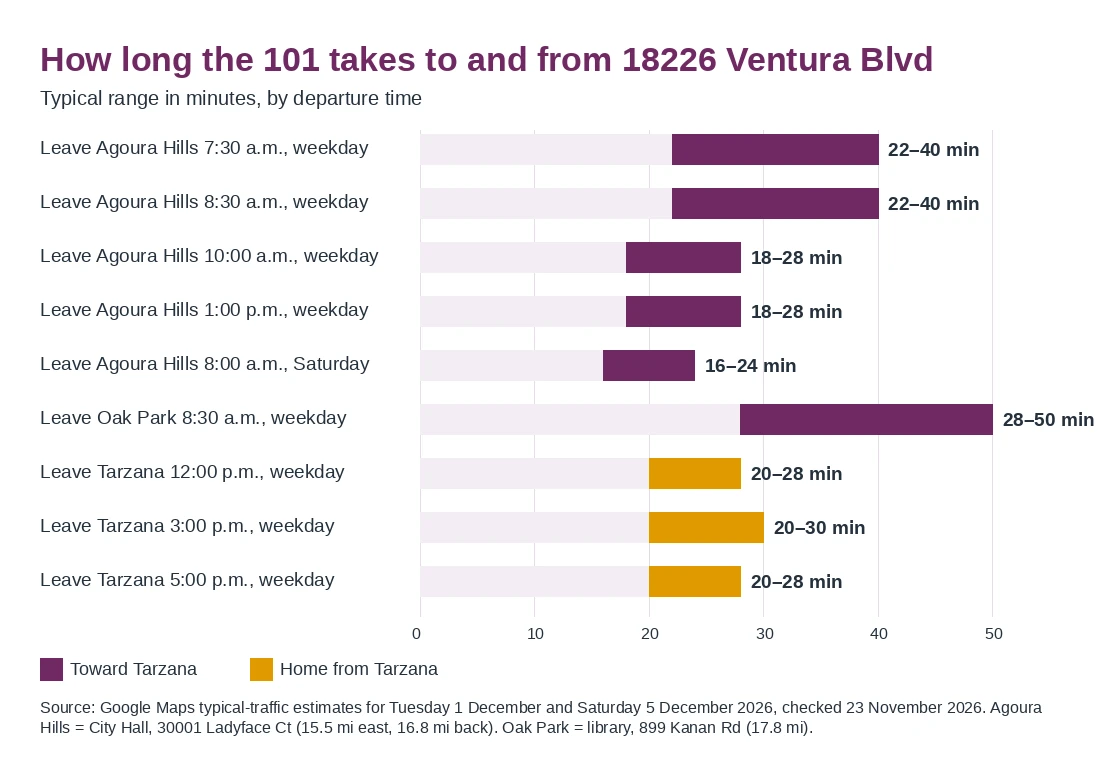
| Typical weekday drive 22 to 40 min leaving 7:30 or 8:30 a.m.; 18 to 28 min leaving 10:00 a.m. or 1:00 p.m.; 16 to 24 min on Saturday at 8:00 a.m. | A mid-morning or Saturday slot saves the most time. | Google Maps directions |
| Limited on-site parking or street parking, listed as free | Free, but spaces are limited; allow time to park. | CACVI: Appointments |
| Three LA County STEMI receiving centers within reach: Los Robles, UCLA West Valley, Providence Cedars-Sinai Tarzana | In a heart attack, 911 takes you to a hospital with a cath team on call around the clock. | LA County EMS STEMI receiving centers map |
| Lab draw sites in Agoura Hills: Quest, 29525 Canwood St; Labcorp, 28240 Agoura Rd | Pre-procedure blood work can be done close to home. | Google Maps listings |
Two of these rows change how people plan. The first is Saturday. The Tarzana office keeps Saturday hours, and on a Saturday morning the 101 is at its quietest of all the times we checked, so a working patient from Agoura Hills can often fit a consultation or a follow-up into a weekend morning instead of losing a weekday. Procedures are scheduled separately, so ask the front desk which visit types are offered on Saturdays.
The second is the hospital list. Three hospitals within reach of Agoura Hills are on Los Angeles County’s map of heart-attack receiving centers, and that matters more to someone with a stent than to anyone else. The section on chest pain after a stent covers it in detail.
What an interventional cardiologist near Agoura Hills trains for and does
If you live in Agoura Hills and need an interventional cardiologist close to home, it helps to know what the title means. The term describes a cardiologist who has gone through additional training to work inside the arteries with catheters, wires, balloons and stents, under live X-ray. It does not describe a surgeon. Nobody’s chest is opened in a catheter lab.
The training behind the title
Every cardiologist starts as an internist. After residency in internal medicine, a doctor spends three years in an accredited cardiovascular disease fellowship. The American Board of Internal Medicine (ABIM) then requires a further 12 months of accredited full-time fellowship in interventional cardiology before a physician can sit for its interventional cardiology certification exam. So the interventional cardiologist you meet in Tarzana has spent at least a year beyond general cardiology learning to do angiograms, angioplasty and stenting.
Some interventional cardiologists stop at the coronary arteries. Others add training in the arteries outside the heart, which is usually called endovascular or peripheral work. The CACVI physicians’ published bios list both, and each lists board certification in endovascular medicine or vascular interpretation as well. That combination means a patient who needs a vascular cardiologist near Agoura Hills can see the same physician for the heart and for the arteries in the legs, neck and kidneys.
What actually goes through a catheter
A catheter is a thin, flexible tube, usually entered through an artery at the wrist or the groin. Once it is inside the arterial tree, it can be steered almost anywhere. In practice, the work falls into four groups:
- Diagnostic angiograms. Contrast dye is injected through the catheter and filmed with X-ray, which shows where an artery has narrowed and how badly.
- Coronary procedures. Balloon angioplasty, stents, and work on hard calcium or fully blocked coronary arteries.
- Peripheral procedures. The same tools used in the legs, the kidney arteries, the carotid arteries in the neck and the aorta.
- Structural and device procedures. Valve replacement through a catheter (TAVR), closure devices such as WATCHMAN, and pacemaker or defibrillator implants, depending on the physician’s training.
Where an interventional cardiologist fits in your care
Most people do not need to start with an interventional cardiologist. A primary care doctor can order the first tests, and many heart conditions are handled with medicines and follow-up visits alone. The point at which an interventional cardiologist becomes the right person to see is usually one of these:
- A stress test, calcium scan or CT angiogram has shown a probable blockage, and someone has raised the idea of an angiogram.
- Your legs give out on a walk before your breath does.
- Blood pressure stays high on several medicines and someone has mentioned the kidney arteries.
- An ultrasound of the neck has shown a narrowed carotid artery.
- You have already been told you need a stent, and you want the person who would place it to explain why.
The last one is common. At CACVI, the physician who reviews your test results in the exam room is also the one who would do the procedure, so the decision and the work are not split between strangers.
When the answer is surgery instead
A catheter is not the right tool for every blockage. Disease in several coronary arteries, especially with diabetes or a weak heart muscle, is sometimes better treated with bypass surgery by a cardiothoracic surgeon. Some aneurysms and some leg-artery blockages are better treated with open repair. An interventional cardiologist who also does surgery-adjacent work will tell you when your anatomy points that way, and refer you. If you live in Westlake Village and were told you may need a heart surgeon or a bypass, this is the conversation to have first: whether you need the surgeon at all.
If a test result mentions a blockage, bring the report and the images to a consultation in Tarzana. The number is 818-905-5904.
Catheter procedures in an outpatient facility, and when a hospital is needed
Many people assume every angiogram happens in a hospital. CACVI does part of its work in an outpatient setting instead. Its “Why Office-Based Procedures?” page says the practice performs diagnostic testing and minimally invasive treatments in an office-based lab (OBL) and/or an ambulatory surgical center (ASC), and that patients treated there leave the same day. The page does not say where that facility is, so ask at booking where your own procedure will be done; it may not be the Tarzana office where you had your consultation.
What an office-based lab is
An office-based lab is a procedure room with the same kind of X-ray imaging used in a hospital catheter lab, run by the physician practice instead of the hospital. An ambulatory surgical center is a separately licensed outpatient facility. Both are built for scheduled procedures where the patient goes home a few hours later. Neither is built for emergencies, overnight monitoring or open surgery.
CACVI’s page lists what it sees as the advantages: a familiar setting, same-day discharge, one-on-one nursing, easier scheduling, and lower cost, which it describes as “a fraction of the costs as compared to inpatient facilities.” That cost statement is the practice’s own; your share depends on your plan, and the office can tell you before you book.
Procedures that commonly suit an outpatient room
Outpatient settings are used most often for leg-artery work and vein procedures. CACVI’s service pages say that a peripheral angiogram can be followed by balloon angioplasty and stenting “in the same setting,” and that the practice can use carbon dioxide (CO2) in place of iodine dye for patients with kidney disease. Vein ablation and venous stenting are also outpatient procedures. The table below sums up, for each catheter procedure on this page, what CACVI’s own page says about it and the typical length of stay given by MedlinePlus or CACVI. Your physician decides the setting for each patient.
| Procedure | What CACVI’s page says | Typical stay |
|---|---|---|
| Peripheral angiogram and leg angioplasty or stent | Narrowing can be treated in the same setting or a later one; CO2 can replace iodine dye for kidney disease. | MedlinePlus: many people go home in 2 days or less, some without an overnight stay. |
| Coronary artery stenting | Drug-eluting stents slowly release medicine; a blood thinner follows. | CACVI: often home the same day or the next day. |
| Complex coronary intervention | Opens arteries that are completely or almost completely blocked. | Ask your physician; depends on the case. |
| Renal artery stenting | Balloon and stent through a catheter, then a blood thinner and follow-up visits. | Ask your physician; depends on the case. |
| Carotid artery stenting | May suit narrowing of 70% or more, past stroke symptoms, or high surgical risk. | MedlinePlus: sometimes overnight, sometimes home the same day. |
| Endovascular aneurysm repair (EVAR) | Stent graft placed through small groin incisions under X-ray. | Hospital procedure. |
| Genicular artery embolization | About two hours, twilight sedation, catheter in the thigh artery. | Ask at booking where it is done. |
When the hospital is the right place
A hospital catheter lab is the safer choice when the procedure is urgent, when the coronary arteries are involved and the case is complex, when a patient has serious kidney, lung or bleeding problems, or when surgery might be needed at short notice. According to his CACVI page, Dr. Khorsandi directs the cath lab at Providence Cedars-Sinai Tarzana Medical Center, the hospital closest to the office. Ask your physician where your procedure would be done and why; it is a fair question, and the answer depends on your case, not on convenience.
Questions to ask before booking a procedure in an outpatient room
An office-based procedure is a reasonable choice for many people, and a few questions make it a confident one:
- Who gives the sedation, and who watches my breathing and heart rhythm while I’m sedated?
- If something goes wrong during the procedure, which hospital would I be moved to, and how?
- How long will I stay after the procedure before I can leave?
- Who do I call that night if the puncture site bleeds or the leg feels cold, and is that line answered after 5 p.m.?
- Has my insurance approved this procedure in this setting, or only in a hospital?
Clear answers to all five, before the date is set, are part of good outpatient care.
What “same day” means for someone driving home to Agoura Hills
Going home the same day still means a few hours of observation, and it never means driving yourself. MedlinePlus, the National Library of Medicine’s patient site, advises people who had a catheter placed through the groin not to drive for at least two days, and peripheral-procedure guidance tells patients to ask whether they need someone to drive them home. For an Agoura Hills patient, that means arranging a driver for the round trip to wherever the procedure is done, plus the waiting time. Once the office has told you the address, check the drive at the hour you’ll be traveling.
Paying for an outpatient procedure
Original Medicare Part B usually pays 80 percent of the Medicare-approved amount for a covered outpatient service after the yearly deductible, leaving you 20 percent, as long as the provider accepts assignment. Medicare Advantage and commercial plans set their own rules, often including prior authorization for angiograms and stents. Ask the office to check authorization before the date is set, not the week of the procedure.
When an angiogram should end with a coronary stent, and when it shouldn’t
A coronary stent is a small metal mesh tube left inside a heart artery to hold it open after a balloon has widened it. CACVI’s stent page notes that most stents now carry a drug that is released slowly to lower the chance of the artery narrowing again, and that many patients go home the same day or the next. That is the procedure. The harder question is whether you need one, and the answer depends a great deal on whether your heart problem is an emergency or a stable condition.
In a heart attack, opening the artery comes first
When a coronary artery closes suddenly, heart muscle starts to die within minutes. In that situation, an emergency angiogram and stent at a hospital with a 24-hour cath lab is the standard treatment, and Los Angeles County routes ambulances to designated hospitals for exactly this reason. Nobody should drive to an office for this. The section on chest pain after a stent lists the receiving hospitals within reach of Agoura Hills.
In stable chest pain, the evidence is more mixed
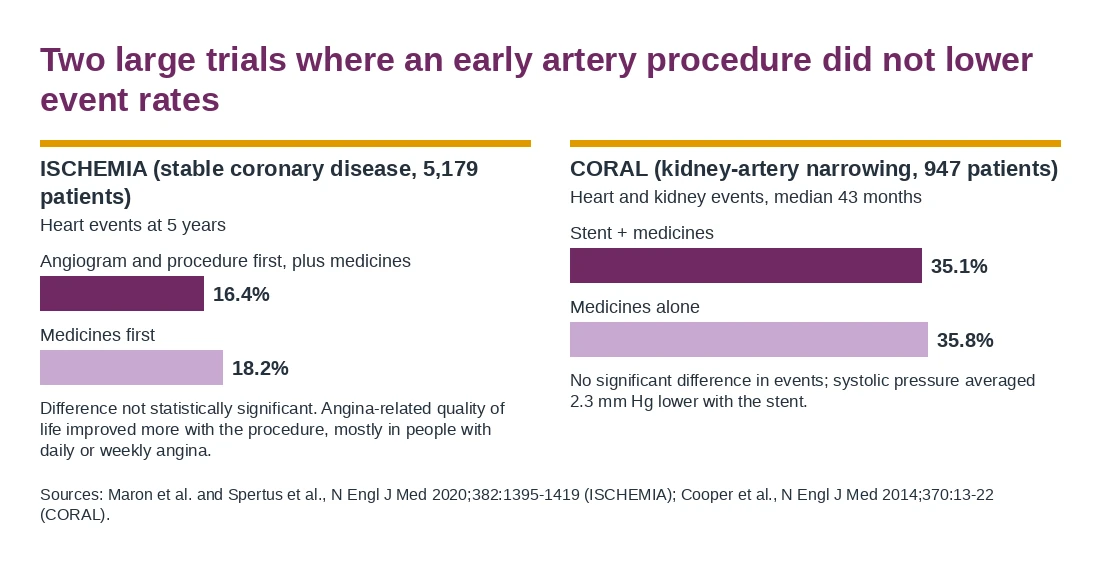
Stable coronary disease is different. These are people whose chest tightness comes on with effort and settles with rest, or who have no symptoms at all but had an abnormal stress test or scan. For them, the largest trial so far is ISCHEMIA, published in the New England Journal of Medicine in 2020. It randomly assigned 5,179 patients with moderate or severe ischemia on stress testing to one of two plans: an angiogram with stenting or bypass where feasible, plus medicines; or medicines first, with an angiogram only if the medicines failed.
Over a median of 3.2 years, the invasive plan did not reduce the combined rate of cardiovascular death, heart attack and hospitalization for unstable angina, heart failure or resuscitated cardiac arrest. At five years the cumulative event rate was 16.4 percent with the invasive plan and 18.2 percent with medicines first, a difference the trial could not separate from chance. Deaths were almost identical: 145 and 144.
What “medicines first” means in practice
The conservative plan in ISCHEMIA was not “do nothing.” MedlinePlus lists the medicines used for stable angina: nitroglycerin pills or spray to stop an episode; beta-blockers to lower heart rate, blood pressure and the heart’s oxygen use; calcium channel blockers to relax the arteries; long-acting nitrates and ranolazine to prevent episodes; ACE inhibitors for blood pressure; and anti-clotting medicines such as aspirin. Cholesterol, blood pressure and diabetes treatment sit alongside them, and a cardiac rehabilitation program may be recommended. MedlinePlus notes that stable angina most often improves with medicines.
The same page sets the line between a phone call and 911. Call 911 if angina pain is not better 5 minutes after taking nitroglycerin, does not go away after 3 doses, is getting worse, or comes back after the nitroglycerin first helped. Call the office if episodes are becoming more frequent, if angina starts while you are sitting still, or if you feel unusually tired, faint or light-headed. A change in pattern like that is often what moves a patient from “medicines first” to an angiogram.
Where a stent clearly helps in stable disease
The same trial measured symptoms. In a companion paper, patients assigned to the invasive plan reported more improvement in angina-related quality of life, and the gain was largest among people who had angina every day or every week before the trial. Among people with no angina at the start, the difference was small.
So the practical reading for a stable patient is this. If chest pain is limiting your life despite medicines, a stent is a reasonable way to relieve it. If you feel fine and the only problem is a test result, a stent is less likely to change your outlook, and good medical treatment matters more. Many patients are surprised to hear that from an interventional cardiologist. It is what the evidence shows.
Reading the report you are handed after an angiogram
Angiogram reports use a short list of names. The left main coronary artery splits into the left anterior descending artery (LAD), which runs down the front of the heart, and the circumflex, which wraps around the side. The right coronary artery (RCA) supplies the bottom of the heart. Branches get their own names, such as diagonals off the LAD and obtuse marginals off the circumflex. Narrowings are described as a percentage of the artery’s width, judged by eye or measured with software, and a report may add whether a pressure wire or an imaging catheter was used. If the report you were given lists a “70 percent” or “90 percent” lesion, bring it, and the images, to the consultation; the location matters as much as the number.
Questions to settle before a stable patient agrees to a stent
- What symptom is the stent meant to relieve, and how much is it limiting me now?
- Have the medicines for angina been tried at full dose?
- Does the artery look narrowed on the pictures, and has the pressure across it been measured during the angiogram?
- Will the procedure be done through the wrist or the groin?
- How long will I need two blood-thinning medicines afterward, and what happens if I need surgery or dental work during that time?
Blockages that need more than a balloon and a stent
Some coronary narrowings are packed with calcium, sit where an artery branches, or have closed completely for months (a chronic total occlusion). CACVI’s complex coronary intervention page describes reopening fully or nearly fully blocked arteries with angioplasty and stenting. The physicians’ bios list high-risk angioplasty, bifurcation disease, chronic total occlusions and orbital atherectomy among their interests. These cases take longer and are usually done in a hospital lab. Whether to attempt one is a decision about symptoms and heart function, not only about anatomy.
After a coronary stent
MedlinePlus notes that many people take aspirin plus a second blood thinner, such as clopidogrel, prasugrel or ticagrelor, after a stent, and that these drugs should not be stopped without talking to the cardiologist, because a clot in a new stent can cause a heart attack. If another doctor or a dentist asks you to stop them, call the office first.
Angioplasty, stents and atherectomy for leg arteries, from Oak Park to Old Agoura
If you live in Oak Park and have been told you may need a peripheral stent, a vascular cardiologist close by can explain the options. In peripheral artery disease (PAD), plaque builds up in the arteries that feed the legs. The textbook complaint is a cramp or ache that shows up at a predictable distance, in the calf, thigh or buttock, and fades within minutes of standing still. CACVI’s angiogram page adds other signs: a foot or lower leg that feels cold, sores on the feet or toes that don’t heal, numbness or weakness, shiny skin, hair loss on the legs, weak pulses in the feet, and in men, erectile dysfunction.


The ankle-brachial index comes first
Before anyone talks about stents, the leg arteries are measured. The ankle-brachial index (ABI) compares blood pressure at the ankle with blood pressure at the arm, using a cuff and a small Doppler probe. The 2024 multisociety PAD guideline from the American College of Cardiology, the American Heart Association and partner societies asks that results be reported in four bands.
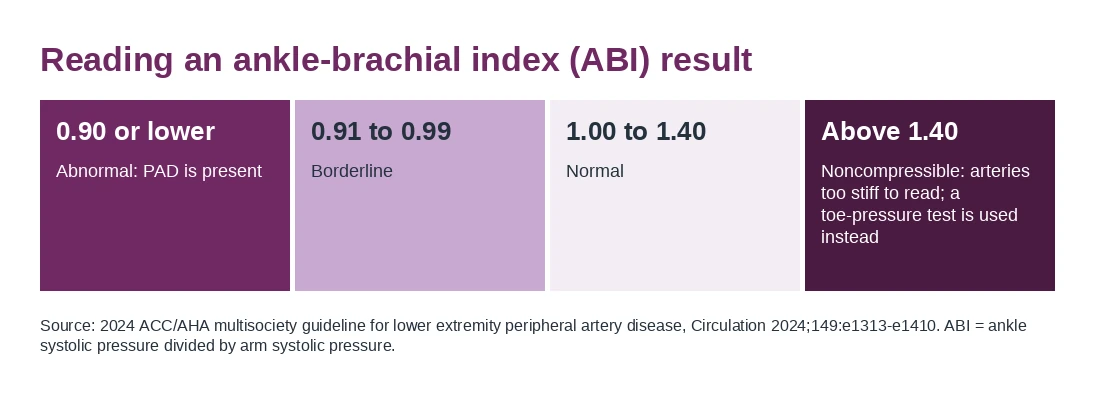
A result of 0.90 or lower confirms PAD. For people whose ABI is normal at rest but whose legs hurt on walking, an exercise ABI can unmask the problem. Ultrasound and, when a procedure is being planned, CT angiography map exactly where the narrowing is.
Diabetes, kidney disease and stiff arteries
The ABI has a known weak spot. The guideline notes that diabetes and chronic kidney disease are associated with arteries so stiff that the ankle cuff cannot squeeze them shut, which pushes the reading above 1.40 and makes it unreliable. In that case the guideline calls for a toe pressure, or toe-brachial index, with waveforms. It also suggests checking people with diabetes for peripheral neuropathy, because numb feet can hide both the pain of poor circulation and the start of a wound. For a patient with diabetes, a “normal” ankle number from an old test is not the end of the question if the feet are cold, the pulses are faint or a sore is slow to close.
Walking therapy before a procedure
This is the step many patients do not expect. For claudication, the 2024 guideline places structured exercise ahead of a procedure. Supervised exercise programs meet at least three times a week for a minimum of 12 weeks, and structured community or home programs are also supported. The guideline is direct about two points:
- If claudication improves enough with medicines and structured exercise, revascularization is not recommended.
- In people with PAD and no symptoms, a procedure should not be done only to keep the disease from progressing.
A procedure enters the picture when walking is still limited after medicines and exercise, and the narrowing is in the aorta-to-thigh section of the circulation (aortoiliac or femoropopliteal disease). In that group, the guideline says endovascular treatment improves walking performance and quality of life.
What each tool inside a leg artery does
Inside a leg artery, an interventional cardiologist has several tools, and the guideline lists them all: plain balloon angioplasty, drug-coated balloons, bare-metal, drug-coated and covered stents, lithotripsy, and atherectomy.
- Balloon angioplasty stretches the narrowed segment open. A drug-coated balloon leaves medicine in the artery wall to slow re-narrowing.
- Stents hold the segment open when the artery recoils or tears after the balloon. CACVI’s peripheral page says a stent is placed “if necessary.”
- Atherectomy removes or shaves hard plaque so a balloon can open the vessel. It is used mostly when calcium is heavy.
- Lithotripsy uses pressure waves to crack calcium inside the wall.
Which one is used depends on where the blockage is, how long it is and how much calcium it holds. Below the knee, the arteries are small and the work is different, which leads to the next point.
The medicines that come with any leg-artery plan
A stent or balloon treats one segment. The medicines treat the whole circulation, and the 2024 guideline is specific about them:
- A statin at high intensity, aiming to lower LDL cholesterol by at least half.
- A single antiplatelet medicine, such as aspirin or clopidogrel, for people with symptoms. The guideline also describes low-dose rivaroxaban as an option for some patients, including after a leg-artery procedure.
- Cilostazol for claudication, to improve symptoms and walking distance. The guideline adds that it may help reduce re-narrowing after a procedure in the thigh arteries.
- Help to quit smoking, with a plan that combines medicine (varenicline, bupropion or nicotine replacement) with counseling or a cessation program.
- A yearly flu shot and preventive foot care, with referral to a foot-care specialist for regular checks where one is available.
Patients who take these seriously often walk farther before any procedure is discussed, and those who do need a stent tend to keep the result longer.
Wounds and rest pain need a faster appointment
The guideline defines chronic limb-threatening ischemia as more than two weeks of pain at rest, wounds or ulcers that won’t heal, or gangrene caused by blocked arteries. This is no longer a walking problem; the foot is at risk. Dr. M. Lala started CACVI’s Limb Salvage and Amputation Prevention Program, and his published work includes a trans-pedal approach, which reaches leg arteries through a small artery in the foot when the usual routes are closed. If someone has told you or a family member that amputation is the only option, CACVI’s amputation prevention page asks you to get a second opinion first. Our leg pain page for Agoura Hills covers leg symptoms, wounds and vein problems in more detail.
For walking pain, a foot wound that won’t close, or a cold, numb foot, call the Tarzana office at 818-905-5904 and say which one it is, so the visit is booked with the right urgency.
Kidney arteries, fibromuscular dysplasia and blood pressure with a mechanical cause
The kidneys sense blood flow. When an artery to one kidney narrows, the kidney reads the drop as low blood pressure and releases hormones that push pressure up throughout the body. CACVI’s renal artery page describes the treatment: a balloon widens the narrowed artery through a catheter and a stent holds it open, with a blood thinner prescribed afterward. If you have high blood pressure in Westlake Village that will not come down and have heard about renal artery stenting, the question is whether this procedure applies to you.
What the CORAL trial found
For the usual cause, cholesterol plaque in older adults, the largest trial is CORAL, published in 2014. It enrolled 947 people with atherosclerotic renal-artery narrowing and either high systolic pressure on two or more medicines or chronic kidney disease. Half received a stent plus medical therapy, half received medical therapy alone. After a median of 43 months, the rate of the combined outcome (cardiovascular or kidney death, heart attack, stroke, heart failure admission, worsening kidney function, or the need for dialysis) was 35.1 percent with the stent and 35.8 percent without it. Systolic pressure was about 2.3 mm Hg lower in the stent group.
That result moved the field. A stent for plaque-related renal-artery narrowing is now kept for selected situations, which the physician weighs case by case, rather than offered to everyone with a narrowed kidney artery and high blood pressure.
Fibromuscular dysplasia is a different disease
Fibromuscular dysplasia (FMD) is not plaque. It is an abnormal growth of the artery wall that can narrow, bead or tear medium-sized arteries. The United States Registry for FMD, reporting on its first 447 patients in Circulation in 2012, found that 91 percent were women and that the average age at diagnosis was 51.9. The renal arteries were involved in 294 patients and the carotid arteries in the neck in 251. The most common presenting symptoms were high blood pressure, headache, and pulsatile tinnitus, a whooshing sound in the ear in time with the heartbeat.
FMD changes the stent conversation. The 2019 international consensus on FMD, commissioned by the European Society of Hypertension and the Society for Vascular Medicine, includes a protocol for catheter angiography and balloon angioplasty of renal FMD. A woman in her 40s or 50s with high blood pressure that came on early, a whooshing in one ear, or a history of an arterial tear is a different case from a 75-year-old with plaque, and the workup should reflect that.
FMD and a heart attack without plaque
FMD also connects to a type of heart attack that mostly affects women: spontaneous coronary artery dissection (SCAD), a tear inside a heart artery. A 2018 review in Clinical Cardiology by Mayo Clinic researchers (Tweet, Kok and Hayes) reports that it accounts for as many as 35 percent of acute coronary syndromes in women in some series, and that extracoronary problems such as FMD are found in more than 60 percent of SCAD patients when they are looked for systematically. Treatment differs from ordinary heart attacks: in patients who are stable with preserved blood flow, observation is preferred over stenting, because a SCAD tear can heal, sometimes within days. Anyone who has had SCAD should ask whether the other arteries have been imaged.
Tests that look at the kidney arteries
- Duplex ultrasound measures flow speed in the renal arteries without dye or radiation.
- CT or MR angiography shows the anatomy in detail and is used when ultrasound is unclear.
- Catheter angiography is the reference test and is also where angioplasty is done if it is needed.
If your blood pressure came on young or suddenly got harder to control, or you hear a whooshing in one ear, ask for a review of the kidney and neck arteries at the Tarzana office.
Carotid stenting and aneurysm repair for the neck arteries and the aorta
Two more artery problems are handled by catheter at CACVI and come up often in people already being treated for coronary or leg disease, because the same plaque process is at work.
A narrowed carotid artery
The carotid arteries run up each side of the neck to the brain. Plaque there raises the risk of stroke, either by narrowing the artery or by sending debris upstream. The traditional fix is carotid endarterectomy, an operation through a neck incision. The catheter alternative is carotid stenting: a balloon widens the narrowing and a stent holds it, usually with a small filter or other embolic protection device catching loose debris during the procedure.
CACVI’s carotid page lists situations where stenting may suit a patient: a narrowing of 70 percent or more, a prior stroke or stroke symptoms, surgery that would be too much for the patient, a new narrowing after a past carotid operation, or a blockage that is hard to reach surgically.
What a carotid stent procedure involves
MedlinePlus describes the procedure: numbing medicine at the groin, medicine to help you relax, a catheter guided up to the neck under moving X-ray, a balloon to open the narrowing, and usually a stent left in place. It lists the situations that can favor a stent over the operation: a patient too ill for endarterectomy, a narrowing in a place that makes surgery harder, previous neck or carotid surgery, and previous radiation to the neck. Some people stay overnight to be watched for bleeding or stroke, and some go home the same day if the procedure was done early and all is well. Carotid stenting is a hospital procedure.
What changed in Medicare coverage in 2023
For people on Medicare, the coverage rules were rewritten in 2023. Before, Medicare covered carotid stenting mainly for patients at high surgical risk with symptoms and at least 70 percent narrowing. CMS’s revised National Coverage Determination 20.7, effective October 11, 2023, extends coverage to beneficiaries with symptomatic narrowing of 50 percent or more and asymptomatic narrowing of 70 percent or more, when an FDA-approved stent and embolic protection device are used. The revision also requires a neurological assessment, imaging, and shared decision-making with the patient. In plain terms, more Medicare patients can now choose between surgery and a stent, and the choice has to be discussed openly with them.
Stroke symptoms are a 911 call, not an appointment
If one side of the face droops, an arm or leg goes weak or numb, speech becomes slurred or vision suddenly fails, call 911. The carotid work-up happens after emergency stroke care, not instead of it.
An aortic aneurysm repaired from the inside
Below the diaphragm, the aorta runs down the back of the abdomen before splitting toward the legs. An abdominal aortic aneurysm is a stretch of it that has widened, like a weak spot in a garden hose, and the bigger it gets the thinner the wall becomes. CACVI’s EVAR page describes endovascular aneurysm repair: through small incisions in the groin, a fabric-covered stent graft is passed up the artery under X-ray and opened inside the aneurysm, so blood flows through the graft instead of pressing on the weak wall. The page notes that EVAR avoids the larger risks of open surgery and gives an option to people who are not candidates for surgery at all. EVAR is a hospital procedure, and grafts need imaging follow-up afterward to make sure they stay sealed.
When an aneurysm is large enough to repair
MedlinePlus explains that repair is more likely to be suggested when an abdominal aortic aneurysm reaches about 2 inches (5 centimeters) across, or when it grows quickly, a little less than a quarter inch over 6 to 12 months. Smaller, stable aneurysms are usually watched with scans. The choice between open and endovascular repair depends on the shape of the aneurysm and the patient’s health. Open repair typically means 5 to 10 days in the hospital and a full recovery of 2 or 3 months, while the endovascular approach avoids the large abdominal incision and may allow a quicker recovery.
Sudden, severe or constant pain in the belly or back, especially with fainting, clammy skin or a racing heart, can mean an aneurysm is leaking. MedlinePlus says to call 911 or go to the emergency room. Only about 1 in 5 people survive a ruptured abdominal aneurysm, which is why size is checked before symptoms appear.
Knee arthritis pain and genicular artery embolization
If you live in Oak Park and are weighing genicular embolization for knee pain, it is worth being clear about what this procedure is and what the research says about it. Genicular artery embolization (GAE) treats knee pain from osteoarthritis by blocking small arteries that feed the inflamed lining of the knee joint (the synovium). Less blood flow to that lining is meant to calm the inflammation that drives the pain.
How the procedure is done
CACVI lists GAE among its vascular services. Its page describes the steps: a twilight sedative for comfort without general anesthesia, a small catheter placed in an artery at the top of the thigh, X-ray guidance to the arteries around the knee, and tiny particles released to block them. The procedure takes about two hours. The page notes that GAE can be done before or after knee replacement, and that it is performed by an interventional radiologist using X-ray and other imaging. If you are considering it, ask at booking who would perform your procedure and where.
What the trials show so far
The evidence for GAE is still early, and patients deserve a straight account of it.
- A 2025 systematic review in the Journal of Orthopaedics pooled the three sham-controlled randomized trials published at the time, 138 patients in all. GAE showed short-term pain reduction, with one trial reporting a large improvement at one month, but pain scores on another standard scale improved only modestly and without statistical significance, and function results were mixed. No serious adverse events were reported; minor bruising at the catheter site was the usual complication.
- A 2025 perspective by radiologists and orthopedic researchers at Erasmus MC in Rotterdam pointed out that the first sham-controlled trial was positive but the two most recent found no significant effect compared with a sham procedure, and argued that wider use is premature until larger trials report.
Taken together, GAE looks safe and may help some people with knee osteoarthritis who have not improved with standard treatment, but whether the benefit holds up against a placebo procedure is still being tested.
Who tends to ask about it
The people who ask about GAE usually have knee pain that has not settled with physical therapy, weight change, anti-inflammatory medicines or injections, and either are not ready for knee replacement or have been told they are not good candidates. CACVI’s knee pain page describes the usual picture: stiffness on rising, swelling, grinding when the knee bends, and a sense that it may give way. A good first visit covers recent knee X-rays or MRI, what has already been tried, and an honest talk about the uncertainty above.
Blood draws before a catheter procedure, close to home in Agoura Hills
A common question before a procedure is whether blood work can be done close to home in Agoura Hills. For a patient scheduled for an angiogram or stent, lab work is often ordered a few days ahead, and it does not have to be done at a CACVI office. Two national lab chains have draw sites within about two miles of City Hall.
| Draw site | Address and phone | Hours listed on Google Maps | Distance from City Hall |
|---|---|---|---|
| Quest Diagnostics | 29525 Canwood St, Suite 101, Agoura Hills, CA 91301; (818) 661-1969 | Monday to Friday 8:00 a.m. to 4:30 p.m.; closed weekends | 1.6 miles |
| Labcorp | 28240 Agoura Rd, Suite 204, Agoura Hills, CA 91301; (818) 707-1552 | Monday, Tuesday, Wednesday and Friday 8:00 a.m. to noon and 1:00 to 3:30 p.m.; closed Thursday and weekends | 2.1 miles |
Before you go, check two things: which lab your insurance plan contracts with, and whether the order asks for fasting. HMO and Medicare Advantage plans sometimes send members to one contracted lab only, and the plan’s member services line can tell you which.


The tests usually ordered before a procedure, and why
- Creatinine and eGFR. These measure kidney function. MedlinePlus explains that eGFR, calculated from creatinine, is a more accurate picture of kidney health than creatinine alone. CACVI’s angiogram page notes that for patients with kidney disease it can use CO2 in place of iodine dye, and these two numbers are what that choice rests on.
- Complete blood count. Hemoglobin shows whether you are anemic before a procedure that can cause some bleeding; the platelet count matters because blood-thinning medicines will be given.
- PT/INR. MedlinePlus lists checking clotting ability before a procedure that may cause bleeding as a main reason for this test. If you take warfarin, the INR decides when the procedure can go ahead.
- Potassium and glucose. Many heart medicines shift potassium, and people with diabetes need their sugar checked before fasting for a procedure.
Timing the draw with the drive
Labcorp’s Agoura Road site closes for lunch from noon to 1 p.m. and is closed on Thursdays, while the Quest site on Canwood Street runs straight through from 8:00 a.m. to 4:30 p.m. on weekdays. Neither is open on weekends. If the procedure is on a Monday, the blood work usually has to be done the week before. Ask the office how recent the results need to be.
Tell the team about these medicines when the lab order is placed
The same phone call is the right time to list anything that affects bleeding or kidneys: warfarin or the newer blood thinners (apixaban, rivaroxaban, dabigatran, edoxaban), clopidogrel, prasugrel or ticagrelor, aspirin, metformin, diuretics and over-the-counter anti-inflammatories. MedlinePlus advises telling the team about every medicine, supplement and herb, including sildenafil, and notes that you may be asked to stop blood thinners for a time before a peripheral procedure. Never stop one on your own.
Wrist or groin access, and the first week at home
Every catheter procedure starts with a needle into an artery, and the choice of artery shapes the rest of the day. The two common routes are the radial artery at the wrist and the femoral artery in the groin. Leg-artery work can also start in the foot, as described above.
The wrist route
Coronary angiograms and stents are often done through the wrist. Dr. M. Lala’s and Dr. V. Lala’s CACVI bios both list trans-radial coronary interventions, and Dr. M. Lala has published on orbital atherectomy done through the wrist. MedlinePlus notes that recovery is often faster when the catheter goes in through the arm. A band is tightened over the puncture and loosened in stages over a few hours. Because there is no groin puncture, most people can sit up and walk soon after.
The groin route
The groin is still used for many leg-artery procedures, for larger devices, for EVAR, and when the wrist arteries are small or blocked. After a groin puncture, patients lie flat for a period while the artery seals; MedlinePlus notes that people who have angioplasty can usually walk around within six hours or less.
| After the procedure | Catheter in the wrist or arm | Catheter in the groin |
|---|---|---|
| Speed of recovery | Often faster | Walking around within about 6 hours |
| Lifting | Nothing heavier than 10 pounds; no heavy pushing, pulling or twisting | No squatting or lifting heavy objects for at least 2 days |
| Driving, yard work, sports | Ask the team | Not for at least 2 days, or until cleared |
| Stairs | No set limit | About twice a day for the first 2 to 3 days |
| Bath, pool, hot tub | Not for the first week | Not for the first week |
| Back to work | 2 to 3 days if the work is not heavy | 2 to 3 days if the work is not heavy |
Where you’ll feel it in Agoura Hills
The first week is when daily routines get interrupted. With a groin site, MedlinePlus advises limiting stairs to about twice a day for the first two to three days, which matters in a hillside home where the bedroom is a flight up; if you can, sleep on the floor with the bathroom for those nights. With a wrist site, the 10-pound lifting limit covers grocery bags, a full laundry basket, a toddler and a pet carrier, so line up help for those. Yard work and squatting wait at least two days after a groin puncture, and baths, pools and hot tubs wait a week for either route, even though showers are fine once the site has stayed dry for 24 to 48 hours.
What normal healing looks like
Some soreness and bruising around and below the puncture are expected, MedlinePlus notes, and a wrist band or groin dressing can leave the skin tender for days. Keep the site dry for the first 24 to 48 hours, change the dressing as you were shown, and, if it oozes, lie down and press firmly for 30 minutes. Most people who don’t do heavy work are back at their jobs in 2 to 3 days, and full recovery takes a week or less.
Signs that need a call to the office or 911
MedlinePlus lists the reasons to contact the heart doctor after a catheter procedure:
- bleeding at the puncture that doesn’t stop with pressure;
- an arm or leg below the puncture that changes color, turns cool or goes numb;
- redness, pain, or yellow or green drainage at the site;
- chest pain or shortness of breath that doesn’t go away with rest;
- a pulse below 60 or above 100 to 120 beats a minute, or one that feels irregular;
- dizziness, fainting or unusual tiredness;
- fever over 101°F (38.3°C) or chills.
Chest pain that does not settle with rest, or a large, fast-growing swelling at the site, is a 911 call.
Timing the 101 from Kanan Road to Ventura Boulevard, Saturdays included
From Agoura Hills, the Tarzana office is a straight run east on the 101, which Google Maps labels US-101 South in this direction. From City Hall on Ladyface Court, the route measured 15.5 miles to the office and 16.8 miles on the way back. From the Oak Park Library at 899 Kanan Road, it measured 17.8 miles, because the trip starts by coming down Kanan Road to the freeway.
Weekday mornings
The time that varies most is the weekday morning. For departures from City Hall at 7:30 or 8:30 a.m. on a Tuesday, Google Maps gave a typical range of 22 to 40 minutes. By 10:00 a.m., that dropped to 18 to 28 minutes and stayed there at 1:00 p.m. From Oak Park at 8:30 a.m., the range was 28 to 50 minutes. If your appointment is at 9:00, the safe plan is to leave Oak Park by about 8:00, or ask for a later slot.
Driving back west after the visit
Westbound, the trip home was steadier than we expected for an afternoon: 20 to 28 minutes leaving Tarzana at noon or 5:00 p.m., and 20 to 30 minutes at 3:00 p.m. That consistency helps on days when the visit runs long and you can’t predict when you’ll leave.


Saturday mornings
At 8:00 a.m. on a Saturday, the trip from City Hall measured 16 to 24 minutes, the shortest range we recorded. Saturday hours on Ventura Boulevard (8:00 a.m. to 4:30 p.m.) suit consultations, follow-up visits and some tests. Ask the scheduler which visits are offered on Saturdays.
Booking the slot and the driver if you’ll be sedated
A procedure day takes longer than a consultation, and the clock starts the night before. Plan the drive only once the office has confirmed where the procedure will be done, as the outpatient section above explains. If you have to fast beforehand, a morning slot is easier to manage than an afternoon one; if the morning drive is on the 101 eastbound, leave the extra 20 minutes the weekday range calls for. Your driver should plan to stay nearby, not head home to Agoura Hills and back, because discharge time depends on how the access site seals. Pack a snack for the ride home, the list of medicines you were told to hold, and a loose pair of trousers if the groin is the planned site.
Parking and finding the door
CACVI lists limited on-site parking at the Ventura Boulevard building, with street parking as the alternative, and lists the pricing as free. If someone is bringing you, they can drop you at the entrance before they look for a space. The CACVI Los Angeles office, at 8741 Alden Drive near Cedars-Sinai, is a much longer trip from Agoura Hills and is open on weekdays only, so the Tarzana office is the practical choice for almost everyone booking from here.
Chest pain after a stent in Agoura Hills or Oak Park, and the hospitals with a cath team on call
People who already have a stent or a known blockage are the ones most likely to face a second cardiac emergency, and they often hesitate because “it might just be the stent.” Don’t wait to find out. The CDC’s heart attack page lists chest pain or discomfort, weakness or light-headedness, pain in the jaw, neck or back, pain in one or both arms or shoulders, and shortness of breath as the main warning signs, and says to call 911 for any of them.


Why 911 beats the car from here
An ambulance crew starts care on the way and takes you directly to a hospital whose catheter team is available around the clock. Agoura Hills is a Los Angeles County city with two county fire stations inside it, Station 89 on Canwood Street and Station 65 on Cornell Road. Los Angeles County’s Emergency Medical Services Agency designates STEMI receiving centers, hospitals that meet its standards for treating the most serious type of heart attack around the clock, and its map dated June 2024 includes three hospitals within reach of Agoura Hills:
| Hospital | Address and phone | Road distance from Agoura Hills City Hall |
|---|---|---|
| Los Robles Regional Medical Center | 215 W Janss Rd, Thousand Oaks, CA 91360; (805) 497-2727 | About 9.8 miles |
| UCLA West Valley Medical Center (formerly West Hills Hospital, renamed by UCLA Health in March 2024) | 7300 Medical Center Dr, West Hills, CA 91307; (818) 676-4000 | About 12.7 miles |
| Providence Cedars-Sinai Tarzana Medical Center | 18321 Clark St, Tarzana, CA 91356; (818) 881-0800 | About 15.3 miles; 0.4 miles from the CACVI office |
Los Robles is in Ventura County but is on Los Angeles County’s receiving-center map, so the county line between the two cities is not a barrier for an ambulance. The paramedics, following county protocols, choose the destination; you don’t need to.
Oak Park sits under Ventura County’s system
Oak Park is an unincorporated community in Ventura County, even though its only original road access ran through Agoura Hills and it once shared Agoura Hills’ ZIP code. A 911 call from Oak Park is answered by Ventura County’s emergency system, which has its own STEMI receiving center standards. The advice for the patient is the same: call 911, don’t drive.
What to have ready if you have a stent
- A card or phone note with the date of each stent, the artery treated, and the hospital where it was placed.
- Your current blood-thinning medicines and doses. The emergency team needs to know if you are on clopidogrel, prasugrel, ticagrelor or an anticoagulant.
- The name of your CACVI physician and the Tarzana office number, so the hospital team can reach the people who know your arteries.
- Any recent angiogram report or CD, if it is close at hand.
If symptoms start on the 101
Patients with known heart disease spend a lot of time on the freeway between Agoura Hills and Tarzana, so it is worth deciding in advance what to do if chest pain or breathlessness begins at the wheel. Pull onto the shoulder or off at the next exit and call 911; don’t try to push on to the office or to a hospital you know. Turn on the hazard lights, unlock the doors, and tell the dispatcher which exit you passed last. If someone else is driving you home after a procedure and you feel unwell, the same rule applies: the driver stops and calls, rather than speeding toward the nearest emergency room.
After the hospital
Once you are home, call the Tarzana office to book a follow-up. Bring the discharge summary and the names of any new medicines, so the plan from the hospital and the plan from the office line up.
The CACVI physicians who do the catheter work
Rather than retell three résumés, this section matches the procedures discussed above to the physicians whose CACVI biography pages list them. A check mark means the procedure or condition appears on that physician’s bio; a blank means it isn’t listed there, not that the physician never does it. Ask the office if your procedure isn’t shown.
| Listed on the CACVI bio | Dr. Khorsandi | Dr. M. Lala | Dr. V. Lala |
|---|---|---|---|
| High-risk or complex coronary angioplasty | ✓ | ✓ | ✓ |
| Chronic total occlusions (CTO) | ✓ | ✓ | |
| Coronary procedures through the wrist (trans-radial) | ✓ | ✓ | |
| Coronary bifurcation disease | ✓ | ||
| Peripheral artery disease and leg-artery procedures | ✓ | ✓ | ✓ |
| Limb salvage, critical limb ischemia, amputation prevention | ✓ | ✓ | ✓ |
| TAVR (catheter valve replacement) | ✓ | ✓ | |
| PFO closure and WATCHMAN | ✓ | ||
| Pacemaker and defibrillator implants | ✓ | ||
| Varicose veins and vein ablation | ✓ | ✓ | ✓ |
| High blood pressure named among conditions managed | ✓ |
What stands out in Dr. Khorsandi’s record
For a patient with a difficult coronary blockage at a branch point, the notable line is that Dr. Mehran J. Khorsandi co-founded Advanced Bifurcation Systems, a company working on a stenting platform for exactly those branch-point lesions, and holds 50 U.S. and international patents in interventional cardiology. He trains interventional fellows in the Cedars-Sinai catheterization lab, where he has been an attending physician since 1993. Five board certifications appear on his bio page.
What stands out in Dr. M. Lala’s record
Dr. Moinakhtar Lala is the physician most tied to the leg-artery work on this page. He built CACVI’s Limb Salvage and Amputation Prevention Program, and two of his papers fit Agoura Hills patients’ questions directly: one on reaching blocked leg arteries from the foot (the trans-pedal approach) and one on orbital coronary atherectomy done through the wrist. He is also certified to read echocardiograms, nuclear studies and vascular ultrasound, so the ultrasound that shows a narrowed leg artery can be interpreted by the same physician who would treat it.
What stands out in Dr. V. Lala’s record
Dr. Vasim Lala’s bio has the widest list of structural procedures of the three, adding PFO closure and the WATCHMAN device to the coronary and leg work, which reflects his interventional, endovascular and structural fellowship at The Mount Sinai Hospital. It also lists the conditions he follows between procedures, from high blood pressure and heart failure to atrial fibrillation and cardio-oncology. Someone whose first question is blood pressure, or whose cancer treatment has raised a heart question, would be well matched with him.
The physician assistants
Several physician assistants work alongside the physicians at CACVI. The site’s bios describe Ariel Bina, PA-C, a Los Angeles native who trained at Chapman University and joined in March 2022; Lindsay Okowita, PA-C, who came from Charlotte after training at Lincoln Memorial University in Tennessee and joined in September 2021; and Jennie Pham, PA-C, a Samuel Merritt University graduate and member of the American Academy of Physician Assistants.
If you want a particular physician, say so when you call 818-905-5904, or describe your problem and let the scheduler match you.
Agoura Hills questions about heart and artery procedures
How far is the nearest CACVI office from Agoura Hills?
About 15.5 miles. The San Fernando Valley office in Tarzana (Suite 102 at 18226 Ventura Boulevard, 91356) is the closest CACVI office to Agoura Hills. Besides Tarzana, CACVI sees patients on Alden Drive in Los Angeles (Suite A at 8741; 310-652-2744) and on Hesperia Road in Victorville (#A5 and #A6 at 12441; 760-706-7115).
Will my plan let me book an interventional cardiologist without a referral?
It depends on your plan. CACVI’s Tarzana page says PPO members can usually book directly, while HMO members generally need a referral from their primary care doctor or medical group. If you are not sure which you have, the plan name on your insurance card and the member services number on the back will answer it.
Can I see a woman clinician at CACVI?
If you’d rather see a woman, ask for one of the physician assistants: the three PAs named in the physician section are women, while CACVI’s three lead physicians are men. Ask the scheduler which of them works on the days you can come to Tarzana, and say that you’d prefer to be seen by her.
Does CACVI take Medi-Cal?
The CACVI site does not publish a list of accepted plans, so call before booking and give the exact plan name. In Los Angeles County, the Medi-Cal plans listed by the Department of Health Care Services are Health Net Community Solutions, L.A. Care Health Plan and, for some members, Kaiser Permanente. Oak Park residents are in Ventura County, where Medi-Cal members are enrolled in Gold Coast Health Plan, with Kaiser as an option for some. Medi-Cal plans work through their own provider networks, so the plan decides which cardiologists it covers.
What does a cardiology visit cost?
It depends on your plan, and the office will check before the visit. CACVI’s Tarzana page says the practice accepts many major PPO and Medicare plans. For the visit itself, have your co-pay amount handy; CACVI takes cash and the four major credit cards (Visa, Mastercard, Discover, American Express). Procedure costs are covered in the office-based section above.
Are a heart catheterization and an angiogram the same thing?
Not quite. Cardiac catheterization is the broader term for passing a catheter into the heart or its arteries. A coronary angiogram is the most common catheterization: dye is injected and filmed to show the heart arteries. Angioplasty and stenting can be done through the same catheter once a narrowing is found.
Will I be awake during an angiogram?
Usually yes. MedlinePlus explains that patients stay awake and able to follow instructions, and may feel pressure where the catheter goes in. Medicine to help you relax is commonly given. For genicular artery embolization, CACVI’s page describes a twilight sedative without general anesthesia.
How long before the procedure do I stop eating and drinking?
MedlinePlus gives 6 to 8 hours without food or drink before a cardiac catheterization. Follow the written instructions the office gives you, which also say which morning medicines to take with a sip of water.
Can a stent be placed during the same visit as the angiogram?
Often, yes; for leg arteries that option is described in the office-based section above. For stable coronary disease, some physicians prefer to finish the angiogram, discuss the findings with the patient, and schedule the stent later. Ask which approach your physician plans before the day.
Do you see patients for high blood pressure alone?
Yes. Hypertension appears on Dr. V. Lala’s bio. Most blood pressure is treated with medicines and home readings. The kidney-artery section of this page explains when imaging of the renal arteries is worth doing.
Does CACVI treat heart rhythm problems?
CACVI offers mobile cardiac telemetry monitoring, pacemaker and defibrillator implants, and the WATCHMAN device for some patients with atrial fibrillation. The physician table above shows which bio lists which of these.
Which papers and images should come with me the first time?
Bring the completed CACVI registration form, which you can download from the new-patient page, and arrive a quarter of an hour early. Carry the insurance card, earlier records and imaging, and every medicine, vitamin, herb and supplement you take (the bottles themselves work). For a procedure consultation, bring the actual images (usually a CD or a download link) as well as the written reports.
I’m looking for varicose vein or laser vein treatment near Agoura Hills. Is that a different page?
Yes. Vein procedures, including endovenous ablation and spider vein treatment, are covered on the leg pain doctor page for Agoura Hills and CACVI’s vein treatment page. Those visits are also booked at the Tarzana office.
Is a check-up possible before I have any symptoms?
Yes. A cardiac evaluation is the usual starting point, and CACVI also offers a coronary calcium scan. For leg arteries, remember the 2024 PAD guideline’s point above: a procedure is not done just because a test is abnormal, if you have no symptoms.
CACVI pages for Agoura Hills’ neighbors and the West Valley
Calabasas, Oak Park and Westlake Village share borders with Agoura Hills. West Hills and Thousand Oaks are home to two of the heart-attack receiving hospitals listed above.
- Cardiologist for Calabasas
- Cardiologist for Oak Park
- Cardiologist for Westlake Village
- Cardiologist for West Hills
- Cardiologist for Thousand Oaks
- Cardiac evaluation at CACVI
Evidence and references behind this Agoura Hills page
| Source | Publisher | What it supports |
|---|---|---|
| CACVI: Appointments and office locations | CACVI | Tarzana address, phone, hours (structured data), parking; other offices. |
| CACVI: New Patients | CACVI | Registration form, arrival time, insurance card, records, payment. |
| CACVI: Cardiologist in Tarzana | CACVI | PPO and HMO referral rules. |
| CACVI: Why Office-Based Procedures? | CACVI | Office-based lab and/or ambulatory surgical center, same-day discharge (location not stated). |
| CACVI physician and PA biographies | CACVI | Training, board certifications and procedure lists. |
| Interventional Cardiology Policies | American Board of Internal Medicine | 12 months of interventional training after 3 years of cardiovascular training. |
| Initial Invasive or Conservative Strategy for Stable Coronary Disease (ISCHEMIA) | N Engl J Med 2020;382:1395-1407 | 5,179 patients; event rates and deaths. |
| Health-Status Outcomes with Invasive or Conservative Care in Coronary Disease | N Engl J Med 2020;382:1408-1419 | Angina-related quality of life in ISCHEMIA. |
| Stenting and Medical Therapy for Atherosclerotic Renal-Artery Stenosis (CORAL) | N Engl J Med 2014;370:13-22 | 947 patients; event rates and blood pressure. |
| 2024 Guideline for the Management of Lower Extremity Peripheral Artery Disease | ACC/AHA and partner societies, Circulation 2024 | ABI bands, exercise therapy, medicines, revascularization, CLTI. |
| The United States Registry for Fibromuscular Dysplasia | Circulation 2012;125:3182-90 | 447 patients; 91% women; arteries involved; symptoms. |
| First International Consensus on Fibromuscular Dysplasia | Vasc Med 2019;24:164-189 | Angiography and angioplasty protocol for renal FMD. |
| Spontaneous coronary artery dissection in women | Clinical Cardiology 2018 (Tweet, Kok, Hayes) | Share of ACS in women, FMD, conservative care. |
| Change request: NCD 20.7 Percutaneous Transluminal Angioplasty (carotid stenting) | Centers for Medicare & Medicaid Services | Coverage effective October 11, 2023. |
| Genicular artery embolization for knee osteoarthritis: a systematic review of sham-controlled trials | J Orthop 2025;67:361-368 | Three trials, 138 patients. |
| Genicular artery embolization for knee osteoarthritis: when the hype doesn't match the evidence | Osteoarthritis Imaging 2025 | Recent sham-controlled trials. |
| Cardiac catheterization – discharge | MedlinePlus | Recovery limits and warning signs. |
| Cardiac catheterization | MedlinePlus | Fasting, being awake, what to tell the team. |
| Angioplasty and stent placement – peripheral arteries | MedlinePlus | Preparation and length of stay. |
| Angioplasty and stent placement – carotid artery | MedlinePlus | Procedure and stay. |
| Abdominal aortic aneurysm | MedlinePlus | Repair size, rupture warning signs. |
| Abdominal aortic aneurysm repair – open | MedlinePlus | Hospital stay and recovery after open repair. |
| Stable angina | MedlinePlus | Angina medicines and when to call 911. |
| Creatinine Test; Prothrombin Time Test and INR | MedlinePlus | eGFR and clotting tests before procedures. |
| About Heart Attack Symptoms, Risk, and Recovery | CDC | Warning signs; call 9-1-1. |
| Ref. No. 320, STEMI Receiving Center Standards | Los Angeles County EMS Agency | Interventional cardiologist on call 24/7/365. |
| STEMI Approved Receiving Centers map (June 2024) | Los Angeles County EMS Agency | Los Robles, UCLA West Valley, Providence Tarzana among SRCs. |
| UCLA Health acquires West Hills Hospital and Medical Center | UCLA Health | Renamed UCLA West Valley Medical Center, March 2024. |
| Medi-Cal Managed Care Health Plan Directory: Los Angeles and Ventura counties | California DHCS | Plans available by county. |
| Medicare costs | Medicare.gov | Part B coinsurance after the deductible. |
| Agoura Hills, California; Oak Park, California | Wikipedia (context only) | Neighboring communities; Oak Park in Ventura County. |
If you have a test result or a procedure recommendation to talk through, the Tarzana office books at 818-905-5904, and the online appointment form works too.
¿Listo para hablar?