




















Evaluación cardíaca
Cardiology Care for Glendora and the Eastern San Gabriel Valley
“My primary care doctor said my EKG looked off. What now?” If that is your question in Glendora, it is a good place to start a first cardiology call.
CACVI sees Glendora heart and circulation patients at three addresses: Alden Drive in Los Angeles, Hesperia Road in Victorville and Ventura Boulevard in Tarzana. This page lays out, for someone living between Route 66 and the foothills, how a visit with a CACVI cardiologist works: which office makes sense from your side of town, what the first appointment covers, how to get there with or without a car, and the heart questions that come up often for people who live at the eastern end of Los Angeles County.
If you’re here because of a test result, a symptom or a referral note, you can skip the reading and call. Phone numbers: Los Angeles 310-652-2744, Victorville (High Desert) 760-706-7115, Tarzana 818-905-5904.
Pick the office that fits your trip and phone it directly, or use the online appointment request and the staff will call you back.
A cardiologist for Glendora patients, without a long referral chain
Heart care for someone in the eastern San Gabriel Valley often turns into a relay. The primary care doctor orders an EKG, a lab result comes back, one specialist orders a test that another specialist reads, and weeks go by before anyone puts it all together. A cardiac evaluation at CACVI is meant to shorten that. The physician who examines you is the one who orders the tests, reads the results with you and, if a procedure turns out to be needed, is one of the people trained to perform it.
What the first appointment covers
Expect to talk first, then be examined. The cardiologist goes through your symptoms, your medicines, your own heart history and your family’s, and the results you bring with you. Blood pressure, pulse, heart and lung sounds and the pulses in your legs are all part of it. Many first visits include a resting EKG before you leave. By the end, you should know what the doctor thinks is going on, which test (if any) would settle it, and what happens while you wait for that test.
One question deserves a direct answer: what to do about an EKG that “looked off.” Many EKG findings turn out to be harmless variants or old changes that haven’t moved in years. Others point to a rhythm problem, a thickened heart wall or a prior heart attack nobody knew about. The cardiologist’s first job is to compare the tracing with any older ones and decide which kind it is. Ask your primary care office for every EKG they have on file, not only the latest, because a change over time says more than one strip.
Heart conditions Glendora patients bring to a first visit
Patients from Glendora and the neighboring foothill cities come to CACVI for the same range of problems seen at any general cardiology practice. The condition pages below explain each one in more depth:
- Enfermedad de las arterias coronarias: chest pressure on effort, a positive stress test or a high calcium score.
- Heart failure: breathlessness, ankle swelling or a weak pumping number on an echocardiogram.
- Arrhythmias and atrial fibrillation: a pulse that races, skips or feels chaotic.
- Care after a heart attack, including the months of follow-up after a hospital stay.
- Miocardiopatía: a heart muscle that is too thick, too stiff or too weak.
- Mitral valve disease and aortic valve disease, often first noticed as a murmur.
- Pacemakers and defibrillators, whether you need one or already have one.
Tests CACVI lists for its offices
CACVI’s diagnostic pages describe the tests its cardiologists use to answer those questions. The electrocardiogram records the heart’s electrical pattern in a few minutes. An echocardiogram uses ultrasound to show the valves, the chamber sizes and how strongly the heart squeezes. Stress tests push the heart to work harder, by walking a treadmill or by drug, and watch what changes. Mobile cardiac telemetry records your rhythm at home for days or weeks. Vascular ultrasounds look at blood flow outside the heart, for example in the neck and leg arteries. Not every test is available at every office on every day, so when you book, ask which ones can be done at the office you’ve chosen.
Procedures, and the physicians who perform them
When a test shows a problem that needs more than medicine, CACVI’s physicians perform catheter-based treatment. The practice lists coronary artery stenting, pacemaker implants, transcatheter aortic valve replacement, WATCHMAN, MitraClip and the CardioMEMS heart failure sensor among its services, along with a long list of artery and vein procedures. According to the practice’s office-based procedures page, much of this work is done outside a hospital, in an office-based lab (OBL) or an ambulatory surgical center (ASC), and patients go home the same day without an overnight stay. It doesn’t name the facility for each treatment. If a procedure is proposed, get the facility’s name and address in writing at that visit, so you can plan the drive from Glendora and the ride home.
Keeping your Glendora doctors in the picture
Most Glendora patients keep their primary care doctor close to home, and that’s how it should be. Have your family doctor’s fax number ready when you book. Then the cardiologist’s write-up has somewhere to go once you’ve been seen. If a San Gabriel Valley specialist already follows you for diabetes, kidney disease or another condition, bring that doctor’s name too. Medicines get changed in cardiology visits, and the doctors who see you most often need to know.
Have an EKG, a referral or a lab result in hand? Request a cardiology visit and keep the paperwork nearby when the office calls you back.
Glendora cardiology at a glance: offices, routes and hospitals
The table below collects the practical facts for someone from Glendora booking with CACVI. Each one is explained further down the page.
| Fact | What it means from Glendora | Source |
|---|---|---|
| Offices serving Glendora: 8741 Alden Dr, Suite A, Los Angeles; 12441 Hesperia Rd, Suites A5 & A6, Victorville; 18226 Ventura Blvd, Suite 102, Tarzana | Every visit is a trip out of town, so choose the office on purpose | CACVI appointments page |
| Los Angeles 310-652-2744 and Victorville 760-706-7115: Monday to Friday, 8:30 a.m. to 5:00 p.m. | Weekday visits in either direction | CACVI appointments page; Google business listings |
| Tarzana 818-905-5904: weekdays plus Saturday, 8:00 a.m. to 4:30 p.m. | The only CACVI office open on a weekend | CACVI appointments page; Google business listing |
| By car from City Hall, Mon 9:00 a.m.: Alden Dr 1 hr 7 min (39.6 mi); Victorville 1 hr 1 min (56.3 mi); Tarzana about 1 hr (41.4 mi) | Victorville can be as quick as Los Angeles despite the extra miles | Google Maps, Nov 23, one observation each |
| By train: A Line from Glendora station, D Line to Wilshire/La Cienega, 1 hr 46 min to Alden Dr | A car-free way to the Los Angeles office | Google Maps transit, Nov 23; Metro D Line extension |
| Parking: Lot 703, 141 Robertson Blvd, first 2 hours free ($12 daily max); Victorville and Tarzana free on site | Budget for parking only at Alden Drive | CACVI appointments page |
| Emanate Health Foothill Presbyterian Hospital, 250 S Grand Ave: 24-hour emergency room | The hospital inside Glendora | Emanate Health |
| Nearest hospitals on the County’s June 2024 heart-attack (STEMI) center map: Inter-Community (Covina), Pomona Valley, USC Arcadia | In a heart attack, call 911; paramedics choose the destination | LA County EMS STEMI Receiving Centers map |
West to Alden Drive or over the Cajon Pass to Victorville: picking the office from Glendora
Glendora sits in an unusual spot on CACVI’s map. Most cities on our pages are clearly closer to one office than the others. From Glendora, two of the three offices are about an hour away in opposite directions: Alden Drive to the west, past downtown Los Angeles, and Hesperia Road to the north-east, up the I-15 through the Cajon Pass. The third, Tarzana, is about the same drive time again by a different freeway. That makes the choice of office a real decision for Glendora patients, and it’s worth making on purpose rather than by default.
What the Monday-morning drive showed
Using Google Maps, we timed all three routes from Glendora City Hall at 116 East Foothill Boulevard on Monday, November 23, at about 9:00 a.m. It was one observation in the week of Thanksgiving, and Google labeled traffic toward Los Angeles as lighter than usual, so treat these as a floor for a normal weekday morning rather than a promise.
- To the Los Angeles office on Alden Drive: 1 hour 7 minutes and 39.6 miles via the westbound 60. The I-10 took about the same time at 39.5 miles, and the 210 was shortest at 36.2 miles but slower, at 1 hour 10 minutes.
- To the High Desert office in Victorville: 1 hour 1 minute and 56.3 miles via the eastbound 210 and the northbound I-15.
- To the Tarzana office: about an hour and 41.4 miles via the westbound 210 and the 134.
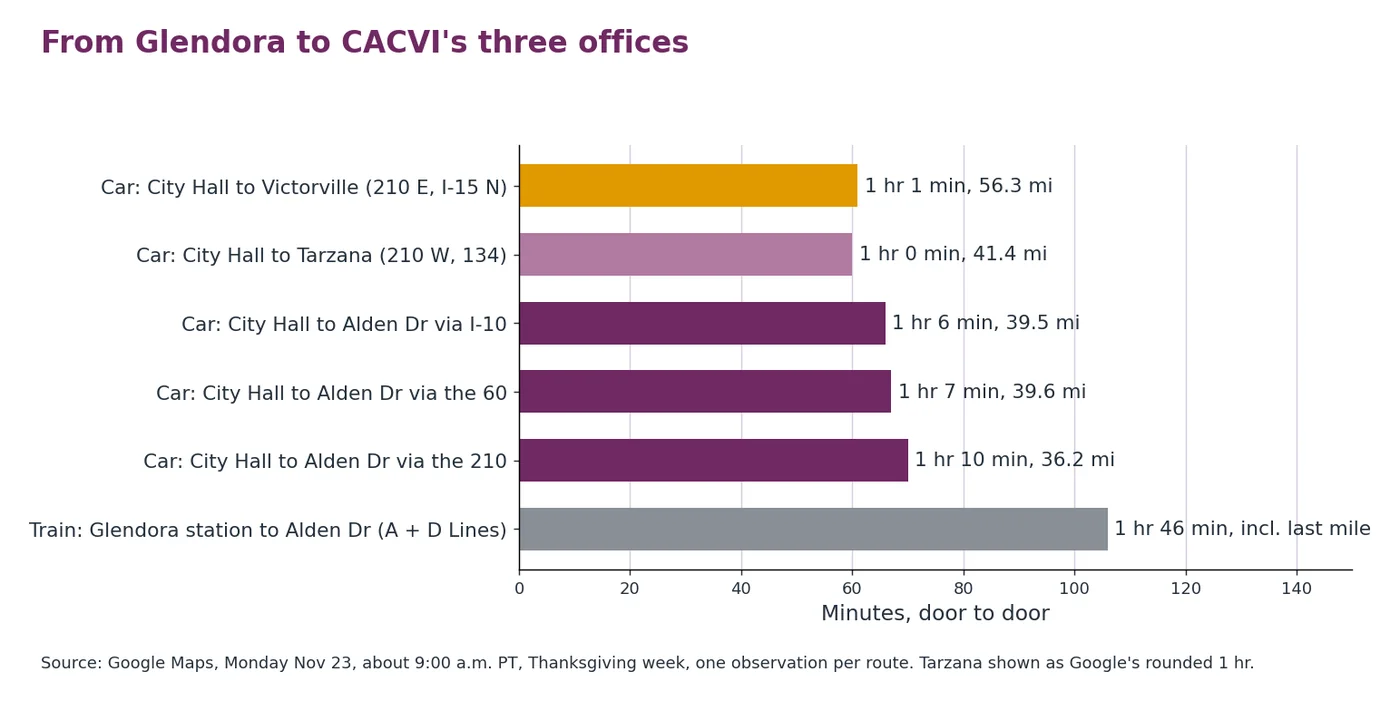
The surprise in those numbers is Victorville. It’s 17 miles farther than Alden Drive, yet it took slightly less time, because the eastbound 210 and the I-15 were moving while the westbound routes into Los Angeles were not. On another morning the order could flip. The useful point is that Glendora patients have two realistic weekday choices, and the right one depends on more than distance.
Alden Drive, west of downtown
Weekdays only, from 8:30 in the morning until 5:00. For parking, the practice points to the Robertson Alden Garage, Lot 703, three minutes from the office on foot; it charges nothing up to two hours and $12 at most for a day. Two other garages within a few minutes’ walk charge more. If your visit is likely to include a test and a consultation, plan on the free two hours running out.
For Glendora patients, the case for Alden Drive is mostly about the route. It’s the office you can reach by train (more on that in the next section), and it’s the one to choose if you already spend time on the Westside or in central Los Angeles for work or family. An appointment late in the morning tends to miss the worst of the inbound traffic; an appointment at 3:00 p.m. means driving home into the eastbound evening rush on the 10 or the 60.
Victorville: the other direction, with free parking
Hesperia Road (Suites A5 and A6) matches Alden Drive’s weekday hours, and its lot is free and right outside. On the practice’s own Victorville page, the test menu runs from EKG and echocardiogram to treadmill or drug-based stress tests, vascular ultrasound and take-home rhythm monitors (Holter and extended event recorders). Physicians rotate between offices, so if you’d like a particular doctor in Victorville, say so on the phone.
For someone in north or east Glendora, close to the 210 on-ramps at Grand Avenue or Lone Hill Avenue, the Victorville trip starts by heading away from Los Angeles traffic. People who already drive to the High Desert to see family, or who find the I-15 easier than the freeways into Los Angeles, may prefer it. Free parking at the door is a real advantage for anyone who walks slowly or uses a walker.
Tarzana for a Saturday visit
Of the three offices, only Ventura Boulevard opens on a weekend. Saturday hours there are 8:00 a.m. to 4:30 p.m. Parking there is free but limited, with street parking nearby. If weekdays are impossible because of work or caregiving, a Tarzana Saturday may be what gets the visit on the calendar this month instead of next season. Saturday availability for new patients depends on the schedule, so ask when you call.
Picking a time of day
Traffic in each direction follows its own clock, and the trip home matters as much as the trip there. Our own measurements cover only one Monday morning, so before you pick a time, use Google Maps’ “depart at” setting for the exact day and hour you’re considering, and check the return leg for the hour you expect to leave the office. A route that looks easy at 9:00 a.m. can look very different at 3:30 p.m.
A practical rule many patients use: book the first or second appointment of the morning in Victorville, and a late-morning slot at Alden Drive, so the return trip starts before the evening rush. Tell the scheduler you’re driving from Glendora; they can’t fix the traffic, but they can avoid booking you for 4:30 p.m.
Matching the office to the visit
A few practical questions settle the choice for most people:
- Will someone drive you? If not, Alden Drive is the office you can reach by public transit from Glendora.
- Do you have mobility limits? Free parking at the door in Victorville or Tarzana is easier than a garage and a walk.
- Is the visit on a weekday? If not, only Tarzana is open.
- Where do you already go? An office on the way to work, a parent’s house or a regular errand turns a half-day trip into a detour.
- Is a particular physician important to you? Ask which office that doctor is seeing patients at in the coming weeks.
You aren’t locked into one office after the first visit. If you start at Alden Drive and later find Victorville easier, tell the front desk; your chart is the same practice’s chart.

Before you head up the I-15
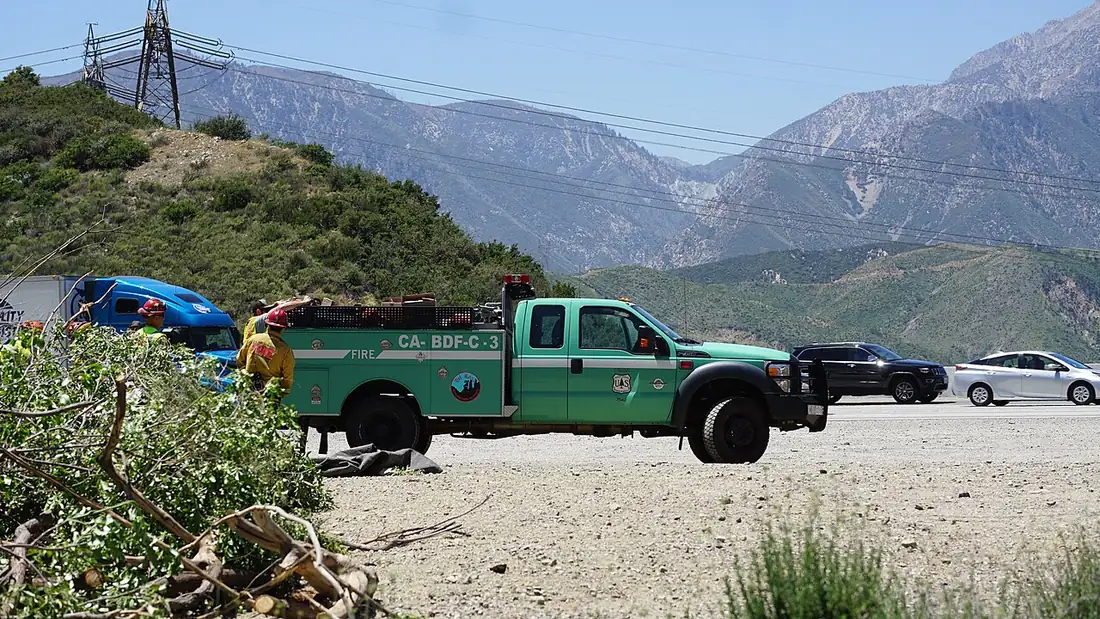
The Cajon Pass is the one stretch of the Victorville trip that can change quickly. Weather, fires and crashes on the I-15 between the 210 and the High Desert can slow the trip. Check Caltrans QuickMap before you leave for a morning appointment, especially from November through March. If the pass looks bad, call the office: it’s better to move the visit or switch it to Alden Drive than to sit in stopped traffic with a heart condition and no bathroom. Take your morning medicines as usual unless the office has told you otherwise for a specific test, and carry water and a snack for the drive.
Taking Metro’s A Line from Glendora station to a Los Angeles appointment
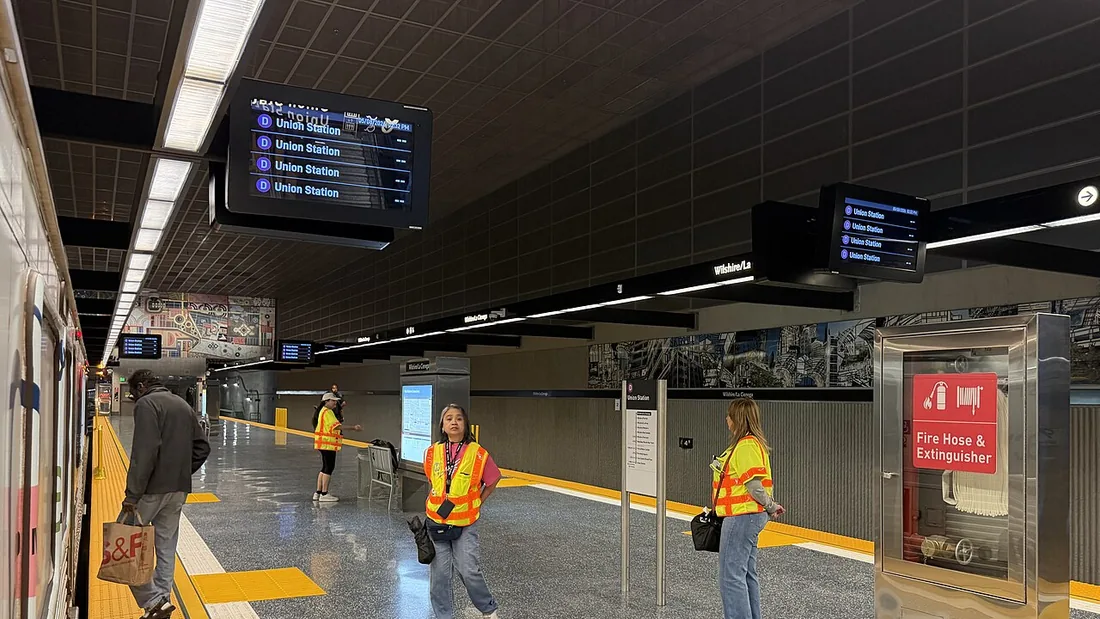
Until September 19, 2025, Glendora had no Metro rail station. That day Metro opened its A Line extension, 9.1 miles of track with new stations in Glendora, San Dimas, La Verne and Pomona. Eight months later, on May 8, 2026, the first stretch of the D Line subway extension opened, ending at a new station where Wilshire meets La Cienega. Put together, those two openings created a rail route from Glendora to within about a mile of CACVI’s Los Angeles office.

Glendora station to Union Station and the D Line
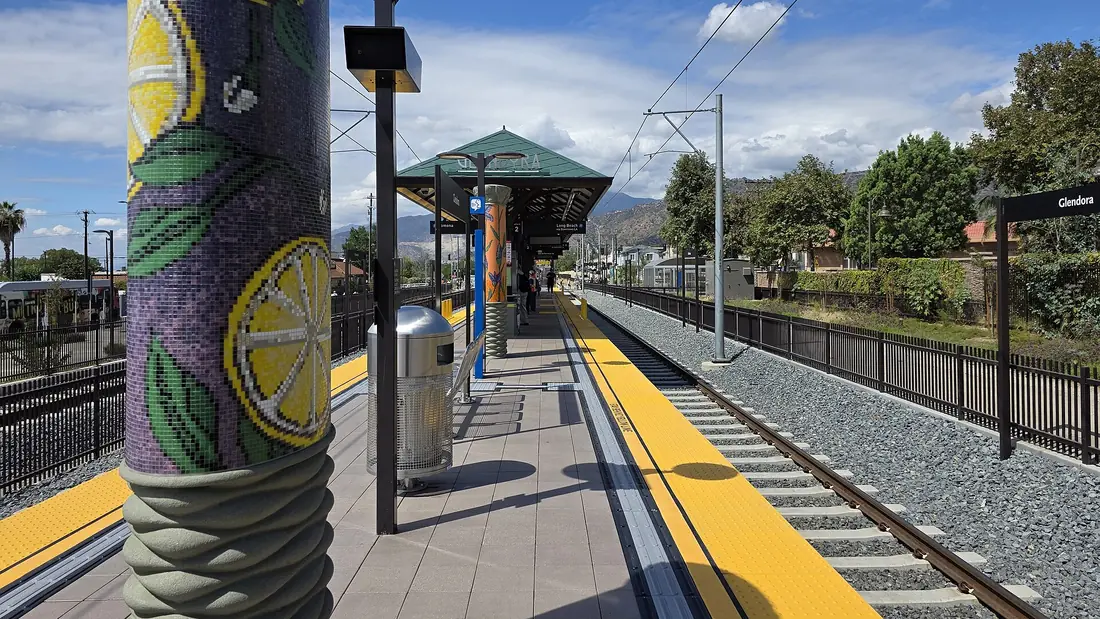
Glendora station is about 0.4 miles by road from City Hall. Metro describes it as a short stroll from Glendora Village, and Foothill Transit Line 284 serves it. The A Line runs every day of the year, from about 4:00 a.m. to about 1:00 a.m.

We asked Google Maps for transit directions from Glendora station to 8741 Alden Drive on Monday, November 23, leaving around 9:00 a.m. The fastest option was the A Line toward Los Angeles followed by the D Line west: board at 9:10 a.m., arrive at 10:56 a.m., 1 hour 46 minutes door to door. An option adding Metro bus Line 105 on La Cienega arrived four minutes later. Options that skipped the D Line and stayed on buses after the A Line took around two hours. So for a 10:30 a.m. appointment, you’d want a train around 8:30, with time to spare.
The last mile from Wilshire/La Cienega
The D Line’s Wilshire/La Cienega station is the stop closest to the office. From the station to 8741 Alden Drive is about 1 mile on foot, roughly a 22-minute walk by OpenStreetMap’s walking route. If a mile on foot is too much, Metro bus Line 105 runs along La Cienega; Google’s routing used it as the final leg of one option. A rideshare for that last mile is another option if the walk or the bus wait is too much on the day.

Fares, senior caps and station parking
A regular Metro ride costs $1.75, transfers within two hours are free when you tap your card, and Metro caps regular fares at $5 a day. Riders 62 and older never pay more than $2.50 a day or $5 in a week, and qualifying riders with disabilities get the same caps. You can pay by tapping a TAP card, a TAP card in a phone wallet, or a contactless credit or debit card.
Glendora station has paid parking: $3 for 24 hours for Metro riders with a valid TAP card, payable through the Metro Parking app. For someone in north Glendora or the foothill neighborhoods, driving to the station and riding from there avoids both freeway traffic and the parking garage at the other end.
Step-free access along the route
Metro says all of its buses and rail lines are wheelchair accessible and that every rail station has a ramp, walkway or elevator to the platform. If an elevator is out of service, Metro lets you take a bus to the next station at no cost, which is worth knowing before you’re standing at the top of a staircase. Walkers, canes and similar aids are allowed; Metro asks riders to fold them when possible and keep them out of aisles and doorways, and walkers can’t be used as seats while the train is moving. Metro describes the new D Line stations as fully ADA-accessible.
For a patient with heart failure, angina or a valve problem, the real limit is usually distance and stairs, not the train itself. The A Line and the D Line meet at 7th Street/Metro Center and at Union Station, and both are big stations. Allow ten minutes for the transfer, use the elevators, and don’t rush for a train that’s about to leave. Another one comes along.
Planning the ride home
The trip back is the part people forget to plan. A consultation that turns into a same-day echocardiogram can stretch a morning into the afternoon. Before you leave the house, look up the return trains for two times, one after a short visit and one after a long one, so you aren’t checking schedules while tired. Use the same card or phone you tapped in the morning, so both legs count toward the $5 daily cap.
If you take a new medicine for the first time during the visit, or a dose is changed, ask whether it can make you light-headed before you set off for the station. Most changes don’t, but a few blood pressure and rhythm medicines can, and a train platform is a bad place to find out.
When the train is the wrong choice
The train works well for a consultation or a test you can walk away from. It’s a poor choice in a few situations:
- Chest pain, fainting or sudden breathlessness right now. That’s a 911 call, not a trip to an office by any means.
- A test or procedure after which you’ve been told not to drive or travel alone. If there’s any chance the visit involves sedation or a drug that can make you woozy, find out when you book and bring someone along.
- A day of heavy symptoms. If walking a block leaves you breathless, the stairs, platforms and the mile from Wilshire/La Cienega may be more than you should take on.
Tell the office when you book that you’re coming by train. Staff can give you a late-morning slot that fits the timetable and avoids the evening crowds on the way home.
A student athlete fainted at practice: California’s clearance rule and who signs it
Every season, some Glendora families get a phone call nobody wants: their child collapsed during practice or right after a game. A faint can have many causes, and plenty of them are harmless. The one that matters is a heart problem that can lead to sudden cardiac arrest, which the California Department of Education calls the leading killer of student athletes. California law treats every episode as possibly cardiac until a clinician has looked.
What the Eric Paredes Act requires of schools
The Eric Paredes Sudden Cardiac Arrest Prevention Act, Education Code sections 33479 to 33479.9, has applied since July 1, 2017. It covers public schools, charter schools and private schools that run athletic programs: interscholastic sports, school-sponsored competitions, cheerleading, club sports sponsored by the school, and their practices and scrimmages.
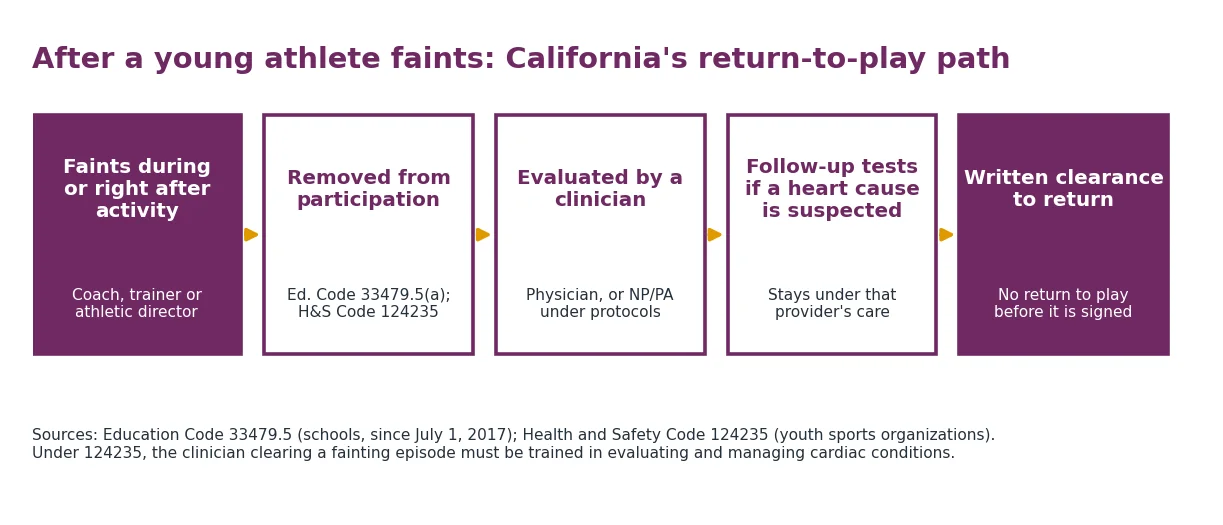
Under section 33479.5, a student who passes out or faints while participating in an athletic activity, or immediately afterward, must be removed from participation by the athletic director, coach, athletic trainer or another authorized person. The student cannot go back until a physician and surgeon, or a nurse practitioner or physician assistant working under the required protocols, has evaluated the student and cleared the return in writing.
The law also lets an athletic trainer or authorized person remove a student showing other warning signs if they reasonably believe the symptoms are cardiac. The signs the Act lists are fainting or seizures during exercise, unexplained shortness of breath, chest pain, dizziness, a racing heart rate and extreme fatigue. Each school year, families sign an acknowledgment that they received the state’s information sheet on those signs, and coaches must complete a sudden cardiac arrest training course every two years.
Club teams and youth leagues follow a parallel rule
Plenty of Glendora children play outside school: club soccer, travel baseball, city leagues and private camps. Those programs fall under Health and Safety Code section 124235, which applies to any “youth sports organization,” including a business, a nonprofit or a local government agency running sports for people 17 and under.
The wording is a little different and in one respect stricter. An athlete who has passed out or fainted must be removed for the rest of the day and can’t return to any athletic activity until a licensed healthcare provider has evaluated them and given written clearance. For fainting, that provider must be trained in evaluating and managing cardiac conditions and acting within the scope of that practice. If the provider suspects a heart condition that puts the athlete at risk of sudden cardiac arrest, the athlete stays under that provider’s care for follow-up testing until cleared. The section applies to everyone participating in the organization’s activities, whatever their age, so an 18-year-old on a club roster is covered too.
Who writes the clearance
For a child or teenager, the right first step is usually the child’s pediatrician, who may then send the family to a pediatric cardiologist. CACVI’s physicians trained first in internal medicine, the adult-medicine specialty, before their cardiology fellowships, so ask your pediatrician before booking a minor with any adult cardiology practice.
Adults are where CACVI fits. A college athlete, a 19-year-old on an adult league team, a coach or a parent who fainted on the sidelines can book a cardiology visit with us. Say on the phone that the visit is about fainting during or after exercise, so the office can plan time for an EKG and the right next test.
Adults who faint during or after exercise
The school and youth-sports rules stop at the edge of those programs. An adult who faints at the gym, on a trail or in a weekend league has no law telling them to sit out, and that’s where people tend to talk themselves out of a visit. The same logic applies, though: fainting during exertion is treated as a heart question until a clinician says otherwise. Don’t drive yourself to that evaluation if you’ve fainted recently, and don’t go back to hard exercise until you’ve been seen. When you call, say “fainted during exercise,” not “felt dizzy,” so the visit is booked with the right urgency.
Free heart screening events for teens
The Act is named after Eric Paredes, a high school sophomore athlete in San Diego County who died of sudden cardiac arrest in 2009. His parents started the Eric Paredes Save A Life Foundation, which runs free youth heart screenings: a health history review, an EKG, a conversation with a cardiologist and, when the physician thinks it’s needed, a limited echocardiogram. Its events are held in San Diego County, and the foundation points families elsewhere in California to Parent Heart Watch to find a screening closer to home. Its site counts 47,671 teens screened and 719 cardiac abnormalities found.
A screening event is not the same as a clearance after a faint, and the foundation says teens already being treated by a cardiologist aren’t eligible. For a family whose child has never fainted, though, it can be a way to get an EKG reviewed before a season starts. The California Department of Education’s page on the Act links to the foundation and to the state’s information sheets in several languages.
Before the season, not after the faint
A few things are easier to do in August than at an emergency department in October:
- Read the sudden cardiac arrest information sheet the school or league sends home, and actually sign it; schools must collect it before the student plays.
- Write down any family member who died suddenly or young, and share it with the pediatrician at the sports physical.
- Ask the coach whether the team has an AED at practices as well as games, and where it’s kept.
- Tell the coach about any earlier fainting episode, even one that happened years ago.
What to bring to the evaluation
The evaluation is quicker and more useful when you bring:
- The coach’s or athletic trainer’s written account: what the athlete was doing, how long they were out, whether they were breathing normally and whether anyone used an AED.
- Any emergency department or urgent care records from that day, including the EKG strip.
- The family history: anyone in the family who died suddenly, unexpectedly or in a drowning or single-car crash before age 50, or who has a pacemaker or defibrillator at a young age.
- The school’s or league’s clearance form, so the physician can fill in exactly what they need.
A clearance isn’t a formality to get back on the field by Friday. If the cardiologist wants a monitor or an imaging test first, the written clearance comes after those results, and the athlete sits out until then.
Smoke days at the foot of the San Gabriels with a heart condition
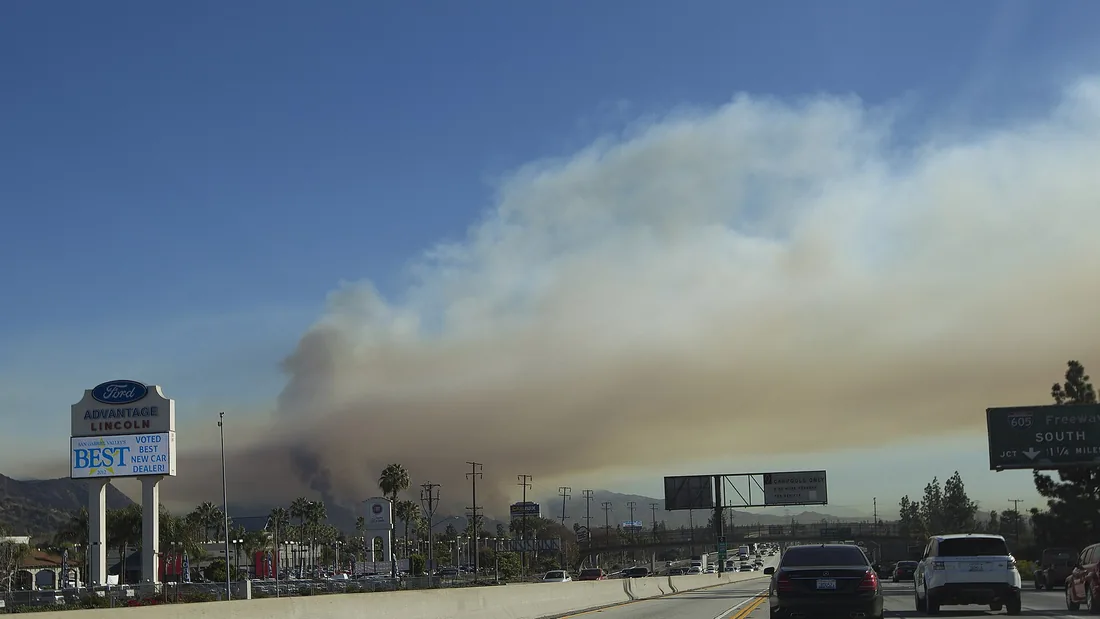
Glendora backs directly onto the Angeles National Forest, and fire seasons have shown how close that is. The Colby Fire started early on January 16, 2014, near Morris Reservoir just north of the city, and burned 1,952 acres before crews contained it on January 27, according to CAL FIRE’s incident record. Smoke from fires much farther away also settles into the San Gabriel Valley. For people with heart disease, those smoky days are a heart problem as much as a lung problem.

Why smoke reaches the heart
The U.S. Environmental Protection Agency describes fine particles, called PM2.5, as the part of wildfire smoke that does the most harm. Particles that small travel deep into the lungs, and EPA lists heart failure flare-ups, heart attacks, strokes and emergency visits and hospital admissions for heart conditions among the effects of short-term smoke exposure. It names people with heart or lung disease, older adults, children and pregnant women as the groups most at risk. Even one day of smoky air can affect your health, EPA says.
That matters for the conditions seen in a cardiology office every week. A person with heart failure who is stable on a clear day may tip into fluid build-up after a few days of smoke. A person with coronary disease may notice chest tightness on a walk that never caused it before.
Reading the Fire and Smoke Map for a Glendora address
El Centro de AirNow Fire and Smoke Map shows air quality readings from official monitors and low-cost sensors, plotted near your address, along with fire locations and smoke plumes. Readings near your own street can differ from the regional number on the news. Check the map before you plan a walk, yard work or errands, not only when you can smell smoke.
Pay attention to the color categories. For people with heart disease, the advice to cut back outdoor exertion starts at a lower level than for healthy adults, at the orange “unhealthy for sensitive groups” category.
A cleaner-air room at home
EPA’s practical advice centers on cleaning the air you breathe indoors. Pick one room, usually a bedroom, and make it the cleanest-air room in the house:
- If you have central air, use the highest-rated filter the system can handle, MERV 13 or higher if it’s compatible, and set the fan to run all the time during a smoke event, not only when cooling.
- If the system draws in outside air, close the fresh-air intake or set it to recirculate.
- Run a portable air cleaner sized for the room, or build EPA’s do-it-yourself version: a box fan with a high-efficiency furnace filter attached.
- If your home uses an evaporative (“swamp”) cooler, EPA suggests covering its outside air intakes with 4-inch MERV 13 filters if you can safely reach them, or using it sparingly while the smoke lasts.
- Window and portable air conditioners usually don’t have filters designed for smoke particles; pair them with an air cleaner.
When you do have to go out, EPA recommends a NIOSH-approved respirator such as an N95, fitted snugly. Some people with heart or lung disease find a respirator hard to breathe through; ask your cardiologist before relying on one.
Yard work, outdoor jobs and the time of day
A lot of physical work in Glendora happens outdoors: gardening on sloped lots, clearing brush, work on a landscaping or construction crew. EPA advises keeping activity levels low outdoors when smoke is present and avoiding vigorous jobs such as yard work or running. It also points out a trap: the coolest part of the day can also be the smokiest. Morning is often when people with a heart condition plan exertion to avoid heat, so check the map first rather than assuming early means safe.
EPA notes that outdoor workers face longer exposure and less chance to get indoors than most people. If your job keeps you outside, the conversation with your cardiologist should cover what to do at work, not only at home, and whether a note to your employer about smoke days would help.
When smoke and heat arrive together
Fire weather and heat waves often overlap at the end of summer and in the fall. EPA notes that exposure to smoke and heat at the same time may be worse than either alone, and that for most people heat is the more immediate danger. If closing up the house makes it dangerously hot, cooling down comes first. EPA suggests a community cleaner-air or cooling center, a library, a mall or a relative’s home with air conditioning and filtration; dialing 2-1-1 is one way to find cooling centers nearby.
Symptoms that change the plan
EPA’s guidance is that smoke can worsen heart and lung disease, and that if it does, you should get medical attention. Put simply:
- Chest pain or pressure, passing out, breathlessness that comes on hard and fast, or a drooping face or weak arm: 911.
- Weight gain over a day or two, new swelling, waking up breathless, a pulse that won’t settle, or needing to sleep propped up: call your cardiologist’s office the same day.
- Mild cough and irritated eyes that ease once you’re indoors in clean air: keep up the clean-room routine and watch for the signs above.
Settle the plan before fire season
EPA recommends making a plan with your healthcare provider before smoke arrives, including keeping enough food and medicine at home to stay inside for several days. Use a summer cardiology visit to settle a few things: refills that won’t run out mid-event, which symptoms should trigger a call and to which number, whether a respirator is safe for you, and how to adjust exercise on bad-air days. Write the answers on one card and keep it with your medicines.
Mt. Baldy, the Notch at 7,800 feet and a heart condition at altitude
Glendora sits at the bottom of the San Gabriel Mountains, and in winter the snow on the peaks to the east is part of the view. Mt. Baldy Resort’s Chair 1 takes visitors to its Top of the Notch area at 7,800 feet, below a 10,064-foot peak, and plenty of Glendora families make the trip for snow play or a day of skiing. For most people it’s an easy outing. For someone with a heart condition, the combination of altitude, cold and exertion deserves a moment of planning.
What changes as you go up
The CDC’s Yellow Book, the federal reference on travel medicine, explains that the main concern at high altitude is lower oxygen pressure in the air. It gives an example: at about 10,000 feet, the oxygen pressure you breathe in is only 69% of what it is at sea level, and arriving suddenly at that height can lower the oxygen saturation of your blood to 88% to 91%. The heart and lungs work harder to make up for it, especially in the first hours and days.
CDC’s consumer guidance says altitude illness becomes a risk above about 8,000 feet and advises people with heart or lung disease to talk to a doctor familiar with high-altitude medicine before such trips. The Notch is just under that line, and a day trip is not the same as sleeping at altitude. The summit and the higher trails are well above it.
Which heart conditions call for caution
The Yellow Book includes a table that sorts medical conditions by the risk of going to high altitude. As it lays them out:
- Likely no extra risk: coronary artery disease after the blockages have been treated (for example with stents or bypass), and high blood pressure that is controlled.
- Caution required: stable angina, coronary disease that hasn’t been treated, compensated heart failure, poorly controlled high blood pressure and poorly controlled arrhythmias.
- Contraindications: unstable angina, decompensated heart failure, and a heart attack or stroke within the past 90 days.
That table explains why the same trip can be fine for one person and unwise for their neighbor. If you’re in the middle group, the trip isn’t ruled out, but it should be planned with your cardiologist.
Cold and exertion on top of altitude
Snow days add their own load. Walking uphill in snow, carrying skis and gear, pulling children on sleds and shoveling around a parked car are all hard work, and they happen in cold air at the very moment the heart is adjusting to less oxygen. MedlinePlus lists cold weather and exercise among the things that can bring on an angina attack in someone with heart disease, because both make the heart muscle need more oxygen. Plan the day so the hardest effort isn’t the first thing you do after arriving, take breaks before you need them, and carry any nitroglycerin you’ve been prescribed.
Questions to settle before a mountain day
- Is my condition in the “caution” group, and if so, what’s a sensible limit on height and effort?
- Should I avoid the higher trails or the summit altogether?
- Do any of my medicines change how I’ll feel at altitude or in the cold?
- At what point do I turn around and drive home, and what would make it a 911 call on the mountain?
CDC’s Yellow Book notes that symptoms of altitude illness improve with descent. Chest pain, fainting or severe breathlessness on the mountain are not altitude problems to wait out: call 911 and tell the dispatcher where you are.
Blood pressure that three medicines haven’t controlled
High blood pressure is the most common reason people are told to “see a cardiologist,” and most of the time the problem is solved with the right one or two medicines. This section is for the smaller group whose numbers stay high despite three. That pattern has a name, resistant hypertension, and it usually has a findable reason.
What “resistant” means
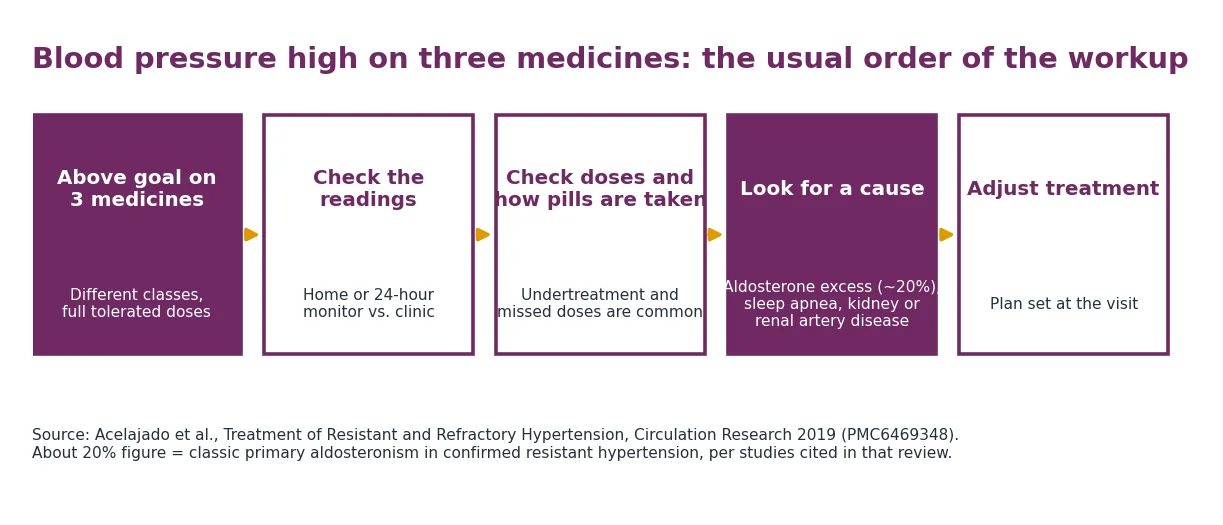
A 2019 review in the journal Circulation Research, written by researchers who have studied the condition for years, uses the standard definition: blood pressure that stays above goal despite three or more blood pressure medicines from different classes, typically a long-acting calcium channel blocker, a drug that blocks the renin-angiotensin system (an ACE inhibitor or an angiotensin receptor blocker) and a diuretic, each at the highest dose the patient can tolerate. The same review describes a rarer and harder group, refractory hypertension, where blood pressure stays uncontrolled on five or more medicines.
The definition has a condition built in: the common causes of “pseudoresistance” have to be ruled out first. Ruling those out takes most of the effort.
Readings that only look resistant
The review lists the usual reasons blood pressure looks resistant when it isn’t:
- Measurement. A cuff that’s the wrong size, a reading taken right after walking in, or an arm hanging unsupported can all push the number up.
- The white-coat effect. Some people’s pressure rises in a clinic and is normal everywhere else. Readings outside the office, from a home cuff or a 24-hour ambulatory monitor, sort this out.
- Undertreatment. Doses that were never raised to the full amount, or a combination that leaves out one of the main drug classes.
- Taking the medicines differently than prescribed. That’s common and not a moral failing. Side effects, cost, confusing schedules and pills that run out between refills are the usual causes, and each has a fix.
The review notes that clinic readings alone can’t separate true resistance from these patterns, which is why out-of-office readings are part of the workup.
Causes worth looking for
Once pseudoresistance is ruled out, true resistant hypertension often has a contributing cause. The review highlights three:
- Excess aldosterone. Aldosterone is a hormone from the adrenal glands that makes the body hold onto salt and water. Studies cited in the review found classic primary aldosteronism in about 20% of people with confirmed resistant hypertension, and lesser degrees of aldosterone excess in more.
- Obstructive sleep apnea. Observational studies in the review found it in a large majority of people with resistant hypertension, especially men. Loud snoring, pauses in breathing that a partner notices and daytime sleepiness are reasons to ask about a sleep study.
- Kidney disease and narrowed kidney arteries. Chronic kidney disease is common in this group. A narrowed renal artery, the artery that feeds a kidney, can also drive blood pressure up. Renal angiography is how CACVI’s physicians confirm that kind of narrowing, according to the practice’s renal artery stenting page, and a stent is the option it describes when the results call for one.
Medicines and other substances that push blood pressure up
Sometimes the cause isn’t a disease at all but something else in the medicine cabinet or the kitchen. MedlinePlus, the National Library of Medicine’s consumer site, lists chemical substances and medicines that can raise blood pressure. Among them:
- Nonsteroidal anti-inflammatory pain relievers (NSAIDs), the class that includes ibuprofen and naproxen.
- Many over-the-counter cough, cold and asthma medicines.
- Caffeine, including energy drinks, and alcohol.
- Some antidepressants, including venlafaxine and bupropion.
- Estrogens, including birth control pills, and testosterone or other anabolic steroids.
- Immunosuppressants such as cyclosporine, and some cancer drugs that block blood vessel growth.
- Stimulants such as amphetamines and cocaine.
MedlinePlus also describes rebound hypertension: blood pressure that jumps after certain medicines, especially beta blockers and clonidine, are stopped suddenly or cut back. That’s one reason never to stop a blood pressure medicine on your own because the numbers look good. None of this means you should stop anything on the list without talking to the doctor who prescribed it; it means the cardiologist needs to see all of it.
What the cardiologist looks at first
A cardiologist who sees resistant blood pressure will usually start by checking the readings themselves and the regimen, before adding anything. The review reports the results of the PATHWAY-2 trial, in which spironolactone, a drug that blocks aldosterone, lowered blood pressure more than the other fourth-line drugs tested in people already on a standard three-drug combination. Whether that, or another change, is right for you depends on your kidney function, potassium level and other conditions, and that’s a conversation for the visit, not a decision to make from a web page.
The visit may also lead to blood tests for aldosterone and renin, a referral for a sleep study, kidney function tests, or an ultrasound of the kidney arteries. Long-standing high blood pressure also takes a toll on the heart itself, so an echocardiogram to look for a thickened heart wall is often part of the picture.
What to bring
- Two weeks of home readings, morning and evening, with dates and times, written down or printed from the cuff’s app.
- Every pill bottle you take, including over-the-counter pain relievers, cold medicines, supplements and anything from another country.
- Recent lab results, especially kidney function and potassium.
- A sleep study report, if you’ve had one.
- The names and doses of blood pressure medicines you’ve tried and stopped, and why.
Cannabis, a heart condition and California’s legal market
Cannabis has been legal for adults in California for years, and it comes up in cardiology visits more often than patients expect. Some people use it for sleep or pain, some recreationally, and some don’t mention it because they assume it doesn’t matter to the heart. It does, and the cardiologist can only factor it in if you say so.
What the CDC says about cannabis and the heart
The Centers for Disease Control and Prevention says cannabis can make the heart beat faster and can raise blood pressure immediately after use. It adds that cannabis could also increase the risk of stroke, heart disease and other vascular diseases. Most of the studies linking cannabis to heart attacks and strokes, CDC notes, come from people who smoked it rather than using it in other forms, and cannabis smoke contains many of the same substances found in tobacco smoke that harm the lungs and the cardiovascular system. CDC is also clear that more research is needed to understand the full effect on the heart and whether use leads to a higher risk of death.
For someone with angina, a rhythm problem or blood pressure that’s hard to control, a faster heart rate and a jump in blood pressure aren’t small things. A racing pulse an hour after an edible, or a high reading taken the morning after, can look like a new heart problem if nobody knows about the cannabis.
Telling the cardiologist without worrying about it
Put cannabis on the medication list you bring to the visit, the same way you’d list a supplement: the form (smoked, vaped, edible, tincture or topical), how often, and roughly how much. A cardiology office asks so it can read your symptoms and test results correctly. If a stress test or a rhythm monitor is planned, ask whether you should skip cannabis beforehand, because a faster resting heart rate can change what the test shows.
What California’s rules mean for a heart patient
California’s Department of Cannabis Control says adults 21 and older can buy cannabis, and people 18 and older can buy it with a physician’s recommendation. Cities and counties can set stricter rules, so check what applies where you live and shop. The state also warns that stores without a license may sell untested products, which can contain mold or pesticides. Licensed retailers must display their state license, and the DCC has a license search to check a store before you buy.
Two other rules from the state are worth knowing in Glendora. Cannabis remains illegal under federal law, so it can’t be used or carried on federal land, and the Angeles National Forest above the city is federal land. And the DCC notes that officers can stop a driver for a sobriety test if they suspect cannabis impairment; if cannabis makes you light-headed or speeds up your heart, that’s one more reason not to drive until it has worn off.
Foothill Presbyterian, the Covina heart program and a Glendora heart patient
Two hospitals shape heart care for most Glendora residents, and they do different jobs. Knowing which one does what helps you make sense of where you were sent, and why.
Glendora’s own hospital
Emanate Health Foothill Presbyterian Hospital at 250 South Grand Avenue is the hospital inside Glendora, about a mile from City Hall. Its emergency room is open 24 hours, and Emanate’s location page lists cardiology among its services, along with imaging and a laboratory. For a Glendora patient, it’s often where blood tests, imaging and emergency visits happen close to home. The main number is (626) 963-8411.
The heart program five miles south
Emanate Health’s heart program is based at Emanate Health Inter-Community Hospital, 210 West San Bernardino Road in Covina, about 5 miles from Glendora City Hall. Emanate describes its Heart Care Center there as offering cardiac catheterization, angioplasty and stents, atherectomy, electrophysiology testing and pacemakers, plus a structural heart program that lists TAVR, MitraClip and Watchman. Its Heart Care Center pages also include open-heart surgery.
Where the County’s heart-attack map points
For the most urgent kind of heart attack, called a STEMI, the County’s EMS Agency sends ambulances only to hospitals it has approved for that purpose. On the County’s map of those centers dated June 2024, Inter-Community Hospital in Covina, Pomona Valley Hospital Medical Center and USC Arcadia Hospital are listed; Foothill Presbyterian is not. That’s one reason a 911 crew may drive a Glendora heart-attack patient past the nearest emergency room. Call 911 and let the paramedics choose; don’t drive yourself to the closest door.
Other emergency rooms people from Glendora end up in
Depending on where you live and where you were when symptoms started, you may have been seen at another hospital in the area. Emanate Health Queen of the Valley Hospital at 1115 South Sunset Avenue in West Covina is about 10 miles from Glendora City Hall by road, and Pomona Valley Hospital Medical Center at 1798 North Garey Avenue in Pomona is a similar distance in the other direction. Head about 13 miles west instead and you reach USC Arcadia Hospital on West Huntington Drive. All three run 24-hour emergency departments. Queen of the Valley is missing from that June 2024 County heart-attack center list, while Pomona Valley and USC Arcadia are on it.
If you were treated there first
If you live in Glendora, you may come to CACVI after a stay or a procedure at one of these hospitals, or at another San Gabriel Valley hospital. We don’t claim hospital privileges at Foothill Presbyterian or Inter-Community, and the hospital’s own cardiologists may continue part of your care. When you come to CACVI for follow-up or a second look, bring the discharge summary, the procedure report and the names of the new medicines, so the visit starts from what the hospital found.
Three CACVI physicians and what each one’s bio says they do most
Three cardiologists see patients at CACVI. What follows is drawn from each doctor’s CACVI profile, in our words; the links lead to the complete training and certification lists. Doctors’ office days shift from week to week, which is why it helps to ask for someone by name.
If you’re unsure whom to ask for, match the reason for your visit to the bios. A complex coronary history, an earlier stent or a pacemaker or defibrillator question lines up with Dr. Khorsandi’s listed interests. A first evaluation that is likely to lead to an echocardiogram, a nuclear stress test or a vascular ultrasound fits Dr. M. Lala’s imaging certifications. High blood pressure, heart failure or atrial fibrillation managed mostly with medicines matches the conditions Dr. V. Lala’s bio puts first. Each of them did internal medicine before cardiology, and each performs catheter procedures. Any of the three can see you first; if a procedure comes up, the office can sort out who does it.
Mehran J. Khorsandi, M.D., for complex coronary disease and heart devices
Runs the catheterization lab at Providence Cedars-Sinai Tarzana Medical Center
His CACVI page shows four medical boards plus a fifth credential as a certified cardiac device specialist; the boards span general internal medicine, cardiology, catheter-based cardiology and endovascular medicine. After Penn, every stage of his career ran through Cedars-Sinai, where he has been on staff since 1993 and coaches the next generation of cath lab fellows. Branch-point (bifurcation) blockages, high-risk angioplasty and implanting pacemakers and defibrillators head his list of interests, followed by leg artery and vein disease. Glendora patients whose coronary history is complicated, or who are weighing a device, have the most to discuss with him.
Moinakhtar Lala, M.D., for imaging-led evaluations and coronary procedures
Holds certifications in echocardiography, nuclear cardiology and vascular interpretation
Saving legs from amputation is the work Dr. M. Lala is known for at CACVI; he built that program after his October 2016 start. He reached cardiology through an internal medicine residency in Brooklyn, finishing as chief resident, and then spent his fellowship years across the river in Manhattan. On the procedure side his bio names complex coronary work through the wrist, chronic total occlusions and TAVR; in clinic it names acute and long-term heart disease and prevention. Read his profile if your first visit is likely to end in an echo, a nuclear stress test or a vascular ultrasound, since those are the studies his imaging boards cover.
Vasim Lala, D.O., for blood pressure, heart failure and structural heart questions
Osteopathic physician with interventional, endovascular and structural training
Dr. V. Lala is a D.O. from Michigan State University’s osteopathic college. Michigan programs (MSU and McLaren Macomb) gave him his internal medicine and general cardiology years; Manhattan’s Mount Sinai Hospital gave him the advanced procedural year. CACVI hired him in mid-2022. Three structural heart procedures appear in his bio: TAVR, PFO closure and WATCHMAN. Just as prominent is his clinic list: hypertension heads it, followed by coronary and leg artery disease, heart failure, atrial fibrillation, cardiomyopathy and cardio-oncology. That makes his the bio to read for blood pressure that resists treatment.
Questions from Glendora patients, answered briefly
Where do Glendora patients see a CACVI cardiologist?
The nearest CACVI offices are an hour or so away: Alden Drive in Los Angeles, Hesperia Road in Victorville and Ventura Boulevard in Tarzana, with full addresses in the booking section below. Glendora patients pick whichever suits the visit.
Which office is closest to Glendora?
By miles, Alden Drive (about 36 to 40 miles depending on the freeway). By time, it varies: on our Monday-morning check, Victorville (56 miles) took 1 hour 1 minute and Alden Drive 1 hour 7 minutes.
My Glendora medical group handles referrals. Do I wait for it?
Usually, yes, if you’re in an HMO. HMO plans and the medical groups that run them usually require one; many PPO plans don’t. Check the back of your insurance card or call the plan first, and if a referral is needed, ask your primary care office to send it to the CACVI office you’ve chosen.
Are you accepting new patients from Glendora?
Yes. Call the office you’d like to use, or send a request through the appointment page, and the staff will look at the earliest dates with the physician you prefer.
Is there a walk-in cardiologist near Glendora?
CACVI doesn’t take walk-ins; appointments are made by phone or through the online request. If something is wrong with your heart this minute, stop reading and dial 911.
Is any CACVI office open on Saturday?
Tarzana, from 8:00 a.m. to 4:30 p.m. Los Angeles and Victorville are open weekdays only, 8:30 a.m. to 5:00 p.m.
Can I get to the Los Angeles office by public transit from Glendora?
Yes. Take the A Line from Glendora station and transfer to the D Line to Wilshire/La Cienega, then walk about a mile or take Metro bus Line 105 up La Cienega. Google estimated 1 hour 46 minutes on a Monday morning.
Where do I park at each office?
For Alden Drive, use the garage the practice recommends on Robertson Boulevard; the details are in the office section above. In Tarzana and Victorville you won’t pay to park; Tarzana’s lot is small, so leave a few minutes to find a street space.
Can an EKG done by my Glendora doctor be used at the visit?
Yes, bring it, and bring older EKGs too. The cardiologist may repeat the tracing to compare, but your prior strips are often the most useful part of the record.
My teenager fainted at practice. Can CACVI clear them to play?
California requires written clearance from a physician, or a nurse practitioner or physician assistant working under protocols, before the student returns. For anyone under 18, start with the pediatrician, who may refer to a pediatric cardiologist. CACVI sees adults.
Do you treat high blood pressure that won’t come down?
Yes. Blood pressure that stays high on three or more medicines is a common reason for a cardiology visit. Bring two weeks of home readings and every pill bottle.
Can CACVI see me after a heart procedure at Inter-Community or another hospital?
Yes, for follow-up or a second opinion. Bring the discharge summary and the procedure report. We don’t claim privileges at those hospitals, so the hospital’s own team may still handle some of your care.
Is it safe to go up to Mt. Baldy with a heart condition?
It depends on the condition and how stable it is. CDC’s Yellow Book treats a heart attack or stroke in the past 90 days, unstable angina and decompensated heart failure as reasons not to go to high altitude, and stable angina or compensated heart failure as reasons for caution. Ask your cardiologist before the trip, especially if you plan to hike above the 7,800-foot Notch.
What should I do if wildfire smoke makes my heart symptoms worse?
Move into your cleanest-air room, check the AirNow Fire and Smoke Map, and call the office the same day for swelling, weight gain or a pulse that won’t settle. If it’s chest pain, a faint or breathing that’s suddenly hard, skip the office and dial 911.
What should a new patient carry in on day one?
The printed registration form, filled in; the insurance card; records and imaging discs or links; every medicine, herbal product, vitamin and supplement; and a way to pay the co-pay.
Does CACVI treat leg and vein problems as well as the heart?
Yes. The practice also treats artery and vein conditions, including peripheral artery disease and varicose veins. The peripheral procedures overview describe those services.
Booking from Glendora: phone lines, hours and what to have ready
CACVI books appointments by phone or through the online request form; there are no walk-in visits. You can call any of the three offices, and the staff can schedule you at whichever one suits you.
- Los Angeles: 8741 Alden Drive, Suite A, Los Angeles, CA 90048. Phone 310-652-2744. Monday to Friday, 8:30 a.m. to 5:00 p.m.
- High Desert: 12441 Hesperia Road, Suites A5 and A6, Victorville, CA 92395. Phone 760-706-7115. Monday to Friday, 8:30 a.m. to 5:00 p.m.
- San Fernando Valley: 18226 Ventura Boulevard, Suite 102, Tarzana, CA 91356. Phone 818-905-5904. Monday to Friday, 8:30 a.m. to 5:00 p.m.; Saturday, 8:00 a.m. to 4:30 p.m.
Records can be faxed ahead to 310-967-2140. Non-urgent questions go to info@cacvi.org. Don’t email urgent symptoms; call instead.
On the phone
The call goes faster when you have these in front of you: the patient’s full name and date of birth as they appear on the insurance card, the member ID, the referring doctor’s name and fax number, and a one-line reason for the visit (“abnormal EKG,” “blood pressure high on three medicines,” “fainted at the gym”). Tell the scheduler you’re coming from Glendora and whether you’ll drive or take the train, so the time slot fits the trip.
On the day
Two requests come from the new-patient page: print and fill in the registration form at home, and give yourself a 15-minute head start for check-in. Bring your insurance card (knowing your co-pay helps), your medical records and any imaging studies, and all your medications, herbals, vitamins and supplements. Have the co-pay ready in cash or on a Visa, Mastercard, Discover or Amex card.
Ready to book? Call the office that suits your trip, or send an appointment request and we’ll call you back.
What patients wrote about CACVI on Google
Cardiology pages for Glendora’s neighbors along the foothills
Census Bureau TIGERweb boundary data show that Glendora touches the cities of Azusa, Covina and San Dimas, plus the unincorporated communities of Charter Oak and Citrus. Each of those three cities has its own CACVI page, linked below. Every one of those pages points to the same three offices that serve Glendora.
- Cardiologist for Azusa patients
- Cardiologist for Covina patients
- Cardiologist for San Dimas patients
The two offices most Glendora patients choose between have their own pages too: cardiology in Los Angeles and cardiology in Victorville.
Every source used on this Glendora page
| Source | Publisher | Used for |
|---|---|---|
| CACVI appointments and office details | CACVI | Addresses, phones, hours, parking |
| CACVI new patients | CACVI | What to bring to a first visit |
| Physician biographies | CACVI | Training, certifications, procedures |
| How to ride the A Line Extension to Glendora, San Dimas, La Verne/Fairplex and Pomona North | Metro (The Source) | Opening date, hours, parking, Line 284 |
| D Line Extension | Metro | Section 1 opening, Wilshire/La Cienega |
| Fares | Metro | Fare, caps, senior and disability caps |
| Eric Paredes Sudden Cardiac Arrest Prevention Act (AB 1639, chaptered) | California Legislature | Education Code 33479 to 33479.9 |
| Eric Paredes Sudden Cardiac Arrest Prevention Act | California Department of Education | School duties, forms |
| Health and Safety Code section 124235 | California Legislature (via public.law) | Youth sports organizations |
| Wildfire Smoke and Health | U.S. EPA | Health effects, at-risk groups, planning |
| Protect Yourself from Heat and Smoke | U.S. EPA | Filters, cleaner-air room, heat |
| Fire and Smoke Map | AirNow | Local air quality |
| Colby Fire incident | CAL FIRE | Dates, location, acreage |
| Treatment of Resistant and Refractory Hypertension (Circ Res 2019) | Acelajado, Hughes, Oparil, Calhoun (PMC) | Definitions, pseudoresistance, causes, PATHWAY-2 |
| Renal artery stenting | CACVI | Kidney artery narrowing |
| Emanate Health Heart Care Center: procedural heart care | Emanate Health | Inter-Community heart program |
| STEMI Receiving Centers map, as of June 2024 | Los Angeles County EMS Agency | Hospitals listed near Glendora |
| Caltrans QuickMap | Caltrans | Road conditions on the I-15 |
| Accessibility guide | Metro | Elevators, mobility aids |
| What is a heart screening; Screening events | Eric Paredes Save A Life Foundation | Free youth screenings |
| High blood pressure: medicine-related | MedlinePlus (NIH) | Substances that raise blood pressure |
| Angina | MedlinePlus (NIH) | Cold weather and exertion as triggers |
| High-Altitude Travel and Altitude Illness (Yellow Book) | CDC | Oxygen at altitude; heart conditions by risk |
| Travel to High Altitudes | CDC | 8,000-foot threshold; heart disease advice |
| Mt. Baldy Resort | Mt. Baldy Resort | Top of the Notch elevation |
| Cannabis and heart health | CDC | Heart rate, blood pressure, vascular risk |
| What’s legal | California Department of Cannabis Control | Age limits, licensed retailers, federal land |
| Emanate Health Foothill Presbyterian Hospital | Emanate Health | Location, services, ER hours |
| Boundary files (TIGERweb) | U.S. Census Bureau | Which cities share a border with Glendora |
¿Listo para hablar?