




















Evaluación cardíaca
Cardiology care for Newport Beach and the Coast Highway
A Newport Beach address puts you a few minutes from one of the biggest hospital heart programs in Orange County. So why would anyone on the harbor, in Corona del Mar or up in Newport Coast pass over the Newport Beach cardiology offices nearby and look at a practice in Los Angeles? Usually for one of a short list of reasons: a second opinion before a big decision, a heart problem that comes with a circulation problem in the legs, a vein or clot issue that never fully settled, or simply a workweek that already ends on the Westside. This page is written for the person weighing that choice, and it is honest about the trade-off.
Newport Beach patients see CACVI’s cardiologists at our Los Angeles office. Of our three offices, Suite A at 8741 Alden Drive is the one nearest to Newport Beach, beside the Cedars-Sinai campus. Google Maps puts it 55.6 miles from the Newport Beach Civic Center by way of the I-405, and the drive takes well over an hour on most weekdays. What you get for that drive is a cardiac evaluation with interventional cardiologists who look after the heart and the arteries and veins of the legs inside the same practice, and who perform the catheter procedures themselves.
If you’d like to talk it through before you decide, call the Los Angeles office at 310-652-2744 or request an appointment. Don’t book anything if the problem is happening as you read this: crushing chest pressure, sudden breathlessness or passing out means dialing 911. A heart attack is not something to drive 55 miles for, and the section on emergencies further down explains where Newport Beach paramedics take cardiac patients.
| Verified detail | What it means for a Newport Beach patient | Source |
|---|---|---|
| Nearest CACVI office: 8741 Alden Drive, Suite A, Los Angeles, CA 90048 | Orange County patients are seen at Alden Drive, so every visit means a trip north. | CACVI appointments |
| Appointment line 310-652-2744; fax 310-967-2140 | Call to book and to ask which tests can be done the same day. | CACVI appointments |
| Office hours Monday to Friday, 8:30 a.m. to 5:00 p.m.; closed weekends | The drive has to fit a weekday, so traffic decides which slot works. | Google Maps listing |
| 55.6 miles from the Newport Beach Civic Center via the I-405 North | Plan for a round trip of about 110 miles. | Google Maps directions |
| Typical Tuesday drive north: 1 hr 5 min to 1 hr 50 min leaving at 11:00 a.m.; 1 hr 40 min to 3 hr leaving at 7:30 a.m. | Leaving at the wrong hour can more than double the trip. | Google Maps directions |
| First two hours free at the Robertson Alden Garage (Lot 703), 141 Robertson Blvd | A short consultation fits the free window; a longer visit may not. | CACVI appointments |
| Hoag Hospital Newport Beach, 1 Hoag Drive: 24-hour emergency department, county Cardiovascular Receiving Center | Heart emergencies are handled in Newport Beach, not in Los Angeles. | OCEMS designation report (May 2024) |
| Copies of medical records due within 15 days of a written request | Ask for Orange County records well before your appointment. | Cal. Health & Safety Code 123110 |
Heart doctor in Newport Beach, or a cardiologist in Los Angeles?
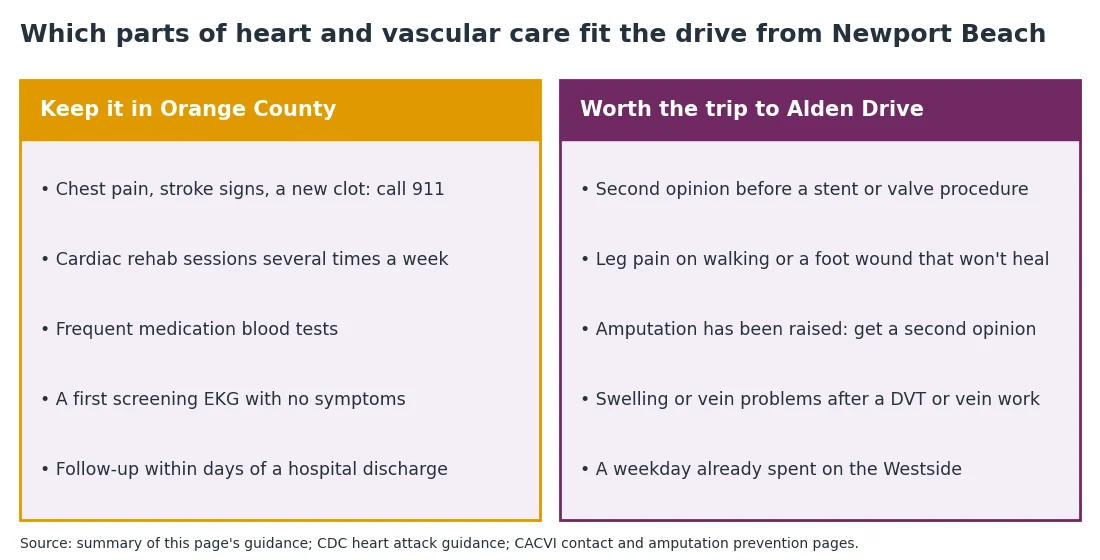
For many people who need a heart doctor or a Newport Beach cardiologist, someone local is the right answer. You’ll have shorter drives, easier follow-ups and a hospital you already know. We’d rather say that plainly than pretend the distance doesn’t exist. The useful question is narrower: which parts of your care can stay close to home, and is there one part that justifies a trip north?
What you can already get without leaving town
Hoag Hospital Newport Beach, at 1 Hoag Drive, runs outpatient cardiovascular services through its Jeffrey M. Carlton Heart & Vascular Institute. Hoag’s own location page lists a vascular lab, Holter monitoring, stress testing, EKG and echocardiography on that campus. Hoag’s emergency department never closes. For a first EKG, a routine echocardiogram ordered by your primary care doctor, or a Holter study for occasional skipped beats, a ten-minute drive usually beats a seventy-minute one.
Testing close to home also has a practical benefit if you later decide to see us. Results from Hoag or any Orange County lab can come with you to Alden Drive, so the first visit in Los Angeles starts from your existing tests instead of repeating them.
What a trip to Alden Drive adds
CACVI is built around interventional cardiology and endovascular care. Our physicians open blocked coronary arteries, and they also open blocked arteries in the legs and work on diseased veins, which most general cardiology offices refer elsewhere. Their bios list coronary procedures alongside limb salvage, venous stenting and vein ablation. When chest symptoms and leg symptoms show up in the same person, one practice can look at both circulations at once and keep one record of the findings.
The practice puts one message at the top of its own contact page: if you were told you need an amputation, get a second opinion. For a Newport Beach patient with a non-healing foot wound or severe leg pain at rest, that is the clearest reason to make the drive. Our amputation prevention procedures page describes the angiogram and balloon angioplasty work behind it.
When staying in Orange County is the sensible choice
Some care belongs close to home, and saying so is part of giving useful advice:
- Anything that feels like a heart attack, a stroke or a blood clot in the lungs. Call 911.
- Cardiac rehabilitation after a heart attack or surgery, which usually means several sessions a week for weeks.
- Frequent blood tests for medication monitoring, where a local lab saves hours each month.
- A first, simple screening EKG when you have no symptoms and no history.
- Follow-up within days of a hospital discharge, when your Orange County team has the full inpatient record.
When patients choose to make the trip
The reasons that justify the drive tend to be specific: a second opinion on a recommended procedure, peripheral artery disease or a foot wound that isn’t healing, leg swelling or vein problems that persist after earlier vein work, or a workweek that already ends on the Westside, where a visit near Cedars-Sinai fits the commute. A single consultation does not mean moving all of your care. You can see us for one question and keep your local cardiologist for everything else.
A second opinion is one appointment, not a transfer
Second opinions sometimes feel awkward, as if asking for one is a vote against your current doctor. It isn’t. Asking another cardiologist to review a case is an ordinary part of medicine, and a well-documented case is straightforward to review. Bring the imaging, the procedure recommendation in writing and the medication list, and ask us the same question you were asked to decide on. You leave with an opinion. What you do with it, and which doctor carries out the plan, stays your decision.
Weighing a recommended procedure? Call 310-652-2744 and say you want a second opinion. Have the date of your most recent imaging handy so the office can tell you what to bring.
How to check any cardiologist before you book, including us
People looking for the best cardiologist in Newport Beach, CA run into star ratings, paid directories and magazine lists. No public body ranks individual cardiologists, and a list that claims to has made its own choices about what to count. You can do better with a few public lookups that take ten minutes and apply equally to every practice you are considering, ours included.
Board certification you can look up yourself
Board certification in cardiovascular disease, and separately in interventional cardiology or clinical cardiac electrophysiology, is issued by the American Board of Internal Medicine. Its free lookup shows whether a certificate is current. Osteopathic physicians (D.O.) may hold certification through osteopathic boards instead, or through ABIM, so check the board their bio names. Our three physicians list their certifications on their profile pages, and you can test every line of them against the boards’ own records.
The California license and its public record
Every doctor practicing in California needs an active state license. The state’s DCA License Search covers both the Medical Board of California (M.D.) and the Osteopathic Medical Board of California (D.O.). A license record shows its status and expiration date and flags any public disciplinary documents. A clean record doesn’t prove skill, but a problem on the record is information you want before an appointment, not after.
Match the type of cardiologist to the problem
Cardiology splits into fields that matter for whom you see:
- A general (non-invasive) cardiologist manages blood pressure, cholesterol, heart failure medications and testing.
- An interventional cardiologist does catheter procedures such as coronary angiograms, stents and, at some practices, leg artery and vein procedures.
- An electrophysiologist handles rhythm problems with ablation and implanted devices.
- A cardiac surgeon operates: bypass surgery, open valve surgery and similar.
If your concern is leg pain when walking, a wound that won’t heal or swollen legs with a history of clots, look for someone whose bio lists endovascular or vascular work. A doctor who never does those procedures will usually refer you to someone who does.
Ask where procedures would happen
A cardiologist’s office is only part of the picture. If a test points to a catheter procedure or an admission, you’ll want to know which hospital or procedure suite it would take place in and whether your insurance covers that facility. For a Newport Beach patient seeing a Los Angeles practice, this question matters twice: a procedure scheduled in Los Angeles means a second trip, and possibly a driver for the ride home.
What reviews can and can’t tell you
Online reviews are useful for the things patients can judge: whether the phone gets answered, how long the wait was, whether the doctor explained things. They are weak evidence on clinical judgment, because most reviewers can’t know what a different doctor would have done. Read them for patterns in service, and use the certification and license lookups above for the medical side.
The physicians you would see at Alden Drive
CACVI’s physicians are interventional cardiologists, and each publishes a bio on our site with training and board certifications you can check against the boards’ own lookups. Providence’s physician directory lists both Dr. Khorsandi and Dr. Moinakhtar Lala at 8741 Alden Drive, Suite A. Which doctor you see on a given day depends on the schedule, so ask when you book.
Mehran J. Khorsandi, M.D.
Dr. Khorsandi graduated from the University of Pennsylvania School of Medicine and did his residency and cardiology fellowship at Cedars-Sinai Medical Center, where his bio says he has been on the attending staff since 1993. He is Cardiac Cath Lab Director at Providence Cedars-Sinai Tarzana Medical Center. His bio lists diplomate status with the American Board of Interventional Cardiology, the American Board of Cardiovascular Disease, the American Board of Endovascular Medicine and the American Board of Internal Medicine. His listed interests include bifurcation disease, high-risk coronary angioplasty, peripheral artery disease and limb salvage, pacemaker and defibrillator implantation, amputation prevention, varicose veins and venous insufficiency.

Moinakhtar Lala, M.D.
Dr. Moinakhtar Lala joined CACVI in October 2016, and his bio credits him with starting the practice’s Limb Salvage and Amputation Prevention Program. He trained in cardiovascular disease and in interventional and endovascular cardiology at Mount Sinai Beth Israel in New York. Seven board credentials appear on his bio, spanning internal medicine, general cardiology, endovascular interventions, echocardiography, nuclear cardiology and vascular interpretation (RPVI). His procedure list covers complex and trans-radial coronary interventions, chronic total occlusions, peripheral endovascular work, critical limb ischemia, vein ablation and TAVR.
Vasim Lala, D.O.
Dr. Vasim Lala came to CACVI in July 2022. Per his bio, the subspecialty fellowship that followed his Michigan training was done at The Mount Sinai Hospital in New York. His bio lists certification in internal medicine, cardiovascular disease, interventional cardiology, nuclear cardiology, echocardiography and vascular interpretation (RPVI). Alongside coronary and peripheral procedures, his listed work includes PFO closure, the WATCHMAN device and TAVR, and his medical practice covers hypertension, heart failure, atrial fibrillation, cardiomyopathies and cardio-oncology. Check his schedule at Alden Drive when you call.
Heart conditions that bring coastal patients to the Los Angeles office
The conditions below are the core of what our cardiologists manage. What changes for a Newport Beach patient is the question behind each one: is this something to handle locally, or is there a specific decision where a visit to Alden Drive earns its place? Each entry links to CACVI’s full condition page.
Coronary artery disease and chest symptoms on exertion
In coronary artery disease, plaque builds up inside the heart’s own blood supply and narrows it. It tends to show up as pressure or tightness in the chest, breathlessness or unusual tiredness with effort, and discomfort that can spread to the arm, neck, jaw or back. Left alone it can end in a heart attack or heart failure.
For a coastal patient, the trip makes the most sense at a decision point. You’ve had a stress test or a coronary CT that showed something, and you’ve been told the next step is an angiogram, a stent or bypass surgery. That is a good moment for an interventional cardiologist to review the images before anything is scheduled. Our physicians’ bios list complex coronary interventions, including work on chronic total occlusions, the long-standing complete blockages that some patients are told can only be bypassed.
Rhythm problems, from extra beats to atrial fibrillation
A heart arrhythmia means the heart beats too fast, too slowly or irregularly. Some are harmless. Some are not, and atrial fibrillation (AFib) leads that group because clots can form in the quivering upper chambers. A smartwatch alert is a reasonable reason to get checked, but the watch’s tracing is a screening tool, not a diagnosis.
Rhythm problems often need monitoring over days rather than a single office reading. CACVI’s mobile cardiac telemetry page describes a monitor that sends heartbeat data over the cellular network to a monitoring service, which contacts your physician if it detects an abnormal rhythm. Wearable monitoring suits a long-distance patient well: you get set up once and the recording happens at home in Newport Beach. For some people with AFib who can’t stay on blood thinners long-term, CACVI’s WATCHMAN page explains a device-based alternative.
Valve disease, including the aortic valve
Aortic valve disease and mitral valve disease affect the valves that keep blood moving in one direction. Narrowing or leaking shows up as breathlessness, chest pain, dizziness or fainting with exertion, and it is usually first found on an echocardiogram.
Valve disease often goes through years of watchful monitoring before anyone recommends a procedure. Those surveillance echoes can stay local. The trip becomes useful when the conversation turns to replacement, and especially to whether a catheter-based option such as transcatheter aortic valve replacement (TAVR) fits your anatomy and health.
Heart failure and a weakened heart muscle
In heart failure, the heart can’t pump as well as the body needs. Swollen ankles, breathlessness when lying flat, weight gain over a few days and steady fatigue are the usual signs. Miocardiopatía, disease of the heart muscle itself, is one of the causes.
Heart failure care leans on frequent adjustments: medication doses, daily weights, lab checks. That rhythm favors a cardiologist close to home. Where a Los Angeles visit can help is in finding a fixable cause. If a blocked coronary artery is part of the picture, opening it can matter more than any dose change, and that is the interventional side of our work. Patients looking for heart failure specialists sometimes need exactly that question answered first.
High blood pressure that won’t settle
Hipertensión is persistently high blood pressure. Most of the time it causes no symptoms at all, which is why it gets missed. Most cases are managed with lifestyle changes and medication by a primary care physician.
A cardiology referral makes sense when pressure stays high even on several medications, or when it rose sharply in an adult who used to have normal readings. One cause worth ruling out is a narrowed kidney artery. CACVI’s page on renal artery stenting explains how a blocked renal artery is opened with a catheter.
Peripheral artery disease in the legs
Enfermedad arterial periférica (PAD) is the same plaque process as coronary disease, in the arteries of the legs. The classic sign is calf, thigh or buttock pain that comes on with walking and eases with rest. In more advanced cases, pain wakes you at night, toes turn pale or dusky, and small cuts stop healing.
PAD is where the case for the drive is strongest, because leg-artery work is a core part of this practice rather than an add-on. The next section covers leg circulation in more detail, since for a Newport Beach patient, leg circulation is where the trip most clearly earns its place.
Legs, veins and clots: the circulation side of the practice
Some circulation problems in Newport Beach aren’t about the heart at all: deep vein thrombosis, vein disease, endovenous ablation and the work of phlebologists. That fits the practice: CACVI is a cardiac and vascular practice, and much of its procedure work involves the arteries and veins of the legs.
A suspected blood clot in the leg is an emergency-room question first
A deep vein thrombosis (DVT) is a clot in a deep vein, usually in the leg. The CDC lists swelling, pain, tenderness and redness of the skin in the affected area as its signs. The real danger is a piece of clot travelling to the lungs, a pulmonary embolism, which the CDC describes as causing difficulty breathing, chest pain that worsens with a deep breath or cough, coughing up blood, and a fast or irregular heartbeat. A pulmonary embolism can happen without any leg symptoms first.
If you’re in Newport Beach and you have those breathing or chest symptoms, call 911. If your leg is newly swollen and painful, get seen the same day, which means an emergency department or urgent care with ultrasound, not a booking for next week in Los Angeles. Diagnosing a fresh DVT needs an ultrasound and starting a blood thinner promptly. Neither should wait for a long drive.
After the clot: venography and venous stenting
Where we come in is often after the first emergency is over. Some people keep having leg swelling, heaviness or skin changes months after a DVT, or develop a second clot. Sometimes the reason is a narrowed vein higher up in the pelvis. One known pattern is May-Thurner syndrome, where an artery presses on the main vein from the left leg.
CACVI’s venography and venous stenting page describes a venogram as an X-ray study of the leg veins using contrast dye that takes about 30 minutes, and explains that a narrowed vein can be opened with a stent. Our page on May-Thurner syndrome explains the condition in more depth. For some patients who can’t take blood thinners, an IVC filter is placed in the body’s largest vein to catch clots before they reach the lungs.
Varicose veins and endovenous ablation
Várices are swollen, twisted veins, most often on the calves, caused by failing valves inside the vein. For some people they are only cosmetic. For others they ache, throb, cramp or swell by the end of the day, and in chronic venous insufficiency they can lead to skin changes and venous leg ulcers.
Endovenous ablation closes the faulty vein from the inside with a thin catheter and heat energy, so blood reroutes through healthy veins. CACVI’s varicose vein treatment page lists radiofrequency ablation among the in-office procedures and describes it as done under local numbing. Our ablation page notes that most patients return to normal activities within a few days and that compression stockings are often recommended afterwards. It also says patients with an active DVT may not be candidates, which is one more reason the clot question comes first.
Leg pain, foot wounds and the amputation conversation
When PAD becomes severe, it can reach critical limb ischemia: pain at rest, ulcers that won’t heal, or tissue that is starting to die. CACVI’s critical limb ischemia page covers this stage. People with diabetes face higher risk, and a foot wound in a diabetic patient deserves a circulation check, not only wound care. CACVI’s page on diabetic foot ulcers explains the link.
Our amputation prevention page describes the approach: a peripheral angiogram uses X-rays and dye to map the blocked arteries, and a narrowing can be opened with balloon angioplasty, sometimes during the same session. The practice’s stated focus includes arteries below the knee, the small vessels that matter for getting blood to a foot wound. If a surgeon has raised amputation, this is the conversation worth driving for, and it is worth having before the date is set.
Arterial or venous: two kinds of leg wound
Not every leg ulcer comes from blocked arteries, and the difference decides where you start. CACVI’s arterial leg ulcer page describes arterial wounds as usually sitting on the outer ankle, heel, toes or feet, looking “punched out” and hurting badly, often worse at night, with tight, shiny, hairless skin around them. Its venous ulcer page describes venous wounds as shallow sores with a red base, usually on the inner side of the lower leg just above the ankle, often with discolored or swollen skin around them and less pain than an arterial ulcer.
An arterial wound needs blood flow restored before it can heal, which points toward the angiogram and angioplasty work above. A venous wound needs the pressure in the veins brought down, which points toward compression and vein procedures. Photographs taken every week or two, with a ruler or coin beside the wound for scale, help a doctor seeing you for the first time judge whether it is improving.
Beyond the legs: neck arteries and the aorta
The same plaque that narrows leg arteries can narrow the carotid arteries in the neck, which supply the brain. CACVI’s carotid artery stenosis page explains that the narrowing develops slowly and that the first sign may be a stroke or a TIA, a temporary interruption of blood flow to the brain. Sudden weakness or numbness on one side, trouble speaking or seeing, or a sudden severe headache is a 911 call in Newport Beach, never an appointment. Where a narrowing has been found on a neck ultrasound and someone has mentioned surgery, our carotid artery stenting page describes the catheter alternative and lists the situations in which it may be considered, including a blockage of 70% or more.
The aorta is the other large artery worth knowing about. An aortic aneurysm is a bulge in its wall, and our page notes that most cause no symptoms until they tear. The U.S. Preventive Services Task Force recommends a one-time ultrasound screening for men aged 65 to 75 who have ever smoked, and says doctors may offer it selectively to men in that age range who never smoked. That scan is simple and can be done near home. Bring the result if an aneurysm was found, together with any follow-up scans that show whether it is growing.
Sitting in the car with a clot history
A fair question from anyone who has had a DVT: is a long drive itself a risk? The CDC says that anyone travelling more than four hours, whether by air, car, bus or train, can be at risk for blood clots. A drive from Newport Beach to Alden Drive is shorter than that on most days, but in heavy traffic the round trip can approach it. The CDC’s advice applies: move your legs and work your calf muscles during long trips, and straighten your legs and flex your ankles when you’ve been sitting a while. If you are on a blood thinner, keep taking it as prescribed, and ask your doctor whether compression stockings make sense for the trip.
Leg swelling that came back after a clot? Ask for a venous evaluation when you call 310-652-2744, and bring the ultrasound reports from your earlier DVT.
When a heart symptom starts in Newport Beach
Everything above is about planned care. This section is about the moment when planning stops. A Los Angeles cardiologist is the wrong first call in an emergency, and that includes ours.
Signs that mean 911, not an appointment
According to the CDC, the main heart attack symptoms are: discomfort or pain in the chest that goes on for more than a few minutes, or fades and returns; weakness, light-headedness or a faint feeling, at times with a cold sweat; jaw, neck or back pain; arm or shoulder pain on one or both sides; and breathlessness. Unusual tiredness and nausea or vomiting can also occur, and the CDC notes that women are more likely to have those other symptoms. Its instruction is plain: call 9-1-1 immediately, because the sooner treatment starts, the less damage the heart muscle takes. The CDC’s heart attack page has the full list.
Don’t drive yourself, and don’t have someone drive you to a hospital of your choosing unless paramedics tell you to. Paramedics can start care on the way and alert the receiving hospital.
Where Newport Beach paramedics take cardiac patients
In Orange County, the county’s Emergency Medical Services agency (OCEMS) designates specific hospitals as Cardiovascular Receiving Centers, the hospitals set up to take patients with the most serious heart emergencies. Hoag Hospital Newport Beach holds that role. An OCEMS Facilities Advisory Committee report from May 2024 recommended Hoag Hospital Newport Beach for unconditional redesignation as a Cardiovascular Receiving Center for April 2024 through April 2027, with no deficiencies identified.
That is the hospital where most heart emergencies in Newport Beach will be handled, and the right place for them. Its emergency department, at 1 Hoag Drive, is open 24 hours a day; Hoag’s location page notes the entrance is immediately on entering the campus from Hospital Road.
After the emergency: where follow-up fits
The days after a heart attack, a new AFib diagnosis or a clot are when the question of a second opinion usually comes up. The CDC’s heart attack guidance points patients toward cardiac rehabilitation and steady follow-up, and much of that is easier near home. If you’d like an interventional cardiologist to review what was found and what was done, bring the discharge summary, the procedure notes and the imaging to a visit at Alden Drive once you’re cleared to travel. We can give a view on the next steps, and your Orange County team stays involved.
Dizziness and fainting deserve a proper look
Dizziness has many causes, and plenty of them have nothing to do with the heart. When it comes with a racing or pounding heartbeat, chest discomfort, shortness of breath, or an actual faint, the heart is one of the first things to check. A faint during exercise, or one with no warning at all, should be assessed promptly. Fainting is also a reason not to drive yourself to any appointment, including one in Los Angeles, until a doctor clears you.

Tests that travel well, and tests worth reviewing in person
If you live an hour or more away, it’s fair to ask whether to get tests done near home before the visit, or to wait and do everything in Los Angeles. There isn’t one answer, but there is a sensible pattern. Standardized tests with clear outputs travel well. Studies where the images themselves carry the answer are worth a direct look by the doctor making the decision.
| Test | Usually fine to do near Newport Beach | Worth bringing for a direct review |
|---|---|---|
| Resting EKG | Yes; bring older tracings too, for comparison. | Rarely needs repeating unless symptoms changed. |
| Holter or event monitor | Yes, if ordered by your doctor. | Bring the full report with your symptom log. |
| Ecocardiograma | Yes, for routine valve or pump-function checks. | The images, when a valve procedure is being discussed. |
| Ankle-brachial index (ABI) | Yes; a good first test for leg pain on walking. | Bring the numbers for both legs. |
| Vein reflux ultrasound | Ask first; it is a different study from a clot check. | Ask whether an outside study can be used. |
| Stress test | Often better chosen by the cardiologist you will see. | Full report plus images for imaging stress tests. |
| Calcium score or coronary CT angiogram | Yes, if already done. | The disc, if it led to a procedure recommendation. |
| Coronary or leg angiogram | Already done elsewhere. | The images: the most useful item for a second opinion. |
EKGs and wearable rhythm monitors
A resting EKG is quick, standardized and easy to read wherever it was recorded. A copy from your primary care office or Hoag is useful, especially an older one, because comparing an old tracing with a new one often says more than either alone. CACVI’s EKG page describes a Holter monitor that records continuously for 24 to 48 hours and an event monitor that records only at set intervals. If a local Holter has already been done, bring the full report, not just the summary line, including the times of any symptoms you logged.
Echocardiograms
An echo report gives measurements, such as how strongly the left ventricle pumps (the ejection fraction) and how narrow or leaky each valve is. For routine monitoring, a recent local echo is usually enough. When a valve decision is on the table, the cardiologist will want the images, because the numbers in a report depend on how each view was taken and measured. Ask the echo lab for the study on a disc or through an image-sharing link.
Ankle-brachial index and leg ultrasounds
For leg pain on walking, CACVI’s peripheral vascular evaluation page describes testing that starts simple: an ankle-brachial index (ABI) compares the blood pressure at your ankle with the pressure in your arm, and a Doppler ultrasound shows where blood flow slows down. If those point to a blockage, a CT angiogram can map exactly where it is. An ABI done locally is a perfectly good starting point to bring with you.
Vein work-ups are different. CACVI’s vascular ultrasound page lists a separate vein reflux study for venous insufficiency, which looks at whether the valves inside the veins leak. A standard clot-check ultrasound is not the same study. If you’re coming in about varicose veins or swelling, ask whether an outside reflux study can be used or whether it should be repeated.
Stress tests
There are several kinds of stress test: a treadmill EKG, a stress echo, nuclear imaging and PET, among others. CACVI’s stress test page describes each, and notes that medication can raise the heart’s workload for patients who can’t exercise. If you’ve already had one locally, bring the full report and, for imaging stress tests, the images. If you haven’t, it is often worth waiting and letting the cardiologist choose which type answers your question, rather than doing one test and then needing another.
Calcium scores and coronary CT angiography
A coronary calcium scan is a CT that measures calcium-containing plaque in the coronary arteries; a coronary CT angiogram uses contrast dye to show the arteries themselves. Both produce images that are worth a second look if they’re the reason you’ve been told you need a catheter procedure. Bring the disc.
Catheter angiograms
If you’ve had a coronary or peripheral angiogram and been told that a blockage needs a stent, bypass or, in the legs, more drastic surgery, the angiogram images are the single most useful thing you can bring for a second opinion. The written report is a summary. The film shows the length of the blockage, the vessels around it and the arteries beyond it, which is what an interventional cardiologist needs to judge whether a catheter approach is possible.
The drive from Newport Beach to Alden Drive, hour by hour
Distance isn’t the problem on this trip. The I-405 is. The same 55 miles can take a little over an hour or close to three, depending almost entirely on when you leave. Below is what Google Maps itself predicts for a weekday, so you can choose an appointment time with real numbers instead of guesses.
What Google Maps expects on a weekday
We asked Google Maps for its typical driving times between the Newport Beach Civic Center (100 Civic Center Drive) and our office at 8741 Alden Drive for departures on an ordinary Tuesday. Google gives a range rather than a single number, because traffic varies from week to week. Northbound, every route Google suggested used the I-405 North, at 55.6 miles.
| Direction | Leave at (Tuesday) | Typical range, Google Maps |
|---|---|---|
| Newport Beach to Alden Drive (I-405 N, 55.6 mi) | 6:30 a.m. | 1 hr 30 min to 3 hr 10 min |
| Newport Beach to Alden Drive (I-405 N, 55.6 mi) | 7:30 a.m. | 1 hr 40 min to 3 hr |
| Newport Beach to Alden Drive (I-405 N, 55.6 mi) | 9:30 a.m. | 1 hr 15 min to 2 hr 10 min |
| Newport Beach to Alden Drive (I-405 N, 55.6 mi) | 11:00 a.m. | 1 hr 5 min to 1 hr 50 min |
| Newport Beach to Alden Drive (I-405 N, 55.6 mi) | 1:00 p.m. | 1 hr 5 min to 1 hr 50 min |
| Alden Drive to Newport Beach (I-405 S, 55.5 mi) | 11:30 a.m. | 1 hr to 1 hr 40 min |
| Alden Drive to Newport Beach (I-405 S, 55.5 mi) | 1:30 p.m. | 1 hr 15 min to 2 hr 30 min |
| Alden Drive to Newport Beach (I-405 S, 55.5 mi) | 3:00 p.m. | 1 hr 30 min to 3 hr 20 min |
| Alden Drive to Newport Beach (I-405 S, 55.5 mi) | 5:00 p.m. | 1 hr 40 min to 2 hr 50 min |
| Alden Drive to Newport Beach (I-405 S, 55.5 mi) | 7:00 p.m. | 1 hr 10 min to 1 hr 50 min |
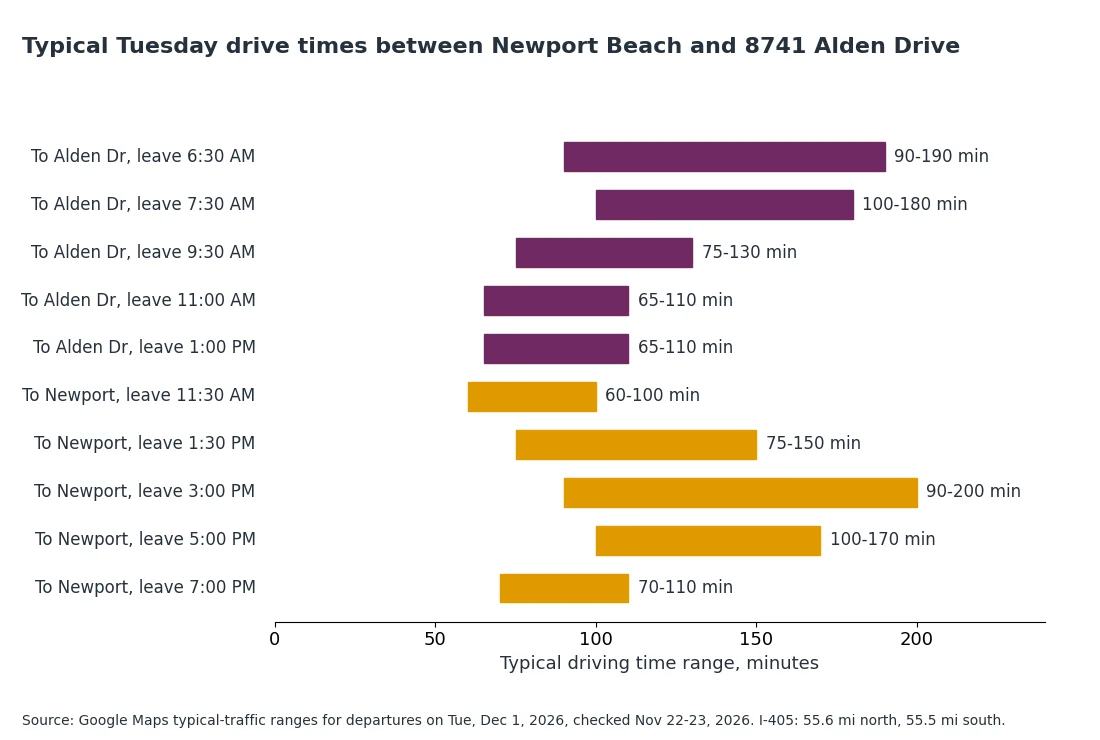
Two things stand out. Northbound, the early-morning departures carry both the longest typical times and the widest ranges: leaving at 7:30 a.m., Google’s typical range runs from 1 hour 40 minutes to 3 hours. Leaving at 11:00 a.m. or 1:00 p.m., it narrows to 1 hour 5 minutes to 1 hour 50 minutes. Southbound, the afternoon is the problem. Heading home on the I-405 South at 3:00 p.m. carried a typical range of 1 hour 30 minutes to 3 hours 20 minutes, while 11:30 a.m. carried 1 hour to 1 hour 40 minutes. Google also offered the I-5 South for the trip home; at 54.7 miles it is slightly shorter, but its typical range was longer than the I-405’s at every hour we checked. These are typical ranges for one Tuesday, not a promise; on the day itself, check live traffic before you leave.
Picking an appointment time that works with the 405
The Los Angeles office is open Monday to Friday, 8:30 a.m. to 5:00 p.m., and closed on weekends. That rules out a quiet Saturday drive, so the choice is between weekday windows. On the numbers above, the most forgiving pattern is a late-morning appointment: leave Newport Beach around 9:30 to 11:00 a.m. and aim to head home by about 11:30 a.m. to 1:30 p.m. An appointment that ends after 3:00 p.m. puts you into the slowest southbound hours. If an afternoon slot is the only one available, leaving Los Angeles at 7:00 p.m. instead brought the typical range back down to 1 hour 10 minutes to 1 hour 50 minutes, which may be worth an early dinner on the Westside.
When you call to book, say you’re coming from Newport Beach. It costs nothing to ask for a slot that fits the traffic, and the front desk can only take it into account if they know. Also ask how long the visit is likely to run. A consultation with an EKG is a different length of stay from one with a stress echo, and the length of the visit decides which traffic you’ll meet on the way home.
The 405 Express Lanes, and who rides free
Part of the route runs through the 405 Express Lanes, which the Orange County Transportation Authority opened on December 1, 2023, between SR-73 in Costa Mesa and the I-605 at the Los Angeles County line. According to OCTA, every vehicle needs a FasTrak transponder and a valid account with a California toll agency to use them. Cars carrying three or more people, motorcycles and vehicles with designated veterans plates ride free with FasTrak, and carpools need a switchable FasTrak Flex transponder to claim it. Vehicles with a disabled-person plate also ride free with FasTrak and a 405 Express Lanes account. Solo drivers pay a toll.
If someone is driving you and a third person comes along, the express lanes cost nothing with a Flex transponder set for three. They stop at the I-605, so they only cover the Orange County part of the trip.
Parking within a few minutes’ walk
CACVI’s contact page lists three places to park, and the first one is the one it recommends:
- Robertson Alden Garage (Lot 703), 141 Robertson Blvd. Free for the first two hours, $3 for three hours, then $1.50 for each additional 15 minutes, $12 daily maximum. Open every day, 6:00 a.m. to 11:30 p.m. About a three-minute walk along Alden Drive.
- Robertson Plaza, 116-120 N. Robertson Blvd. $3 for 15 minutes, $12 for an hour, $20 daily maximum. Open daily, 6:00 a.m. to 2:00 a.m.
- Steven Spielberg Building, 8723 Alden Dr. Free for the first hour, then $5 for each further hour, $15 daily maximum. Weekdays only, 8:00 a.m. to 5:00 p.m.
The two-hour free window at Lot 703 is the detail to plan around. A short consultation fits inside it. A visit with testing may not, so leave a few dollars in the budget rather than rushing through the appointment to beat the clock.
When someone else should drive
Many office visits and non-invasive tests don’t affect your ability to drive. Some procedures do. If your appointment involves sedation, ask the office whether you need a driver before you set out, because a long drive back to the coast isn’t something to improvise in the parking garage. The same goes for anyone recently started on a medication that causes dizziness, or anyone who has fainted. On those days, the honest answer may be that a family member drives, or that the visit waits until it can be arranged.


Making one trip count: records, images and the day itself
When the office is an hour or more away, a missing report costs more than a phone call. It can mean a second trip. The preparation below is about arriving with everything a cardiologist needs to give you an answer at the first visit.
Get your records out of Orange County first
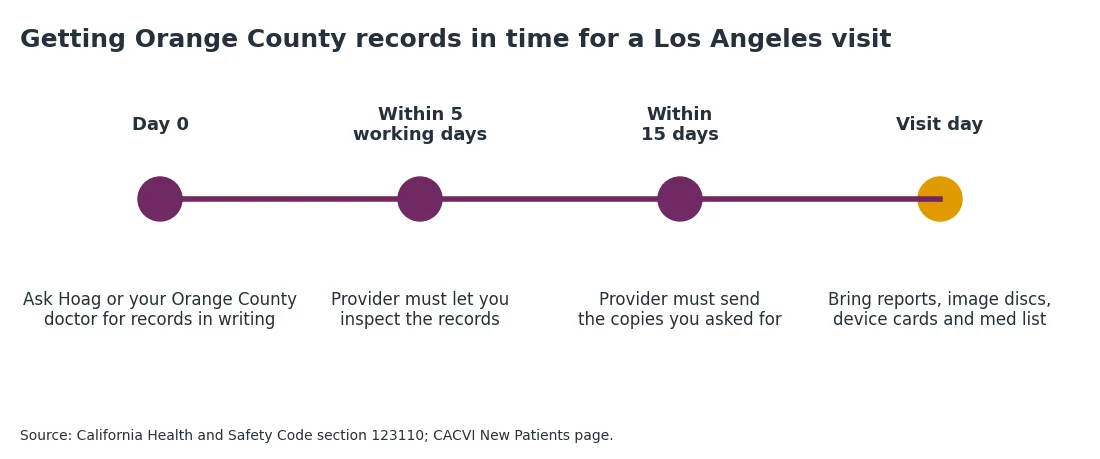
If your tests were done at Hoag, at an Orange County imaging center or by your local cardiologist, request copies before the appointment rather than relying on them being sent. California law gives you a firm timeline. Under Health and Safety Code section 123110, a provider must let you inspect your records within five working days of a request, and must send copies within 15 days of a written request.
Fifteen days is a long time if your appointment is next week, so ask early. Most hospital systems also have a patient portal where recent reports can be downloaded the same day. Reports, though, are only part of what’s useful.
Bring the images, not only the reports
For an echo, a CT, an angiogram or a vascular ultrasound, the written report summarizes what one reader saw. A second opinion is much stronger when the cardiologist can look at the images themselves. Ask the imaging department for a disc or a download link with the actual study. CACVI’s new patients page asks you to bring all your medical records and any imaging studies, which covers exactly this.
For catheter procedures you’ve already had, the procedure note matters most: which arteries were treated, what was found, which stents were used. If you carry a device card for a stent, pacemaker or defibrillator, bring that too.
What the new-patient page asks for
CACVI’s new-patient instructions are short, and following them avoids a slow start:
- Download, print and fill out the New Patient Registration Form before you leave home.
- Get there a quarter of an hour ahead of the appointment so registration doesn’t eat into it.
- Bring your insurance card, and know your office-visit co-pay if you can.
- Bring your medical records and imaging studies.
- Bring a list, or the bottles, of every medication, herbal product, vitamin and supplement you take.
- Bring payment: the page lists cash and Visa, Mastercard, Discover and American Express.
For a Newport Beach patient, “arrive 15 minutes early” really means “add 15 minutes to whatever Google said, then add the walk from the garage.”
Ask what can happen on the same day
Some tests can be done at the first visit, and some need a separate appointment or a different location. Our site describes a wide range of testing, including EKGs, echocardiograms, pruebas de esfuerzo, vascular ultrasounds, a coronary calcium scan and coronary CT angiography. Not every test is offered at every office on every day. When you book, ask which tests can be done at Alden Drive during the same visit. Asking once on the phone can save a second 110-mile round trip.
Write down the question you came to answer
It sounds obvious, but it changes the visit. After a long drive, it’s easy to arrive with a general worry and leave without the specific answer you needed. Write one sentence at the top of your notes: “Do I need this stent?”, “Is my leg pain from my arteries?”, “Why did my legs swell again after the vein procedure?” Then list your symptoms with dates, what makes them better or worse, and what earlier doctors told you. A clear question gets a clear answer.
Test day when the test is 55 miles from home
Preparation instructions for heart tests are written as if the patient lives around the corner. For someone leaving Newport Beach at 9:30 in the morning, ordinary rules about coffee, meals and medication land differently. The instructions below come from CACVI’s own test pages. Where they meet the realities of a long drive, ask the office before you go rather than improvising.
The morning coffee before a stress test
CACVI’s stress test page says caffeine, including coffee, tea, soda, chocolate drinks and energy drinks, should be avoided for at least 24 hours before a nuclear stress test, a PET stress test or a pharmacologic stress test, because caffeine can interfere with how the heart responds to the test. If your habit is a large coffee for the drive up the 405, this is the day to skip it, and the day before as well. Plan for a caffeine headache and bring water instead.
Eating around a long drive
For stress testing, the same page advises against a heavy meal for about two to four hours before the appointment, though a small snack may be allowed depending on the test. CACVI’s coronary CT angiography page says you’ll likely be asked to fast for four to six hours before the scan and to avoid caffeine and smoking on the day. With a drive of an hour or more, the fasting window starts at home. If you have diabetes and take insulin or other glucose-lowering medicine, ask your doctor how to handle a fast that now includes a freeway trip, and keep something with you to eat once the test is over.
What to wear and bring for a treadmill test
The stress test page asks for loose, breathable clothing and sturdy walking shoes, because clothing that is too tight can interfere with the EKG electrodes or the blood pressure cuff. It also says to stop a medication only if your provider clearly instructs you to; otherwise keep taking it as prescribed. The page puts the whole visit at about an hour, with some nuclear and PET studies taking longer. Add a consultation to that and the visit can outlast the free parking window described above.
After a contrast scan
The coronary CT page notes that drinking plenty of water afterwards helps flush the contrast dye, especially for people with kidney problems or a risk of kidney disease. A 55-mile drive home is a good reason to start before you get in the car, and to stop if you need to. If you’ve reacted to contrast dye before, tell the office when you book, not on arrival.
What the first consultation covers, and what you should leave with
A first cardiology visit has a fairly standard shape. Knowing it in advance helps you use the time well, which matters more when you’ve driven an hour to be there.
History first, then the examination
CACVI’s cardiac evaluation page describes the first visit as a physical examination and a medical history. Expect questions on your symptoms, your relatives’ heart history, your medicines and any other diagnoses; the hands-on part looks for what is driving symptoms like chest pain or breathlessness and checks how the heart is working. Blood or urine tests may be added. For leg problems, CACVI’s vascular evaluation page describes checking the pulses in the legs and feet and looking for skin changes and ulcers.
Questions you’ll probably be asked
Thinking about these before the drive is time well spent:
- When did the symptom start, and has it changed?
- What brings it on, and what makes it stop? Rest, sitting up, time?
- How far can you walk before you have to stop, and why do you stop?
- Has anyone in your family had heart disease, a stroke or a sudden death young?
- Do you smoke now, or did you in the past?
- Do you have diabetes, high blood pressure or high cholesterol, and what are you taking for them?
- What procedures have you already had on your heart, arteries or veins?
What you should have before you leave
Ask for these before you walk back to the garage:
- A plain-language summary of what the doctor thinks is going on.
- The next step, and whether it can be done near Newport Beach.
- Any test orders in writing, with where and how to schedule them.
- Changes to your medications, written down.
- Who to call with questions, and the right number for it.
- Confirmation that a note will go to your primary care doctor or local cardiologist.
When the answer is “it can be managed locally”
Sometimes the most useful outcome of a long drive is hearing that the plan you already have is reasonable, or that a problem can be handled close to home. That’s a good result, not a wasted trip. A second opinion that confirms the first one lets you go ahead with confidence.
Insurance when the cardiologist is in another county
Crossing from Orange County into Los Angeles County doesn’t change anything medically. It can change things for your insurance. Plans built around a local network or a local medical group may not cover a cardiologist in another county without a referral, and some won’t cover it at all. Ten minutes on the phone with your plan before booking avoids a surprise bill.
Original Medicare
Medicare’s own comparison page is clear on this: with Original Medicare, you can use any doctor or hospital that takes Medicare, anywhere in the U.S., and in most cases you don’t need a referral to see a specialist. If you have Original Medicare, perhaps with a supplement, the county line is unlikely to matter. Confirm with our office that the physician you’ll see accepts Medicare, as you would with any practice.
Medicare Advantage and HMO medical groups
Medicare’s comparison also notes that a Medicare Advantage plan may require you to use doctors in the plan’s network and service area for non-emergency care, and may require a referral to see a specialist. Many commercial HMO plans in Southern California work the same way, routing specialist care through your primary care physician’s medical group.
If your plan works like this, the place to start is your primary care doctor and your medical group, not our front desk. Ask whether a referral to an out-of-county cardiologist is possible, and on what grounds.
PPO plans and out-of-network costs
PPO plans usually let you see doctors outside their network, at a higher share of the cost. Before booking, ask your plan two things: whether CACVI’s physicians are in network, and if not, what you would pay for an out-of-network consultation and for any testing done the same day. Testing can cost more than the visit itself.
California’s wait-time standard for specialist appointments
If you’re in a California-regulated HMO and the reason you’re looking further afield is the wait for a local appointment, know your rights. The Department of Managed Health Care’s timely access standards say a non-urgent appointment with a specialist should be offered within 15 business days of the request. The DMHC advises contacting your health plan first if that isn’t happening, and its Help Center next. Sometimes the right answer is an earlier appointment in Orange County, and that’s a perfectly good outcome.
Questions to ask our office before you drive
When you call 310-652-2744, ask:
- Does the physician I’m booking with accept my plan, and is that in or out of network?
- Will I need a referral or prior authorization for the visit or for testing?
- What is the expected co-pay for the consultation?
- If you recommend a test or procedure, where would it be done, and is that facility covered?
Not sure your plan covers a Los Angeles visit? Call your plan first, then call us at 310-652-2744 with your member ID card in hand.
If a procedure is recommended: planning the second trip
If the visit ends with a recommendation for a catheter procedure, a second trip to Los Angeles is likely. Our About Us page says the physicians perform a variety of procedures in the office, and our amputation prevention page notes that a leg-artery narrowing found on an angiogram can be opened with a balloon in the same setting or at a separate session. Other procedures take place in a hospital. Where yours happens shapes everything else about the day.
Questions to ask about where and how long
- Will the procedure be in the office or at a hospital, and at which address?
- How long should I plan to be there, from arrival to leaving?
- Will I have sedation, and do I need someone to drive me home?
- Is there any chance of staying overnight, and how would I know in advance?
Medications before the procedure
Some procedures require changes to blood thinners, diabetes medication or other drugs beforehand. These instructions are specific to the procedure and to you, so get them in writing from the team doing the procedure and follow those, not general advice from the internet or from an earlier procedure. If your local doctor manages a medication, tell both doctors so the instructions don’t conflict.
The ride home and the first night
A long drive back after a procedure is the part to plan most carefully. Ask how soon after the procedure you can sit in a car for over an hour, whether you should stop on the way, and what to watch for at the puncture site in the wrist or groin. Know before you leave who to call if something changes that evening, and which nearby emergency department to use if it’s serious. In Newport Beach, that is usually Hoag.
Follow-up near home
Not every follow-up needs another drive north. Ask which checks, such as a repeat ultrasound, blood tests or wound care, can be done in Orange County and sent to us, and which ones the treating physician wants to do in person.
Keeping your Orange County doctors in the loop
Seeing a cardiologist in another county works better when your local doctors know what happened. A visit that ends with new medication and no note to your primary care physician leaves room for a conflicting prescription or a repeated test.
Doctors can share records for your care
You might wonder whether privacy rules stop doctors from talking to each other. For this purpose, they don’t. The U.S. Department of Health and Human Services explains that the HIPAA Privacy Rule allows a health care provider to share patient information with another provider for treatment, without a separate written authorization from the patient. What helps is giving both offices the right names, fax numbers and addresses.
Bring the contact details with you
At check-in, have the name, practice, phone and fax of your primary care physician and any Orange County cardiologist you see. Ask for the consultation note to be sent to them, and ask your local office to send their recent notes to us. If you use Hoag’s patient portal, you can also download recent results yourself and bring them.
One medication list, kept current
Care split between two counties can easily end up with two medication lists that don’t match. Keep one list yourself, with the dose and time of day for each drug, and update it after every visit. Bring it to both offices, and ask each one to check it against their records.
Booking a visit from Newport Beach
Call the Los Angeles office at 310-652-2744, Monday to Friday between 8:30 a.m. and 5:00 p.m., or send a request through our appointments page. Start with the question you want answered and the tests you’ve already had; the rest of the booking follows from those two things.
Questions Newport Beach patients ask about a Los Angeles cardiology visit
Which CACVI office is closest to Newport Beach?
CACVI’s offices are in Los Angeles (8741 Alden Drive, Suite A), Tarzana (18226 Ventura Blvd, Suite 102) and Victorville (12441 Hesperia Road, #A5 and #A6). From Newport Beach, Los Angeles is the closest.
How long is the drive on a weekend?
The office is closed on weekends, but as a point of comparison: on a Sunday afternoon in November, Google Maps estimated about 1 hour 14 minutes for the 55.6 miles via the I-405 North, and about 1 hour 12 minutes using the express lanes.
Are CACVI’s cardiologists part of Hoag?
No. Hoag has its own cardiologists through its Jeffrey M. Carlton Heart & Vascular Institute. CACVI is an independent practice based in Los Angeles. Dr. Khorsandi’s bio lists him on the attending staff at Cedars-Sinai and as cath lab director at Providence Cedars-Sinai Tarzana. If you’re admitted to Hoag, the doctors on staff there will look after you, and you can bring the records to us afterwards.
Can I get a same-day or next-day cardiology appointment?
Availability changes day to day, so we can’t promise a time on this page. Call 310-652-2744 and ask for the first opening. If your symptoms can’t wait a day, they shouldn’t wait for an appointment at all: go to an emergency department.
Is a concierge cardiologist the same as an interventional cardiologist?
No. “Concierge” describes a payment and access model, usually an annual fee for more direct contact. “Interventional” describes a clinical training path in catheter procedures. A doctor can be one, both or neither. CACVI’s physicians are interventional cardiologists.
Are your doctors cardiac surgeons?
No. Cardiac surgeons perform operations such as bypass and open valve surgery. Our physicians are interventional cardiologists, who work through catheters, usually placed through an artery or vein in the wrist or groin. If you need surgery, that is a referral to a surgeon.
I had a DVT treated at Hoag. Can you see me for the follow-up?
Yes, for the venous side: persistent swelling, a second clot, or a question about venous stenting or an IVC filter. Bring the ultrasound reports, the name and dose of your blood thinner and the date you started it, and the discharge paperwork.
Do you see patients for varicose veins alone, without a heart problem?
Yes. Varicose veins and venous insufficiency are part of the practice in their own right. Mention which leg bothers you and any earlier vein procedures when you call, so the visit can include the right ultrasound.
Where can I get an EKG, echo or stress test closer to Newport Beach?
Hoag’s Newport Beach location page gives two scheduling numbers: (949) 764-5588 for Holter monitoring, stress tests and echocardiograms, and (949) 764-6350 for the Hoag Vascular Lab. Those tests usually need an order from your doctor. Bring the results to a CACVI visit if you see us later.
What should I bring if I’ve been told I need an amputation?
Any angiogram or arterial ultrasound of the leg, with the images if you can get them; photos of the wound taken over the last few weeks; the surgeon’s notes; and a list of your diabetes and blood thinner medications. Ask for the visit before a surgery date is set.
Can I send my records before the visit?
Yes. Email them to info@cacvi.org or fax them to 310-967-2140, the fax number on our contact page, and mention the date of your appointment. Bring paper copies or the disc anyway, in case something doesn’t arrive.
My smartwatch flagged an irregular rhythm. What should I bring?
Export the recordings the watch saved, with their dates and times; many watch and phone health apps let you save them as a PDF. Note what you were doing and feeling at each one. A watch tracing is a single-lead screening record, so expect the cardiologist to confirm it with a standard EKG or a longer monitor.
Neighboring Orange County cities
Huntington Beach, Costa Mesa and Irvine share a city line with Newport Beach; Laguna Beach lies just past Crystal Cove State Park. Each has its own page: cardiologist in Huntington Beach, cardiologist in Costa Mesa, cardiologist in Irvine and cardiologist in Laguna Beach. For the office and the neighborhood around it, see the Los Angeles cardiologist page.
Newport Beach evidence and reading links
| Source | Publisher | What it covers |
|---|---|---|
| CACVI: Appointments and office locations | CACVI | Los Angeles office address, phone, fax, email and the three parking options. |
| CACVI: New Patients | CACVI | Printable intake form plus the documents, cards and payment the office expects. |
| CACVI: Cardiac Evaluation | CACVI | What the first cardiology evaluation consists of. |
| CACVI: Peripheral Vascular Disease Evaluation | CACVI | ABI, Doppler ultrasound and CT angiography for leg circulation. |
| Providence: Dr. Mehran Khorsandi | Providence | Physician directory listing with the 8741 Alden Drive practice location. |
| Providence: Dr. Moinakhtar Lala | Providence | Physician directory listing with the 8741 Alden Drive practice location. |
| Hoag Hospital Newport Beach | Hoag | Emergency department, outpatient cardiovascular testing and scheduling numbers. |
| OCEMS Facility Designations Summary Report, May 2024 | Orange County Emergency Medical Services | Hoag Hospital Newport Beach review as a Cardiovascular Receiving Center. |
| I-405 Improvements Open | Orange County Transportation Authority | 405 Express Lanes opening, extent and FasTrak rules. |
| About Heart Attack Symptoms, Risk, and Recovery | CDC | Heart attack symptoms and the instruction to call 9-1-1. |
| About Venous Thromboembolism (Blood Clots) | CDC | Signs of DVT and pulmonary embolism. |
| Blood Clots and Travel | CDC | Clot risk on trips over four hours and how to reduce it. |
| Health and Safety Code section 123110 | California Legislative Information | Deadlines for inspecting and copying medical records. |
| Timely Access to Care | California Department of Managed Health Care | Wait-time standards, including 15 business days for a non-urgent specialist appointment. |
| Compare Original Medicare and Medicare Advantage | Medicare.gov | Doctor choice and referral rules in each type of Medicare coverage. |
| Sharing information for treatment under HIPAA | U.S. Department of Health and Human Services | Providers may share patient information for treatment without a separate authorization. |
| Abdominal Aortic Aneurysm: Screening | U.S. Preventive Services Task Force | Who should have a one-time ultrasound screening for an abdominal aortic aneurysm. |
| Verify a Physician | American Board of Internal Medicine | Free search showing whether a physician holds a current certificate. |
| DCA License Search | California Department of Consumer Affairs | Public lookup of California medical licenses. |
¿Listo para hablar?