




















Evaluación cardíaca
Cardiologist Care for Alhambra and the West San Gabriel Valley
Heart and vascular care for Alhambra patients, seen by CACVI’s cardiologists at 8741 Alden Drive in Los Angeles.
Patients from Alhambra come to our Los Angeles office on Alden Drive, next to the Cedars-Sinai campus, and most of them get there on the westbound 10. We say that up front because the honest description is a drive of about 20 miles. What you get at the end of it is a cardiology practice that does the office side of heart care (the consultation, the EKG, the echocardiogram, stress testing, rhythm monitors, medication management) and whose physicians also perform catheter procedures on the heart, the leg arteries and the veins.
Heart care needs in Alhambra differ. You may want a cardiologist or heart doctor and simply need a name and a phone number. You may want a cardiovascular center or a heart and vascular center because a relative’s leg pain or a vein problem is part of the picture. Or you may want cardiology near downtown Los Angeles because you work downtown and live in Alhambra. What follows is written for each of these situations, and especially for working adults who have to fit heart appointments around a commute on the 10.
The Los Angeles office books appointments on 310-652-2744, weekdays between 8:30 a.m. and 5:00 p.m. Anyone reading this with chest pressure, sudden breathlessness or a fainting spell happening now should put the page down and dial 911.
Ready to book from Alhambra? Call 310-652-2744 or use the appointment request form. Tell the scheduler you are coming from Alhambra so the visit can be timed around the drive.
Alhambra to Alden Drive in one table
The figures below cover the practical facts for Alhambra patients before a first visit. Each row says where the number comes from, and the drive times are single observations, not fixed figures. The sections after the table explain each one in more depth.
| Item | Why it matters from Alhambra | Where we found it |
|---|---|---|
| CACVI Los Angeles: 8741 Alden Dr, Suite A, Los Angeles, CA 90048. Phone 310-652-2744, fax 310-967-2140 | The office Alhambra patients usually book; Monday to Friday, 8:30 a.m. to 5:00 p.m. | CACVI contact page; office hours from the site’s office data |
| Alhambra City Hall to Alden Dr: 21.3 miles, 53 minutes via the westbound 10 | Weekday mornings are slow; late-morning and early-afternoon slots avoid the rush. | Google Maps fastest route, checked 9:05 a.m. on Monday, Nov 23 |
| CACVI Tarzana: 18226 Ventura Blvd, Suite 102. Phone 818-905-5904. Saturday 8:00 a.m. to 4:30 p.m. | The Saturday option; 28.4 miles and 51 minutes from City Hall on the same check. | CACVI contact page; Google Maps |
| Robertson Alden Garage (Lot 703), 141 Robertson Blvd: free for the first 2 hours, $12 daily max | About three minutes’ walk to the office; enough for a consultation and a test. | CACVI contact page |
| Nearest County STEMI Receiving Center: Garfield Medical Center, 525 N Garfield Ave, Monterey Park | 1.9 miles from City Hall. Alhambra Hospital Medical Center is closer but not on the County’s STEMI list. | LA County EMS STEMI Receiving Centers map, June 2024 |
| California paid sick leave: at least 40 hours or five days a year | Covers diagnosis, treatment and preventive care for you or a family member. | Labor Commissioner FAQ |
| Workplace accommodations: private employers with 5 or more employees, and all public employers | A schedule change, lighter duties or work from home can be requested after a heart diagnosis. | CRD Disability Accommodations at Work fact sheet |
| Kick It California: 800-300-8086, free coaching by phone, text or chat; app in several languages | Free coaching to quit smoking or vaping. | Kick It California |
Cardiology services Alhambra patients book at the Alden Drive office
This section lists the cardiology services Alhambra patients can book, in the order a typical visit moves through them. The short version: the consultation and much of the first round of testing happen with one practice, and any procedure is planned by the same physicians who saw you in clinic.
A consultation built around one question
A first visit works well when it has a single question at its center. “Why does my chest tighten on the stairs at work?” “Is the murmur my primary care doctor heard something to fix?” “My father had a stent at 58; what does that mean for me?” The cardiologist takes a history, examines you, reviews the medicines you take, and looks at whatever earlier results you bring. Most first visits also include a resting EKG recorded in the exam room. By the end you should know which tests are being ordered and what each one is meant to settle.
If your question is about a relative rather than yourself, bring the relative. A cardiologist can’t plan around a description of someone else’s symptoms, and Alhambra families often book a parent and an adult child on the same morning so one drive covers both.
Tests that usually follow the first visit
These are the tests a cardiologist most often orders after a first visit, each with its own page on this site:
- An echocardiogram, the ultrasound that shows pumping strength, wall thickness and how each valve opens and closes.
- Stress testing, either walking on a treadmill or, for people whose knees or lungs rule that out, with a drug that raises the heart’s workload.
- Mobile cardiac telemetry and other wearable monitors, for palpitations or dizzy spells that never happen during an appointment.
- Vascular ultrasound of the neck arteries, the leg arteries and the leg veins.
- A coronary calcium scan or coronary CT angiogram when the question is plaque in the heart’s own arteries; these need a CT scanner, so ask where yours will be booked.
The EKG, echocardiogram, stress testing and rhythm monitoring are done in the Los Angeles office. When you call, find out which of these can be fitted into the consultation day. For a patient who has already taken a morning off and driven in from Alhambra, getting the echocardiogram done before leaving saves a second trip.
Procedures planned from the clinic
Several CACVI procedures go through the heart’s arteries or valves with a catheter instead of open surgery. The practice’s pages describe coronary stenting and complex coronary intervention, transcatheter aortic valve replacement (TAVR), MitraClip for a leaking mitral valve, and the WATCHMAN implant for people with atrial fibrillation who can’t stay on a blood thinner. Devices are part of the same list: pacemakers, defibrillators, biventricular defibrillators and the CardioMEMS pressure sensor used in heart failure.
Where a procedure happens depends on the procedure. CACVI’s page on office-based procedures explains that the practice uses an office-based lab and/or an ambulatory surgery center, with same-day discharge, for procedures suited to that setting; it doesn’t name the location for each one, so ask your cardiologist where yours would be done and whether you’ll go home the same day.
What matters for an Alhambra patient is continuity. The physician who examines you in the office is the one who reviews the angiogram or the valve measurements and explains whether a procedure makes sense at all. Many people who come in asking about a stent leave with a medication plan instead, and that is a normal outcome of a consultation.
The vascular half of the center’s name
CACVI stands for Center for Advanced Cardiac and Vascular Interventions. The “vascular” part means heart and vascular care for Alhambra patients comes from one center. The same physicians look after narrowed leg arteries (peripheral artery disease), varicose veins, venous ulcers, carotid narrowing and aortic aneurysms. These problems share risk factors with coronary disease, so a heart visit often turns up a leg question and the reverse.
If leg pain on walking is your main reason for looking, our leg pain and PAD page for Alhambra goes into that in detail, and you can stay with one practice for both.
What gets referred elsewhere
Being clear about the limits saves a wasted trip. CACVI doesn’t perform operations that open the chest; coronary bypass and surgical valve replacement are hospital operations done by cardiothoracic surgeons. Catheter ablation for atrial fibrillation is done by electrophysiologists and isn’t among the procedures listed on our physicians’ biographies. Transplant evaluation for advanced heart failure also happens at a transplant center. In each case a CACVI cardiologist can do the evaluation, explain the options and send the records to the right team.
Not sure which visit to ask for? Call 310-652-2744 and describe the symptom or the result that worries you. The scheduler can tell you whether to book a heart consultation, a vascular evaluation or both on the same day.
From Valley Boulevard to Alden Drive: the 10, its ExpressLanes and the hour you pick
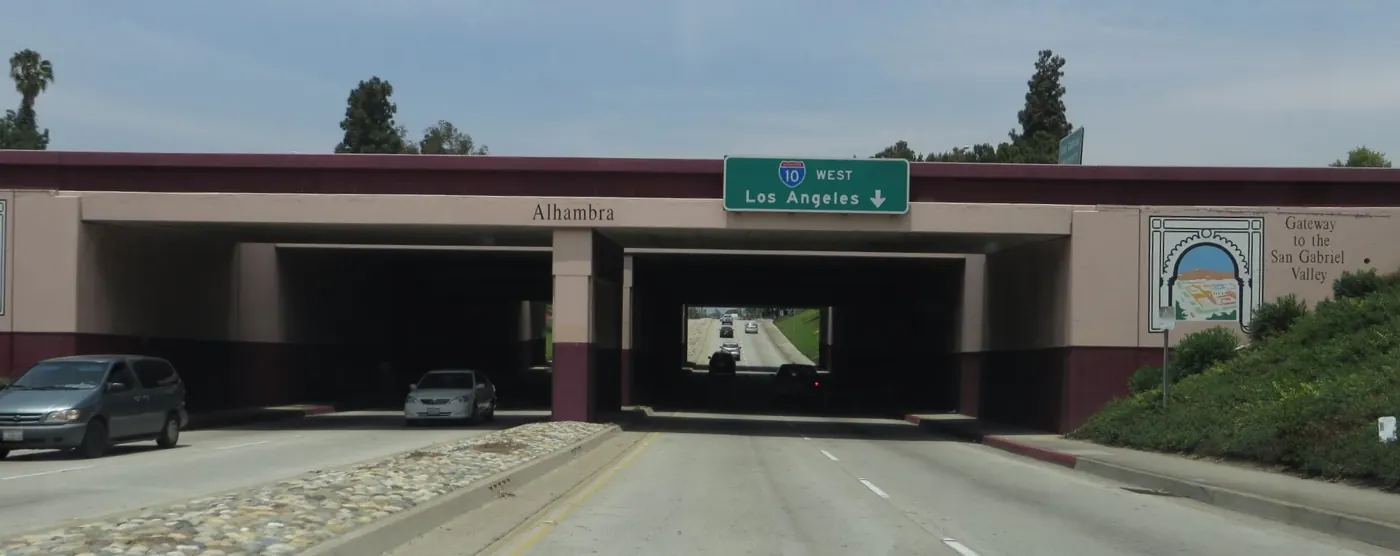
Nearly every Alhambra patient arrives by car, and the drive is the part of a cardiology visit people underestimate. The office at 8741 Alden Drive sits just west of Robertson Boulevard, which from Alhambra means crossing the full width of central Los Angeles. Most of the routes Google Maps offered us ran along the westbound San Bernardino Freeway (the 10) and on into the Santa Monica Freeway; at some hours it preferred the 101 and Beverly Boulevard instead.

What the drive took when we checked
On a Monday morning a little after 9:00, Google’s fastest route from Alhambra City Hall at 111 South First Street to Alden Drive was 21.3 miles and 53 minutes. From the corner of Valley Boulevard and Atlantic Boulevard it was 19.5 miles and 48 minutes. Both were marked “heavy traffic, as usual.”
A single reading only tells you about one morning, so we also asked Google Maps for its typical-traffic ranges for a Tuesday. Leaving City Hall at 7:30 a.m., the typical trip to Alden Drive ran from 55 minutes to two hours. At 11:00 a.m. it was 35 minutes to 1 hour 10 minutes, at 1:00 p.m. 35 minutes to an hour, and at 4:30 p.m. 40 minutes to 1 hour 20 minutes. From Valley and Atlantic, a 1:00 p.m. departure was typically 30 to 55 minutes.
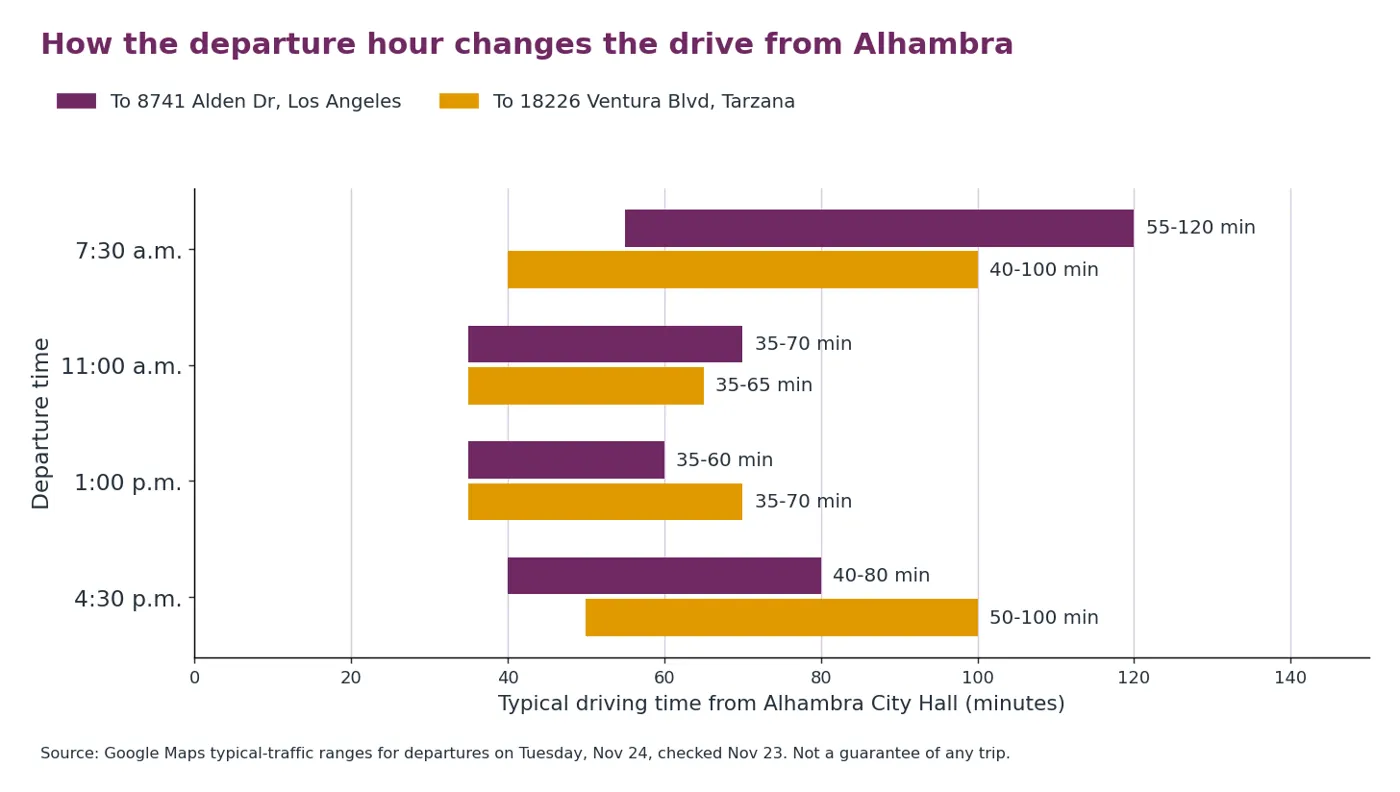
The practical lesson is simpler than any single number. Ask for a late-morning or early-afternoon appointment if your schedule allows it. A 9:00 a.m. slot is possible, but it means leaving Alhambra before 7:30 and accepting a wide spread in arrival times.
Using the ExpressLanes on the 10
The I-10 ExpressLanes run in the median of the San Bernardino Freeway on the busway between El Monte and downtown, passing just south of Alhambra. Metro sets the toll by traffic: higher when the lanes are in demand and lower when they aren’t. Solo drivers can pay to use them, and carpools that meet the occupancy rule ride free, as long as the car carries a FasTrak Flex transponder with its switch set to the number of people on board. The occupancy rule on the 10 is stricter at peak hours than off-peak, so check the posted rule rather than assuming a two-person carpool rides free at 8 a.m.


Two points matter for a cardiology trip. A patient being driven by a spouse or an adult child is already part of a carpool, so the switch setting is worth getting right before you leave. And the busway lanes end at Alameda Street near Union Station; the miles west toward Robertson are in the ordinary lanes, which is where much of the morning delay builds.
Parking near Alden Drive
Three garages within a short walk appear on CACVI’s contact page. Lot 703, the Robertson Alden Garage at 141 Robertson Boulevard, is the one the practice marks as preferred: three minutes on foot, open daily 6:00 a.m. to 11:30 p.m., no charge for the first two hours and $12 at most for the day, according to that listing. Robertson Plaza at 116-120 North Robertson and the Steven Spielberg Building garage at 8723 Alden Drive are the alternatives, both more expensive per hour. A consultation plus same-day testing can run past two hours, so the Lot 703 pricing is worth knowing before you choose a garage.
When the Tarzana office is the better choice
CACVI’s second office, at 18226 Ventura Boulevard in Tarzana, is farther from Alhambra in miles but not always in minutes. On the same Monday morning, City Hall to Tarzana took 51 minutes over 28.4 miles by the 134 and the 101, two minutes faster than the trip to Alden Drive, and Google’s typical range for an 11:00 a.m. Tuesday departure was 35 minutes to 1 hour 5 minutes. Tarzana also has free, limited on-site parking, and of the two offices within reach of Alhambra it is the one open on Saturdays, from 8:00 a.m. to 4:30 p.m. When weekday leave is impossible, Tarzana’s Saturday hours are the practical answer for Alhambra patients. Call 818-905-5904 for that office.
A disabled person placard when the walk is the hard part
For some heart patients the drive is manageable and the walk from the garage is not. Severe heart failure, angina that comes on after a short distance and recovery from a procedure can all make a few hundred feet hard going. California’s DMV issues disabled person placards to people with a diagnosed disease that substantially impairs mobility, and the application (form REG 195) needs a medical provider’s certification from a licensed physician, physician assistant, nurse practitioner or certified nurse midwife.
The DMV offers two kinds. A temporary placard carries a fee and expires after 180 days at most, sooner if your clinician writes an earlier end date. A permanent placard has no fee. With a placard you can park in accessible spaces, next to blue curbs, at green curbs for as long as you like, and at on-street meters at no charge, but not in the striped access aisles or next to red, yellow or white curbs. Garages set their own rules for placard holders, so ask at the entrance. If you think you qualify, bring the REG 195 form to your visit and ask the cardiologist whether your condition meets the DMV’s description.
Letting someone else drive
After a procedure, or on a day when a medicine for a stress test may leave you lightheaded, plan for a driver. The office will tell you at booking whether the visit calls for one. For a routine consultation most people drive themselves, but a parent in their eighties will usually do better with a family member at the wheel and someone to keep notes during the visit.
A downtown workday with a cardiology appointment in it
If you live in Alhambra and want a cardiologist near downtown LA, close to where you work, the plan starts with your commute: home east of the city line, a desk somewhere between Union Station and the Financial District, and very little room in the week for medical visits. The Los Angeles office is closer to a downtown job than it is to an Alhambra driveway, and that changes how a visit can be planned.
From a downtown desk to Alden Drive
On the same Monday morning we timed the Alhambra routes, the drive from Los Angeles City Hall at 200 North Spring Street to Alden Drive took 34 minutes over 8.9 miles. Google sent the car along Beverly Boulevard rather than the freeway, with Third Street a minute behind. Tarzana was 36 minutes from City Hall on the 101. For a patient who works downtown, an appointment just after the lunch hour, driving west from the office and home to Alhambra afterwards, usually costs less time than starting the trip from home.
Booking around the working week
When you call, say that you work downtown and ask three things. One: can the consultation and the probable first tests, an EKG and quite often an echocardiogram, share a single appointment? Second, how long to block on the calendar; a consultation alone is shorter than one with an echocardiogram and a stress test. Third, whether any test needs preparation that affects the morning, such as not eating beforehand or holding a medicine. Asking these questions turns two half-days into one.
Wearing a heart monitor to the office
If the cardiologist wants to catch a rhythm that only shows up now and then, you may go home with a wearable monitor for days or weeks. These are designed to be worn through ordinary life, which for most patients means a normal workday. The useful habit is a short log: the time of each flutter, skipped beat or dizzy spell, and what you were doing at that moment, whether climbing the stairs from the Metro platform or sitting in a meeting. The physician matches each entry to the recording, and a log with times in it makes the report far easier to read.
Long hours, short nights
Can long hours, shift work or caring for a relative affect the heart? The American Heart Association counts sleep among its eight measures of heart health, alongside diet, activity, tobacco, weight, cholesterol, blood sugar and blood pressure, and says most adults need seven to nine hours a night. A commute that starts before 7:00 a.m. on the 10 and ends after dark leaves little room for that.
If your schedule is the reason your blood pressure or blood sugar hasn’t settled, say so at the visit. A cardiologist can time medicines around a shift, and can ask about loud snoring or daytime sleepiness if those come up. Advice that ignores the hours you actually keep rarely survives the first week back at work.
If symptoms start at work instead of at home
A heart attack that starts in a downtown office is handled by the Los Angeles Fire Department, not by Alhambra’s paramedics, and the hospitals close to downtown are different from the ones near home. LA County’s list of STEMI Receiving Centers, the hospitals approved to take heart-attack patients straight to a catheterization lab, includes Los Angeles General Medical Center, Adventist Health White Memorial and PIH Health Good Samaritan Hospital, all within a few miles of the downtown core. Paramedics choose among them under the County’s rules, so a coworker’s job is to call 911, not to drive you anywhere.
The defibrillator in your building
California law places duties on anyone who puts an automated external defibrillator (AED) in a building. Under Health and Safety Code section 1797.196, the building owner must tell tenants at least once a year where the AED units are, offer a yearly demonstration to at least one person associated with the building, and post instructions in at least 14-point type next to each device. If you have a heart condition, it is worth reading that notice when it arrives and knowing which floor the nearest unit is on.
Coworkers sometimes hesitate to use an AED for fear of doing harm. California’s Civil Code section 1714.21 protects a person who uses one in good faith, and not for pay, at the scene of an emergency from civil liability, except in cases of gross negligence or willful misconduct. That is worth telling the people who sit near you.
Working downtown? An early-afternoon Alden Drive slot usually fits a downtown workday; mention any test you hope to combine with it. Call 310-652-2744.
Time off for heart care under California’s leave and disability rules
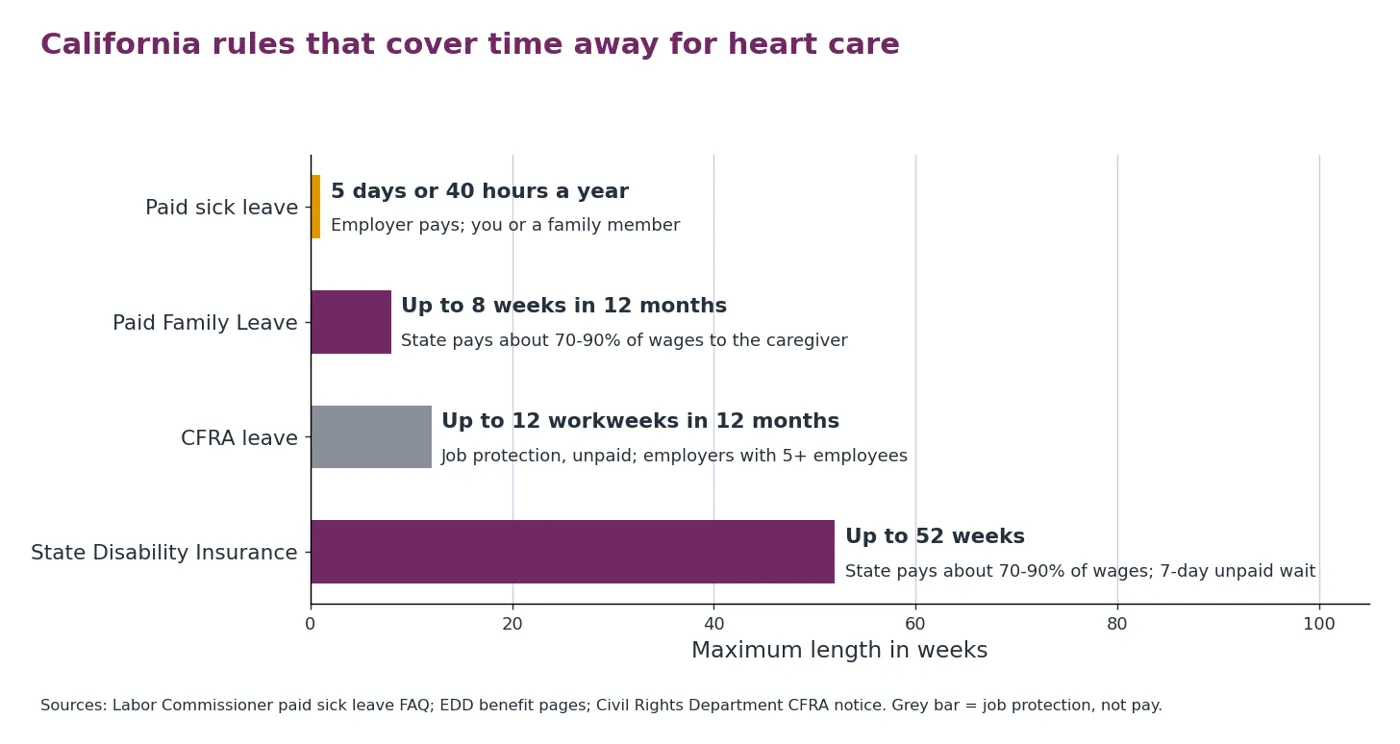
Working adults tend to put off a cardiology visit because of the time away from work, and then put off the follow-up for the same reason. California has more protection here than most states, and knowing the rules before a diagnosis makes the conversation with an employer much easier. Four of them matter most when a heart condition takes someone away from work. It is general information from the state’s own pages, not legal advice, and your employer’s policies can add to these rules.
Paid sick days for appointments and tests
Since January 1, 2024, California employers generally must let employees use at least 40 hours or five days of paid sick leave a year, whichever is more, according to the Labor Commissioner’s paid sick leave guidance. That is enough to cover a consultation, a day of testing and a follow-up visit. Sick leave can be used for preventive care and for diagnosis or treatment of an existing condition, so a cardiology visit with no symptoms behind it still qualifies.
California’s “kin care” rule, Labor Code section 233, lets an employee who has sick leave use part of it for a family member’s care. An adult child who drives a parent from Alhambra to Alden Drive for an echocardiogram can use their own sick leave for the morning.
State Disability Insurance after a heart attack or procedure
If a heart attack, a procedure or a new diagnosis keeps you from doing your usual work, State Disability Insurance (SDI), run by the Employment Development Department, can replace part of your wages. The EDD describes the weekly benefit as about 70 to 90 percent of wages earned 5 to 18 months before the claim start date, depending on income, up to a weekly maximum. Its current table puts that maximum at $1,765 a week. Benefits can last up to 52 weeks for a non-work-related illness, and the first seven days of a claim are an unpaid waiting period.
The disability has to be certified by a physician or practitioner. For a heart condition, that is often the cardiologist who is treating you, so mention at your visit that you have filed or plan to file, and ask how the office handles the certification.
The EDD’s claim form, the DE 2501, has two parts: your own statement (Part A) and the medical certification (Part B). File no earlier than nine days and no later than 49 days after the disability begins; the medical certification has the same 49-day limit, and the EDD says the claim won’t be processed until it has both parts. If your physician certifies online, the EDD asks you to allow about 14 calendar days for the claim to be received and processed.
Paid Family Leave for the person who helps
Paid Family Leave (PFL), run through the same state program, pays the family member, not the patient. The EDD allows up to eight weeks within any 12-month period to care for a seriously ill family member, at the same 70 to 90 percent benefit rate, and the weeks don’t have to be taken all at once. After a parent’s valve procedure or heart failure admission, a daughter or son can take PFL for the first weeks at home and later use the remaining weeks for follow-up visits.
Job protection under the California Family Rights Act
SDI and PFL pay benefits; they don’t by themselves hold your job open. That protection comes from the California Family Rights Act (CFRA). According to the Civil Rights Department’s workplace notice, CFRA covers employers with five or more employees and gives eligible employees up to 12 workweeks of job-protected leave in a 12-month period, for their own serious health condition or that of a child, spouse, domestic partner, parent, parent-in-law, grandparent, grandchild, sibling or a “designated person.” To qualify, you need more than 12 months with the employer and at least 1,250 hours worked in the 12 months before the leave starts.
The same notice says CFRA leave can be taken intermittently or on a reduced schedule when medically necessary. For a heart patient, that can mean a series of half-days for cardiac testing and rehabilitation sessions rather than one long absence.
Small employers and the five-employee line
CFRA’s job protection starts at five employees. Someone who works for a smaller business, such as a family restaurant or a two-person office, doesn’t have CFRA rights, though the paid sick leave rule still generally applies and SDI and PFL still pay if SDI has been withheld from their wages. In that situation it is worth talking to the employer early, before the leave starts, and asking for any agreement about returning in writing.
If you run your own business
Self-employed people don’t pay into SDI automatically, so a heart attack can leave a sole proprietor with no state benefit at all. The EDD’s Disability Insurance Elective Coverage program lets sole proprietors, independent contractors, partnerships and some LLC managing members buy in. It requires at least $4,600 a year in net profit reported on Schedule SE, a commitment to stay in the plan for two full calendar years, and at least six months in the plan before you can file a claim. Participants can receive up to 39 weeks of disability benefits, and the program also gives access to Paid Family Leave. The six-month wait means it only helps if you enroll before you need it, which is exactly why a first cardiology visit is a sensible moment to look into it.
Putting the pieces together
In practice the rules stack. A worker recovering from a heart attack might use sick days for the first appointments, file for SDI for the weeks off work, and rely on CFRA to return to the same job. A spouse or adult child might use PFL pay while CFRA protects their position. The forms ask for dates, so keep a simple record of each visit and procedure date from the start. When the EDD asks your physician to certify a claim, those dates are what the certification rests on.
Staying at work with a heart condition: accommodations under California law
Time off is only half of the working patient’s problem. Most people with a heart condition keep working, and what they need is a job that bends a little: a later start after a bad night, no heavy lifting for a few weeks after a device implant, a day at home when a new medicine makes them lightheaded. California’s Civil Rights Department (CRD) published a fact sheet on disability accommodations at work in July 2026, and its rules apply to many heart patients who would never describe themselves as disabled.
Who the protection covers
According to the CRD fact sheet, these protections apply to private employers with five or more employees and to all public employers. They cover job applicants, employees, interns and volunteers. To receive an accommodation, a person generally needs a physical or mental impairment that limits their ability to do major life activities, and the CRD lists walking and lifting among its examples, along with thinking, communicating and concentrating.
Two details in the fact sheet matter for heart patients. A condition still counts if it can be treated with medication, and it still counts if it is temporary. Heart failure kept steady with medicines, angina that limits how far you can walk, or the weeks of restricted arm movement after a pacemaker implant can all fall within that description. Whether your own condition qualifies depends on how it limits you, which is exactly what a cardiologist’s note describes.
Asking for a change at work
The rules for asking are simpler than most people expect. The CRD says employers can’t require the request to be in writing or to use particular words; if you ask for a change to your workplace or working conditions so you can do the essential parts of your job, that is a reasonable accommodation request. There is no limit on when you ask or how many times. What you do have to explain is the connection: how the change you are asking for would help you do the job, given your heart condition.
Once a request arrives, the employer must respond promptly and start what the law calls the interactive process, a conversation about the request. The CRD fact sheet says both sides must take part in good faith and without delaying it, whether or not the accommodation is granted in the form first requested.
Changes that often fit a heart patient
The CRD’s list of possible accommodations includes changing work schedules, restructuring job tasks, transferring an employee to a different work site and allowing work from home. Each of these has an obvious use after a heart diagnosis:
- a shifted schedule so cardiac rehab sessions or follow-up visits don’t cost a full day each time;
- a start time that avoids the worst of the morning drive, since the typical trip from Alhambra to Alden Drive at 7:30 a.m. ran anywhere from 55 minutes to two hours in Google’s estimate, against 35 minutes to an hour at midday;
- lighter duties, or someone else handling the lifting, for the weeks after a device implant or a groin or wrist catheter procedure, when your physician has given you limits;
- working from home for a stretch while medicines are adjusted and side effects settle;
- a workstation nearer the entrance or the restroom when walking distance or diuretics are part of the picture.
The CRD says employers must consider the employee’s preference, but where several accommodations would work, the employer may choose the one that suits the business. It also says an employer can’t make you accept an accommodation that doesn’t address your actual need.
What your cardiologist can put in writing
Employers may ask for medical documentation during the interactive process when the disability or the need isn’t obvious. The CRD lists the forms this can take: a letter or note from a health care provider, a certification form, or a medical inquiry form completed after the request. It is equally clear about the limits. An employer’s form must not ask for more than the employer is entitled to, which includes medical records, specific diagnoses and information about what caused the disability.
So the useful note from a cardiologist usually describes what you can and can’t do, and for how long, rather than naming every diagnosis. “No lifting above a set weight until a stated date” or “may need to leave for medical appointments twice a month for three months” gives the employer what it needs to act. If your employer has its own form, bring it to the visit, and tell the cardiologist what your job actually involves: how much you lift, how long you stand, whether you drive for work, how many stairs you climb.
When an employer says no
The CRD fact sheet lists only four grounds on which an employer can deny an accommodation request: the person doesn’t have a disability recognized by the law; granting it would take away an essential function of the job; it would create significant difficulty or expense for the employer (undue hardship); or it would endanger the health or safety of the person or others at the workplace. In judging hardship, the fact sheet says employers should consider their own resources, including the size of the business, the number of employees, what the business does and what the accommodation costs.
If a request is turned down, ask which of those grounds the employer is relying on, and ask what alternative it can offer, since the interactive process continues while options remain. The CRD handles complaints of disability discrimination in employment, and its fact sheet is the clearest place to start reading.
Accommodation and leave working together
An accommodation and the leave rules described in the section above can be used together. A few weeks of leave after a procedure may be followed by a period of shorter days or lighter duties, set up as an accommodation, before you are back to your full schedule. Planning both at once, before the procedure date if possible, avoids the scramble of negotiating a return to work while you are still recovering.
Need a work note after your visit? Bring your employer’s form and a short description of your job to the appointment. Call 310-652-2744 to book.
Quitting cigarettes or vapes with California’s free help
Of all the changes a cardiologist may ask for, stopping smoking does the most for the arteries, and it is the one people most often try to do alone. California pays for a free quit program that anyone in the state can use. A heart diagnosis is a good moment to call it, because the benefit starts sooner than most people expect.
How quickly the heart benefits
The CDC’s summary of the evidence gives a timeline worth keeping on the refrigerator. One to two years after quitting, the risk of a heart attack drops sharply. Within three to six years, the added risk of coronary heart disease falls by half. Stroke risk falls over five to ten years, and after fifteen years the risk of coronary heart disease is close to that of someone who never smoked. The CDC also states that people already diagnosed with coronary heart disease benefit from quitting: it lowers the risk of another heart attack, of death from heart disease and of premature death.
That last point matters after a stent. Some patients think the procedure “fixed” the artery and that smoking no longer matters. The stent props open one narrowed segment; the rest of the coronary tree, and the arteries in the neck and legs, still respond to every cigarette.
Kick It California
Kick It California is the state’s free program for quitting tobacco and nicotine, including cigarettes, vapes and smokeless tobacco. The main line is 800-300-8086, and there is also a text program and an online chat. A quit coach works out a personal quit plan with you, including a quit date, your triggers and what to do about them, and checks in at key points. The program says working with a coach can double your chances of quitting, and some callers qualify for free nicotine patches. Its free mobile app adds a quit plan, a progress tracker and help with cravings, and the app is available in several languages.
Helping a parent who smokes
If you are an adult child in Alhambra wondering how to raise smoking with a parent who has just been told about a blocked artery, know that lectures rarely work and practical help often does. Offer to make the first call or send the first text with them, put the quitline number in their phone, and come to the cardiology visit so the physician’s advice is heard by both of you. If the parent smokes indoors, the rest of the household breathes that smoke too, which gives the whole family a reason to set a quit date together. Kick It California’s site also has a section for friends and family who want to help someone else quit.
Fitting the quit plan around your heart appointments
Treat the quit date as part of the cardiology plan rather than a separate project. Tell the cardiologist the date you have chosen and which quit aids you intend to use, so the advice you get at the visit matches the plan. Put the date in the same calendar as your follow-up appointments, and expect the next visit to include a question about how it went; a slip is something to report, not hide, because the plan can be adjusted. If a procedure is already scheduled, mention the quit date when the office calls with your instructions, so everyone involved is working from the same information.
Counseling through Medicare
For Medicare patients, Part B covers up to eight counseling sessions in a 12-month period to help you stop smoking or using tobacco. There is no charge to you when the provider accepts Medicare’s approved amount as full payment, which Medicare calls accepting assignment. Ask your cardiologist or primary care doctor to include quit counseling in your plan, and use Kick It California’s coaching between visits.
Medicines that help, and what to tell the cardiologist
Nicotine patches, gum and lozenges, and prescription quit medicines, are commonly used alongside coaching. Tell your cardiologist which ones you plan to use, particularly in the weeks right after a heart attack or procedure, so the choice fits with your heart medicines. Don’t let worry about a quit medicine keep you smoking; that is exactly the question the visit is for.
Vaping is not a safe midpoint
Switching from cigarettes to e-cigarettes still keeps you on nicotine, and a cardiologist will ask about it the same way. Kick It California treats vaping as something to quit in its own right, and its coaches work with people who vape as well as people who smoke. If you switched to a vape to cut down, the quit plan can include stepping off that too.
Bring your quit date to the visit. Tell the cardiologist when you plan to stop and which quit aids you want to use, and call 310-652-2744 to book.
Freeway air and a heart condition in Alhambra
The 10 runs along Alhambra’s southern edge, and the north end of the 710 freeway, the “stub” covered by the city’s Advancing Alhambra road plan, reaches into the west side of the city, so plenty of Alhambra homes, schools and workplaces sit close to heavy traffic. For most people that is simply part of living in the San Gabriel Valley. For someone with coronary disease, heart failure or a recent heart attack, the air near a freeway is one more thing a cardiologist may ask about, and there is good California research on what to do about it.
What the research links to the heart
In 2010 the American Heart Association updated its scientific statement on particle pollution and cardiovascular disease. Its writing group concluded that exposure to fine particles (PM2.5) over a few hours to weeks can trigger cardiovascular deaths and nonfatal events, that longer exposure over a few years raises cardiovascular death risk even more, and that the overall evidence is consistent with a causal relationship. It also called PM2.5 exposure a modifiable factor, meaning that reducing it is worth the effort.
Traffic is one of the main local sources. The U.S. Environmental Protection Agency states that exposure to pollutants emitted from motor vehicles can cause lung and heart problems and premature death. The California Air Resources Board (CARB) lists worsening of cardiovascular disease among the health effects of living near busy roadways.
Distance from the freeway, and the hours that matter
CARB’s land-use handbook has long recommended keeping homes, schools and similar uses 500 feet or more from freeways. Its 2017 technical advisory, written for planners, adds an important detail about time of day. During the late morning and afternoon, ultrafine particles near a freeway typically fall back to background levels within about 300 meters (984 feet) downwind. Before sunrise the picture changes: one study cited by CARB found ultrafine particle levels didn’t return to background until 2,600 meters (8,530 feet) from the freeway.
For an Alhambra patient who walks for exercise, that suggests a simple adjustment. A walk in the late morning or afternoon, on streets away from the 10, exposes you to less traffic pollution than a pre-dawn walk along a freeway frontage road.
Air inside the car on the 10
The drive to Alden Drive is itself time spent in traffic exhaust, and CARB’s advisory notes that the more time people spend on roadways, the greater their exposure. It also reports what helps. Many newer cars have cabin air filters, and in one study cited by CARB, running the fan with the recirculation setting on cut ultrafine particles inside the car by about 85 percent. Exposure can be very high when windows are open in traffic or when the cabin filter is old.
Before a long freeway trip to an appointment, keep the windows up, switch the ventilation to recirculate, and have the cabin filter changed on the schedule in the owner’s manual.
Filtering the air at home
CARB’s review found that high-efficiency filters in a central heating and air system remove about 50 to 99 percent of particles, and portable air cleaners about 30 to 90 percent, depending on particle size and other factors. The flat one-inch fiberglass filters found in many homes are usually rated no higher than MERV 4 and remove only some of the largest particles. Filters rated MERV 13 to MERV 16 remove part of the ultrafine and very small particles from vehicles, and true HEPA filters remove 99.97 percent or more of particles smaller than 0.3 microns.
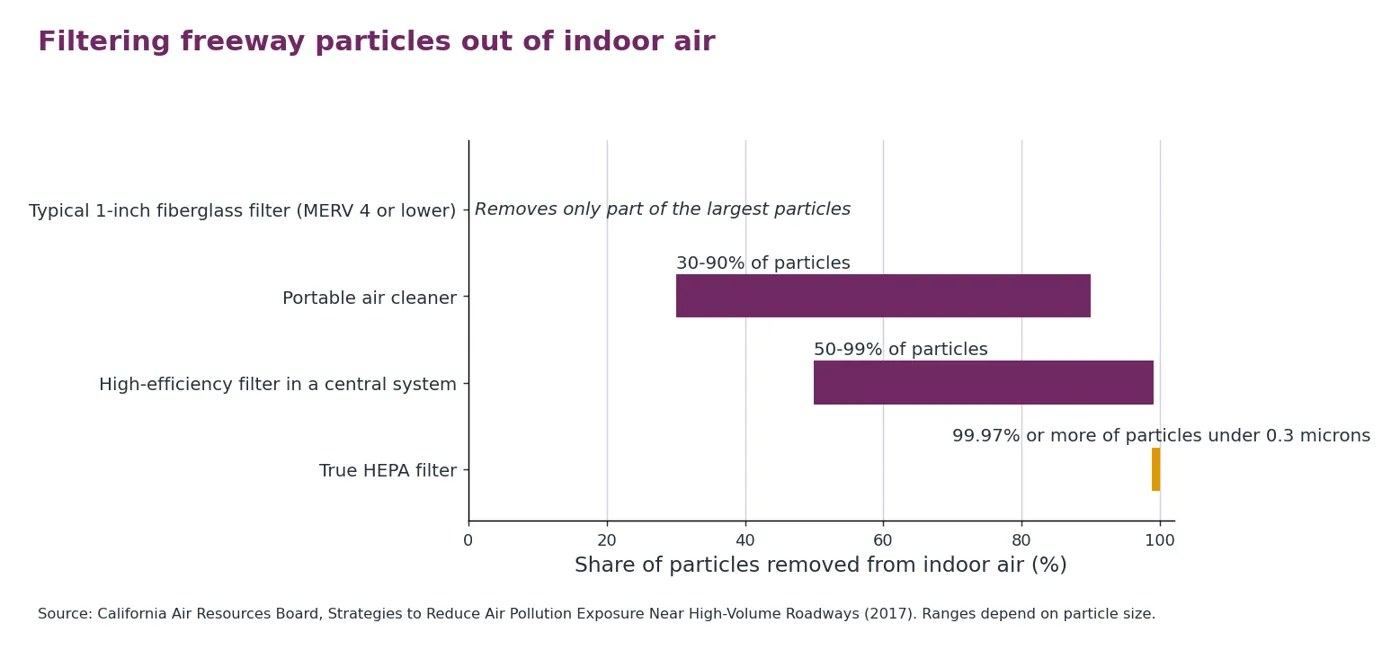
If your home or apartment is close to the 10 or the 710, ask your landlord or HVAC contractor whether the system can take a MERV 13 filter, or put a portable HEPA cleaner in the bedroom where you spend the most hours. Check that the cleaner is sized for the room.
Telling your cardiologist about where you live
Mention it at your visit if you live or work within a few blocks of the freeway, especially if you have heart failure, angina that comes on with exertion, or a recent heart attack. It won’t change the diagnosis, but it can shape the advice you get about when and where to exercise and how to plan the recovery weeks at home.
Alhambra Hospital, the County’s heart-attack map and the ambulance ride
Alhambra Hospital Medical Center is the closest 24-hour emergency room for most of the city. It is close, and for a broken wrist or a bad fall it may well be where you belong. For a heart attack, though, Los Angeles County runs a separate system, and the hospital an ambulance heads for may not be the nearest one. This section explains why, using the County’s own documents.
Alhambra Hospital Medical Center
Alhambra Hospital Medical Center is at 100 South Raymond Avenue, phone (626) 570-1606, and lists emergency services among its departments. From Alhambra City Hall it was 1.3 miles and about 6 minutes by car when we checked. It is not on the Los Angeles County EMS Agency’s map of approved STEMI Receiving Centers, dated June 2024, and its own services list doesn’t mention a cardiac catheterization lab. That doesn’t make it the wrong hospital for chest pain in general; it means that when paramedics’ EKG shows a particular kind of heart attack, the County’s rules point them elsewhere.
What a STEMI Receiving Center is
A STEMI (ST-elevation myocardial infarction) is a heart attack in which a coronary artery is fully blocked, and it shows a recognizable pattern on a 12-lead EKG. LA County EMS Agency Reference No. 513 reserves the title for hospitals that hold a license for a cardiac catheterization lab and have County approval to receive these patients. The same policy, revised July 1, 2025, sets out what paramedics do:
- record a 12-lead EKG in the field and, if it shows a STEMI, transmit it directly to the receiving center;
- take the patient to the most accessible open STEMI Receiving Center when ground transport is 30 minutes or less;
- do so regardless of whether that hospital’s emergency department is on diversion;
- notify the center and discuss activating the cath lab before arrival;
- go to the next most accessible open center if the closest one has asked for STEMI diversion.
The receiving centers closest to Alhambra
On the County’s June 2024 map, the approved centers nearest Alhambra include Garfield Medical Center in Monterey Park, Huntington Hospital in Pasadena, Los Angeles General Medical Center and Adventist Health White Memorial in Boyle Heights, and USC Arcadia Hospital. We timed the car trip from Alhambra City Hall to each one on the same Monday morning, as a rough guide to distance; an ambulance with lights and siren moves differently, and paramedics, not families, choose the destination.
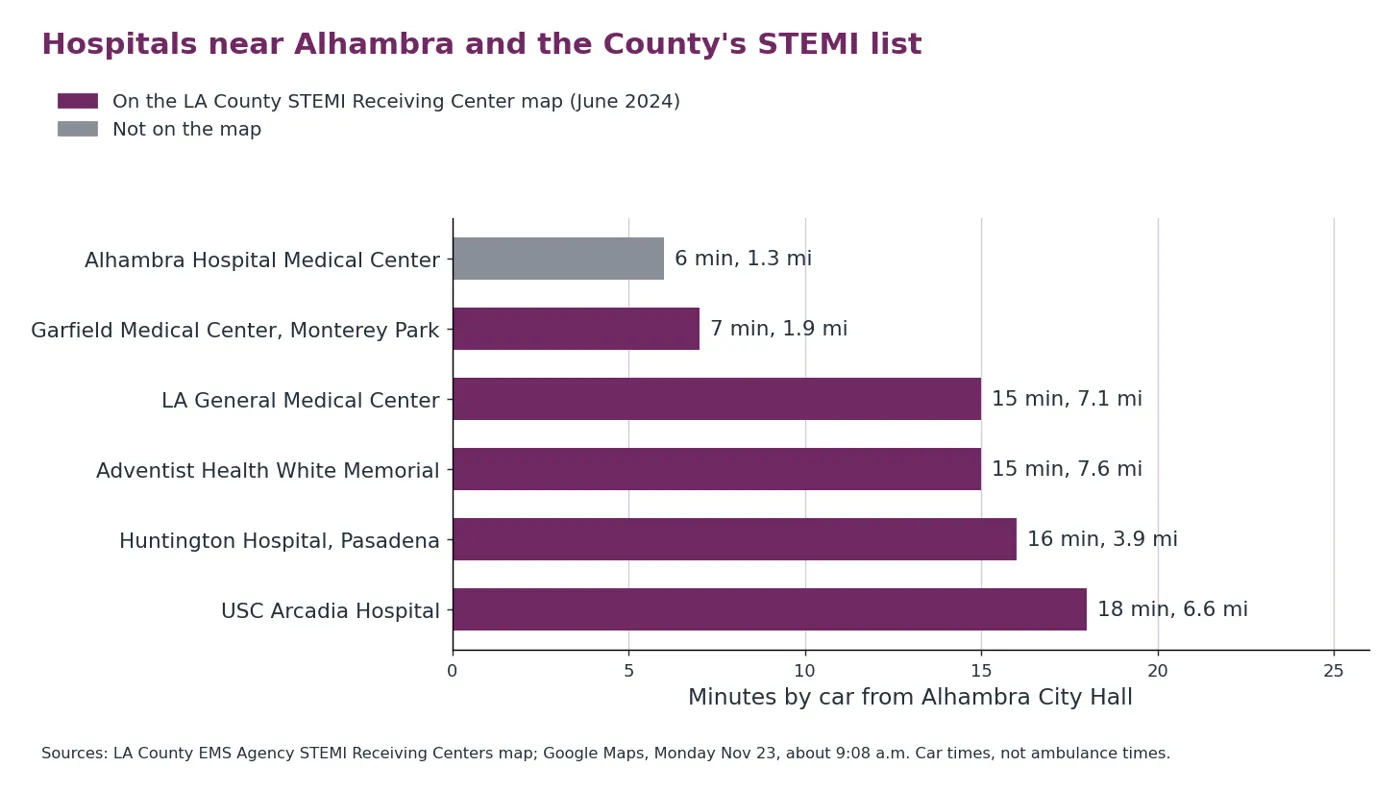
Garfield Medical Center, at 525 North Garfield Avenue, was the closest receiving center by a wide margin: 1.9 miles and about 7 minutes from City Hall, straight down Garfield Avenue. Its website describes a Heart and Vascular Institute on the campus. Huntington Hospital was 16 minutes, and Los Angeles General and White Memorial were each about 15 minutes by way of the 10.

Cardiac arrest follows the same map
A cardiac arrest, when the heart stops pumping, is handled under a separate County policy, Reference No. 516, revised on the same date as the heart-attack policy. For adults, it says resuscitation should happen where the person collapsed until a pulse returns or the patient is pronounced, and that moving a patient without a pulse is discouraged except in specific cases. When a pulse comes back, the destination rule matches the heart-attack one: the nearest open STEMI Receiving Center that is no more than 30 minutes away by ground. For an arrest in Alhambra, that again usually means one of the receiving centers above rather than the nearest emergency room.
For the people standing nearby, the policy explains why paramedics may stay on scene longer than a family expects. The work done in those first minutes, on the floor of a living room or an office, is the treatment. The most useful thing a bystander can do is call 911, start chest compressions, send someone for an AED and keep going until the crew takes over.
Why calling 911 beats the family car
All of this only works if paramedics are involved. The field EKG, the call ahead to the cath lab team and the choice of a STEMI center all happen in the ambulance. A relative who drives a patient to the nearest emergency room skips each of those steps, and may arrive at a hospital without a cath lab. In Alhambra, 911 reaches the city’s own fire department, whose headquarters station is at 301 North First Street according to the County’s facility locator.
Dial 911, not the office, for chest discomfort that lasts beyond a few minutes, discomfort that travels into an arm, the jaw, neck or back, breathlessness that comes on suddenly, a cold sweat with nausea, or a faint. Waiting to see whether it fades, or getting behind the wheel, wastes the minutes that matter.
A medicine list in your wallet
Paramedics and emergency doctors make faster, safer decisions when they know what you take, and a heart patient’s list often includes exactly the drugs that change emergency care: blood thinners such as warfarin or apixaban, platelet medicines such as clopidogrel after a stent, and nitroglycerin. Keep a current list on a card in your wallet and as a photo on your phone, with the doses, your cardiologist’s name and 310-652-2744, and the date and place of any stent or device implant. If you carry a pacemaker or defibrillator identification card from the manufacturer, keep it with the list.
For a parent who lives alone in Alhambra, tape a copy to the refrigerator door and tell the family, and any neighbor with a key, where it is.
Two local hospitals, one hospital group
Alhambra Hospital Medical Center and Garfield Medical Center both belong to AHMC Health, and Alhambra Hospital’s website lists a medical records department and a patient portal. If you were seen in one of them for chest pain, a fainting spell or an irregular heartbeat, even without a heart attack, the emergency department’s EKG and blood results are worth requesting before your first cardiology visit. An EKG from the day of the symptom is often more useful than one recorded weeks later in a calm office.
Where CACVI fits before and after
CACVI is an outpatient practice, not an emergency department, and it isn’t on the County’s STEMI list. Our part comes before and after the emergency: the evaluation that finds coronary disease before it causes a heart attack, and the follow-up after a hospital stay, wherever that stay happened. If you were treated at Garfield, Huntington, LA General or another hospital, bring the discharge summary, the cath report and the medication list to your first visit at Alden Drive, and ask the hospital to send the angiogram images if a procedure was done.
Dr. Khorsandi, Dr. M. Lala and Dr. V. Lala: training and procedure lists
Three physicians see patients at CACVI. Each card condenses the physician’s published CACVI biography, and the link under it opens the full version. All three perform catheter procedures and also see patients in the office, so whichever one you see for a consultation can follow you through testing and treatment.
Mehran J. Khorsandi, MD, FACC, FSCAI
Runs the catheterization lab at Providence Cedars-Sinai Tarzana; more than 30 years of coronary and vascular procedures
Penn’s medical school came first; Cedars-Sinai then trained him in internal medicine and cardiology and kept him on its attending staff from 1993, and he still teaches fellows in its cath lab. His bio counts five certifications in total, four of them board diplomas (internal medicine, cardiovascular disease, interventional cardiology, endovascular medicine) and the fifth a cardiac device credential. Coronary bifurcation lesions are his particular field; he co-founded a company developing bifurcation stents and has been issued 50 U.S. and international patents. His procedure interests also take in high-risk angioplasty, pacemakers and defibrillators, and limb salvage.
Moinakhtar Lala, MD, RPVI, FACC, FSCAI
At CACVI since October 2016; reads echo, nuclear and vascular studies as well as performing catheter work
Brooklyn’s SUNY Downstate program, where he was chief resident for a year, preceded three fellowship stages at Mount Sinai Beth Israel: general, interventional and endovascular cardiology. The practice’s amputation-prevention program was his creation. Wrist-access stenting, long-closed coronary arteries (chronic total occlusions), valve replacement by catheter and vein closure all appear among his procedures. Because his certifications include echocardiography and nuclear cardiology, he is closely involved in reading the imaging that shapes a treatment decision.
Vasim Lala, DO, FACC, FSCAI, RPVI
At CACVI since mid-2022; structural heart procedures plus clinic care for blood pressure, heart failure and rhythm problems
An osteopathic graduate of Michigan State, Dr. V. Lala did his residency and cardiology fellowship in Michigan, then moved to The Mount Sinai Hospital in Manhattan for subspecialty training that combined coronary, endovascular and structural work. Closing a PFO, implanting WATCHMAN and replacing the aortic valve by catheter are on his list. Office patients see him for hypertension, weakened or failing heart muscle, AFib and the cardiac side effects of cancer therapy. His writing has appeared on American College of Cardiology and TCTMD blogs, and he authored and edited StatPearls material.
Name the physician you’d like when you call. If you want to discuss a stent or a complex blockage, you can ask for Dr. Khorsandi or Dr. M. Lala; if your main concern is blood pressure, heart failure or atrial fibrillation, Dr. V. Lala is a natural place to start. Any of the three can see a new patient, and the office will suggest a match if you describe the problem.
Google reviews left by CACVI patients
Questions Alhambra residents ask before booking a heart doctor
Where do Alhambra patients see a CACVI cardiologist?
The nearest of CACVI’s three offices to Alhambra is Suite A at 8741 Alden Drive, Los Angeles 90048; the others are on Ventura Boulevard in Tarzana (Suite 102, number 18226) and on Hesperia Road in Victorville. Alhambra patients usually book at Alden Drive, phone 310-652-2744. Saturday visits go through Tarzana at 818-905-5904.
What do the other garages near Alden Drive charge?
According to CACVI’s contact page, Robertson Plaza at 116-120 North Robertson Boulevard charges $3 for 15 minutes, $12 for an hour and $20 for the day, and is open daily from 6:00 a.m. to 2:00 a.m. The Steven Spielberg Building garage at 8723 Alden Drive is free for the first hour, then $5 an hour up to $15 a day, open Monday to Friday from 8:00 a.m. to 5:00 p.m. Prices can change, so check the signs at the entrance.
What fax number or email should my Alhambra doctor use for records?
CACVI’s contact page gives 310-967-2140 as the fax line and info@cacvi.org as the email address. Ask your primary care office to send recent notes, EKGs, echocardiogram reports and lab results a few days before the appointment, and call 310-652-2744 to confirm they arrived.
Can I book a cardiologist from Alhambra without a referral?
Your insurance decides that, not your ZIP code. HMO plans, and the medical groups that manage care for them, usually want a referral from your primary care doctor before you see a cardiologist; PPO plans often don’t. Ask your plan, or tell our scheduler which plan you have, before the first appointment.
Is “heart specialist” just another word for cardiologist?
Usually, yes. A cardiologist is a physician who trained first in internal medicine and then completed a fellowship in cardiovascular disease. Some go on to further training in a narrower area, such as interventional cardiology, electrophysiology (heart rhythm procedures) or advanced heart failure. When you look for a heart specialist, the useful question is which of those areas fits your problem.
Do CACVI’s cardiologists do open-heart surgery?
No. All three are cardiologists. Their procedures go through blood vessels via a catheter: stents, TAVR, WATCHMAN, pacemakers and leg-artery work among them. Coronary bypass, open valve surgery and any operation through the breastbone are hospital cases for a cardiothoracic surgical team. When a surgical opinion makes sense, your CACVI cardiologist sets up that referral and sends the records.
What does “interventional” mean in interventional cardiologist?
The word means the cardiologist has a further fellowship, and a board certification, in catheter work: threading a thin tube from the wrist or groin to open a blocked artery with a balloon and stent, for example. All three CACVI physicians list interventional cardiology among their board certifications.
Which CACVI physicians list TAVR or WATCHMAN?
Both Lalas, Moinakhtar and Vasim, name transcatheter aortic valve replacement (TAVR) in their biographies. WATCHMAN, the implant that closes off the left atrial appendage in atrial fibrillation, and PFO closure appear on Dr. Vasim Lala’s list. Device implants and high-risk angioplasty sit on Dr. Khorsandi’s list, along with blockages at artery branch points (bifurcations).
Can I start with a vein or leg-artery visit instead of a heart visit?
Yes. The same physicians handle peripheral artery disease, varicose veins and other circulation problems. Our leg pain and PAD page for Alhambra explains that side of the practice, and you can mention both concerns when you book so one visit covers them.
Is Alhambra Hospital Medical Center a STEMI Receiving Center?
No. Its name is missing from the June 2024 STEMI Receiving Center map published by the County’s EMS Agency. Under County Reference No. 513, if ground transport to every receiving center would take more than 30 minutes, paramedics take a STEMI patient to the most accessible receiving facility instead; from Alhambra, several receiving centers are well inside that limit.
Does Garfield Medical Center have a cardiac cath lab?
Yes. Garfield Medical Center appears on the County’s June 2024 STEMI Receiving Center map, and County Reference No. 513 only grants that status to hospitals licensed for a cardiac catheterization laboratory. The hospital’s own website also describes a Heart and Vascular Institute on its Monterey Park campus. Nothing on CACVI’s site says our physicians hold privileges there, so a Garfield admission is managed by the hospital’s own doctors, and we take up the follow-up visits afterwards.
What else must a building owner do with an office AED in California?
Beyond the yearly notice to tenants, Health and Safety Code section 1797.196 requires whoever acquires an AED to notify the local EMS agency of its existence, location and type, maintain and test it according to the manufacturer’s guidelines, test it at least twice a year and after each use, inspect it at least every 90 days, and keep records of that maintenance and testing.
How do I find out whether CACVI takes my insurance?
Call 310-652-2744 with your insurance card in hand before you book. Plan networks change from year to year, and a Medicare Advantage plan can have network and referral rules of its own, so the office checks the specific plan rather than the insurance company’s name.
Setting up a first appointment from Alhambra
The Alden Drive phones are answered on weekdays from 8:30 a.m. until 5:00 p.m. at 310-652-2744; outside those hours, the online request form reaches the same scheduling staff. Paperwork for a first visit is on the new patients page. Have your insurance card, your medication list and any recent test results nearby when you call, and tell the scheduler you are coming from Alhambra so the appointment can be set around the drive on the 10. Saturday appointments are booked through Tarzana, 818-905-5904. Physicians who want to send a patient can use the patient referral page.
Book Alden Drive on 310-652-2744 or through the online request form. Symptoms happening now are a 911 call, not a booking.
CACVI pages for cities that border Alhambra
The Census Bureau’s TIGERweb boundary files show five cities sharing a boundary with Alhambra: Monterey Park, San Gabriel, San Marino, South Pasadena and the City of Los Angeles. Their CACVI pages are listed below. They describe the same Alden Drive and Tarzana offices that serve Alhambra.
- Cardiologist for Monterey Park patients
- Cardiologist for San Gabriel patients
- Cardiologist for South Pasadena patients
- Cardiologist for San Marino patients
- Cardiologist for Los Angeles patients
Temple City doesn’t share a border with Alhambra, but it is one city further east and has its own cardiology page. The diagnostic procedures overview describes each test named above in more detail.
Sources for the Alhambra figures and rules on this page
| Source | Publisher | Used for |
|---|---|---|
| CACVI appointments and office details | CACVI | Office addresses, phones, fax, email, parking garages and prices |
| Physician biographies: Dr. Khorsandi, Dr. M. Lala, Dr. V. Lala | CACVI | Training, certifications and procedure lists |
| STEMI Receiving Centers map, as of June 2024 | Los Angeles County EMS Agency | Which hospitals near Alhambra and downtown are approved STEMI Receiving Centers |
| Reference No. 513, ST-Elevation Myocardial Infarction Patient Destination (revised 07-01-25) | Los Angeles County EMS Agency | Field EKG, transmission, 30-minute rule, diversion rules |
| Alhambra Hospital Medical Center | AHMC Health | Address, phone and listed services |
| Garfield Medical Center | AHMC Health | Heart and Vascular Institute on campus |
| City of Alhambra Fire Department | Los Angeles County facility locator | Headquarters address and non-emergency line |
| TIGERweb boundary services | U.S. Census Bureau | Cities that share a boundary with Alhambra |
| I-10 ExpressLanes Extension | LA Metro | Dynamic tolls, FasTrak Flex and carpool rules |
| El Monte Busway | Wikipedia | Extent of the busway lanes on the 10 |
| California Paid Sick Leave: Frequently Asked Questions | California Labor Commissioner | 40 hours or five days; covered uses |
| Labor Code section 233 (kin care) | California Legislative Information | Using sick leave for a family member |
| Calculating DI Benefit Payment Amounts | Employment Development Department | SDI benefit rate, maximum and 52-week limit |
| Disability Insurance eligibility FAQs | Employment Development Department | Seven-day waiting period |
| Paid Family Leave benefits and payments FAQs | Employment Development Department | Eight weeks in 12 months; benefit rate |
| Family Care and Medical Leave and Pregnancy Disability Leave notice | California Civil Rights Department | CFRA coverage, eligibility and family members |
| Disability Accommodations at Work (fact sheet, July 2026) | California Civil Rights Department | Coverage, requests, interactive process, documentation limits, grounds for denial |
| Kick It California | Kick It California | Free quit coaching, phone line, app, friends-and-family help |
| Benefits of Quitting Smoking | CDC | Heart-risk timeline after quitting |
| Counseling to prevent tobacco use | Medicare.gov | Eight sessions in 12 months |
| Particulate Matter Air Pollution and Cardiovascular Disease (2010 update) | American Heart Association, Circulation | PM2.5 and cardiovascular events |
| Research on Near Roadway and Other Near Source Air Pollution | U.S. EPA | Vehicle emissions and heart problems |
| Strategies to Reduce Air Pollution Exposure Near High-Volume Roadways (2017) | California Air Resources Board | Distance, time of day, in-car air, filtration figures |
| Health and Safety Code section 1797.196 | California Legislative Information | Building owner duties for AEDs |
| Civil Code section 1714.21 | California Legislative Information | Liability protection for AED users |
| Advancing Alhambra | City of Alhambra | I-710 north stub road plan |
| Reference No. 516, Non-Traumatic Cardiac Arrest Patient Destination (revised 07-01-25) | Los Angeles County EMS Agency | Where paramedics take cardiac arrest patients |
| Life’s Essential 8 | American Heart Association | Sleep as a heart-health measure |
| Disabled person parking placards and plates | California DMV | Placard eligibility, certification and parking rules |
| How to file a DI claim by mail | Employment Development Department | DE 2501 parts and the 9-to-49-day filing window |
| Disability Insurance Elective Coverage | Employment Development Department | Coverage for the self-employed |
| ¿Por qué procedimientos en consultorio? | CACVI | Office-based lab / ambulatory surgery center setting |
¿Listo para hablar?