



Evaluación cardíaca
Are you searching for a cardiologist near Glendale?
In a lot of Glendale homes, the person reading this isn’t the patient. It’s a daughter who noticed her father stopping halfway up the stairs at home, or a husband who drives his wife to every appointment and keeps her pill list in his wallet. Sometimes it’s the patient after all, sitting with a discharge envelope from a Glendale hospital and a line that says “follow up with cardiology.” Whoever you are, if you’re looking for a cardiologist in Glendale, this page is for the call you’re about to make.
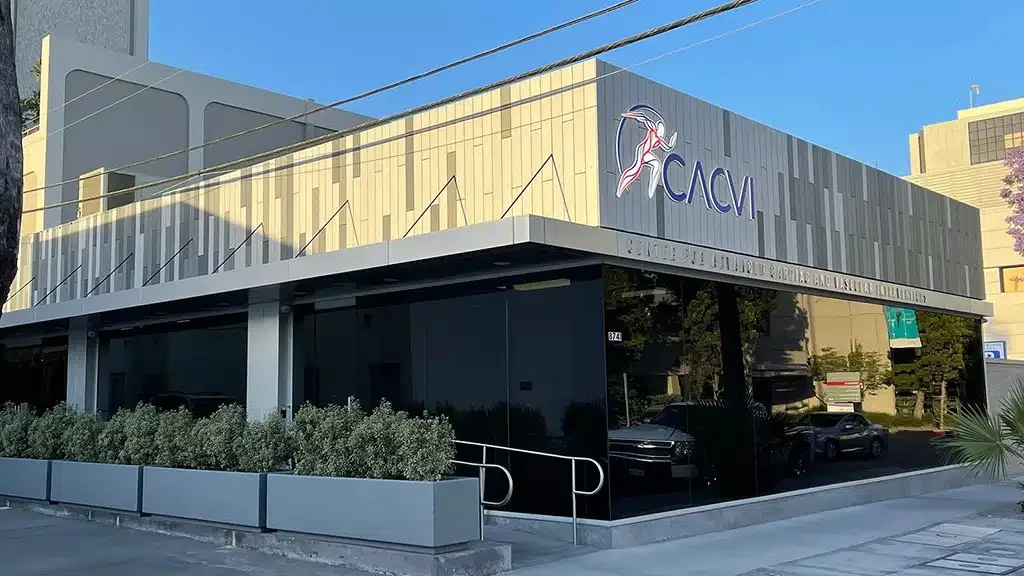
The Center for Advanced Cardiac and Vascular Interventions (CACVI) sees Glendale patients for heart care at two offices: our Los Angeles office on Alden Drive, 8741 Alden Dr, Suite A, and our San Fernando Valley office on Ventura Boulevard in Tarzana. Neither office is in Glendale, and we’d rather say so up front. What we can offer is a cardiac evaluation with cardiologists who also perform the procedures they recommend, plus an honest account of the drive, the hospitals around you, and the paperwork a family member will need.
Find out the cause of your heart condition.
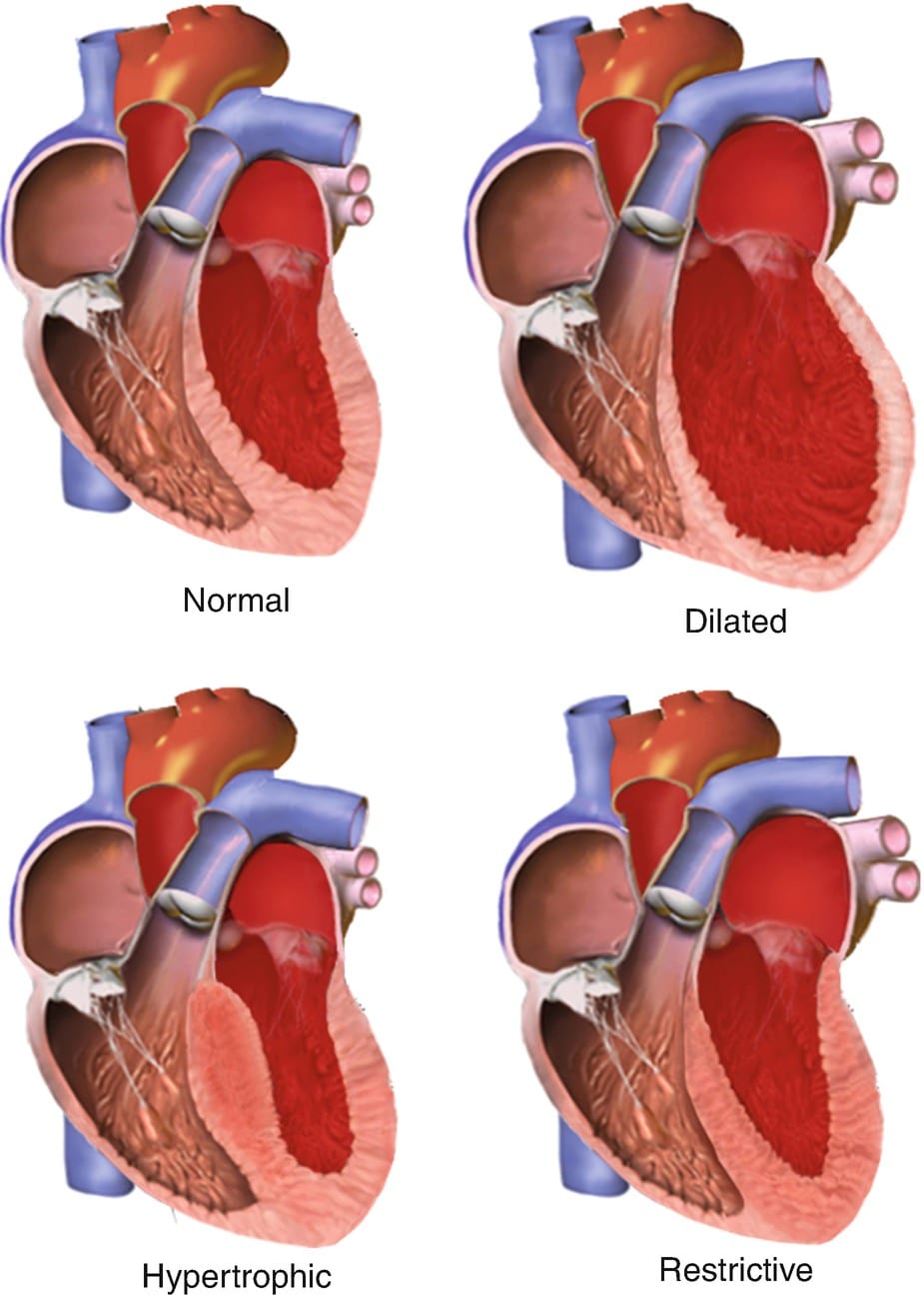
For Glendale patients, our cardiologists treat coronary artery disease, heart failure, cardiomyopathy, recovery after a myocardial infarction (MI), commonly known as a heart attack, a heart arrhythmia such as atrial fibrillation (AFib), mitral valve disease and aortic valve disease. If you already have a pacemaker or defibrillator, we can manage it from here on. Problems of the heart are hard on the whole family, not only the patient, and our physicians have spent more than thirty years and over 15,000 vascular and cardiac procedures learning how to explain them plainly.
Call the Los Angeles office at 310-652-2744 or the Tarzana office at 818-905-5904, or request an appointment online.
Glendale cardiology facts to have in front of you before you call
Every figure below has a source you can open yourself. Drive times are one observation each, not a promise; traffic on the 134 changes by the hour.
| Detail | Why a Glendale family should care | Where it comes from |
|---|---|---|
| Nearest CACVI office: 8741 Alden Dr, Suite A, Los Angeles, CA 90048. Phone 310-652-2744. Monday to Friday, 8:30 a.m. to 5:00 p.m. | Weekday visits, closest in miles to central Glendale. | CACVI appointments page; Google listing |
| Valley office: 18226 Ventura Blvd, Suite 102, Tarzana, CA 91356. Phone 818-905-5904. Saturday 8:00 a.m. to 4:30 p.m. | The only CACVI office near Glendale with Saturday hours; free on-site parking, limited. | CACVI appointments page and its office data; Google listing |
| City Hall to Alden Drive: 14.7 miles via the westbound 134, about 41 minutes | Plan for surface streets at the Los Angeles end. | Google Maps, Sun Nov 22, about 4:15 p.m. |
| City Hall to Tarzana: 18.5 miles via the 134 and the 101, about 32 minutes | More miles, but less time on the day we checked. | Google Maps, Sun Nov 22, about 4:15 p.m. |
| Glendale Memorial and Adventist Health Glendale are both approved STEMI Receiving Centers | Paramedics can send a heart-attack EKG ahead to a cath lab inside the city. | LA County EMS STEMI Receiving Centers map, June 2024 |
| Adventist Health Glendale cardiac rehab: 1509 Wilson Terrace, East Tower, 818-409-8099 | A rehab program inside the city after a stent, heart attack or valve procedure. | Adventist Health Glendale |
| California health plans must provide a qualified interpreter on request, at no cost | Book the plan’s interpreter when you book the visit. | DMHC language assistance |
| Medicare covers up to 36 cardiac rehab sessions over up to 36 weeks | Two Glendale hospitals list cardiac rehab programs. | 42 CFR 410.49 |
Seeing a CACVI cardiologist from Glendale: what the care covers
Most people looking for a cardiologist in Glendale want one of three things: an answer about a symptom, a second look at a plan someone else proposed, or a doctor to take over long-term care for a heart condition that is already diagnosed. All three start in the same place.
The first appointment is a conversation and an exam
The initial evaluation of a cardiac patient consists of a physical examination and a medical history. During the exam, the cardiologist looks for an underlying cause for the symptoms that brought you in, such as chest pain or shortness of breath, and checks how well your heart is working. Expect questions about what you’ve felt, who in the family had heart trouble, every medicine in the house and any other diagnoses. Blood or urine tests may be added when they would help identify a condition.
A consultation is usually requested by an internist, a family doctor, or sometimes another specialist or surgeon who wants a cardiologist’s opinion. If your primary doctor in Glendale sent you, ask them for the referral note and any recent lab results before your visit. That one sheet often answers the question the cardiologist would otherwise spend ten minutes reconstructing.
Tests the practice describes, and how to read the list
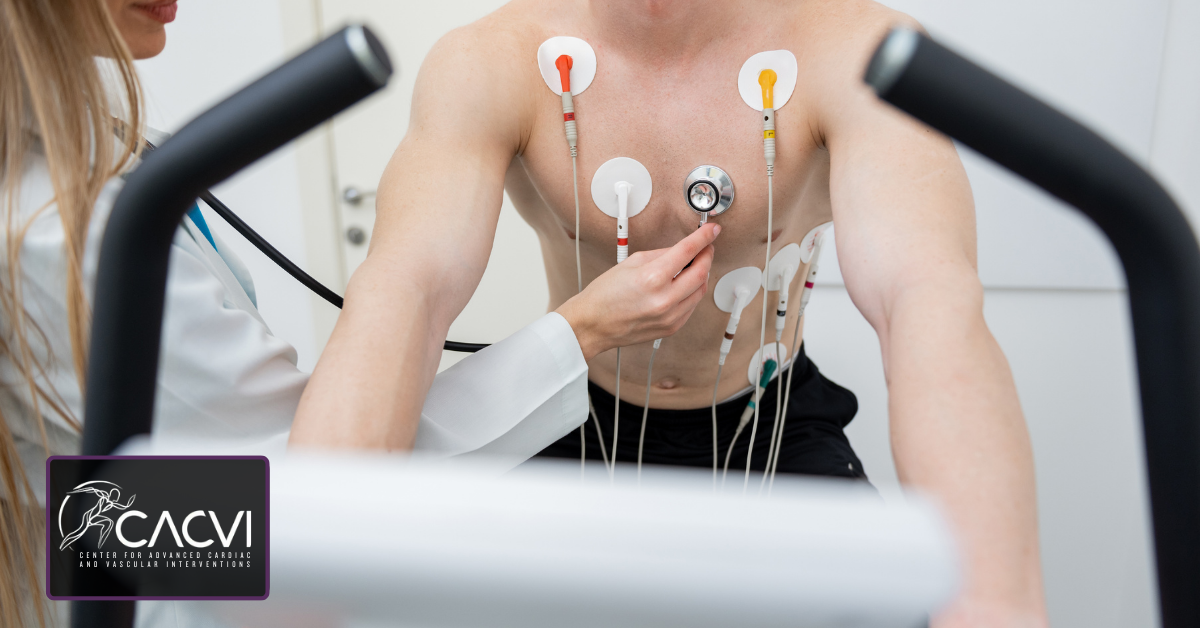
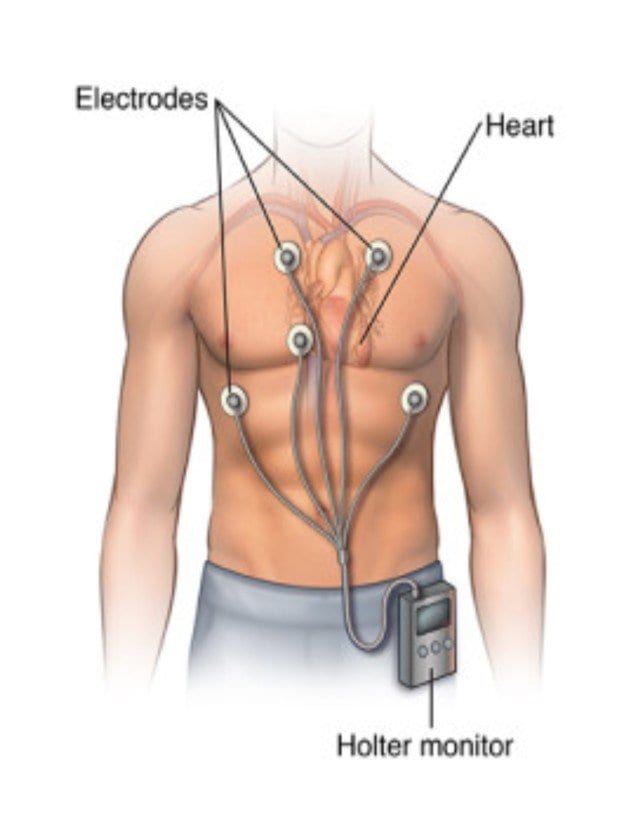
CACVI’s site describes the tests our physicians use: an electrocardiogram (EKG) including Holter and event monitors, an echocardiogram, pruebas de esfuerzo on a treadmill, bike or with medication, mobile cardiac telemetry, a coronary calcium scan and coronary CT angiography. Three of those, echo, EKG and stress testing, can be done inside the Ventura Boulevard office according to its own page.
A list like that is a menu, not a package. The cardiologist chooses tests to answer a specific question about your heart, and a test that helped a neighbor may tell you nothing. If you’re comparing heart doctors in Glendale by how many machines they own, you’re measuring the wrong thing. A better question for any practice is: “Which test would you order for my symptom, and what would change depending on the result?”
Asking for an EKG on its own
You may want an EKG test in Glendale that lets you walk in, get a tracing and leave. A resting EKG is quick and painless, and urgent care clinics and primary care offices can usually do one. At a cardiology practice, the EKG is normally part of a visit, because the tracing means little without someone examining you and hearing what happened. An EKG done somewhere else is worth carrying in on paper, waves and all, because the machine’s summary line leaves out what a cardiologist compares. Cardiologists compare old and new tracings side by side, and a change between them can matter more than either one alone.
Procedures our physicians perform
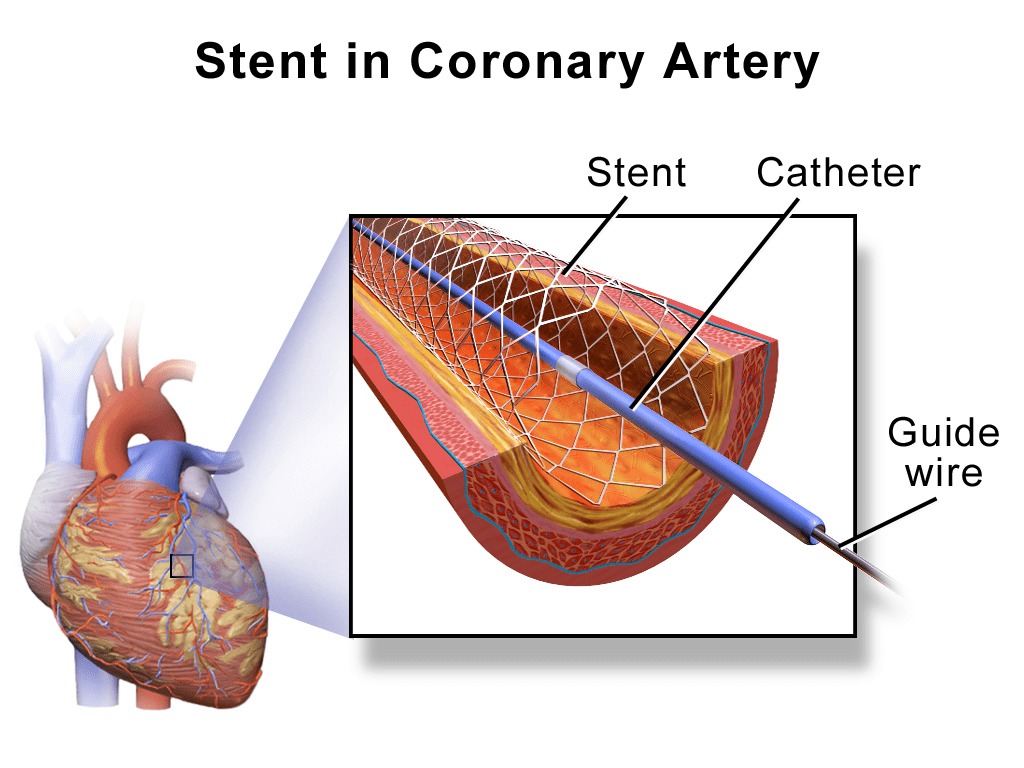
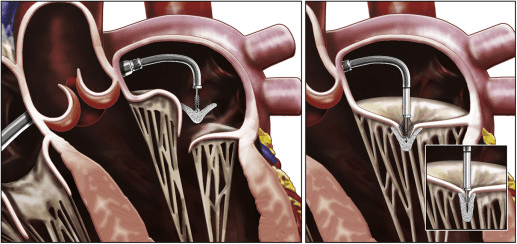
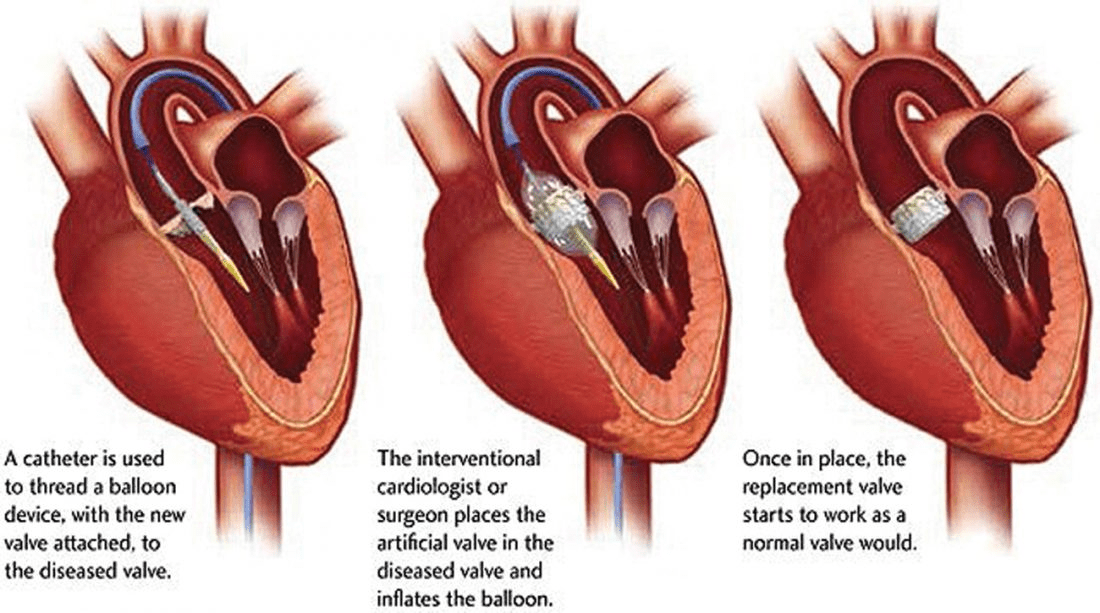
Each of our three physicians trained in interventional cardiology. In practice, the doctor who examines you in the office also performs catheter procedures, rather than handing you to a stranger once a blockage is found. The site describes coronary artery stenting, complex coronary intervention, pacemaker implants, defibrillator implants, biventricular defibrillators, the CardioMEMS heart failure sensor, TAVR, MitraClip and the WATCHMAN device for some people with atrial fibrillation who struggle with blood thinners.
Where a procedure happens depends on the procedure. CACVI’s page on office-based procedures explains that some scheduled tests and minimally invasive treatments are done in an office-based lab or an ambulatory surgical center, with the patient going home the same day. Hospital procedures take place at Providence Cedars-Sinai Tarzana Medical Center. Dr. Khorsandi directs its cath lab, and Dr. Moinakhtar Lala appears in the same Providence directory. For a Glendale family that is worth knowing early, because it tells you which hospital’s paperwork, parking and visiting rules you’d be dealing with if a procedure is planned.
Where this page stops and another begins
This page is about the heart. If the problem is pain or cramping in the legs when you walk, sores that won’t heal on the feet, or swollen, heavy legs, those are circulation questions, and our leg pain doctor page for Glendale covers them. The two often overlap, because the same plaque that narrows heart arteries can narrow leg arteries, so mention both at your visit if both are happening.
One more boundary. Neither CACVI office is an emergency room, and we don’t see walk-in patients. Chest pain that is new, severe or getting worse belongs with 911, and the section on heart attacks below explains what happens when you call from a Glendale address.
Have a referral or a hospital discharge note? Send us an appointment request and keep the note handy when we call back.
Heart doctors in Glendale are not interchangeable: match the doctor to the problem
Look for the best Glendale heart doctors and you’ll find star ratings, paid listings and directories that sort by distance. Nobody publishes an official league table of cardiologists, so those lists are opinions. What does exist is a set of board certifications that tell you what kind of heart problem a cardiologist trained to handle. Picking the right type first saves a second referral later.
Cardiologists start with the American Board of Internal Medicine’s (ABIM) cardiovascular disease certificate; the narrower ABIM certificates below are layered on top of it. Here’s how the main ones line up with the problems Glendale patients bring.
General cardiology: the first look
A cardiologist certified in cardiovascular disease handles the broad first questions: Is this chest discomfort from the heart? Why is my blood pressure still high on two medicines? Is this murmur something to watch? Most people start here, and many never need anyone else. All three CACVI physicians hold this certification, according to their bios.
Interventional cardiology: blocked arteries and catheter procedures
Interventional cardiology adds a year of training in catheter work: angiograms, balloon angioplasty and stents. If you’ve been told you might need a stent, or you had one placed during a heart attack at a Glendale hospital and want ongoing care from someone who does that work, an interventional cardiologist is the natural fit. Dr. Khorsandi, Dr. Moinakhtar Lala and Dr. Vasim Lala all list board certification in interventional cardiology.
Electrophysiology: rhythm problems that need a procedure
Clinical cardiac electrophysiology is the subspecialty for complicated heart rhythm problems, including catheter ablation of atrial fibrillation and other arrhythmias. Our physicians evaluate palpitations and AFib, implant pacemakers and defibrillators, and Dr. Vasim Lala lists the WATCHMAN device, but none of their bios lists electrophysiology board certification or ablation. If ablation is the question, we’ll say so and help you find an electrophysiologist rather than pretend otherwise.
Advanced heart failure and transplant cardiology
Advanced heart failure and transplant cardiology is for heart failure that has moved past standard treatment, including evaluation for heart pumps and transplant. CACVI manages heart failure in the office and the site describes the CardioMEMS sensor, Impella and balloon pump procedures. A transplant evaluation is a different program at a transplant hospital.
Adult congenital heart disease
Adults born with a heart defect, repaired or not, may need a cardiologist certified in adult congenital heart disease. If you had heart surgery as a child, say so on the first call. It changes who should see you.
The question behind “hypertension specialist doctor”
If you live in Glendale and want a hypertension specialist, a cardiologist can help. Stubborn blood pressure is a frequent reason primary doctors send patients to cardiology, and hypertension is the first chronic condition named on Dr. Vasim Lala’s bio. The cardiologist’s job there is to look at what high pressure has already done to the heart, check whether a narrowed artery is part of the story, and adjust a plan with your primary doctor. Bring the readings you’ve taken at home, the names and doses of every blood pressure medicine tried so far, and a note of any that were stopped because of side effects. That list tells the cardiologist more than a single office reading.
What a rating can’t tell you
A five-star average tells you people liked the front desk and the wait was short. It doesn’t tell you whether the doctor holds the certification your problem calls for, which hospital they work at, or whether they do procedures themselves. You can check a physician’s California license on the DCA License Search. One detail many families miss: a doctor with a D.O. degree, like Dr. Vasim Lala, is licensed through the Osteopathic Medical Board of California, not the Medical Board, so search the right board.
| The problem | Type of cardiologist (ABIM certification) | At CACVI |
|---|---|---|
| Chest discomfort, breathlessness, a murmur, blood pressure that won’t settle | Cardiovascular disease (general cardiology) | Yes, all three physicians |
| Blocked coronary arteries, a stent, follow-up after a heart attack | Interventional cardiology | Yes, all three list it |
| Narrowed aortic valve (TAVR) or leaking mitral valve (MitraClip) | Interventional cardiology with structural heart training | TAVR listed by Dr. M. Lala and Dr. V. Lala; MitraClip described on the site |
| Pacemaker or defibrillator | Interventional cardiology or electrophysiology | Implants listed by Dr. Khorsandi |
| Catheter ablation for atrial fibrillation | Clinical cardiac electrophysiology | Not listed; we refer |
| Heart failure needing a pump or transplant evaluation | Advanced heart failure and transplant cardiology | Office heart failure care and CardioMEMS; transplant evaluation elsewhere |
| Heart defect present since birth | Adult congenital heart disease | Not listed; we refer |
When you’re the one making the call for a parent or spouse
In plenty of families a grown child, a spouse or a sibling handles the logistics of someone else’s heart care: the calls, the rides, the pill organizer. That arrangement works well, as long as the paperwork and the office know who is who. Here’s what tends to come up, and how to get ahead of it.
Booking on someone else’s behalf
You can call our office to request an appointment for a parent or spouse. Before dialing, gather the patient’s legal name as it appears on the insurance card, birth date, member ID and the referring doctor’s name. If the referral came from a hospital stay, have the discharge papers too. The staff will need to speak with the patient at some point, both to confirm the details and because the patient decides how much the family is told.
Federal privacy rules are less of a wall than many families expect. Under 45 CFR 164.510(b), a provider may share the information that is directly relevant to a family member’s involvement in someone’s care, as long as the patient agrees or, when given the chance, doesn’t object. In practice, if your mother says “my son can hear everything,” the cardiologist can talk to you in the room.
Sitting in on the visit
Two people in the exam room hear more than one. The patient answers the questions about symptoms, because only they know what the chest felt like at the top of the hill. The family member writes down the answers to the questions the family prepared in advance, and the names of any new medicines with their doses. If the patient prefers to speak another language, read the interpreter section below before deciding to translate yourself.
A short list of questions brought on paper keeps a visit on track. Useful ones for a parent’s first cardiology appointment:
- What do you think is causing the symptom, and what else could it be?
- Which test are you ordering, and what will each possible result change?
- Could one of the pills already in the cabinet be causing this?
- Which changes at home are a phone call to you, and which are an ambulance?
- When do you want to see them again, and who orders the next blood work?
Paperwork that gives you a formal role
Being involved in someone’s care is different from having legal authority to decide for them. If your parent can still make decisions but wants you to receive records and test results by phone, ask the office for its form authorizing release of information to a named family member. If you’re thinking further ahead, California has a statutory Advance Health Care Directive in which a person names a health care agent and writes down their wishes. For heart patients this isn’t an abstract exercise. People with a defibrillator, or with heart failure that has been getting harder to manage, eventually face choices about resuscitation and about whether a device should keep firing, and it’s far better if the person who’ll be asked has already heard the answer.
A medicine list that survives a pharmacy change
CACVI’s new patient instructions ask you to bring your medicines, herbals, vitamins and supplements. For families who split prescriptions across more than one pharmacy, or who refill some medicines on trips abroad, bring the actual boxes and bottles rather than a typed list. Brand names differ from country to country, and the same drug can appear under a name nobody in a Glendale pharmacy would recognize. The cardiologist needs the generic name and the strength in milligrams, and the packaging usually shows both.
Watch for duplicates. A blood thinner from a hospital discharge and a second one from a primary doctor, or two blood pressure pills from the same family under different names, are exactly the kind of overlap that a cardiology visit is meant to catch. Herbal products matter too: some interact with blood thinners and heart rhythm medicines, so list the teas and powders as well as the pills.
Records from another country
If a parent’s earlier heart care happened in another country, bring those records, even if they aren’t in English. A cardiologist can read a pressure number, a date, an EKG tracing or an echo measurement in any alphabet, and a heart catheterization report showing which artery was stented, and when, can change the plan. Where the original hospital can release the actual echo or angiogram images, by disc or download link, bring them along. A written translation of the summary helps, but don’t hold the appointment hostage to it.
When the patient doesn’t want to go
It happens. A father who feels fine apart from “getting older” may not see the point. Two things tend to help: booking the visit around something the patient values, such as being able to keep walking to services or to the grandchildren’s school, and letting the cardiologist explain the reason for a test directly. Families can push for the appointment. Only the patient can agree to the treatment.
Calling for someone else? Keep the member ID nearby and send the request here.
Arranging an interpreter and sending records before a cardiology visit
A heart appointment runs on precise words: a dose in milligrams, “twice a day” versus “only when you have pain,” the name of the artery that was stented. When the patient is more comfortable in a language other than English, the plan for those words needs to be made before the visit, not improvised in the exam room. This section covers who provides an interpreter, how to book one, and how to get earlier records to the cardiologist in time to be useful. CACVI’s website doesn’t list the languages its staff speak, so don’t assume an interpreter will be waiting; arrange one.
Your health plan’s interpreter, at no cost to you
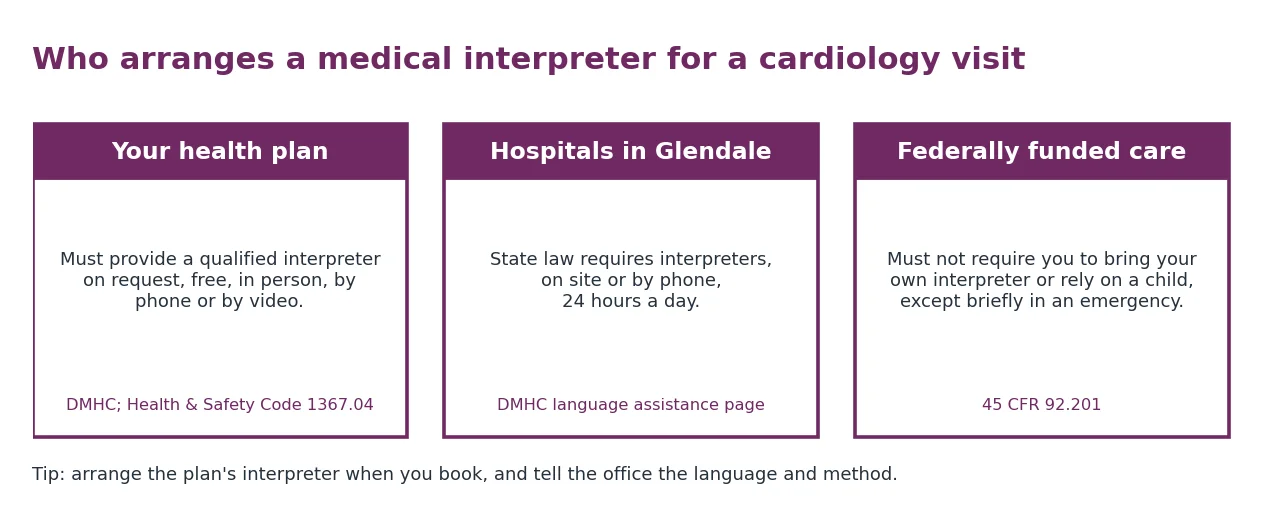
California’s Department of Managed Health Care says that all health plans it regulates must provide a qualified interpreter when a member asks, in person or by telephone or video, and that qualified interpretation is available for free, even when a family member or friend could interpret. The underlying law is Health and Safety Code section 1367.04. The DMHC’s language assistance page also suggests asking your doctor, plan and pharmacy to note your language in your record, and telling the office as far ahead as possible.
So when you request a CACVI appointment for a parent who prefers another language, say so on the first call, and call the member services number on the back of their insurance card to arrange the plan’s interpreter for that date and time. Give the plan the office address, the appointment time and how long the visit is expected to last, and ask whether the interpreter will join by phone, by video or in person. If a test such as an echocardiogram or a stress test is added on the same day, the interpreter may need to stay longer, so ask for extra time rather than less. Keep the confirmation number with the appointment card.
Hospitals in Glendale must have interpreters around the clock
The same DMHC page notes that state law requires hospitals to have interpreters, on site or by phone, 24 hours a day. That matters on the worst day. If your parent is taken to Glendale Memorial or Adventist Health Glendale by ambulance, ask for the hospital’s interpreter right away rather than relaying everything yourself under stress.
Why a grandchild shouldn’t be the interpreter
Children often end up translating for grandparents because they’re the most fluent person in the room. In a cardiology visit that puts a child in charge of words like “blockage” and “surgery.” Federal rules for health programs that receive federal funding, at 45 CFR 92.201, say those programs must not rely on a minor child to interpret except as a temporary measure in an emergency, and must not require a patient to bring their own interpreter. Even where those rules don’t apply, the reasoning holds. A trained interpreter keeps information private and translates what was said, not a softened version of it.
Words worth knowing before the visit
A few terms come up in almost every cardiology conversation. Families who’ve heard them once in their own language find the visit easier to follow.
- Cardiac catheterization (cath): a procedure in which a thin tube goes through an artery in the wrist or groin to the heart, to take pictures of the arteries or open a blockage.
- Stent: a small mesh tube left inside an artery after it has been opened with a balloon.
- Anticoagulant: a blood thinner that lowers the risk of clots, used for example in atrial fibrillation; missed or doubled doses both carry risk.
- Arrhythmia: any heartbeat that is too fast, too slow or irregular.
- Holter or event monitor: a recorder worn at home to catch a rhythm problem that doesn’t happen in the office.
- Murmur: a sound heard through the stethoscope that can come from a valve; it needs an explanation, not panic.
Getting earlier records to the cardiologist first
Records that arrive before the visit get read; records that arrive in a shopping bag on the day often don’t. The patient has a federal right to their own records: under 45 CFR 164.524, a provider covered by HIPAA must act on a request for access no later than 30 days after receiving it, must provide an electronic copy in the form requested when the records are kept electronically and it’s readily producible, and may charge only a reasonable, cost-based fee for copies. In practice, ask the hospital or the previous doctor’s office for the specific reports, not “everything”: the discharge summary, catheterization report, echocardiogram report, latest EKG and the current medication list.
Ask for the reports to be sent to the CACVI office where the visit is booked, and confirm by phone a few days before that they arrived. Bring your own copies anyway, in case a fax went to the wrong office. Records from outside the country are covered in the family section above.
What to tell the scheduler when you book
When you call to book, say the patient’s preferred language, whether a health plan interpreter is arranged and by what method (phone, video or in person), and whether a family member will attend. Mention any hearing difficulty too; the DMHC page notes that the right to a sign language interpreter is protected by the federal Americans with Disabilities Act. A visit planned around those details starts on time.
The DMHC also offers an “I Speak” card that shows, in English and the patient’s language, which interpreter is needed. Keeping one in a parent’s wallet costs nothing.
Cardiac rehabilitation from a Glendale address
After a heart attack, a stent, bypass surgery or a valve procedure, the next step most people hear about from their cardiologist is cardiac rehabilitation: supervised exercise, education and risk-factor work over several weeks. Glendale residents who need cardiac rehab nearby have options inside the city, and the details of coverage are clearer than most people assume.
Who Medicare covers
The federal rule, 42 CFR 410.49, opens Part B rehab and intensive rehab to patients with at least one of these on their record:
- a heart attack within the preceding 12 months;
- coronary artery bypass surgery;
- current stable angina;
- heart valve repair or replacement;
- coronary angioplasty or stenting;
- a heart or heart-lung transplant;
- stable, chronic heart failure with an ejection fraction of 35 percent or less and symptoms despite at least six weeks of optimal heart failure treatment.
Every program has to include physician-prescribed exercise, risk-factor counseling, a psychosocial assessment, outcome tracking and an individual plan that a physician reviews and signs every 30 days.
How many sessions, and what they cost
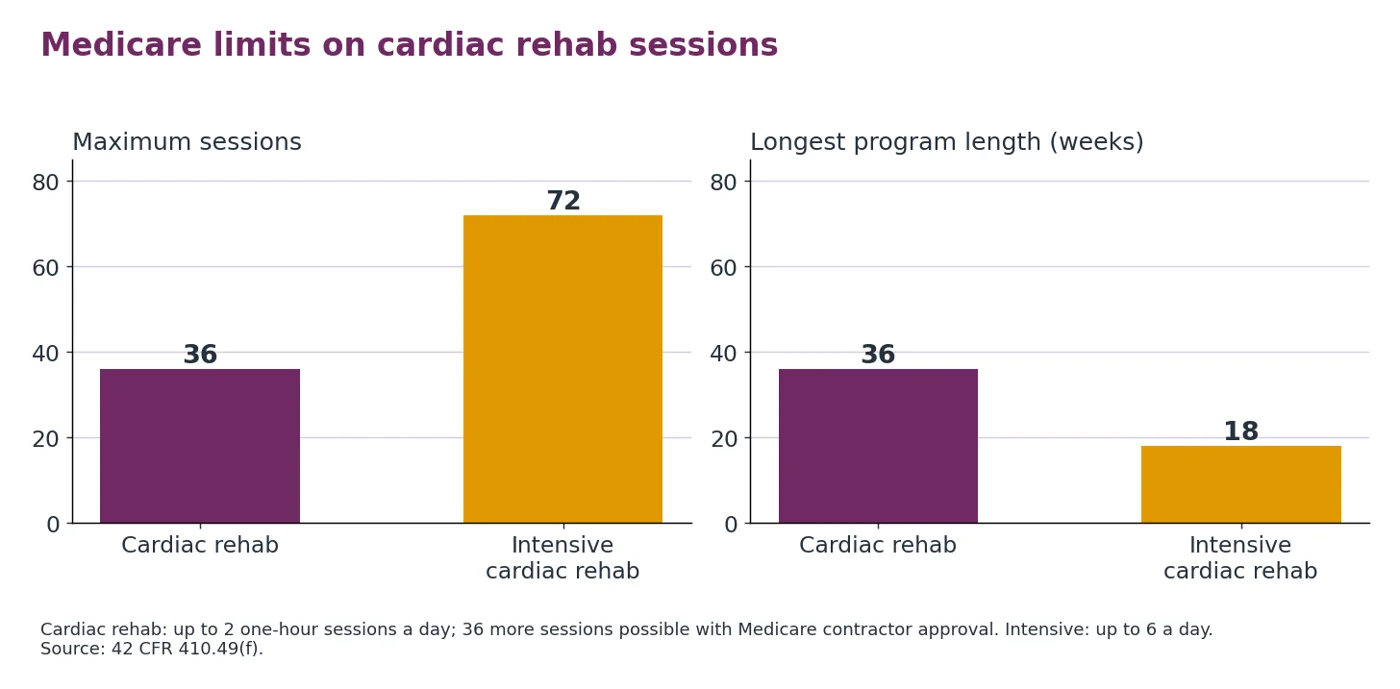
Standard cardiac rehab is limited to two one-hour sessions a day, up to 36 sessions over up to 36 weeks, with the option of 36 more if the Medicare contractor approves. Intensive cardiac rehab allows up to 72 one-hour sessions, up to six a day, over as long as 18 weeks. Medicare.gov puts your share at 20 percent of the approved amount once the Part B deductible is met; a hospital-based program adds a hospital copayment on top. If the patient is in a Medicare Advantage plan, its prior-approval steps may apply; the member services line will know.
Programs inside Glendale
Adventist Health Glendale runs a cardiac rehabilitation program at 1509 Wilson Terrace, East Tower, reachable at 818-409-8099. Its page lists bypass surgery, coronary stenting, heart attack, heart failure, valve repair or replacement and pacemaker or defibrillator placement among the reasons people join, and describes a first one-on-one evaluation with a registered nurse followed by supervised exercise, balance work, nutrition counseling and education on stress and smoking.
USC Verdugo Hills Hospital at 1812 Verdugo Blvd, in north Glendale near La Cañada Flintridge, lists cardiac rehabilitation among its services; its main line is 818-790-7100. For families in Montrose, La Crescenta or the Verdugo City area, that program can be the shorter trip.
CACVI doesn’t run a rehab gym. Our role is the cardiology side: deciding whether you qualify, making the referral, and seeing you during and after the program so the exercise plan and the medicines move together.
The referral is the step that slips
The federal Million Hearts initiative reports that people who attend 36 sessions have a 47 percent lower risk of death and a 31 percent lower risk of heart attack than people who attend only one. It also reports that for every day a person waits to start, they’re 1 percent less likely to enroll, and that the strength of the physician’s recommendation is the greatest predictor of whether someone goes. One finding should catch every Glendale family’s attention: Million Hearts names whether the eligible person speaks English as one of the best predictors of being referred at all.
So ask directly, at discharge and again at the first cardiology visit: “Does my father qualify for cardiac rehab, and can you send the referral today?” If the answer is yes, call the program the same week. If language is a worry, ask the program how it handles interpreters before the first session, not during it.
What a typical week looks like
Each program sets its own schedule; finishing 36 sessions in 12 weeks, for example, works out to three a week. At Adventist Health Glendale, the program page describes a first one-on-one evaluation with a registered nurse, then supervised sessions on treadmills, exercise bikes, elliptical machines and weight machines, with nutrition counseling and education on stress and smoking. Ask the program whether a family member can attend the nutrition sessions; when one person cooks for the whole household, that person needs the advice as much as the patient.
Recently discharged after a stent, a heart attack or a valve procedure? Book the cardiology follow-up and bring the discharge papers, so the rehab referral can go out from that visit.
A heart attack in Glendale: what 911 does that a car can’t
This is the section to read before you need it. Anyone reading it with chest pain right now should put the phone down and dial 911.
The warning signs are wider than chest pain
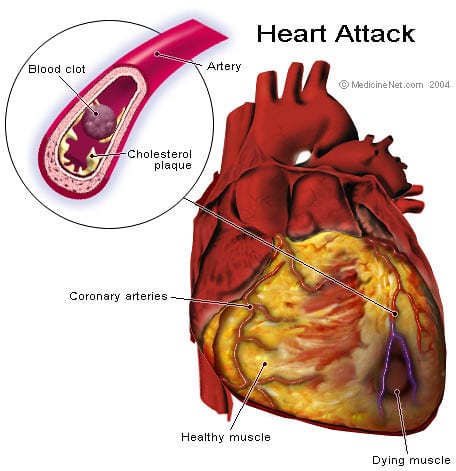
The National Heart, Lung, and Blood Institute lists the symptoms of a heart attack as chest pain, heaviness or discomfort in the center or left side of the chest, which is the most common symptom; pain or discomfort in one or both arms, the back, shoulders, neck, jaw or above the belly button; shortness of breath at rest or with little activity, which is more common in older adults; sweating for no reason; unusual tiredness, sometimes for days, which is more common in women; nausea and vomiting; light-headedness or sudden dizziness; and a rapid or irregular heartbeat. NHLBI also notes it is possible to have mild symptoms, or none, and still be having a heart attack.
Older parents often describe these signs in their own words: “my stomach is bad,” “I’m just tired,” “my arm feels heavy.” Families are usually the first to notice that something is off.
Why the ambulance, even when the hospital is five minutes away
Glendale is small enough that the hospital can feel closer by car than by ambulance. NHLBI is direct about this: an ambulance is the best and safest way to get to the hospital, and you should not drive yourself or let someone else drive you. The reason is what happens before you arrive.
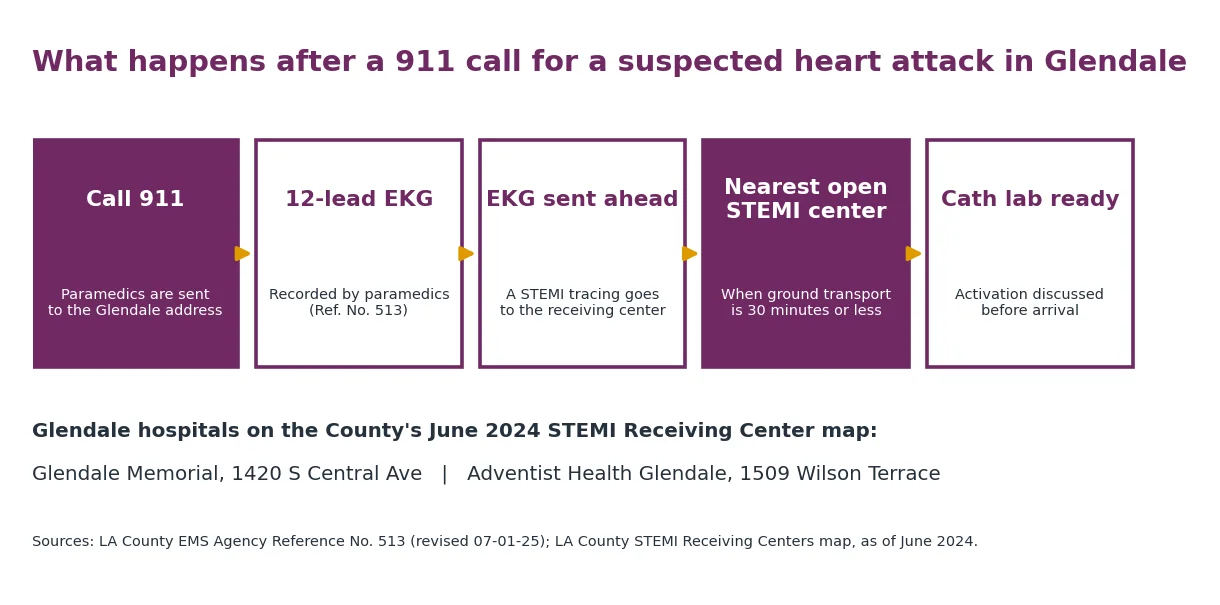
Under Los Angeles County’s Reference No. 513, paramedics perform a 12-lead EKG in the field. If it shows an ST-elevation heart attack (a STEMI), they transmit the tracing directly to the receiving hospital and discuss activating the cardiac catheterization lab before the patient arrives. The policy directs these patients to the most accessible open STEMI Receiving Center when ground transport is 30 minutes or less. A car can’t do any of that. A family member driving to the nearest emergency door may arrive at a hospital that then has to transfer the patient.
Glendale’s STEMI Receiving Centers
The County EMS Agency’s map of approved STEMI Receiving Centers, dated June 2024, includes two Glendale hospitals:
- Dignity Health Glendale Memorial Hospital and Health Center, 1420 S Central Ave, Glendale 91204, main line (818) 502-1900, in south Glendale.
- Adventist Health Glendale, 1509 Wilson Terrace, Glendale 91206, main line (818) 409-8000. Its emergency care page lists STEMI Receiving Center designation and Chest Pain Center accreditation.
A STEMI Receiving Center, in the County’s definition, is licensed for a cardiac catheterization lab and cardiovascular surgery and approved by the EMS Agency. Both hospitals sit in the middle of the city, which is part of why paramedics in most Glendale neighborhoods have a receiving center close by.
USC Verdugo Hills Hospital, 1812 Verdugo Blvd, runs a 24-hour emergency department and an interventional radiology and cardiac catheterization lab, according to Keck Medicine of USC. It does not appear on the County’s June 2024 STEMI Receiving Center map. That doesn’t make it a poor hospital; it means that when the field EKG shows a STEMI, the County protocol points paramedics toward a designated center. Let the paramedics decide. They know which centers are open that hour.
If someone collapses at home
A heart attack and a cardiac arrest are not the same thing. In cardiac arrest the heart stops pumping effectively, and the person collapses and stops breathing normally. NHLBI’s cardiac arrest guidance lays out the steps: check whether the person responds and is breathing; if not, call 911, start CPR, find an AED and follow its spoken instructions, and keep doing CPR until first responders take over. At home, a family member can call 911 while doing CPR. NHLBI notes that AEDs are made for untrained bystanders, that they are often found in public places such as office buildings, gyms and shopping centers, and that apps can show nearby AEDs or alert trained people close by.
Under the County’s Reference No. 516, paramedics generally keep working on an adult in cardiac arrest at the scene until the heart restarts, and patients whose circulation returns go to the most accessible STEMI Receiving Center when ground transport is 30 minutes or less. In Glendale that again points to the two receiving centers in the city. For a household with a heart patient, a CPR and AED class for the adults who live there is time well spent; NHLBI notes training is often offered together and some is online.
What our office can and can’t do on that day
CACVI’s offices are outpatient medical offices. They are not emergency rooms, and calling us during a heart attack only costs minutes. Our physicians’ hospital work is centered at Providence Cedars-Sinai Tarzana Medical Center, which is itself on the County’s STEMI Receiving Center map for the Valley, but paramedics in Glendale won’t drive past two receiving centers to reach it, and they shouldn’t. Where we come in is afterward.
After the hospital: what to bring to the first cardiology visit
If a family member was treated at Glendale Memorial, Adventist Health Glendale or USC Verdugo Hills and you’re arranging follow-up with us, ask the hospital before discharge for copies of four things: the discharge summary, the cardiac catheterization report if a cath was done (it names the artery, the type of stent and its size), the echocardiogram report, and the final medication list. Arriving with those papers means the cardiologist spends the visit planning ahead rather than piecing together the hospital stay.
Home from a Glendale hospital after a heart attack or stent? Request your follow-up visit and have the discharge summary ready when we call.
The months after a stent or heart attack, at home in Glendale
The first cardiology visit after a hospital stay is where long-term care starts, and most of what decides how the next year goes happens at home between visits. These are the questions our physicians hear most from families in that period.
The antiplatelet medicine nobody should stop on their own
NHLBI’s guidance on stent recovery explains that antiplatelet medicines help stop a blood clot from forming inside a coronary stent. That’s why the most important rule after a stent is simple: don’t stop or skip these medicines unless the cardiologist who knows your stent says so. The danger often comes from another office with good intentions. A dentist planning an extraction, a surgeon scheduling a knee replacement, or a pharmacist filling a cheaper substitute may suggest a pause. Before any of that, call the cardiologist.
Keep a card in the wallet that names the stent, the date it was placed and the hospital. The catheterization report has all three. When a parent is seen in an emergency room for something unrelated, that card answers the first question every doctor will ask.
Going back to work, driving and daily life
NHLBI notes that after a stent most people can resume normal physical activity and return to work within a few days to a week, when their provider says it’s okay. After a heart attack the timeline depends on how much heart muscle was damaged, which is one reason the echocardiogram matters. Ask the cardiologist specifically about driving, lifting grandchildren, climbing the hills of north Glendale on foot and flying to visit family abroad. A vague “take it easy” helps nobody.
Mood after a heart event
NHLBI lists stress, depression and anxiety among factors that can raise the risk of coronary heart disease. After a heart attack, many people feel low or anxious for weeks, and families sometimes read that as stubbornness or laziness. Mention it at the follow-up visit. It’s part of heart care, and cardiac rehab programs include a psychosocial assessment for exactly this reason.
Food that is cooked for the whole table
When one person in a household gets a heart diagnosis, the kitchen usually changes for everyone. The cardiologist and the rehab dietitian will talk about salt, saturated fat and portion sizes, and the person who cooks should hear that advice first-hand, not second-hand from a tired patient in the car. Bring the cook to the visit, or to the education sessions at rehab. Ask for advice that fits the dishes your family actually eats, rather than a printed list of foods nobody at home buys.
Follow-up tests and how often
After a stent or a heart attack, cardiologists may recheck cholesterol and other blood work after medicines change, and may repeat an echocardiogram to see how the heart muscle has recovered. The schedule is individual. What matters for a family is knowing who orders what: write down at each visit whether the cardiologist or the primary doctor is responsible for the next lab draw, so that nothing falls between two offices.
Your parent’s heart diagnosis and your own heart
When a father in Glendale has a heart attack at 52, his grown children may ask the cardiologist in the hospital hallway, “What does this mean for me?” It’s a good question, and the answer belongs with each person’s own doctor. Here’s what to bring to that conversation.
What counts as early heart disease in a family
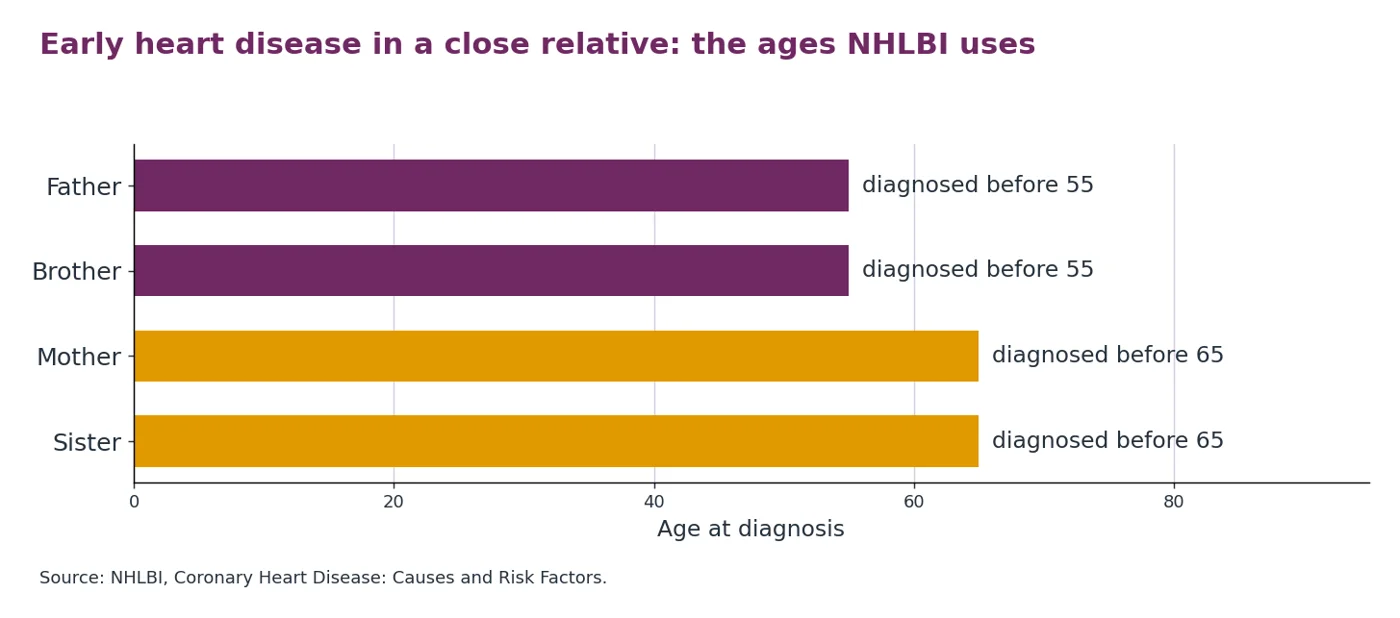
NHLBI describes a family history of early heart disease as a risk factor for coronary heart disease, especially when a father or brother was diagnosed before age 55, or a mother or sister before age 65. Write down which relative, which diagnosis and at what age. “Heart problems” isn’t enough; a stent at 50 and a slow heart rhythm at 85 are entirely different signals.
Cholesterol that runs in families
Some families carry an inherited form of very high cholesterol called familial hypercholesterolemia. MedlinePlus Genetics describes it as affecting an estimated 1 in 200 to 1 in 250 people in most countries and as the most common inherited condition affecting the heart and blood vessels. In its most common forms, one altered gene copy from one parent is enough to cause it, which is why a single diagnosis in a family can mean siblings and children should be checked. If a parent’s LDL cholesterol was very high long before the heart attack, say so.
Lipoprotein(a), a number most people have never heard of
Lipoprotein(a), usually written Lp(a), is a cholesterol-carrying particle whose level is set mostly by genes. According to MedlinePlus, people usually reach their adult level by about age 5, and it tends to stay about the same for the rest of their life, and a family history of early heart or blood vessel disease is one of the reasons a provider may order the test. For a grown child of someone with early heart disease, it’s a fair question to put to your own doctor.
Screening the household without scaring it
Siblings and adult children don’t need a cardiologist by default. They need their own primary doctor to know the family history, check blood pressure and cholesterol, and decide whether anything further is warranted. A coronary calcium scan is one test some doctors use to refine risk in adults without symptoms, and CACVI’s site describes it. Whether it fits a given person is a decision for that person and their doctor, not something a family should order for everyone after one bad day.
Have a parent with early heart disease and questions about your own risk? Ask for a cardiology consultation and bring the family history written out by relative and age.
Heart failure at home: what the family can watch between visits
Heart failure is a long condition, and most of it is lived at home, not in an exam room. In households where a spouse or grown child is around every day, that person often spots the change before the patient admits to it. This section is about turning that attention into something a cardiologist can use.
Support for the person doing the caring
NHLBI’s guidance on living with heart failure suggests joining a patient support group to learn how others with similar symptoms have coped, and notes that a provider or an area medical center can help find one. The same advice applies to the spouse or adult child who does the driving, the cooking and the medicine sorting. Caregivers burn out quietly, and a tired caregiver misses changes. If you are that person, ask at the next visit what local support exists, and say honestly how the household is managing.
Signs that are easy to miss
Families describe the early changes in everyday terms: shoes that suddenly feel tight, a parent who now sleeps propped on extra pillows or in a recliner, a cough at night, getting winded walking to the car. Each of those is worth mentioning at a visit. None of them should wait if breathing becomes hard at rest; that’s a 911 call.
Salt, fluids and the family kitchen
NHLBI notes that heart failure patients may be asked to limit salt and the amount of liquid they drink to reduce fluid buildup. The specific limits come from the cardiologist, and they differ from person to person. In practice the hard part is that salt hides in foods families make in large batches, bread from the bakery, pickled vegetables, cured meats and soups. Ask the cardiologist or the rehab dietitian which household staples are the big sources, and change the recipes for everyone rather than cooking a separate plate.
Where the CardioMEMS sensor fits
For some patients with heart failure who have been hospitalized, a small pressure sensor implanted in the lung artery lets the care team see fluid building up before weight or symptoms change. CACVI’s site describes the CardioMEMS implant. Whether it suits your parent depends on the type and stage of heart failure; it’s a reasonable question to ask after a second hospital stay in a short time.
Keeping the phone list current
NHLBI suggests keeping phone numbers for your provider, the hospital and someone who can take you for medical care where they are easy to find. For a Glendale household that list is short: the CACVI office you use, the hospital where the last admission happened, the health plan’s nurse line and the family member who drives. Put it on paper by the phone as well as in your contacts.
Living with a pacemaker or defibrillator in a busy household
For some Glendale families, the reason they need a cardiologist is a device: a pacemaker for a heart that beats too slowly, or an implantable cardioverter-defibrillator (ICD) for a heart at risk of a dangerous rhythm. Device implantation is one of Dr. Khorsandi’s stated interests, backed by a device certification on his bio.
The ID card goes everywhere
NHLBI says to carry the pacemaker ID card for emergencies and show it to airport security, new doctors and anyone else who needs to know about the device. The card lists the device and leads, the implant date and the doctor’s contact information. For someone who travels abroad to see family, keep a photo of the card on a phone as well.
Phones, headphones and the kitchen
According to NHLBI, people with a pacemaker should keep it at least 6 inches away from devices with strong magnetic fields, hold a cell phone to the ear on the opposite side of the body from the device, avoid carrying a phone or headphones in a shirt pocket, and wear headphones as far from the device as possible. Grandchildren who like to sit on a grandparent’s lap with a tablet or phone don’t need to be banished; the rule is distance and not resting the device over the implant.
Airport screening and medical procedures
NHLBI notes the risk from metal detectors is low, though a device may set one off, and that people can show their ID card and ask for a separate screening. MRI and shock-wave lithotripsy for kidney stones can affect devices, so always tell a doctor or dentist about the device before a procedure; changes can often be made in advance.
Check-ups, remote boxes and batteries
NHLBI describes visits several times a year for a pacemaker, and at least every six months for an ICD, with a check of the battery and leads. For an ICD, NHLBI adds that a provider may hand out a remote monitoring box for home, sending device data to the manufacturer, the provider or both. For an ICD, NHLBI notes batteries last between 5 and 7 years, after which a procedure is needed to replace the device. If your parent moves in with you or changes phone numbers, contact the manufacturer for a new ID card and make sure the remote box is set up at the new address.
After a shock
An ICD shock is frightening for the person and for whoever is in the room. NHLBI notes that after a high-energy shock a person may need to wait six months before driving again, and that some providers are not familiar with the legal driving restrictions, so families may need to look into them. Call the cardiologist’s office after any shock. If there is more than one shock, or the person doesn’t feel well afterward, call 911.
Moved to Glendale with a pacemaker or ICD and no cardiologist nearby? Request a visit and bring the device ID card.
Long trips to see family abroad with a heart condition
When a Glendale family plans a long visit to relatives overseas, the flight itself is the easy part to forget about if a parent has a heart condition. A pre-trip cardiology visit is worth booking a month or two ahead, because the paperwork and refills take time.
A letter from the cardiologist
CDC’s Yellow Book guidance for travelers with chronic illnesses suggests getting a letter from your healthcare professional, on office letterhead, that outlines existing conditions, prescribed medicines with generic names and doses, allergies and any equipment required. For a heart patient that letter is what a doctor in another country will read first if something goes wrong. Ask for it at the visit before the trip, and ask for a printed copy of the most recent EKG; CDC also suggests keeping records such as an electrocardiogram on a phone so they are reachable.
Medicines in the carry-on, in their original containers
The same CDC chapter advises packing enough medicine for the whole trip plus several days in case of delays, in carry-on luggage, in original containers, with medical information alongside. For blood thinners and rhythm medicines that advice matters twice over: a suitcase lost for three days is three days of missed doses. Time zones are the other trap. Ask the cardiologist how to shift dose times on a ten-hour time difference before you board, not after you land.
Carrying your heart history on the trip
CDC’s chapter also suggests carrying medical information on your person, for example a medical alert bracelet or tag, and keeping health records on a phone so they’re reachable if needed. For a heart patient abroad, the useful set is short: the cardiologist’s letter, the current medication list with generic names, the stent or device card, and a recent EKG. A doctor in another country who sees those four things in the first minutes can avoid repeating tests or changing a medicine that was chosen on purpose.
Devices at the airport
The device ID card section above applies here too. Show the card at security and ask for a separate screening if you prefer. Before a long stay, ask the device clinic whether remote monitoring works from the destination country, and how to reach them if the device alerts while you’re away.
Insurance and getting care while away
CDC also suggests travel insurance with a 24-hour assistance line and medical evacuation coverage. Check what your own health plan pays outside the United States before the trip, not in a hospital lobby. Write the name of the nearest hospital at the destination on the same card as the device or stent details. If chest pain starts while you’re away, use the local emergency number first and call us once you’re safe.
The 134, the 101 and the drive from Glendale to either office
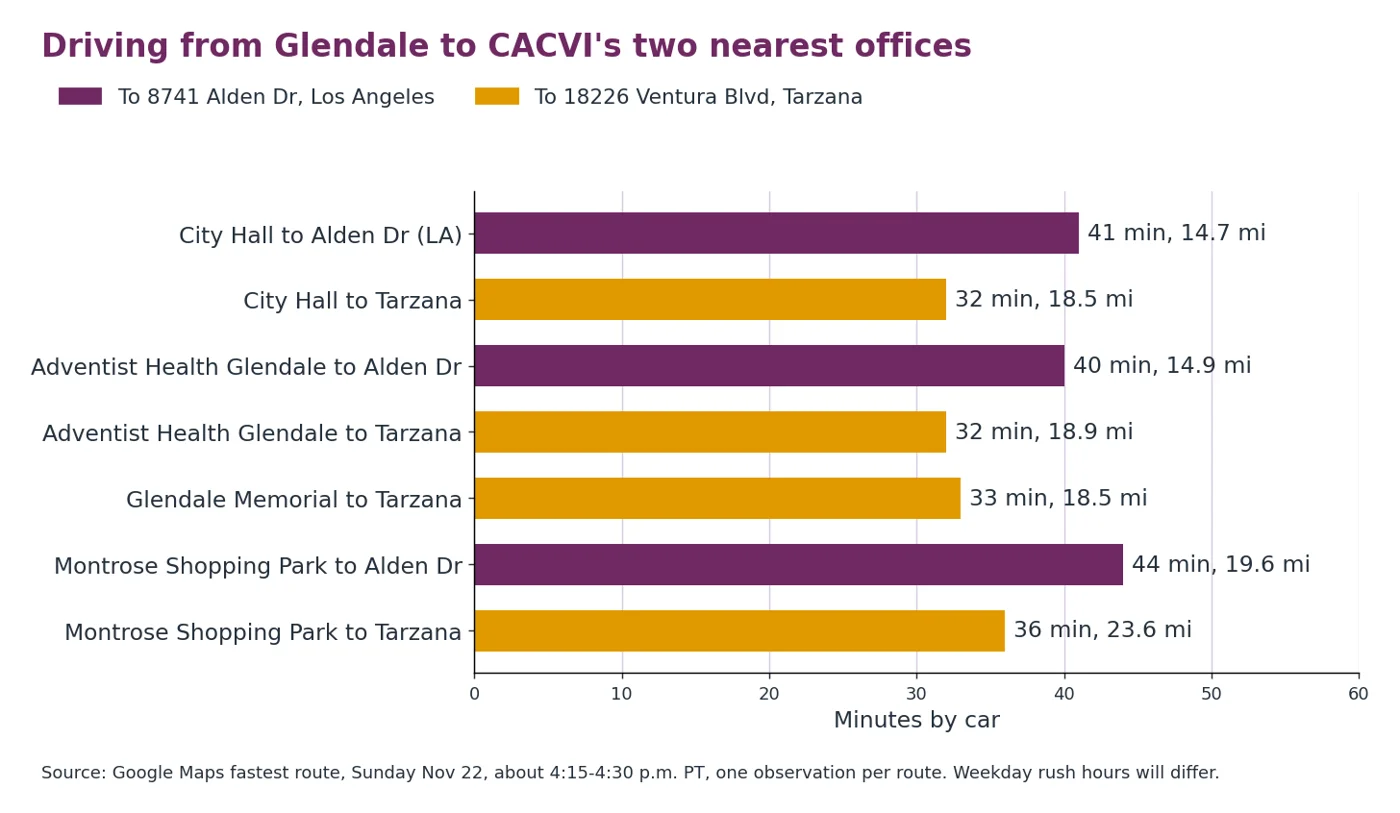
Glendale sits between our two Los Angeles County offices. Alden Drive is closer in miles; Tarzana took less time on the afternoon we checked and is the only one of the two open on Saturdays. We checked both from several Glendale starting points with Google Maps and with the open-source OSRM routing engine. Google’s figures below come from a single Sunday afternoon, November 22, between about 4:15 and 4:30 p.m. Pacific; weekday rush hours will differ, so check a live estimate the morning of your visit.

From central and south Glendale to Alden Drive
From Glendale City Hall at 613 E Broadway, Google’s fastest route to 8741 Alden Dr was 14.7 miles via the westbound 134, about 41 minutes. It also offered a 19.6-mile route over Coldwater Canyon and a 20.6-mile route by way of the 10, both within a couple of minutes of that time. From Adventist Health Glendale on Wilson Terrace the picture was almost identical: 14.9 miles via the 134 in about 40 minutes, or 14.1 miles via the 2 and Beverly Boulevard.
OSRM, which assumes free-flowing traffic, prefers surface streets for this trip: from City Hall it routes down Central Avenue, across Los Feliz Boulevard and Western Avenue, about 11.7 miles in 27 minutes. That route only makes sense when traffic is light. For a 9 a.m. appointment, the freeway estimate is the safer one to plan around.
From Montrose, La Crescenta and the foothills
North Glendale adds distance to either office. From the Montrose Shopping Park on Honolulu Avenue, Google’s route to Alden Drive was 19.6 miles via the 134, about 44 minutes. The same starting point to Tarzana was 23.6 miles via the 134 and the 101 in about 36 minutes, or 27.7 miles via the 210 in about 35. For foothill families the Valley office is often the easier choice despite the extra miles.
Choosing Tarzana instead


From City Hall to 18226 Ventura Blvd, Google’s route was 18.5 miles via the 134 and the 101, about 32 minutes, with a six-minute slowdown on the 101 at the time. From Glendale Memorial on Central Avenue it was 18.5 miles and 33 minutes the same way; Google also offered an alternative up the 5 north, 28.5 miles and about 39 minutes, a useful fallback when the 134 is backed up. The Ventura Boulevard office also opens Saturday mornings and afternoons, and parking there costs nothing, though spaces in its own lot are few.
Parking at Alden Drive
For an older parent, the short walk matters more than the price. CACVI’s appointments page points drivers to Lot 703 at 141 Robertson Blvd, roughly three minutes away on foot, and says the first two hours there cost nothing; two paid garages are listed as backups.
No car, or no one free to drive
If nobody in the household can drive the patient, tell us when you call, and ask your health plan whether it covers rides to medical appointments. If it does, book the ride when you book the visit, not the night before.
Planning the day around a test
Some visits run longer than a standard appointment because a test is added. If a stress test is likely, wear comfortable shoes and clothes you can walk in, and ask when you book whether to skip caffeine or hold any medicine. If the patient is older or tires easily, a family member who can drive home matters more than the route.
The physicians Glendale patients see at CACVI
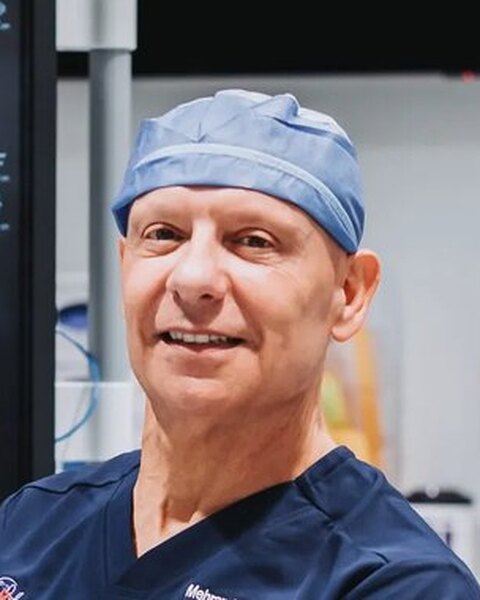
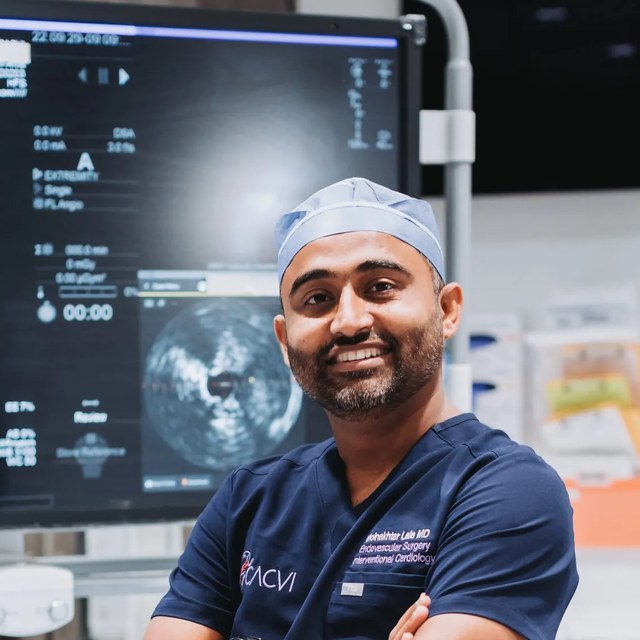
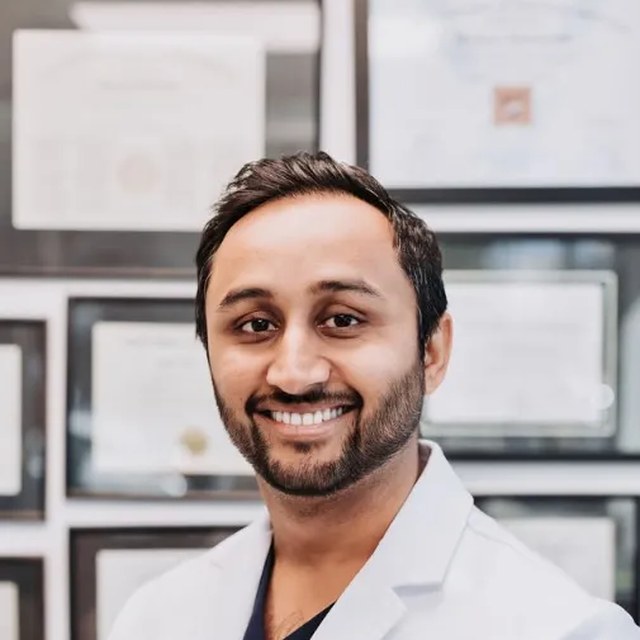
CACVI is led by Dr. Mehran J. Khorsandi and Dr. Moinakhtar Lala, joined by Dr. Vasim Lala. The details below come from their published biographies; follow the links for full training and certification lists. Office-by-office schedules change week to week; name the physician you prefer when you call.
Dr. Mehran J. Khorsandi, M.D.
Runs the cath lab at Providence Cedars-Sinai Tarzana; interventional and endovascular cardiologist
After medical school at Penn, Dr. Khorsandi spent his training years at Cedars-Sinai and stayed on as an attending physician from 1993. His bio counts five certifications in all: four medical boards, among them interventional cardiology and endovascular medicine, and one device credential. His listed interests include high-risk coronary angioplasty, coronary bifurcation disease and pacemaker and defibrillator implantation, which makes him the physician to ask about if a parent has a device or a complicated coronary history.
Dr. Moinakhtar Lala, M.D.
Certifications span echocardiography, nuclear cardiology and vascular ultrasound as well as interventional work
Since October 2016 Dr. Moinakhtar Lala has been part of CACVI; his subspecialty years were spent at Mount Sinai Beth Israel in New York. His bio lists complex and trans-radial coronary interventions, coronary total occlusions and transcatheter aortic valve replacement, and says he manages acute and chronic heart disease and preventive care in the office. His certifications in echocardiography and nuclear cardiology bear directly on reading the tests a first evaluation often leads to.
Dr. Vasim Lala, D.O.
D.O.; certified in interventional cardiology, imaging and vascular interpretation
Dr. Vasim Lala, an osteopathic physician, arrived at CACVI in mid-2022 from Mount Sinai in Manhattan, where he trained in coronary, vascular and structural procedures. His procedure list includes TAVR, PFO closure and WATCHMAN, yet much of his clinic time, by his own bio, goes to high blood pressure, heart failure, AFib, weakened heart muscle and heart care during cancer treatment. For a Glendale patient whose main worry is blood pressure or heart failure, his is the profile to read first.
Heart care questions from Glendale patients
Which CACVI cardiology offices serve Glendale?
The nearest CACVI offices are in Los Angeles at 8741 Alden Dr, Suite A (310-652-2744), and in Tarzana at 18226 Ventura Blvd, Suite 102 (818-905-5904). A third office is in Victorville. From Glendale City Hall, Google’s route to Alden Drive was 14.7 miles and to Tarzana 18.5 miles on the afternoon we checked.
Is any CACVI office near Glendale open on weekends?
Tarzana is. Saturday runs from eight in the morning to half past four there, the same in our site data as on Google. Alden Drive keeps weekday hours only, 8:30 a.m. to 5:00 p.m. Sunday appointments aren’t offered at either. New-patient Saturday slots depend on the week’s schedule.
Will my insurance make me get a referral first?
It depends on the plan, not on the practice. Medicare.gov explains that in most cases an HMO plan requires a referral to see a specialist. Other plan types have their own rules. Check the back of the insurance card or call the plan before the visit.
Is there a walk-in cardiologist in Glendale?
Not at CACVI; both offices see patients by appointment. For a quick EKG without a visit, an urgent care clinic or your primary doctor’s office is the usual route. Chest pain that is new or building needs paramedics, not an urgent care line.
Does Dr. Khorsandi see patients in Tarzana?
Yes. In Providence’s directory, both CACVI addresses appear under Dr. Mehran J. Khorsandi: Alden Drive in Los Angeles and Ventura Boulevard in Tarzana. The Tarzana hospital a few blocks from the office is also where he runs the cath lab. His days at each office vary, so ask when booking.
Where can a Glendale patient do cardiac rehab?
Adventist Health Glendale runs a cardiac rehabilitation program at 1509 Wilson Terrace, East Tower (818-409-8099), and USC Verdugo Hills Hospital lists cardiac rehabilitation among its services (818-790-7100). A program needs a physician referral and, for Medicare, a qualifying condition such as a recent heart attack, a stent or bypass.
Can my son or daughter make the appointment for me?
Yes. Relatives often place the first call. The office will need the patient’s details and will speak with the patient to confirm them. Tell the staff if you want a family member to receive information about your care.
Can I bring an interpreter, or should my health plan provide one?
California’s Department of Managed Health Care says plans it regulates must provide a qualified interpreter on request, free, in person, by phone or by video. Call the member services number on the insurance card a few days before the visit to arrange it, and tell our staff the language when you book.
Where does a Glendale ambulance go with a heart attack?
That’s the paramedics’ decision. Under Los Angeles County policy, patients whose field EKG shows a STEMI heart attack go to the most accessible open STEMI Receiving Center when transport is 30 minutes or less. Glendale Memorial and Adventist Health Glendale are both on the County’s June 2024 map of those centers.
Could a CACVI doctor see my father while he’s admitted in Glendale?
Plan on the hospital’s own cardiology team during the admission. CACVI’s physicians practice at Providence Cedars-Sinai Tarzana, and we don’t list privileges at Glendale Memorial or Adventist Health Glendale. Once he’s discharged, he can see us for follow-up no matter which hospital treated him.
What goes in the bag for a first CACVI appointment?
CACVI’s new patient page asks for the completed registration form, your insurance card, payment, medical records and imaging, and all medicines, herbals, vitamins and supplements. Arrive 15 minutes early. Coming straight from a hospital stay? Pack the discharge papers and the cath report as well.
Will you see me for leg pain too?
Yes, but that’s a separate kind of visit. Leg pain when walking, leg sores and swollen legs are covered on our leg pain doctor page for Glendale. Mention both at your visit if you have heart and leg symptoms, because the same artery disease can cause both.
Requesting your first visit from a Glendale address
To see a CACVI cardiologist from Glendale, call the Los Angeles office at 310-652-2744 or the Tarzana office at 818-905-5904, or send a request through our appointments page. Tell us you’re calling from Glendale, which office suits you, the reason for the visit and the patient’s preferred language. If someone else is calling for the patient, say so; it saves a step.
Reviews from CACVI patients at the Los Angeles and Tarzana offices
Cardiology pages for places that share a border with Glendale
Burbank, Pasadena, La Cañada Flintridge, the city of Los Angeles and the unincorporated La Crescenta-Montrose area all share a boundary with Glendale, according to the Census Bureau’s TIGERweb boundary files. These CACVI pages cover the ones we have written about, and each points to the same offices that serve Glendale.
- Cardiologist for Burbank patients
- Cardiologist for Pasadena patients
- Cardiologist for La Crescenta patients
- Cardiologist for Montrose patients
- Cardiologist for Los Angeles patients
Verdugo City is a neighborhood inside Glendale; its cardiology page covers the same offices. For background on every test mentioned here, see the diagnostic procedures overview.
Sources behind the Glendale facts on this page
| Source | Publisher | Used for |
|---|---|---|
| CACVI appointments and office details | CACVI | Addresses, phones, parking, Tarzana Saturday hours (site office data) |
| CACVI new patients | CACVI | What to bring to a first visit |
| LA County EMS Reference No. 513, STEMI patient destination | Los Angeles County EMS Agency | Field EKG, transmission, 30-minute rule |
| STEMI Receiving Centers map, as of June 2024 | Los Angeles County EMS Agency | Glendale Memorial and Adventist Health Glendale listed |
| Emergency care, Adventist Health Glendale | Adventist Health | STEMI center and chest pain accreditation |
| Cardiac rehabilitation, Adventist Health Glendale | Adventist Health | Program location, phone and eligibility |
| Cardiology at USC Verdugo Hills Hospital | Keck Medicine of USC | Cardiac rehabilitation, main line |
| 42 CFR 410.49 | eCFR | Medicare cardiac rehab conditions and limits |
| Cardiac rehabilitation coverage | Medicare.gov | Cost sharing |
| Cardiac Rehabilitation At A Glance | Million Hearts (HHS) | Outcomes, referral and enrollment findings |
| Language Assistance | California Department of Managed Health Care | Interpreter rights in health plans and hospitals |
| 45 CFR 164.510 and 45 CFR 92.201 | eCFR | Family involvement; interpreter rules |
| Heart attack symptoms; stents; heart failure; pacemakers; coronary heart disease risk factors | NHLBI | Symptoms, recovery and device guidance |
| Lipoprotein(a) blood test; familial hypercholesterolemia | MedlinePlus (NIH) | Inherited cholesterol risk |
| LA County EMS Reference No. 516, non-traumatic cardiac arrest | Los Angeles County EMS Agency | Cardiac arrest destination |
| Cardiac arrest treatment | NHLBI | CPR and AED steps |
| 45 CFR 164.524 | eCFR | Patient access to records: 30 days, electronic copies, fees |
| Travelers with chronic illnesses | CDC Yellow Book | Travel letter, medicines and records |
¿Listo para hablar?