


Vascular & Leg Pain Care
Leg Pain Doctor Compton
A sore above the ankle that has been open for weeks, that closes and then breaks down again, or that sits in a patch of brown, hardened skin is often a venous leg ulcer. The wound is on the skin, but the cause is in the veins: blood that should flow back up the leg pools instead, and the pressure keeps the skin from healing. The Center for Advanced Cardiac and Vascular Interventions (CACVI) treats that cause for patients from Compton, alongside whatever wound care they already receive.
Patients from Compton are seen at CACVI’s Los Angeles office on Alden Drive. Call 310-652-2744 to arrange a vein evaluation for a leg ulcer. A wound with spreading redness, fever or chills, or new pus and odor should be seen the same day; the route section below gives the nearest emergency department.
Healing and recurrence figures for a Compton leg ulcer
| Result | Meaning when an ulcer keeps reopening | Study or page |
|---|---|---|
| 56 vs 82 days | Median time to healing when the leaking surface vein was closed within two weeks, against waiting until later, in 450 patients. | EVRA trial, NEJM 2018 |
| 12% vs 28% | Ulcers back within a year with compression plus vein surgery, against compression alone. | ESCHAR, Lancet 2004 |
| 31% vs 56% | The same comparison four years on: fixing the vein cut recurrence by almost half. | ESCHAR, BMJ 2007 |
| GRADE 1A | The US guideline’s strongest grade, given to closing incompetent surface veins in addition to compression to cut ulcer recurrence. | SVS/AVF guideline, 2011 |
| 48 trials | Randomized studies in a Cochrane review; healing was better with compression than without it. | Cochrane review, 2012 |
| 3.0 mi / ~7 min | Compton City Hall to the 24-hour emergency department at MLK Community Hospital, which also runs an outpatient wound healing center. | MLKCH |
| 22.6 mi / ~35 min | Free-flow driving distance north to the Alden Drive office (I-110, then I-10). | OSRM route, no traffic |
Jump to
- A leg sore that keeps reopening: venous ulcer care for Compton
- Why the vein underneath decides whether the sore stays closed
- Keep your wound clinic, add a vein doctor
- Venous, arterial or diabetic: why the type of ulcer matters
- Slow-healing ulcer: what Compton patients ask
- Leg-care pages for Lynwood, Carson and neighbors
- Compton to Alden Drive, and MLK Community Hospital for emergencies
- Google comments about the practice
- Ulcer guideline and condition sources
A leg sore that keeps reopening: venous ulcer care for Compton
People usually reach a vein doctor after months of dressings. A home health nurse, a podiatrist, a primary care doctor or a hospital wound center has been cleaning and wrapping the sore, and it improves, stalls, closes, then opens again. That cycle is a strong hint that the sore is being driven by something underneath it. CACVI’s part is to find that cause in the veins and treat it, so the wound care you already get has a better chance of working and the skin has a better chance of staying closed.
How a venous ulcer looks
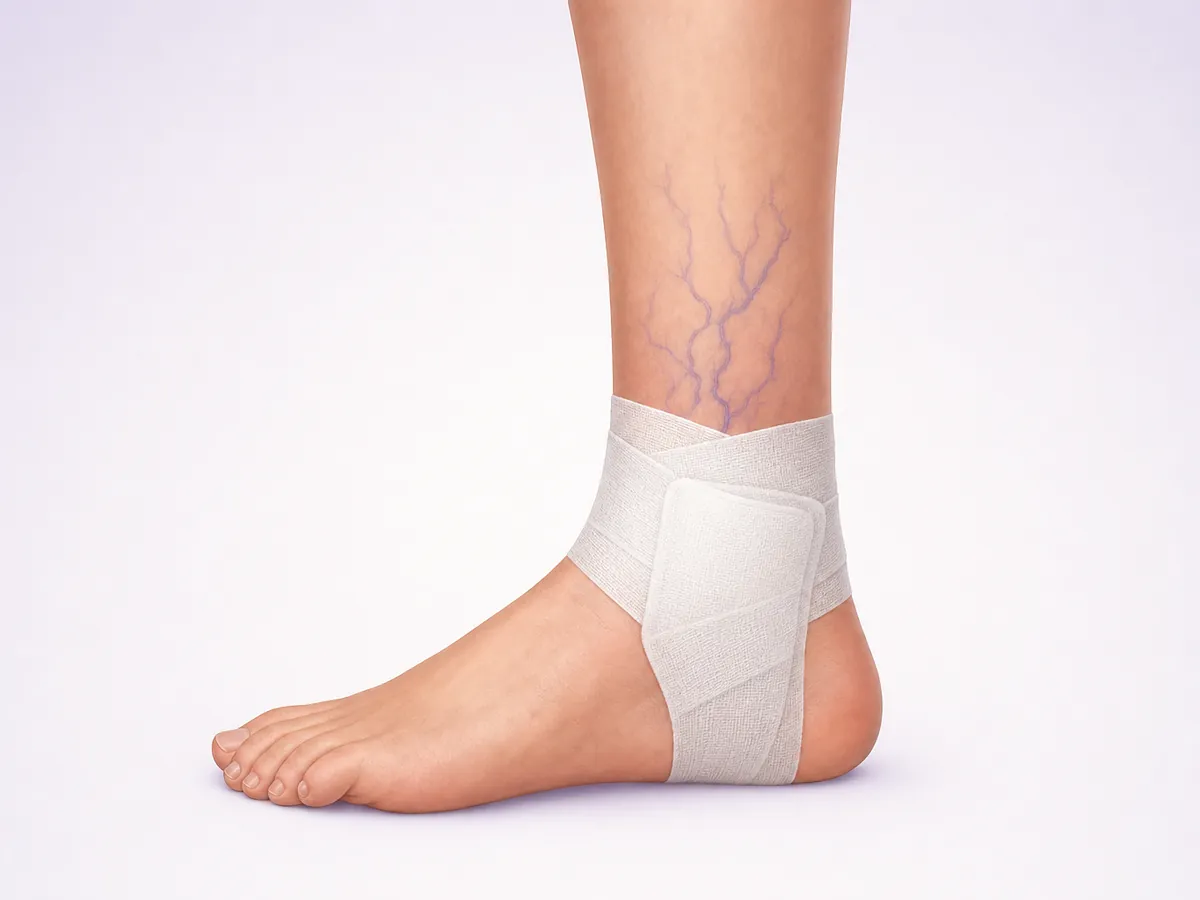
MedlinePlus describes a venous ulcer as a shallow sore with a red base, sometimes covered by yellow tissue, with unevenly shaped borders. The skin around it may be shiny, tight, warm or hot, and discolored, and the leg often aches. Most form on the leg above the ankle. CACVI’s ulcer page puts them along the lower leg, usually on the inner side, sometimes the outer.
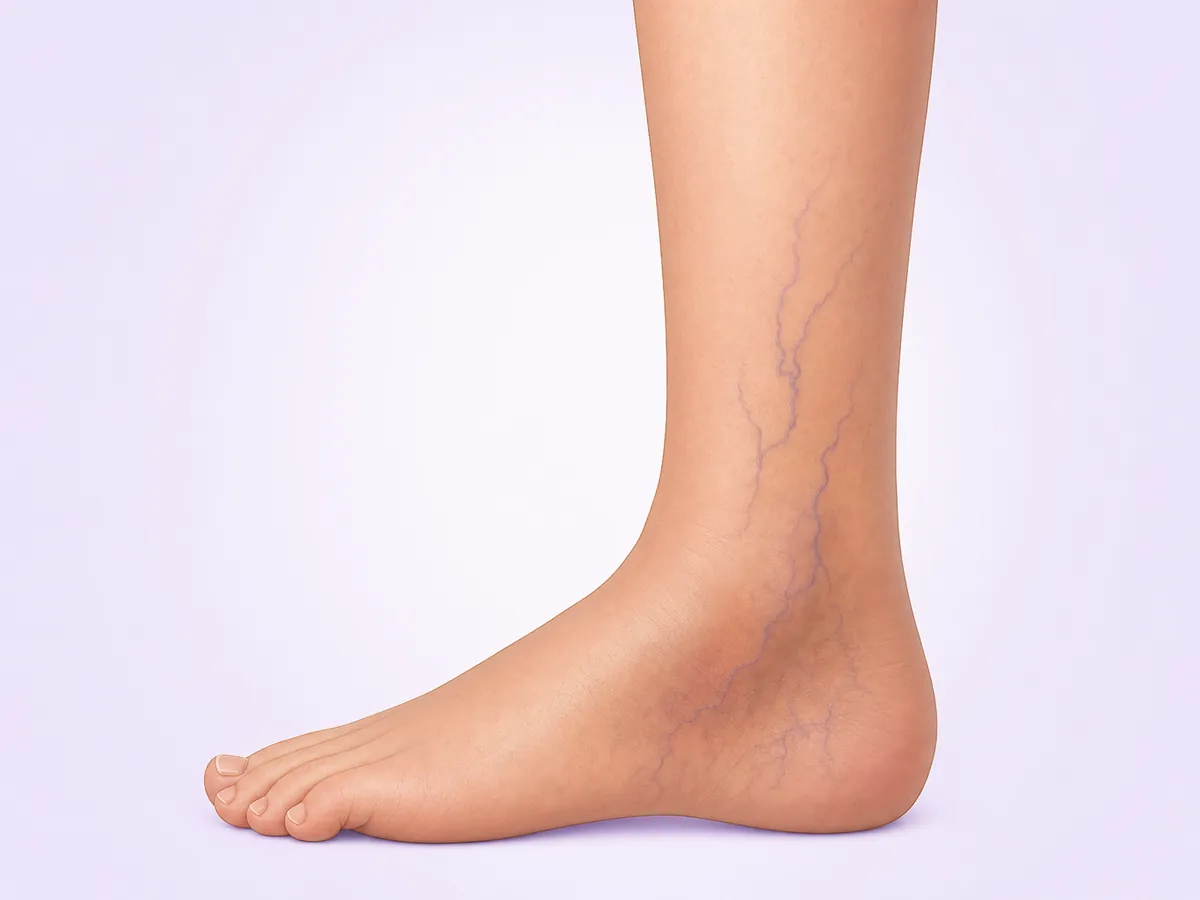
The skin nearby tends to carry the history: brown staining, itch, and patches that have become thick and hard. Those are signs of long-standing venous pressure, and they help tell a venous ulcer apart from other kinds.
What keeps it open
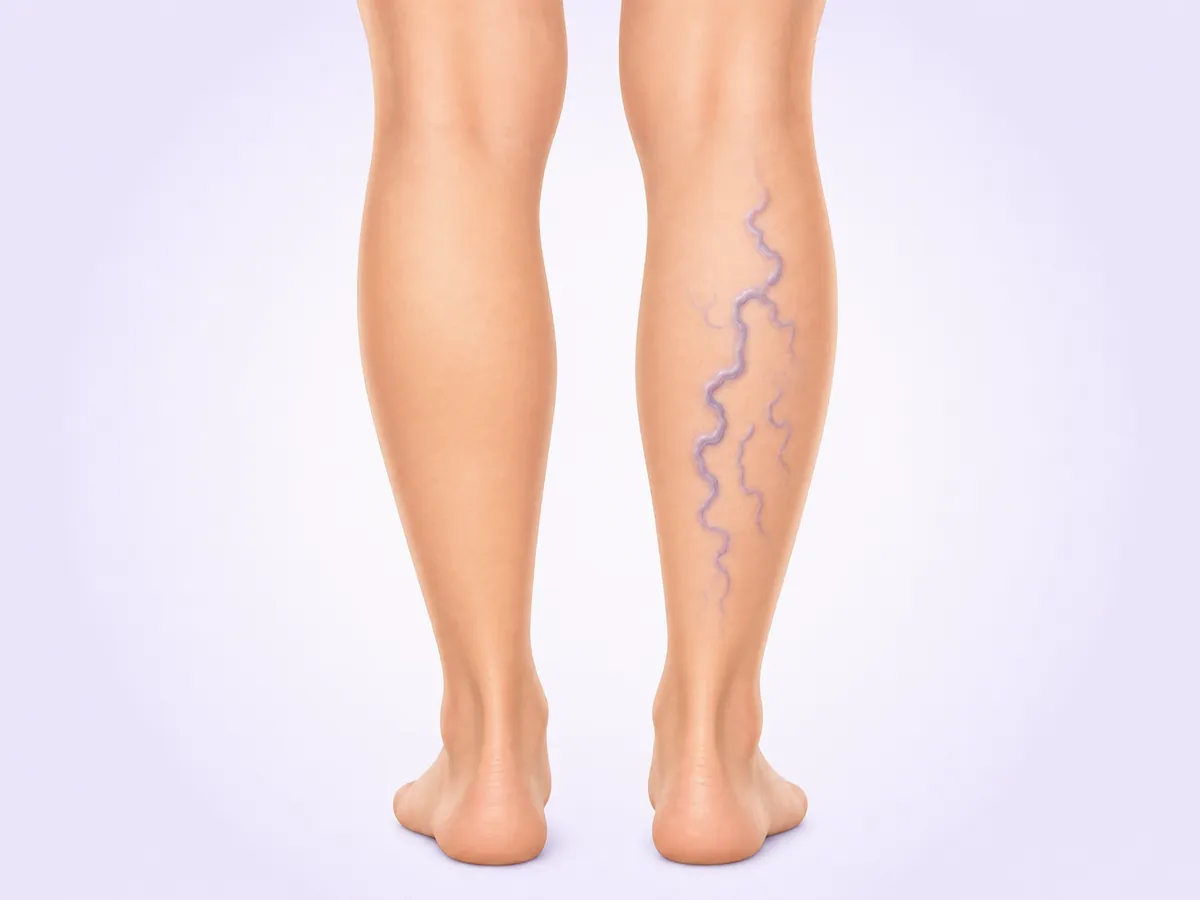
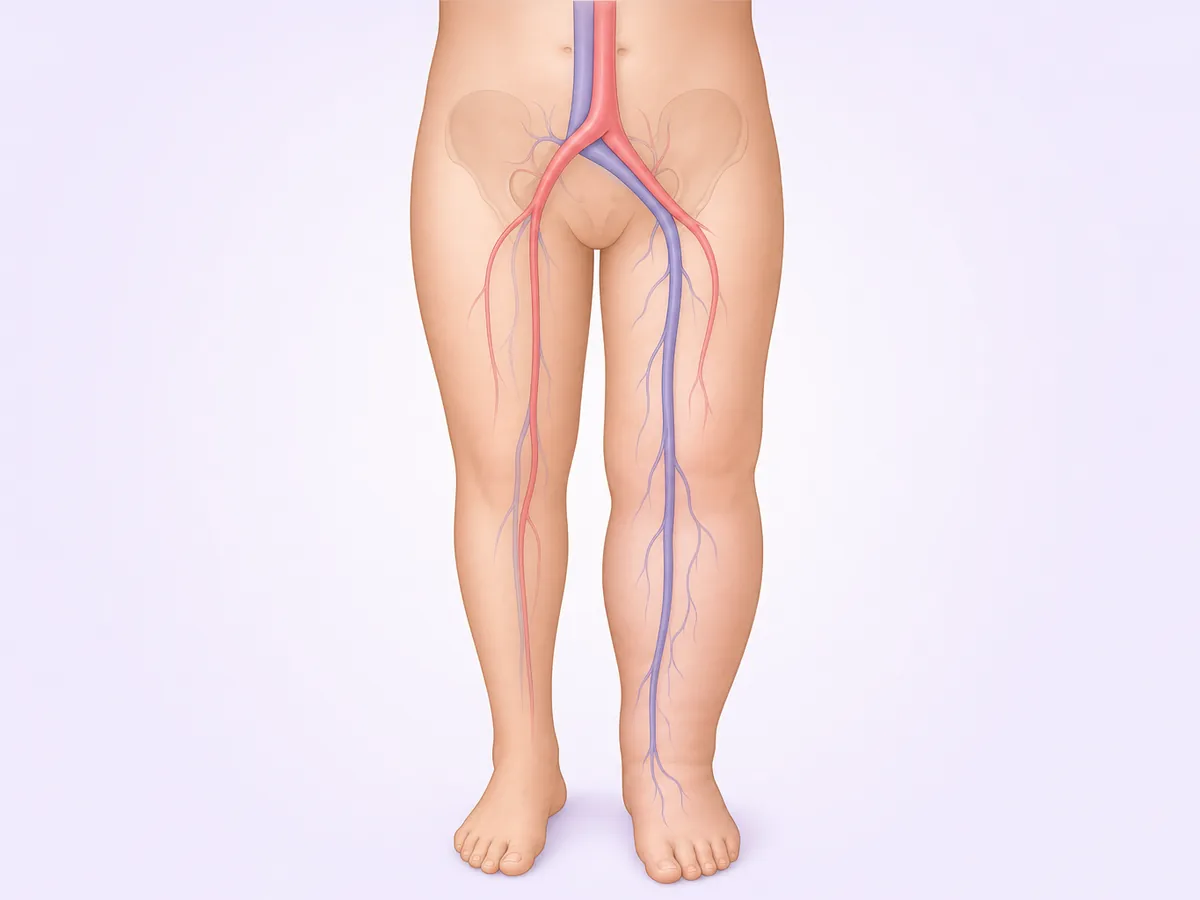
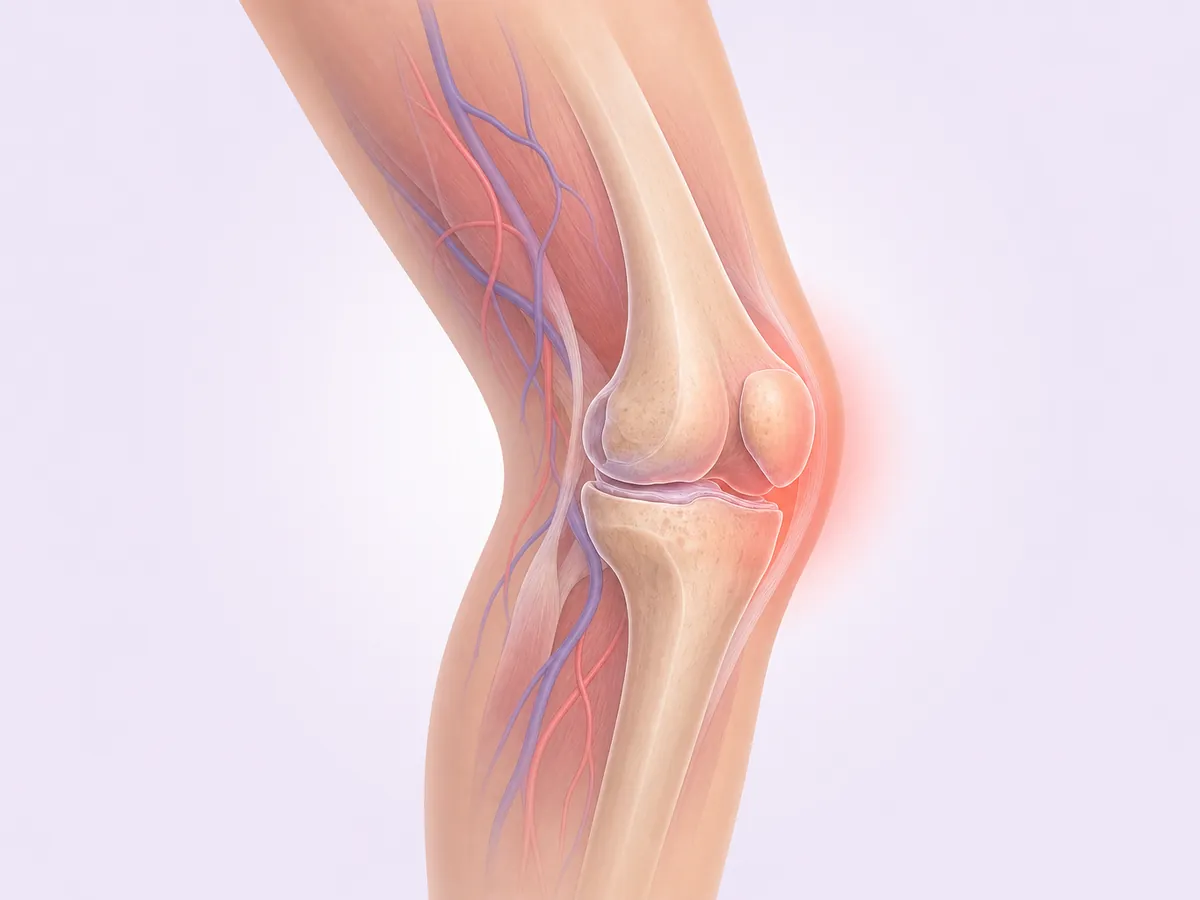
Leg veins have one-way valves that keep blood moving toward the heart. When the valves weaken, or the veins are scarred or blocked, blood flows backward and pools. MedlinePlus explains that the higher pressure and extra fluid make it harder for oxygen and nutrients to reach the skin, cells die, and a wound forms. Dressings cannot lower that pressure. That is why a wound can look clean and well cared for and still not close.
Who gets venous ulcers
Anything that raises venous pressure for years raises the risk, and the general risk factors for venous insufficiency are listed on our Hermosa Beach page. The MedlinePlus list for ulcers adds some that are easy to overlook:
- varicose veins already present on the leg
- blocked lymph vessels that let fluid build up
- smoking
- a broken long bone in the leg
- other serious leg injuries, such as burns, muscle damage or a major operation
The injury items are worth raising at the visit. A fracture or a crush injury decades ago can damage the veins of that leg, and it changes what the doctor looks for on the scan. So does a clot in that leg at any point in the past.
What CACVI does for a patient with an ulcer
The visit starts with the wound and the leg around it, a history of how long the sore has been open and what has been tried, and a duplex ultrasound of the veins. The scan shows whether a surface vein is leaking (superficial reflux), whether the deep veins are involved, and whether there is a clot. Our Brentwood page explains how that scan is performed and interpreted.
If a leaking surface vein is feeding the ulcer, closing it is the treatment that the trials below support. CACVI does this with endovenous ablation, and the procedure appears in the published bios of Dr. Moinakhtar Lala and Dr. Vasim Lala, whose bios name symptomatic venous insufficiency interventions and vein ablations, and Dr. Mehran J. Khorsandi, whose bio lists venous insufficiency and varicose vein treatment.
Why the vein underneath decides whether the sore stays closed
Two large British trials answered the question patients ask most: if my ulcer can heal with bandages, why touch the vein at all? The short answer is that bandages close the sore, and treating the vein helps it close sooner and stay closed.
ESCHAR: healing came out even, the recurrence did not
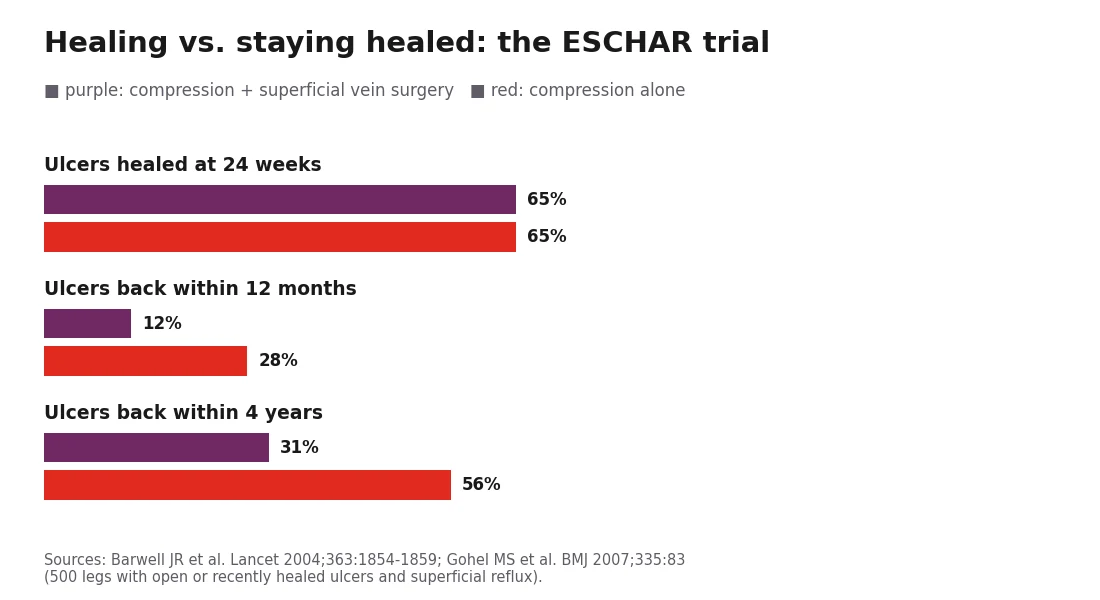
The ESCHAR trial scanned 500 consecutive patients with open or recently healed leg ulcers at three centers. Those with superficial reflux, alone or mixed with deep reflux, were assigned compression alone or compression plus surgery on the surface vein. Compression meant weekly multilayer bandaging until the ulcer healed, then class 2 below-knee stockings.
At 24 weeks, 65% of ulcers had healed in both groups. The difference showed up afterward. At 12 months, 28% of healed ulcers had come back with compression alone, against 12% with compression plus surgery. The long-term report found 56% against 31% at four years, with more ulcer-free time in the surgery group. The authors concluded that most patients with chronic venous ulceration would benefit from adding simple vein surgery.
EVRA: closing the vein while the ulcer is still open
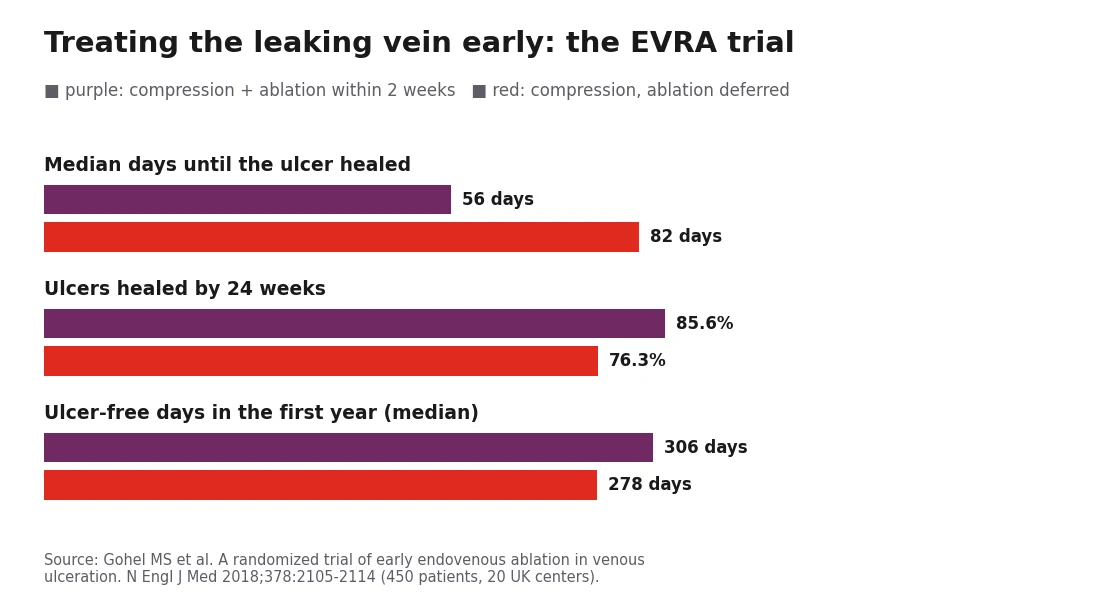
ESCHAR used open surgery and left open the question of timing. The EVRA trial, run at 20 UK centers, randomized 450 patients with venous leg ulcers to compression plus endovenous ablation within two weeks, or compression with ablation deferred until the ulcer healed or six months had passed. Ulcers healed faster with early treatment: a median of 56 days against 82. By 24 weeks, 85.6% were healed in the early group and 76.3% in the deferred group. In the first year, the early group spent a median of 306 days free of ulcers, against 278.
What happened over the following years
The EVRA team kept following their patients after the first year. Of the 426 whose ulcers had healed, 121 (28.4%) had at least one recurrence. The time to the first recurrence did not differ clearly between groups, but ulcers came back less often overall in the early group: 0.11 per person-year against 0.16. Early treatment also kept its faster healing for first-time ulcers and was judged highly likely to be cost-effective over three years.
Two points matter for a patient. Treating the vein does not make an ulcer impossible to return; more than a quarter of people in the trial had one come back. And it lowers how often that happens. The leg still needs care after the sore has closed.
The US guideline’s two ulcer recommendations
In 2011 the two US vein societies wrote this evidence into a pair of guideline recommendations. It recommends compression as the primary treatment to help a venous ulcer heal (GRADE 1B). To lower recurrence, it recommends ablating the incompetent superficial veins in addition to compression (GRADE 1A). The second recommendation carries the guideline’s highest grade.
Where compression fits in this plan
Compression remains the base of ulcer care, before and after any vein procedure. The Cochrane review of 48 randomized trials found that ulcers heal better with compression than without it, and that systems with several layers, including an elastic one, generally do better than a single bandage. Which system you wear is usually your wound team’s call. How compression works day to day, and how to live with it, is the subject of our Hermosa Beach page on venous swelling and compression.
Keep your wound clinic, add a vein doctor
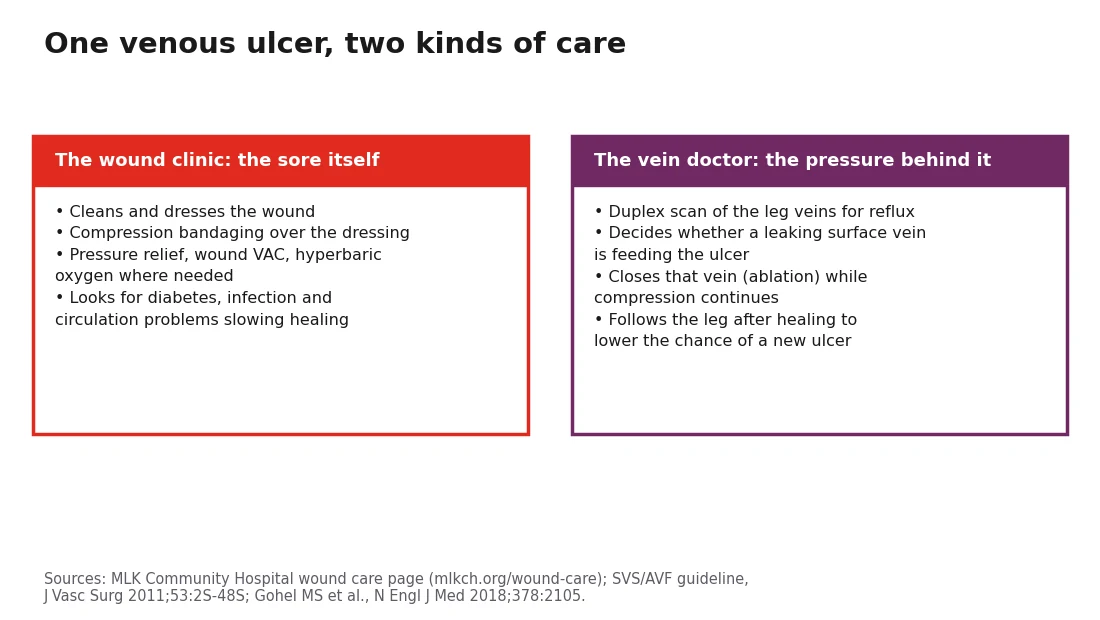
Patients sometimes worry that seeing a vein doctor means leaving the nurses who know their wound. It doesn’t. The two kinds of care treat different parts of the same problem, and the trials above tested vein treatment on top of good wound care, never instead of it.
What a wound center handles
If you already go to the Wound Healing and Hyperbaric Therapy Center on the MLK Community Hospital campus in Willowbrook, you are in the kind of setting this section is about. Its website describes a team that looks for what is slowing healing, naming diabetes, poor circulation, pressure, infection and past radiation treatment. Treatment there may include specialized dressings, pressure relief, compression, wound VAC therapy and hyperbaric oxygen. The hospital says the team works with a patient’s other providers. Keep going. CACVI has no formal tie with MLK’s wound center; the point is simply that your wound team and your vein doctor each have a job.


What the vein doctor adds
The vein side answers three questions that need a vein scan. Is there superficial reflux that can be closed? Are the deep veins damaged or blocked? Is there a clot? Depending on the answers, the plan may be ablation of a surface vein soon, as in EVRA; imaging of the pelvic veins, described on our Camarillo page; or compression and wound care alone if the deep veins are the main problem and nothing superficial is worth treating.
Information worth carrying between the two
Decisions go faster when each side sees what the other knows. Before the vein visit, ask your wound clinic for:
- the date the ulcer first opened, and earlier ulcers on either leg
- recent wound measurements and photos
- the dressings and compression system currently in use, and how often they are changed
- any circulation test done on the arteries of the leg
- swab or culture results and antibiotics given
- your current medicines, especially anticoagulants and diabetes drugs
After the vein visit, the scan result and the plan go back to the wound team, so dressings and bandaging can be timed around any procedure.
Signs of infection that cannot wait for the next appointment
MedlinePlus tells people with venous ulcers to contact their provider for any of these:
- redness, increased warmth or swelling around the wound
- more drainage than before, or drainage that is yellowish or cloudy
- bleeding
- odor
- fever or chills
- increased pain
Call your wound clinic the same day. If redness is spreading up the leg, or you have fever and feel unwell, go to an emergency department.
Daily care between visits
The MedlinePlus self-care advice for venous ulcers is specific. Keep the wound clean and bandaged, and change the dressing as often as you were told. Keep the dressing and the skin around it dry, because soaked healthy skin softens and the wound can grow. Keep the surrounding skin clean and moisturized. Wear the compression bandages or stockings every day as instructed. Raise your feet higher than your heart whenever you can. Walk or exercise every day. If you have diabetes, keep blood sugar under control, since that helps healing. Check both legs and feet daily, including heels and ankles, for cracks or color changes, and stop smoking.
Venous, arterial or diabetic: why the type of ulcer matters
“Leg ulcer” covers several different wounds. The treatment that heals one can harm another, so the first job of any ulcer visit is naming the type.
Telling them apart
Venous ulcers are the shallow sores with irregular edges described above, usually low on the inner leg, surrounded by brown, thickened skin and swelling, and worse after standing. An ulcer on the toes, the heel or the sole, or a wound on a cold, pale foot with weak pulses, raises other possibilities. Those are covered on CACVI’s arterial leg ulcer and diabetic foot ulcer pages, and arterial disease in the leg is the subject of our Oxnard page on PAD and limb preservation.
Why the type changes the plan
Compression is the base of venous ulcer care because it works against the high pressure in the veins. A wound caused by poor arterial supply has a different cause and a different treatment, which is why the arteries are checked when there is any doubt, and why a wound on a leg with weak pulses goes down a different path. A vein procedure also helps only when the scan shows a vein that is part of the problem.
When more than one cause is present
Some legs have both. A person with venous ulcers can also have diabetes or narrowed arteries, and each slows healing in its own way. MedlinePlus advises people with venous ulcers who have diabetes to keep their blood sugar under control because it helps them heal faster, and MLK’s wound team lists diabetes and poor circulation among the main reasons wounds stall. In a mixed leg, the vein doctor, the wound team and whoever manages the diabetes all need the same picture.
Diabetic foot wounds and CACVI’s amputation prevention program
Of these wounds, the diabetic foot carries the highest stakes. CACVI’s diabetic foot ulcer page points out that these sores often do not hurt, since many people who get them can no longer feel pain in the foot, and that black tissue around the sore means blood is not reaching it. Untreated narrowing of the leg arteries can progress to critical limb ischemia, with sores that will not heal and a risk of losing the limb. Keeping that limb is the purpose of CACVI’s amputation prevention program, which uses endovascular (catheter) work on the tiny vessels of the lower leg to bring back the blood supply a wound needs. If anyone on your wound team has raised the word amputation, ask for the arteries of that leg to be checked along with the veins; the peripheral artery disease page lists the warning signs.
Where else to read
CACVI’s venous insufficiency leg ulcer page has the condition overview. An ulcer that follows an old DVT gets the same scan and the same wound and vein care described on this page; the clot’s other lasting effects on the leg, grouped as post-thrombotic syndrome, are covered on the Castaic page.
Slow-healing ulcer: what Compton patients ask
How common are leg ulcers, and how many come from the veins?
The 2012 Cochrane review on compression puts it at up to one person in a hundred in industrialized countries having a leg ulcer at some point, and says most of those ulcers come from problems in the veins. That is why a vein scan belongs early in the work-up of any sore on the lower leg, not only after months of dressings.
My ulcer has been open for more than six months. Is it too late for vein treatment?
No, although the evidence comes from a different trial. EVRA only enrolled ulcers open for less than six months, so its faster-healing result applies to newer ulcers. ESCHAR enrolled people with chronic ulcers, and its recurrence benefit, described above, came from that group. In its long-term report, almost all ulcers eventually closed with or without surgery (89% and 93% at three years); the surgery made its difference in how many came back.
Does every patient with an ulcer qualify for an ablation?
No. To find its 450 participants, EVRA assessed 6,555 patients and excluded 6,105. The reasons included an ulcer open longer than six months, an ulcer that had already healed, blockage of the deep veins, and not enough reflux in a surface vein to justify treating it. Whether ablation fits your leg is decided by your own scan.
Does it matter if my deep veins leak as well?
It changes how much surgery helps. In the long-term ESCHAR report, recurrence at four years in legs with surface reflux only was 51% with compression alone and 27% with surgery added. Where the surface reflux came with partial deep reflux, the three-year figures were 52% and 24%. Where the deep reflux was total, they were 46% and 32%, a gap the trial could not show was real. The scan describes which pattern your leg has.
What about the vein directly under the ulcer?
Perforating veins connect the surface veins to the deep ones, and a faulty one can sit right beneath a sore. The 2011 SVS/AVF guideline suggests treating a perforator whose abnormal outward flow, from the deep vein toward the surface, lasts 500 milliseconds or longer and which measures at least 3.5 mm across, when it lies under a healed or open ulcer (GRADE 2B, a weaker suggestion). The same guideline advises against treating perforators selectively in people with simple varicose veins and no ulcer.
Which ablation method was used in EVRA?
The trial left the choice of endovenous method and strategy to the treating team, so its results are not tied to one device. For the method used at CACVI, see the practice’s endovenous ablation page.
What are the risks of ablation for someone with an ulcer?
EVRA reported pain and deep vein thrombosis as the most common complications of the procedure. In ESCHAR, adverse events after surgery were few and about equal in the two groups. Your doctor will go through your own risks before treatment.
How much ulcer-free time did vein surgery add?
Over three years in ESCHAR, patients who had surgery spent 78% of the time free of an open ulcer, against 71% with compression alone. In EVRA’s longer follow-up, ulcers came back at 0.11 episodes per person each year after early ablation and 0.16 after deferred treatment.
Which compression bandage heals ulcers fastest?
The Cochrane review found that multi-component systems beat single-component bandages for complete healing at six months, and that systems containing an elastic layer appear to do better than those made mainly of inelastic layers. In pooled data, the four-layer bandage healed ulcers faster than the short-stretch bandage, a median of 90 against 99 days, and two-component systems appeared to perform as well as the four-layer bandage. The four-layer bandage was also more cost-effective than the short-stretch one. Most trials were small, so your wound team’s choice for your leg matters more than any ranking.
Does compression alone keep a healed ulcer from coming back?
The compression evidence cannot answer that. The 2012 Cochrane review was built around healing, and its authors could not draw firm conclusions about recurrence from the bandage and stocking trials. The clearest recurrence data on this page come from the trials that added vein treatment to compression, which is why the guideline ties its strongest grade to that combination.
How do I reach MLK’s wound center?
The Wound Healing and Hyperbaric Therapy Center is at 12021 Wilmington Avenue, Building 11, Suite 2200, Los Angeles, CA 90059, on the MLK medical campus. It is open on weekdays from 8:30 a.m. to 5 p.m., and the hospital books wound appointments at 424-338-8936.
Is hyperbaric oxygen used for venous ulcers?
Not routinely. MLK’s wound center describes the treatment as resting in a pressurized chamber while breathing 100% oxygen, which can help some damaged tissue heal and fight certain infections. It also says the therapy is not needed for every wound and that the wound team decides who may benefit. A venous ulcer’s main problem is pressure in the veins, which is what compression and vein treatment address.
Could a leg ulcer turn into something worse?
MedlinePlus lists bacterial skin infection, bone infection, permanent scarring and squamous cell skin cancer as complications of stasis ulcers. A sore that changes in appearance, bleeds easily or will not respond to good care should be looked at again by your doctor.
After it heals, what else lowers the chance of a new ulcer?
Beyond the stockings and daily skin checks, MedlinePlus lists a few habits for people at risk of venous ulcers: eat healthy foods, get plenty of sleep, lose weight if you are overweight, and keep blood pressure and cholesterol under control.
Were the trial patients like me?
Both trials were run in the United Kingdom. EVRA’s participants averaged 67 to 69 years old by group, and 92% were White; ESCHAR’s patients came from nurse-led leg ulcer clinics at three vascular centers. The biology of venous pressure does not depend on where you live, but it is fair to know who was studied.
Leg-care pages for Lynwood, Carson and neighbors
CACVI pages for cities that border or sit close to Compton:
- Leg pain doctor, Lynwood
- Leg pain doctor, Paramount
- Leg pain doctor, Carson
- Leg pain doctor, South Gate
- Leg pain doctor, Long Beach
- Compton cardiology (heart conditions)
Compton to Alden Drive, and MLK Community Hospital for emergencies
The drive north
Distances on this page are measured from Compton City Hall at 205 South Willowbrook Avenue. The free-flow route goes west on Compton Boulevard and Rosecrans Avenue, joins the Harbor Freeway (I-110) north for about eight miles, transfers to I-10 west, and finishes on La Brea Avenue, San Vicente Boulevard, Wilshire and Robertson. Without traffic, OSRM estimates 22.6 miles and roughly 35 minutes. Weekday rush hours make it longer.
The office address
CACVI Los Angeles is at 8741 Alden Drive, Suite A, Los Angeles, CA 90048, phone 310-652-2744. Wear loose clothing that rolls up past the knee, and expect the dressing to be taken down so the doctor can see the wound; bring a fresh dressing kit if your wound team gave you one.
The Tarzana office
CACVI also sees patients on Ventura Boulevard in Tarzana. The Valley office is 33.7 miles away (about 46 minutes in light traffic) via Central Avenue, I-105, I-405 and US-101, so most Compton patients use Alden Drive.
MLK Community Hospital for emergencies
Martin Luther King Jr. Community Hospital, 1680 East 120th Street, runs an emergency department 24 hours a day, seven days a week. From Compton City Hall it is 3.0 miles, about seven minutes. Head there, or dial 911, if a leg wound comes with fast-spreading redness, fever with chills or heavy bleeding, or if a calf suddenly swells and hurts.
Google comments about the practice
Current reviews are on the office’s Google listing. No star average is printed here, because that figure changes with every new review.
Ulcer guideline and condition sources
- Gohel MS, et al. A randomized trial of early endovenous ablation in venous ulceration. N Engl J Med. 2018;378(22):2105-2114. doi:10.1056/NEJMoa1801214. PubMed 29688123
- Gohel MS, et al. Long-term clinical and cost-effectiveness of early endovenous ablation in venous ulceration: a randomized clinical trial. JAMA Surg. 2020;155(12):1113-1121. doi:10.1001/jamasurg.2020.3845. PubMed 32965493
- Barwell JR, et al. Comparison of surgery and compression with compression alone in chronic venous ulceration (ESCHAR study): randomised controlled trial. Lancet. 2004;363(9424):1854-1859. doi:10.1016/S0140-6736(04)16353-8. PubMed 15183623
- Gohel MS, et al. Long term results of compression therapy alone versus compression plus surgery in chronic venous ulceration (ESCHAR): randomised controlled trial. BMJ. 2007;335(7610):83. doi:10.1136/bmj.39216.542442.BE. PubMed 17545185
- O’Meara S, Cullum N, Nelson EA, Dumville JC. Compression for venous leg ulcers. Cochrane Database Syst Rev. 2012;11:CD000265. doi:10.1002/14651858.CD000265.pub3. PubMed 23152202
- Gloviczki P, et al. The care of patients with varicose veins and associated chronic venous diseases: clinical practice guidelines of the Society for Vascular Surgery and the American Venous Forum. J Vasc Surg. 2011;53(5 Suppl):2S-48S. doi:10.1016/j.jvs.2011.01.079. PubMed 21536172
- MedlinePlus. Venous ulcers: self-care. National Library of Medicine. medlineplus.gov/ency/patientinstructions/000744.htm
- MedlinePlus. Stasis dermatitis and ulcers (complications). National Library of Medicine. medlineplus.gov/ency/article/000834.htm
- MLK Community Hospital. Wound care. mlkch.org/wound-care; Emergency care. mlkch.org/emergency-care
- CACVI. Venous insufficiency leg ulcers. cacvi.org
- Driving distances: OSRM route, no traffic, queried 18 November 2026.
¿Listo para hablar?