




















Vascular & Leg Pain Care
Leg Pain Doctor Hermosa Beach
Ankles that are slim in the morning and puffy by dinner, calves that feel heavy after a shift on your feet, skin above the ankle that has started to itch or turn brown: these are the leg problems this page is about. Together they usually point to chronic venous insufficiency (CVI), a condition in which the leg veins stop sending blood back toward the heart as well as they should. Patients from Hermosa Beach and the rest of the South Bay come to the Center for Advanced Cardiac and Vascular Interventions (CACVI) for this: an exam of the swelling and the skin, then a decision on whether stockings, daily habits or a vein procedure will help most.
The practice does not have a South Bay location. Its nearest office is on Alden Drive in Los Angeles, north of the beach cities. To book a CVI consultation, call 310-652-2744. Sudden calf swelling with heat and pain, or trouble breathing, calls for 911 rather than an appointment.
Compression and calf-pump numbers for a Hermosa Beach leg
| Value | Why a swollen-ankle patient should care | Backed by |
|---|---|---|
| 16.9 mi / ~30 min | The drive from Hermosa Beach City Hall on Valley Drive to CACVI on Alden Drive, by Aviation Boulevard, I-405 and La Cienega Boulevard, with no traffic. | OSRM route, no traffic |
| 3.9 mi / ~9 min | From City Hall to the emergency department at Providence Little Company of Mary in Torrance, the paramedic base station for Hermosa Beach. | Providence |
| 3 to 4 times a day, about 15 minutes | How often MedlinePlus suggests raising the leg when venous skin changes have started. | MedlinePlus |
| 3 to 6 months | How long a pair of compression stockings keeps its squeeze before it should be replaced. | MedlinePlus |
| 10 to 50 mm Hg | The pressure range of the stockings tested in 13 trials of compression for varicose veins without ulcers. | Cochrane review, 2021 |
| 6 months, 31 patients | A randomized trial in which supervised calf exercise, added to stockings, brought calf pump function back to the normal range in people with venous skin changes. | Padberg 2004 trial |
| GRADE 1B | US guideline: compression should not be the main treatment for someone who is a candidate for closing the leaking saphenous vein. | SVS/AVF guideline, 2011 |
Sections
- Swollen ankles and heavy legs in Hermosa Beach: what a vein doctor looks for
- Getting to Beverly Grove from the beach cities, and the closest ER
- How pooled venous blood changes the skin over months
- Compression, elevation and walking as the first layer of care
- When stockings stop being enough
- Swelling, stockings and skin, in brief
- Other beach-city and South Bay leg pages
- CVI source list
Swollen ankles and heavy legs in Hermosa Beach: what a vein doctor looks for
Leg swelling has many causes, and only some of them are venous. The job of a first CVI visit is to decide whether your veins explain what you feel and see, how far the condition has gone, and what to do first. Most people who come in for this are not in danger. They are uncomfortable, they are tired of socks leaving deep grooves in their ankles, and they want to know whether the brown patch on their shin will spread.
The pattern that points to the veins
Venous swelling follows gravity. It builds through the day, it is worst in the lower legs and ankles, and it eases overnight or when the legs are raised. MedlinePlus lists the typical complaints as a dull ache, heaviness or cramping in the legs, itching and tingling, and pain that gets worse when you stand and better when you put your legs up. The CACVI CVI page adds new varicose veins and leathery, flaking skin on the legs or feet.
That rhythm is the useful part. Someone who says “my legs are fine at breakfast and awful by six” is describing pooled blood, and the doctor will want to know how many hours you stand or sit, whether the swelling leaves a dent when pressed, and which leg is worse.
Swelling that needs a different answer
CVI develops over months and years and usually affects both legs, often one more than the other. Swelling that appears over a day or two in one leg, with calf pain, is a different problem until proven otherwise, because a blood clot in a deep vein can look like that. Our Los Alamitos page on phlebitis and deep vein clots explains those signs. A swollen leg that is also red, hot and tender, especially with fever, can be a skin infection and needs to be seen the same day.
A foot sore with diabetes is an artery question first
Venous swelling seldom starts in the foot. A sore under the big toe or the ball of the foot in someone with diabetes, a foot that is cool to the touch with weak pulses, or calf pain that comes on with walking all point toward the arteries, and CACVI treats that side too. CACVI describes itself as an amputation prevention center, with physicians who work inside the small arteries of the lower leg to restore the circulation a foot sore depends on. The pages on diabetic foot ulcers, peripheral artery disease (PAD) and critical limb ischemia describe each condition, and an arterial duplex scan in the office checks the leg arteries the way a venous scan checks the veins. Numb or burning feet in diabetes are covered on the diabetic neuropathy page, which notes that poor circulation has to be ruled out before the nerves are blamed.
Who tends to develop CVI
The condition usually comes from valves in the leg veins that no longer close properly. It can also follow a blood clot that damaged a deep vein years earlier. MedlinePlus names these risk factors:
- older age
- a family history of venous insufficiency
- female sex, which it links to the hormone progesterone
- a past deep vein thrombosis in the legs
- obesity
- pregnancy
- long hours sitting or standing
- being tall
What a CVI consultation at CACVI covers
The visit starts with history and examination. MedlinePlus notes that the diagnosis is often made from how the leg veins look while you stand or sit with your legs hanging down. The physician looks at the ankle skin, checks how the swelling behaves, and asks about past clots, pregnancies, medicines and what you have already tried.
A duplex ultrasound is usually the next step. It shows how blood flows in the veins and whether a clot is present. The scan itself is explained on our Brentwood page about the vein reflux study and on the vascular ultrasound page. This page stays with what happens around it: the swelling, the skin and the treatment that follows.
The physicians who see venous insufficiency
These are the CACVI physicians whose bios cover vein imaging and endovascular procedures. Dr. Mehran J. Khorsandi, an interventional cardiologist and endovascular interventionalist, names venous insufficiency and varicose vein treatment among his interests. The two Drs. Lala, Moinakhtar and Vasim, each perform vein ablations for venous insufficiency according to their bios, and each is registered to read vascular ultrasound (RPVI). The doctor who examines your ankles can also read your scan and, if needed, perform the procedure.
Getting to Beverly Grove from the beach cities, and the closest ER
A swollen leg rarely needs a hospital, but it helps to know in advance which trips are for appointments and which are for emergencies. For people in Hermosa Beach those two places are in opposite directions.
Up Aviation, I-405 and La Cienega
The appointment trip runs north. From City Hall the free-flow route takes Pacific Coast Highway and Artesia Boulevard to Aviation Boulevard, joins I-405 at Rosecrans Avenue, then follows South La Cienega Boulevard for about seven miles before a short run on Wilshire and Robertson boulevards. The route engine puts it at 16.9 miles and about 30 minutes without traffic. Weekday afternoons on I-405 will stretch that.
Suite A on Alden Drive
The office is CACVI Los Angeles, 8741 Alden Drive, Suite A, Los Angeles, CA 90048, phone 310-652-2744. It is the office for CVI visits, scans and follow-up. Wear loose pants or shorts so your lower legs can be examined without changing, and bring any stockings you already own so the doctor can check their size and strength.
Tarzana, if the Valley suits you better
CACVI’s second office is on Ventura Boulevard in Tarzana. From Hermosa Beach City Hall it is 29.4 miles and about 40 minutes with clear roads, by I-405 and US-101. Few beach-city patients choose it, but it can make sense if you work in the San Fernando Valley.
Torrance’s Providence hospital for anything sudden
The emergency department at Providence Little Company of Mary Medical Center Torrance, 4101 Torrance Boulevard, is open 24 hours and is 3.9 miles from City Hall. Providence describes the hospital as the designated paramedic base station that gives medical direction to South Bay communities including Hermosa Beach. Use it, or 911, when swelling comes on suddenly with calf pain, when chest pain or breathlessness appears, or when the leg is red and hot with a fever.
How pooled venous blood changes the skin over months
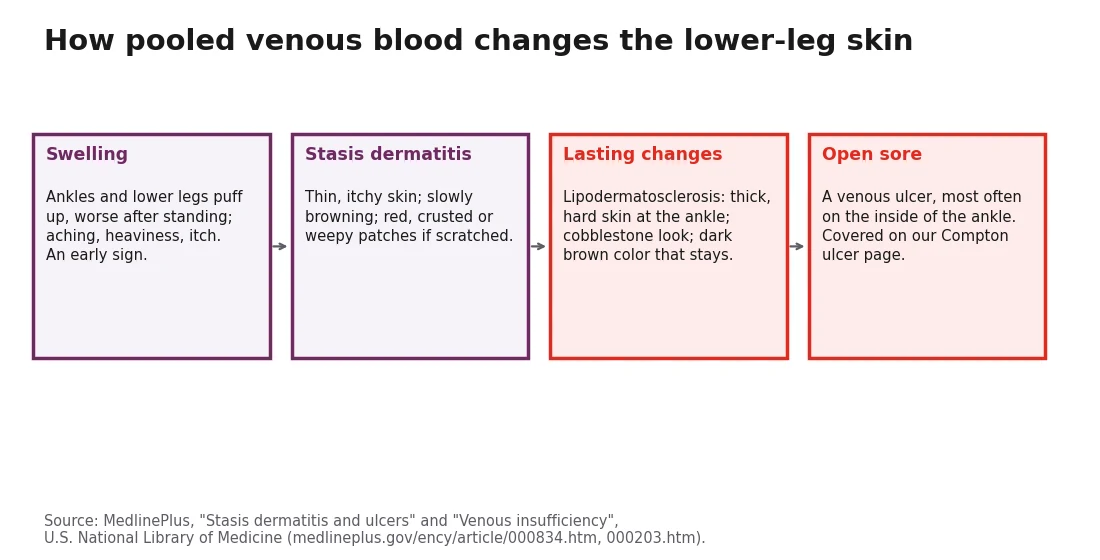
Swelling is what people notice first. The skin is what decides how serious CVI becomes. The changes come slowly, they start around the ankle and lower leg, and the later ones do not fully reverse. Knowing the stages lets you describe your own leg accurately and see a change before it becomes a sore.
What leaks out when the valves fail
When blood pools in the lower-leg veins, pressure inside them stays high. MedlinePlus describes fluid and blood cells leaking out of the veins into the skin and the tissue under it. That fluid is the swelling. Over months, that leakage stains the skin brown. CACVI’s CVI page describes the same process from the small vessels’ side: as pressure rises, capillaries burst and the skin over them takes on a reddish-brown color and tears easily if bumped or scratched.
Itch, browning and weeping: stasis dermatitis
The first skin stage has a name, stasis dermatitis. MedlinePlus says the skin of the ankles and lower legs may first look thin or papery, then slowly brown. Scratching irritates or cracks it, and patches can turn red, swollen, crusted or weepy. Its location gives it away: venous dermatitis sits low on the leg, where the pooling is worst.
When the skin turns hard
With time, some changes become permanent. MedlinePlus lists thickening and hardening of the skin on the legs and ankles, called lipodermatosclerosis, a bumpy or cobblestone surface, and a dark brown color that no longer fades. A leg at this stage feels firm when pressed. The aim of treatment changes from reversing the damage to keeping this skin from breaking down.
Creams that can make it worse
Irritated venous skin reacts badly to some common products. MedlinePlus advises talking to your provider before putting any lotion, cream or antibiotic ointment on the area, and names these to avoid:
- topical antibiotics such as neomycin
- drying lotions such as calamine
- lanolin
- benzocaine and other numbing products
What it does suggest, when your provider agrees: plain moisturizers for dryness, and topical steroid creams or ointments for inflamed patches. Bring the tubes you have been using to your visit. MedlinePlus warns that some skin treatments make the problem worse, so a rash that spreads after you start a new product deserves a call.
Past this point: an open sore
Untreated, the damaged skin can break open into a venous ulcer, most often on the inside of the ankle. CACVI’s CVI page warns that these sores heal slowly and can become infected, and that an uncontrolled infection can spread into the surrounding tissue as cellulitis. If you already have an open sore, read our Compton page on venous leg ulcers, which covers wound care and how it fits with vein treatment.
Compression, elevation and walking as the first layer of care
For most people with CVI, treatment begins with three things done at home every day. None of them repairs a valve. What they do is lower the pressure in the leg veins for as many hours as possible, and that pressure drives both the swelling and the skin damage. They also remain part of the plan after any procedure.
What a compression stocking actually does
A medical compression stocking squeezes the leg hardest at the ankle and less on the way up. MedlinePlus explains that this graded squeeze pushes blood up the leg and prevents swelling, and to a lesser extent clots. Stockings come in pressures from light to strong and in lengths from knee-high to the top of the thigh. They should feel tight, with the most pressure around the ankle.
Strength is measured in millimeters of mercury (mm Hg). In the 2021 Cochrane review of stockings for varicose veins without ulcers, the 13 trials used pressures from 10 to 50 mm Hg. In the calf-exercise trial described below, everyone with skin changes wore 30 to 40 mm Hg. Your doctor chooses the strength from your exam and scan. The pressure printed on the package tells you which end of that range you are buying.
Getting stockings on, and keeping them working
Stockings only help if they go on every day, and getting them on is the hard part. MedlinePlus has practical advice:
- Put them on first thing in the morning, before getting out of bed, when the legs are least swollen.
- Roll the stocking down to the heel, put the foot in as far as it goes, seat the heel, then unroll it up the leg.
- Smooth out every wrinkle; do not let the fabric bunch up.
- Knee-length stockings should end two finger-widths below the bend of the knee.
- If they are hard to pull on, let lotion dry first, use a little powder or cornstarch, wear rubber dishwashing gloves for grip, or use a stocking donner.
- Wash them daily in mild soap and water, rinse and air dry. Two pairs let you wear one while the other dries.
A shop that measures your legs gives a better fit than buying by shoe size, and MedlinePlus suggests getting a prescription from your provider first.
Warm days, itching and the urge to stop
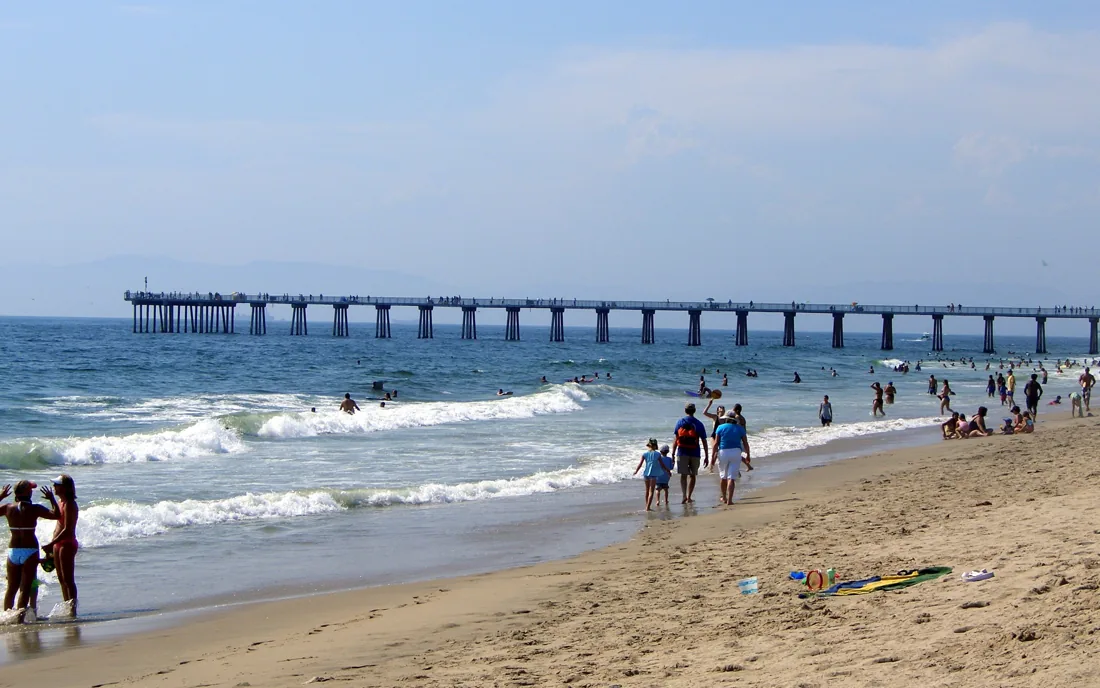

Living near the beach does not make CVI worse, but it does make stockings harder to wear. The Cochrane reviewers found that compliance varied between trials. One study had many dropouts because of discomfort, difficulty putting them on, and appearance, while two others reported good compliance. Itching and irritation were the main side effects, and no trial reported a serious one.
If yours are uncomfortable, MedlinePlus is clear: do not quietly stop. Tell your provider, because a different length, fabric or strength may suit you better.
Raising the legs, and how often
Gravity filled the veins, so gravity can help empty them. MedlinePlus suggests keeping the leg raised whenever you sit, or raising it three to four times a day for about 15 minutes at a time. For it to help, the feet need to be above the level of the heart. MedlinePlus gives the example of lying down with your feet propped on pillows; resting them on a low stool does not get them above the heart.
Walking, and why the calf matters
The calf muscle works as a pump: each step squeezes the deep veins and pushes blood upward. Padberg and colleagues began from the observation that worsening calf pump function goes with CVI getting worse, and tested whether training the pump helps. They randomized 31 patients with venous skin changes or ulcers to stockings alone or stockings plus six months of physical therapy aimed at the calf muscles. In the exercise group, calf pump measures returned to the normal range, and the share of blood left in the calf after exercise fell, while it rose slightly in the stockings-only group.
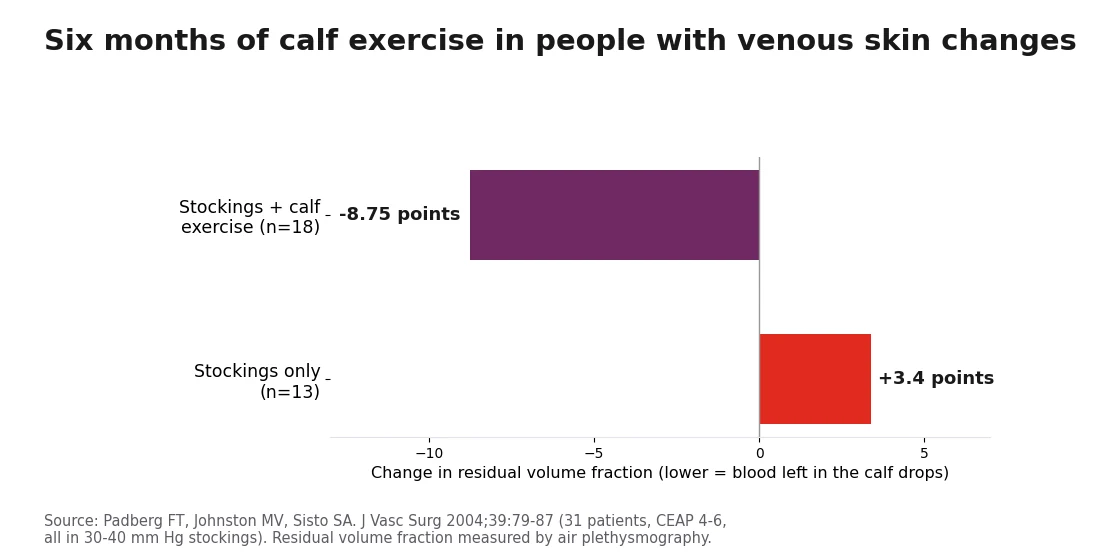
The trial was small and used supervised therapy, not casual walks, so it does not prove that any walk will do the same. It does support what MedlinePlus advises: exercise regularly, avoid sitting or standing still for long periods, and keep the legs moving even a little while you are stuck in one place.

When stockings stop being enough
Compression controls pressure only while you wear it. It does not close a leaking vein, so for many people with CVI it is a stage in treatment, not the end of it. The question at follow-up is whether the swelling, the symptoms and the skin are holding steady or still moving the wrong way.
What the evidence says about stockings by themselves
The Cochrane review of stockings as the first and only treatment for varicose veins found low to very low certainty evidence. In the four trials that measured symptoms, people felt better by the end, but the comparisons were not always made fairly between groups. One study using ultrasound found less swelling with real stockings than with placebo stockings, and another found no clear change in ankle size. In short, stockings help many people feel better, and the research has not shown that they change how the disease progresses.
What the US guideline says
The 2011 guideline of the two US vein societies (SVS and AVF) draws the line plainly. It suggests compression for symptomatic varicose veins, a weak recommendation (GRADE 2C). But for someone who is a candidate for closing the faulty saphenous vein, it recommends against using compression as the main treatment (GRADE 1B). If your scan shows a superficial vein that can be treated, stockings should not be the whole plan.
Signs the plan should change
MedlinePlus lists the situations in which a provider may recommend more invasive treatment:
- leg pain or heaviness that makes the legs feel tired despite home care
- skin sores from poor venous flow that do not heal, or keep coming back
- thickening and hardening of the skin on the legs and ankles
We would add one more: brown staining that is visibly spreading from one visit to the next. Comparing phone photos taken in the same light every few months is an easy way to show this.
Where treatment goes next
MedlinePlus describes the procedures used for venous insufficiency: sclerotherapy, in which a solution or foam is injected to seal a vein; phlebectomy, in which a vein is removed through small cuts; office procedures that close a vein with laser, radiofrequency energy, glue or foam; and, less often today, vein stripping. CACVI closes a leaking saphenous vein with endovenous ablation. How that decision is made, and what the day looks like, is covered on our Cypress page on varicose vein treatment.
When the cause sits higher up, or in the past
Not all CVI starts in the surface veins. Swelling of one whole leg that persists after the surface veins are treated can come from a narrowed vein in the pelvis; our Camarillo page on iliac vein compression covers that. CVI that began after a deep vein thrombosis is described on our Castaic page on post-thrombotic syndrome. In both cases, compression and daily walking stay part of the routine.
Swelling, stockings and skin, in brief
My ankles swell only after long flights or drives. Is that CVI?
Not necessarily. MedlinePlus notes that long flights and car rides often cause some ankle swelling on their own, and suggests stopping often to stand and move around and avoiding tight clothing around the thighs. What points to the veins is swelling that also builds on ordinary days, not only after a trip. One calf that stays swollen and painful after a trip is a different matter; call your doctor that day or go to an emergency department.
Will my insurance pay for compression stockings?
It depends on the plan, so ask before you buy. MedlinePlus suggests calling your health insurance or prescription plan to find out whether it pays for compression stockings, and asking specifically whether your durable medical equipment benefit covers them.
How long does a pair of stockings last?
MedlinePlus advises replacing them every 3 to 6 months so they keep their compression.
Is a knee-high or a thigh-high stocking better, and how strong should it be?
The research has not settled it. Eight of the trials in the 2021 Cochrane review compared different types or pressures of knee-length stockings, and the reviewers could not say which length or pressure works better. Side effects in those comparisons included sweating, itching, skin dryness and a feeling of tightness, and discomfort was the main reason people preferred one stocking over another. That is why the choice is made for your leg at the exam, and why it is worth reporting a stocking you cannot tolerate rather than living with it.
Does venous insufficiency get worse over time?
MedlinePlus says chronic venous insufficiency tends to get worse over time, but that it can be managed if treatment starts in the early stages, and that self-care may ease the discomfort and keep it from getting worse. It adds that a procedure is likely to be needed at some point. The skin changes are the part most worth preventing, because the later ones do not reverse.
I have varicose veins too. Are they the same problem?
Often they are related. CACVI’s CVI page notes that CVI is commonly associated with varicose veins, the twisted, enlarged veins close to the skin. One scan looks at both, and the treatment plan addresses them together. Our varicose veins page describes them in more detail.
Both my legs are swollen and I get short of breath. Is that my veins?
It may not be. MedlinePlus points out that the skin changes of venous disease can also be linked to heart problems and other conditions that cause leg swelling, and that swollen legs can be a sign of heart, kidney or liver failure. Checking for those can mean blood tests, a urine test, a chest X-ray or an ECG alongside the leg scan. If you have heart or kidney disease and the swelling gets worse, MedlinePlus says to contact your provider right away; for shortness of breath or chest pain with the swelling, it says to call 911.
Will exercise repair the leaking valve?
No, and the calf-exercise trial shows why it still helps. After six months of supervised calf training, reflux in the leg veins was unchanged in both groups, while calf strength and pump function improved in the exercise group. Its quality-of-life and severity scores did not change over those six months. Exercise works on the pump that moves blood out of the leg; closing a leaking vein is a separate step.
Could one of my medicines be making my ankles swell?
It is possible. MedlinePlus lists several kinds of medicine that can cause leg swelling: calcium channel blockers taken for blood pressure, some antidepressants, hormones such as estrogen and testosterone, steroids, and anti-inflammatory painkillers (NSAIDs). Bring the full list to the visit, and do not stop any of them on your own: MedlinePlus says never to stop a medicine you suspect without first talking to your provider.
Does cutting salt help, and should I take a water pill?
MedlinePlus includes a low-salt diet among the home measures that may reduce fluid buildup and swelling. It adds that a provider may prescribe a diuretic (water pill), but that these drugs have side effects, and that for swelling not caused by a serious medical condition, home treatment is usually tried first.
My legs swelled during pregnancy and never fully settled. Is that common?
Pregnancy is on the MedlinePlus list of risk factors for venous insufficiency. Compression during pregnancy is possible, though the Cochrane review notes that pregnant women increasingly rejected compression tights as their pregnancy went on. Swelling that remains months after delivery is worth an exam. During pregnancy itself, MedlinePlus says to contact your provider right away for more than mild swelling or a sudden increase, because severe swelling can be a sign of preeclampsia, a serious condition with high blood pressure.
Which papers and items help at the first CVI visit?
A list of your medicines, and the date and result of any earlier leg ultrasound or clot. A few photos of the ankle at the end of a long day help too, because the morning appointment may not show how bad it gets. It also helps to have answers ready for the questions MedlinePlus says a provider asks about swelling: which parts swell, and whether above or below the knee; whether it is there all the time or worse in the morning or the evening; what makes it better or worse; and whether raising the legs helps.
Besides creams, what treats the skin itself?
MedlinePlus lists several options for stasis dermatitis, each used when your provider decides it fits: an Unna boot, which is a compressive wet dressing wrapped around the lower leg and used only when instructed; antibiotics taken by mouth; good nutrition; and wound care for any open sore. It adds that healing depends on treating the underlying vein problem, so these sit alongside the vein plan rather than replacing it.
Other beach-city and South Bay leg pages
These CACVI pages cover neighboring cities; vein visits for all of them happen at Alden Drive.
- Leg pain doctor, Manhattan Beach
- Leg pain doctor, Redondo Beach
- Leg pain doctor, Torrance
- Leg pain doctor, Lawndale
- Leg pain doctor, El Segundo
- Chronic venous insufficiency at CACVI
Current reviews are on the office’s Google listing. No star average is printed here, because that figure changes with every new review.
CVI source list
- Gloviczki P, et al. The care of patients with varicose veins and associated chronic venous diseases: clinical practice guidelines of the Society for Vascular Surgery and the American Venous Forum. J Vasc Surg. 2011;53(5 Suppl):2S-48S. doi:10.1016/j.jvs.2011.01.079. PubMed 21536172
- Knight Nee Shingler SL, Robertson L, Stewart M. Graduated compression stockings for the initial treatment of varicose veins in people without venous ulceration. Cochrane Database Syst Rev. 2021;7:CD008819. doi:10.1002/14651858.CD008819.pub4. PubMed 34271595
- Padberg FT, Johnston MV, Sisto SA. Structured exercise improves calf muscle pump function in chronic venous insufficiency: a randomized trial. J Vasc Surg. 2004;39(1):79-87. doi:10.1016/j.jvs.2003.09.036. PubMed 14718821
- MedlinePlus. Venous insufficiency. National Library of Medicine. medlineplus.gov/ency/article/000203.htm
- MedlinePlus. Stasis dermatitis and ulcers. National Library of Medicine. medlineplus.gov/ency/article/000834.htm
- MedlinePlus. Foot, leg, and ankle swelling. National Library of Medicine. medlineplus.gov/ency/article/003104.htm
- MedlinePlus. Compression stockings. National Library of Medicine. medlineplus.gov/ency/patientinstructions/000597.htm
- CACVI. Chronic venous insufficiency (CVI). cacvi.org
- Providence Little Company of Mary Medical Center Torrance. Emergency care. providence.org
- Driving distances: OSRM route, no traffic, queried 18 November 2026.
¿Listo para hablar?