




















Vascular & Leg Pain Care
Leg Pain Doctor Cypress
Many people in Cypress who look for a leg pain doctor are really asking about their veins: veins on the calf or behind the knee that bulge, ache by late afternoon and make the legs feel heavy. Varicose veins, and the leaking trunk behind them, are what this page covers. The Center for Advanced Cardiac and Vascular Interventions (CACVI) evaluates varicose veins and treats the faulty vein underneath them with radiofrequency ablation, done as an office procedure.
Cypress patients are seen at the Los Angeles office, 8741 Alden Drive, Suite A, Los Angeles, CA 90048, phone 310-652-2744. If you have been searching for a Cypress vein doctor, and want to know whether a vein doctor serving Cypress from Los Angeles is worth the drive, the sections below cover the decision in the order you will face it: whether your veins need treatment, what the ablation day involves, and how to get there.
Request a vein consultation at Alden Drive
Cypress varicose vein figures, from the drive to the clot rate
| Data point | Relevance to a varicose vein decision | Reference |
|---|---|---|
| 31.7 miles, about 48 minutes without traffic | Road distance from Cypress City Hall to the Alden Drive office, by Moody Street, Carmenita Road, I-5 and I-10 | OSRM route, no traffic |
| 45.3 miles, about 59 minutes without traffic | The same trip to the Tarzana office, 18226 Ventura Blvd, Suite 102 (818-905-5904) | OSRM route, no traffic |
| Same-day discharge | Office-based procedures at CACVI involve no overnight stay | CACVI |
| 3 mm | The width at which a leg vein counts as varicose rather than reticular | SVS/AVF/AVLS 2023 |
| 16.4 minutes | Average time the catheter work took per procedure in the first study of segmental radiofrequency ablation | Proebstle 2008 |
| 1 day | Median time back to normal activity after radiofrequency ablation in a four-way randomized trial | Rasmussen 2011 |
| 0.3% | Rate of deep vein thrombosis after thermal ablation across 15,676 patients | Healy 2018 |
| 1.9 miles | Distance from Cypress City Hall to the emergency department at La Palma Intercommunity Hospital | OSRM route, no traffic |
On this page:
- Varicose vein treatment for Cypress: finding the vein behind the bulge
- Which varicose veins are worth treating
- Radiofrequency ablation in the office: one day, no overnight stay
- Ablation, aching and appearance, explained for Cypress
- From Cypress to Alden Drive on I-5 and I-10
- Nearby north Orange County pages
- Guideline and trial references
Varicose vein treatment for Cypress: finding the vein behind the bulge
For varicose veins, Cypress patients usually ask first about the treatment. Vein treatment in Cypress starts with one question: is the bulging vein you can see fed by a larger vein you cannot see? Varicose veins usually form because valves inside a deeper superficial trunk, most often the great saphenous vein along the inner thigh and calf, stop closing properly. Blood falls back down the leg, pressure builds in the branches near the skin, and those branches stretch. Treating only the visible branch leaves the cause in place. CACVI’s work for a Cypress patient is to find out whether a leaking trunk exists and, if it does, to close it.
What CACVI treats in the leg’s blood vessels
CACVI is a cardiac and vascular practice, so it looks at the leg through its blood vessels. On the vein side, its conditions pages cover varicose veins, chronic venous insufficiency, venous insufficiency leg ulcers and May-Thurner syndrome. The first look at most of these is a vascular ultrasound done in the office.
This page stays with the varicose veins in that list; the other conditions each have their own CACVI page.
When the leg problem is in the arteries: wounds, diabetes, amputation risk
Some Cypress patients looking for a leg doctor have a different problem from varicose veins: a diabetic foot wound, or a sore on the toes, heel or ankle that has stopped healing. Those wounds depend on arterial blood flow, and CACVI treats the artery side of the leg as well: peripheral artery disease, critical limb ischemia and arterial leg ulcers. Its diabetic foot ulcer page warns that an infected ulcer can lead to amputation if it is neglected. A wound held back by poor circulation is what CACVI’s amputation prevention program exists for.
Leg pain that is not a vein problem
Plenty of leg pain has nothing to do with blood vessels. A sore knee joint, heel pain, a pinched nerve in the lower back that sends pain down the leg, a torn tendon: these belong with an orthopedic surgeon, a podiatrist or a spine doctor, and CACVI does not treat them. Vein pain has its own pattern. MedlinePlus describes varicose veins as swollen, twisted veins you can see just under the skin, caused by weak or damaged one-way valves that let blood back up and pool (MedlinePlus). The ache tends to sit in the calf, gets worse the longer you stand, and eases when you lift your legs. If your pain comes with movement of a joint, or shoots from the buttock to the foot, start with your primary care doctor instead of a vein visit.
Veins here, heart questions on the Cypress cardiology page
CACVI also has a cardiology page for Cypress. It covers heart care: an abnormal EKG, chest tightness, cholesterol worries. This page is the one for the legs. Both lead to the same practice, so mention “varicose veins” or “leg veins” when you phone, and the call starts in the right place.
Physician bios behind CACVI’s vein care
These are the CACVI physicians whose bios cover vein imaging and endovascular procedures. Dr. Mehran J. Khorsandi trained at Cedars-Sinai Medical Center and lists board certification in endovascular medicine among his diplomate certifications. Dr. Moinakhtar Lala, M.D., FACC, FSCAI, RPVI joined CACVI in October 2016 and started its limb salvage and amputation prevention program. Dr. Vasim Lala, D.O., FACC, FSCAI, RPVI joined in July 2022 after training at The Mount Sinai Hospital.
A Los Angeles office for Orange County patients: what that changes
Because the nearest CACVI office is in Los Angeles, a Cypress patient plans each visit as a trip rather than a quick stop. CACVI’s physicians decide on ablation at an initial appointment, so the consultation and any procedure are separate steps. Ask when you book how many trips your plan is likely to involve, and whether the scan and the consultation can happen on the same morning. The route and the arrival details are in the driving section further down.
What to have ready before the first call
- A list of every medicine you take, with blood thinners marked. CACVI’s ablation page lists clotting disorders and a deep vein thrombosis among the conditions that can rule a patient out, so the doctor will ask.
- Any earlier leg ultrasound report, even an old one, and the name of the lab that did it.
- A note of when the legs feel worst: after a shift on your feet, after a long drive, by evening.
- Phone photos of the veins taken late in the day, when they stand out most.
- Whether a vein has ever bled, been hot and tender, or had a sore near it.
- Earlier vein treatment on either leg, and roughly when it was done.
Book the vein consultation and scan
Which varicose veins are worth treating
Not every visible vein needs a procedure, and the guidelines American vein doctors follow say so plainly. The 2023 clinical practice guidelines from the Society for Vascular Surgery, the American Venous Forum and the American Vein and Lymphatic Society (SVS/AVF/AVLS) tie the decision to two things: symptoms, and backward flow along a main vein trunk on ultrasound (Gloviczki et al., 2024). Size and color alone do not decide it.
Symptoms count for more than size
For people whose varicose veins cause symptoms and whose great or small saphenous vein refluxes, the guidelines give a strong recommendation for treating the vein rather than relying on compression stockings long term (recommendation 2.1.2). The symptoms that matter are the ones you already know: aching, heaviness, throbbing, cramping, itching and swelling by evening, the list CACVI’s own varicose vein treatment page gives. A large vein that causes no trouble can be watched. A modest vein that makes every afternoon at work uncomfortable is a reason to be evaluated.
Where your veins sit on the CEAP scale
Vein doctors describe legs with the CEAP classification, updated by an American Venous Forum task force in 2020 (Lurie et al., 2020). The clinical part runs from C0 to C6. The guideline defines the line that matters for this page: dilated veins 3 mm or wider are varicose veins, class C2. Classes C3 to C6 add swelling, skin changes and ulcers, which the guideline groups as chronic venous insufficiency.
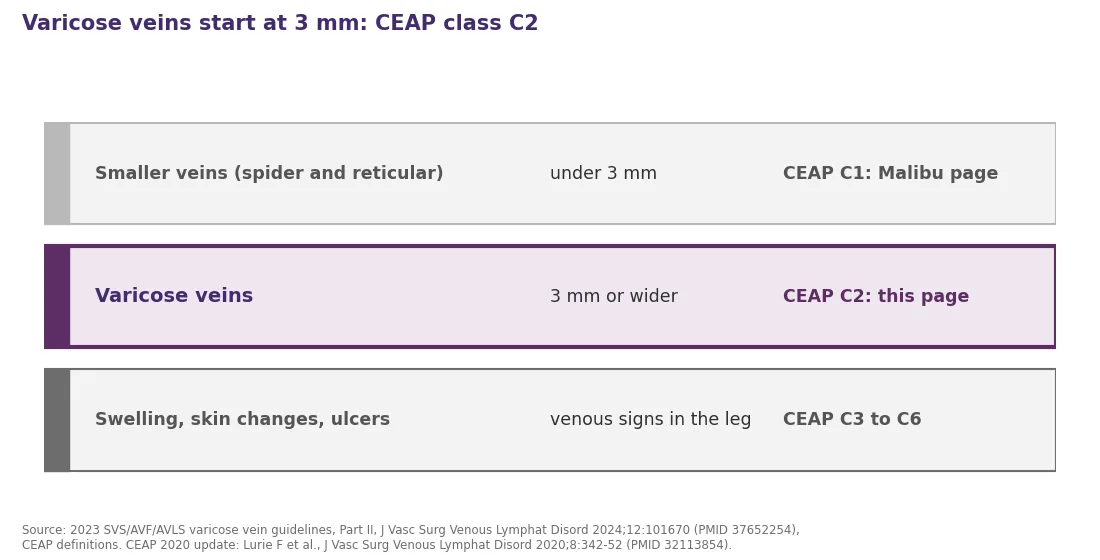
Smaller veins, class C1, are covered on the Malibu page. Swelling and skin changes are covered on the Hermosa Beach page, and open sores on the Compton page.
Duplex ultrasound decides it
Whether a trunk vein is leaking is decided by a duplex ultrasound, not by looking at the leg. For a symptomatic C2 leg, the scan is the step that turns “I have varicose veins” into a treatment plan. How that study is done is explained on the Brentwood page.
When waiting is a reasonable choice
Treatment is elective for most varicose veins, and the guideline accepts compression stockings as the main treatment when a person’s mobility or other illnesses argue for a conservative approach, or simply when the person prefers it (recommendation 2.1.1). Self-care while you wait is covered on the Hermosa Beach page.
Months of stockings before a procedure?
Many patients have been told they must wear compression stockings for three months before anyone will treat a vein. The clinical guideline does not ask for that. For symptomatic patients who are candidates for endovenous treatment and want to go ahead, it suggests against a three-month compression trial before the procedure (recommendation 2.1.4). Health plans write their own approval rules, and those are a separate question from the medical one; ask the office what your plan requires when you book.
Veins that came back after earlier treatment
Some Cypress patients had veins stripped or closed years ago and now see new bulges in the same leg. The CEAP update gave this its own marker: a small “r” after the class, added in 2020 for varicose veins or ulcers that have recurred. The guideline asks for an examination and a fresh duplex scan before anything is redone, because the source of the recurrence decides the treatment (recommendation 9.1.1). When the great saphenous vein or its accessory branch is leaking again, either open or catheter treatment can work well (9.1.2). When reflux returns at the groin and a straight stump of the old vein remains, laser or radiofrequency ablation can close it if the stump is long enough; recurrence from a tangle of new small vessels is treated with injections or phlebectomy instead (9.1.3). Bring the dates and, if you have them, the operation notes from the earlier treatment.
A varicose vein that bleeds
A varicose vein close to the skin can bleed heavily after a small knock or while showering. The guideline’s first steps are to raise the leg and press directly on the bleeding point; its consensus statements then call for prompt referral to a vein doctor and, once the bleeding is controlled, evaluation and treatment of the veins responsible to reduce the chance of another bleed (statements 13.1 to 13.3). The same document asks that patients’ families learn the leg-raise and pressure technique (13.4). If pressure does not stop the bleeding, call 911.
Signs that belong somewhere else
A hard, red, tender cord along a varicose vein, or a calf that swells suddenly on one side, needs to be checked for a clot first; the Los Alamitos page explains how to tell a surface clot from a deep one and when to go to an emergency room. A wound near the ankle that will not close is a venous ulcer question for the Compton page linked above. Neither is a reason to wait for an elective ablation slot.
Aching veins every evening? Ask for a scan at Alden Drive
Radiofrequency ablation in the office: one day, no overnight stay
CACVI performs endovenous radiofrequency ablation as one of its in-office procedures for varicose veins (CACVI). The idea is to close the leaking trunk from inside instead of pulling it out. Once it is shut, blood that was falling back down the leg travels up through healthy veins, and the bulging branches fed by the trunk lose their pressure.
What happens in the procedure room
CACVI describes the steps this way. A numbing agent is applied to the treatment area. A tiny incision is made in the skin and a fine tube, the catheter, is passed into the target vein. Radiofrequency energy is delivered from the catheter tip, and as the catheter is withdrawn the heat makes the vein collapse and close. The body turns the closed vein into scar tissue over time (CACVI; endovenous ablation page). Ultrasound guides the catheter throughout.
The current form of the technique heats the vein in segments rather than in one continuous pull. In the first multicenter study of segmental radiofrequency ablation, 194 patients had 252 great saphenous veins treated under tumescent local anesthesia, a dilute numbing solution injected around the vein. The catheter work took an average of 16.4 minutes and the energy itself was switched on for an average of 2.2 minutes. The closure rate was 99.6% at three days, three months and six months (Proebstle et al., 2008). Preparation, scanning and recovery time make the visit longer than those minutes.
Why ablation rather than stripping
Older vein surgery tied off the great saphenous vein at the groin and pulled it out. CACVI’s ablation page notes that stripping uses larger incisions and general anesthesia, where ablation uses a small incision and local anesthesia. The 2023 guidelines give a strong recommendation for endovenous ablation over high ligation and stripping of the great saphenous vein in symptomatic patients who are candidates for treatment (recommendation 4.1.1), and the same for the small saphenous vein in the calf (4.1.2). For the great saphenous vein, they accept either thermal or nonthermal closure, depending on the physician’s experience and the patient’s preference (4.2.1). CACVI’s vein pages name radiofrequency as the method it uses.
How radiofrequency compared in a head-to-head trial
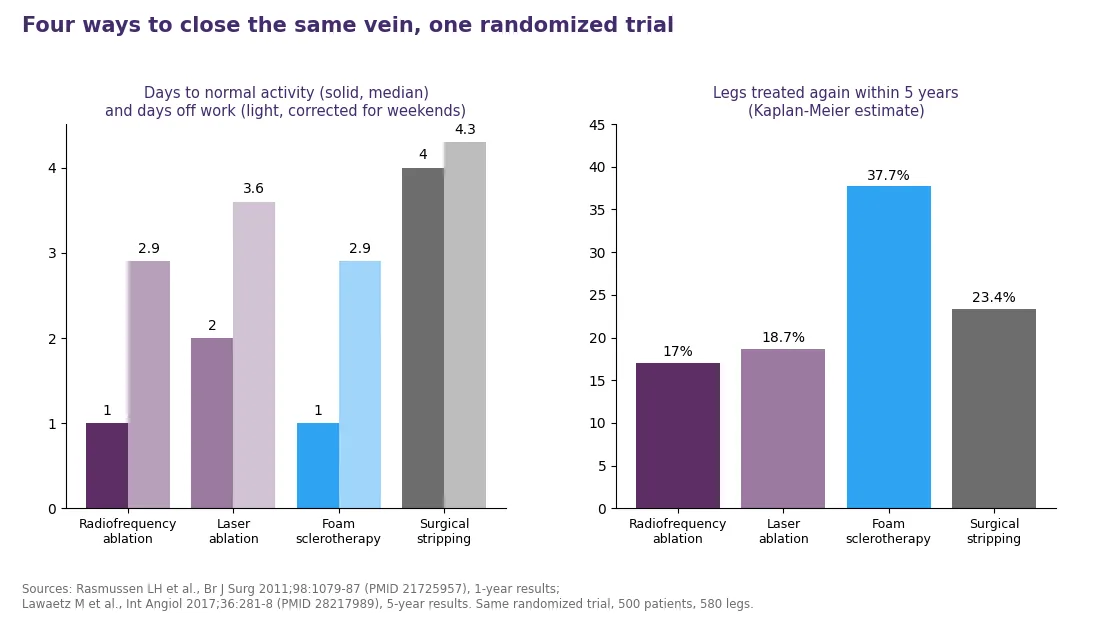
One randomized trial put 500 patients (580 legs) with a refluxing great saphenous vein into four groups: laser ablation, radiofrequency ablation, foam sclerotherapy and surgical stripping. At one year, 4.8% of the radiofrequency-treated veins were open and refluxing, against 5.8% after laser, 16.3% after foam and 4.8% after stripping. Median time back to normal function was 1 day after radiofrequency, 2 days after laser, 1 day after foam and 4 days after stripping, and time off work was 2.9 days after radiofrequency against 4.3 after stripping (Rasmussen et al., 2011). Five-year follow-up of the same patients found 17% of radiofrequency-treated legs had been treated again, compared with 18.7% after laser, 37.7% after foam and 23.4% after stripping (Lawaetz et al., 2017).
The bulging branches near the skin
Closing the trunk takes the pressure off the visible branches, but some of them stay prominent. The guidelines recommend treating the leaking trunk together with the varicose branches, either by removing them through tiny incisions (phlebectomy) or by injecting them with foam, in the same session (recommendation 8.1.1). Staging the branches for a later visit is suggested only when there is an anatomical or medical reason, after a shared decision with the patient (8.1.3). If the branches are your main concern, ask at the consultation how they will be handled and whether that happens on the ablation day.
Stockings and time off work afterward
After thermal ablation the guidelines suggest compression for at least one week to reduce pain (recommendation 2.2.1). The trial figures above give the time away from work for each method.
Clots, bruising and other risks
CACVI lists bruising, swelling, some pain and superficial thrombophlebitis as the common side effects of ablation, with infection at the incision and irritation of a nearby skin nerve (numbness or tingling, usually temporary) as less common ones (CACVI). The guideline adds that heat can burn the skin or leave pigmentation when the vein runs very close to the surface; in that situation a minor surgical removal may suit better (consensus statement 5.2.6).
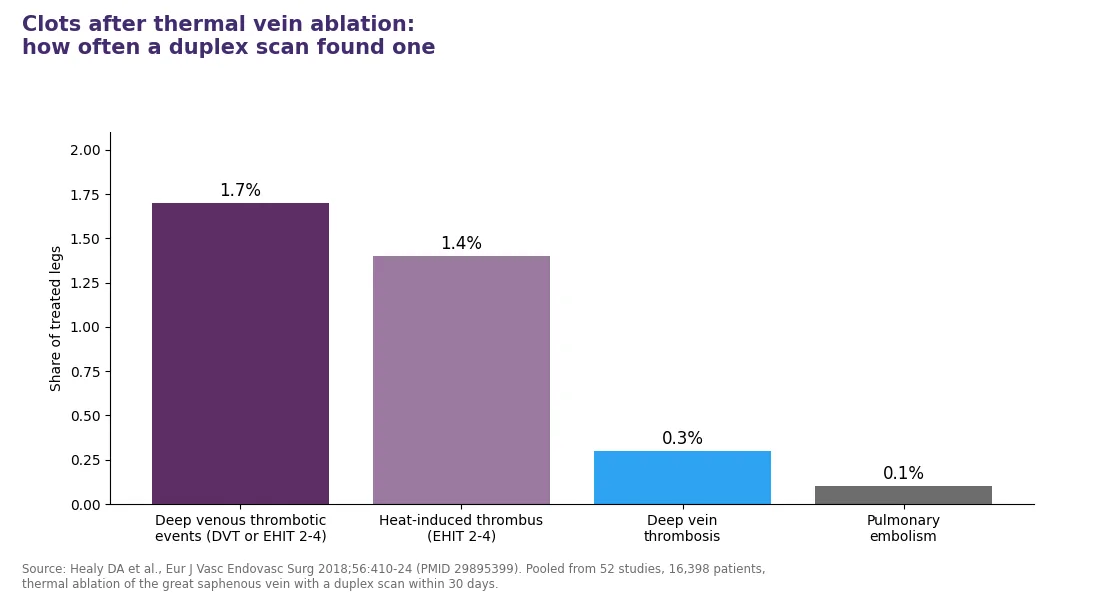
The risk people ask about most is a clot. A pooled analysis of 52 studies of thermal ablation of the great saphenous vein, each with an ultrasound check within 30 days, found deep vein thrombosis in 0.3% of patients and pulmonary embolism in 0.1%. Heat-induced thrombus reaching into the deep vein (EHIT types 2 to 4) appeared in 1.4%, and radiofrequency and laser gave similar results (Healy et al., 2018). The 2023 guideline now calls that last finding ablation-related thrombus extension, or ARTE.
Clot-risk checks before and after the procedure
Because clots are uncommon but serious, the guideline builds the checks around each patient’s risk rather than a single routine:
- Every patient having endovenous ablation should be assessed for clot risk beforehand, to decide whether blood-thinning prevention is needed around the procedure (consensus statement 11.2.2).
- For patients judged high risk, it suggests preventive anticoagulant medication (recommendation 11.2.1).
- For an average-risk patient with no symptoms after thermal ablation, it recommends against a routine early ultrasound to look for ARTE or deep vein thrombosis (11.1.1).
- A high-risk patient should have an early scan even without symptoms (11.1.3).
- Anyone with symptoms after ablation, such as new calf pain or swelling, should have an early scan (11.1.4).
- If a symptomatic ARTE or a deep vein thrombosis above the knee is found, the guideline recommends a direct oral anticoagulant (11.3.3 and 11.3.4).
So whether you are booked for a scan in the first days depends on your own risk profile, which is worth asking about at the consultation.
Who may not be a candidate
- People with a current deep vein thrombosis.
- People with an active infection.
- People with a significant blood clotting disorder.
- Legs where the ultrasound shows the vein is not suitable for a catheter.
That list comes from CACVI’s ablation page, which adds that candidates should be in good general health and able to have the procedure under local anesthesia. Size alone rarely rules a vein out: for saphenous veins wider than 10 mm that are not aneurysmal, the guideline prefers heat-based ablation over nonthermal methods (consensus statement 5.2.7).
How long the result holds
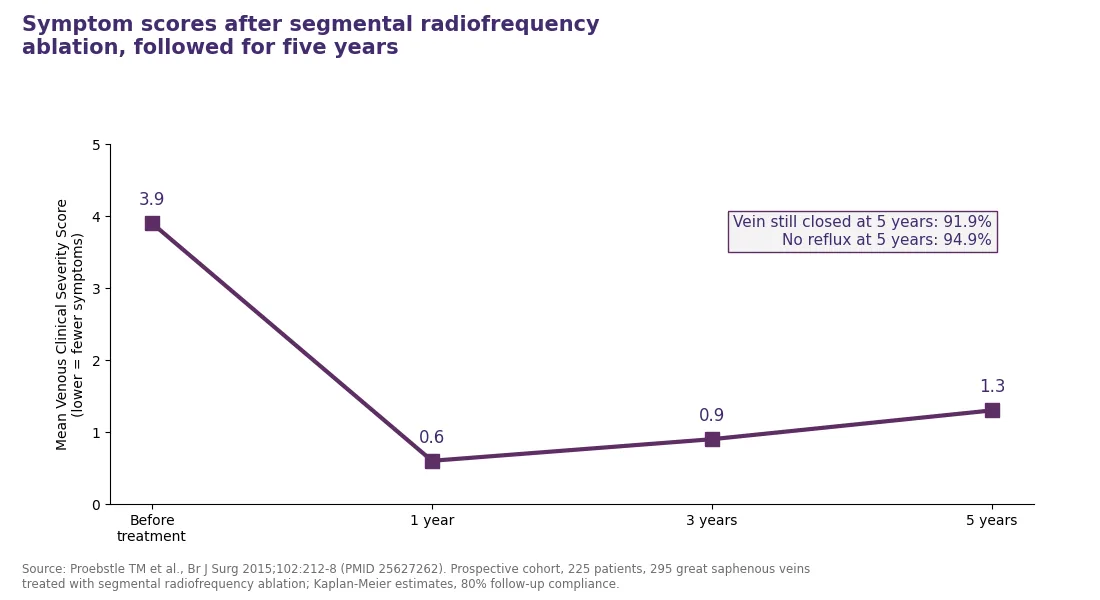
The longest follow-up of segmental radiofrequency ablation comes from a multicenter cohort of 225 patients and 295 great saphenous veins. Five years later, 91.9% of the veins were still closed and 94.9% were free of reflux. Of the 12 legs whose vein partly reopened, six patients had symptoms. The average Venous Clinical Severity Score, a doctor-rated measure of pain, swelling and visible disease, fell from 3.9 before treatment to 0.6 at one year and was 1.3 at five years (Proebstle et al., 2015).
Ready to talk about ablation? Request an appointment
Ablation, aching and appearance, explained for Cypress
Will CACVI treat a varicose vein I mainly dislike the look of?
CACVI’s own pages say ablation may be right for people bothered by the appearance of varicose veins as well as those in pain. The scan still has to show a trunk worth closing. If the veins that bother you are under 3 mm, the spider-vein options on the Malibu page are the closer fit.
Can both legs be treated on the same day?
In the first study of segmental radiofrequency ablation, 58 of the 194 patients (29.9%) had both legs treated in one session, with an average treated length of about 37 cm. Whether that suits you depends on your scan and your health, and is settled at the consultation.
Is there a vein too large for radiofrequency?
Veins from 2 mm up to 18 mm wide were closed in that first study, where the average was 5.7 mm across.
Can the closed vein open again?
It can, but rarely. In the randomized trial, the five-year estimate of radiofrequency-treated veins that reopened was 5.8%, against 31.5% after foam. New varicose veins are a different matter: 18.7% of radiofrequency-treated legs developed recurrent varicose veins over five years.
Is there a medicine that helps while I decide?
For people who are not candidates for a procedure, who are waiting for one, or who still have symptoms afterward, the guideline suggests micronized purified flavonoid fraction or Ruscus extract for vein pain, heaviness and a feeling of swelling (recommendation 3.1). The guideline also notes that these products are not FDA-approved drugs. Ask your doctor before starting either, since they do not treat the reflux itself.
What does “axial reflux” mean on my ultrasound report?
It means blood runs backward along one of the main superficial trunks, such as the great saphenous vein, the small saphenous vein or the anterior accessory great saphenous vein. These are the veins the guideline recommendations on ablation refer to. A report that shows reflux only in small branches leads to a different plan.
Are the connecting veins treated at the same time?
Perforating veins link the surface system to the deep veins. For a C2 leg with significant symptomatic reflux in the great or small saphenous vein, the guideline recommends against treating incompetent perforators during the first ablation (recommendation 10.1.1).
Is there a treatment that keeps the saphenous vein?
Yes, in some cases. The guideline suggests two vein-sparing strategies, ASVAL (removing the varicose branches under local anesthesia and leaving the trunk) for early symptomatic varicose veins, and CHIVA (ambulatory conservative hemodynamic correction of venous insufficiency), each only when done by a physician familiar with the method (recommendations 6.1.1 and 6.1.2). If keeping the vein matters to you, ask whether either approach is offered.
What if the scan shows a bulge in the vein near the groin?
A ballooned segment of a main superficial vein, a superficial venous aneurysm, is handled differently from ordinary varicose veins. The guideline advises open removal when it lies within 3 cm of the junction with the deep vein, ablation alone when it lies farther down and causes no symptoms, and surgical removal for aneurysms that are symptomatic, clotted or larger than 3 cm (statements 14.1 to 14.3).
How is a vein severity score worked out?
The Venous Clinical Severity Score used in the follow-up studies grades each sign from 0 to 3. For varicose veins, which must be at least 3 mm wide to count, a few scattered branches score 1, veins confined to the calf or the thigh score 2, and veins on both calf and thigh score 3. Swelling scores 1 when it stays at the foot and ankle, 2 when it rises above the ankle but stays below the knee, and 3 when it reaches the knee or higher. The guideline prints the full table.
Does laser ablation hurt more than radiofrequency?
In the four-way trial, average pain after the procedure was 1.21 on a 0 to 10 scale after radiofrequency and 2.58 after laser, with foam at 1.60 and stripping at 2.25. That trial used bare-tip laser fibers (980 and 1470 nm), and laser devices with other fiber designs may compare differently.
If foam is quicker, why not use foam on the trunk?
Foam injection closed the trunk less reliably in both large trials. In a separate 798-patient trial comparing foam, laser and surgery, successful closure of the main saphenous trunk was less common after foam than after surgery, and procedural complications were 1% after laser against 7% after surgery (Brittenden et al., 2014). Foam still has a place for branches and smaller veins.
If my varicose veins cause no symptoms, would treating them now stop them getting worse?
The guideline says no: for people with varicose veins and no symptoms, treating them in advance does not prevent the disease from progressing (consensus statement 5.2.1). Progression is real, though. In the Edinburgh Vein Study, which followed 880 people for about 13 years, 31.9% of those who started with varicose veins alone went on to chronic venous insufficiency, and a family history of varicose veins, an earlier deep vein thrombosis and obesity were the risk factors. What changes the advice is symptoms: once they start, the treatment recommendations above apply.
Is my vein too narrow to be worth closing?
Width alone does not decide it. For symptomatic varicose veins, the guideline suggests against using the trunk vein’s diameter to choose who needs ablation (recommendation 5.1.1). Among the studies behind that advice, radiofrequency ablation of symptomatic great saphenous veins narrower than 5 mm closed the veins and lowered severity scores at three months, and a registry review concluded that patients with smaller veins should not be denied treatment on size alone.
Why is ablation done in an office rather than a hospital?
The guideline leaves the setting to the physician: an office, a surgery center or a hospital operating room can all be used, and it notes that better patient experience and lower cost were reported for procedures done in an office (consensus statement 5.2.2). CACVI’s page on why it works in the office gives the practice’s own reasons.
My scan shows a leak only at the groin junction. Does the whole vein need closing?
Not on that finding alone. For symptomatic varicose veins, the guideline says a leak confined to the saphenofemoral junction does not justify ablating a great saphenous vein that otherwise works (consensus statement 5.2.3). The reverse also happens: ablation may be indicated when the trunk leaks even though the junction holds and the reflux does not run its full length, while closing a short leaking stretch between healthy ones is rarely needed (5.2.4). The plan follows the map of where the reflux runs.
Why might a different method be used below the knee?
The guideline gives two reasons. When the great saphenous vein leaks below the knee, treating it down to the lowest point of reflux gave better early results, and nonthermal methods are preferred for leaking saphenous veins low in the calf, to avoid heat injury to nearby nerves (consensus statement 5.2.5).
What does CACVI publish about cost?
Its varicose veins page puts treatment cost between about $500 and $13,000, depending on the procedure and how many veins are treated. Your own figure depends on the scan findings and your coverage, so ask the office for an estimate after the consultation.
From Cypress to Alden Drive on I-5 and I-10
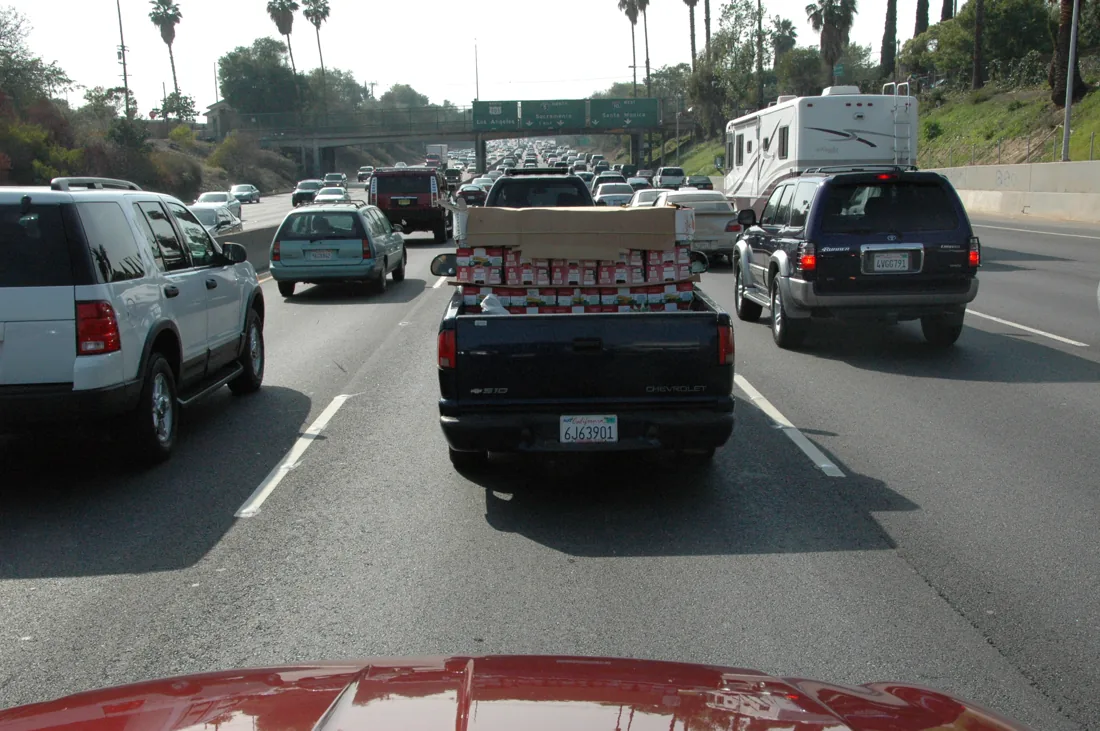
Cypress patients drive to Alden Drive. From Cypress City Hall at 5275 Orange Avenue, the routing engine takes Moody Street and Carmenita Road up to I-5 north, follows I-5 toward downtown Los Angeles, then turns west on I-10 for the last stretch toward Beverly Grove. Without traffic that is 31.7 miles and about 48 minutes. Those are free-flow figures; a weekday morning on I-5 and I-10 will take longer, so allow extra time for a morning appointment.
The address and the arrival
CACVI Los Angeles, 8741 Alden Drive, Suite A, Los Angeles, CA 90048. Alden Drive runs along the west side of the Cedars-Sinai Medical Center campus, which is the easiest landmark to follow on the last mile. The Tarzana office appears in the table at the top of this page for reference; it is the longer drive from Cypress.

Planning the procedure day from Cypress
- Leave extra time for I-5 traffic on the way in, so you are not rushing into the procedure room.
- Bring the compression stocking the office asks for, or ask whether one is supplied.
- Pick clothes with a loose leg, since the treated leg may be bandaged for the trip home.
- Ask the office before the day whether you should have someone drive you home.
- Keep the office number in your phone for questions on the drive back and in the days after.
Close to home if something is urgent
Urgent problems belong close to home, not on I-5. La Palma Intercommunity Hospital, 7901 Walker Street, La Palma, has a 24-hour emergency department about 1.9 miles from Cypress City Hall (La Palma Intercommunity Hospital). Go there, or call 911, for sudden chest pain or breathlessness, or a calf that swells quickly and hurts.
Current reviews are on the office’s Google listing. No star average is printed here, because that figure changes with every new review. Two of the reviews, quoted as written:
“I have had several procedures done here and everything was very professional and well done.” Scott Hale, May 2026
“Dr Moinakhtar Lala is god sent! He has literally saved my mother’s life and has been instrumental in improving her quality of life. My family and I will forever be grateful to him! He has surrounded himself with an amazing team who treat you with love and compassion – a very rare thing to find at a doctor’s office nowadays! We went to many different cardiovascular doctors before we found Dr Lala – wish we had found him earlier, but I am glad we finally did! If you are seeking any cardiovascular help for yourself or a loved one – do yourself a favor and come here first!” Aditt, September 2026
Nearby north Orange County pages
- Leg pain doctor, Los Alamitos: tender veins and clots, and when a leg needs the emergency room
- Leg pain doctor, La Palma
- Leg pain doctor, Buena Park
- Leg pain doctor, Garden Grove
- Leg pain doctor, Hawaiian Gardens
- Varicose veins: causes, warning signs and treatment options
- Endovenous ablation at CACVI
Guideline and trial references
- Gloviczki P, Lawrence PF, Wasan SM, et al. The 2023 Society for Vascular Surgery, American Venous Forum, and American Vein and Lymphatic Society clinical practice guidelines for the management of varicose veins of the lower extremities. Part II. J Vasc Surg Venous Lymphat Disord. 2024;12(1):101670. PMID 37652254
- Lurie F, Passman M, Meisner M, et al. The 2020 update of the CEAP classification system and reporting standards. J Vasc Surg Venous Lymphat Disord. 2020;8(3):342-352. PMID 32113854
- Proebstle TM, Vago B, Alm J, et al. Treatment of the incompetent great saphenous vein by endovenous radiofrequency powered segmental thermal ablation: first clinical experience. J Vasc Surg. 2008;47(1):151-156. PMID 18178468
- Proebstle TM, Alm BJ, Göckeritz O, et al. Five-year results from the prospective European multicentre cohort study on radiofrequency segmental thermal ablation for incompetent great saphenous veins. Br J Surg. 2015;102(3):212-218. PMID 25627262
- Rasmussen LH, Lawaetz M, Bjoern L, et al. Randomized clinical trial comparing endovenous laser ablation, radiofrequency ablation, foam sclerotherapy and surgical stripping for great saphenous varicose veins. Br J Surg. 2011;98(8):1079-1087. PMID 21725957
- Lawaetz M, Serup J, Lawaetz B, et al. Comparison of endovenous ablation techniques, foam sclerotherapy and surgical stripping for great saphenous varicose veins. Extended 5-year follow-up of a RCT. Int Angiol. 2017;36(3):281-288. PMID 28217989
- Brittenden J, Cotton SC, Elders A, et al. A randomized trial comparing treatments for varicose veins. N Engl J Med. 2014;371(13):1218-1227. PMID 25251616
- Healy DA, Kimura S, Power D, et al. A systematic review and meta-analysis of thrombotic events following endovenous thermal ablation of the great saphenous vein. Eur J Vasc Endovasc Surg. 2018;56(3):410-424. PMID 29895399
- MedlinePlus. Varicose veins. National Library of Medicine. medlineplus.gov/varicoseveins.html
- CACVI. Tratamiento de várices, Endovenous ablation, Why office-based procedures?
- Route distances: OSRM route, no traffic, from 5275 Orange Avenue, Cypress, run 18 November 2026.
¿Listo para hablar?