
Blood Clot in the Calf of Leg
Quick answer
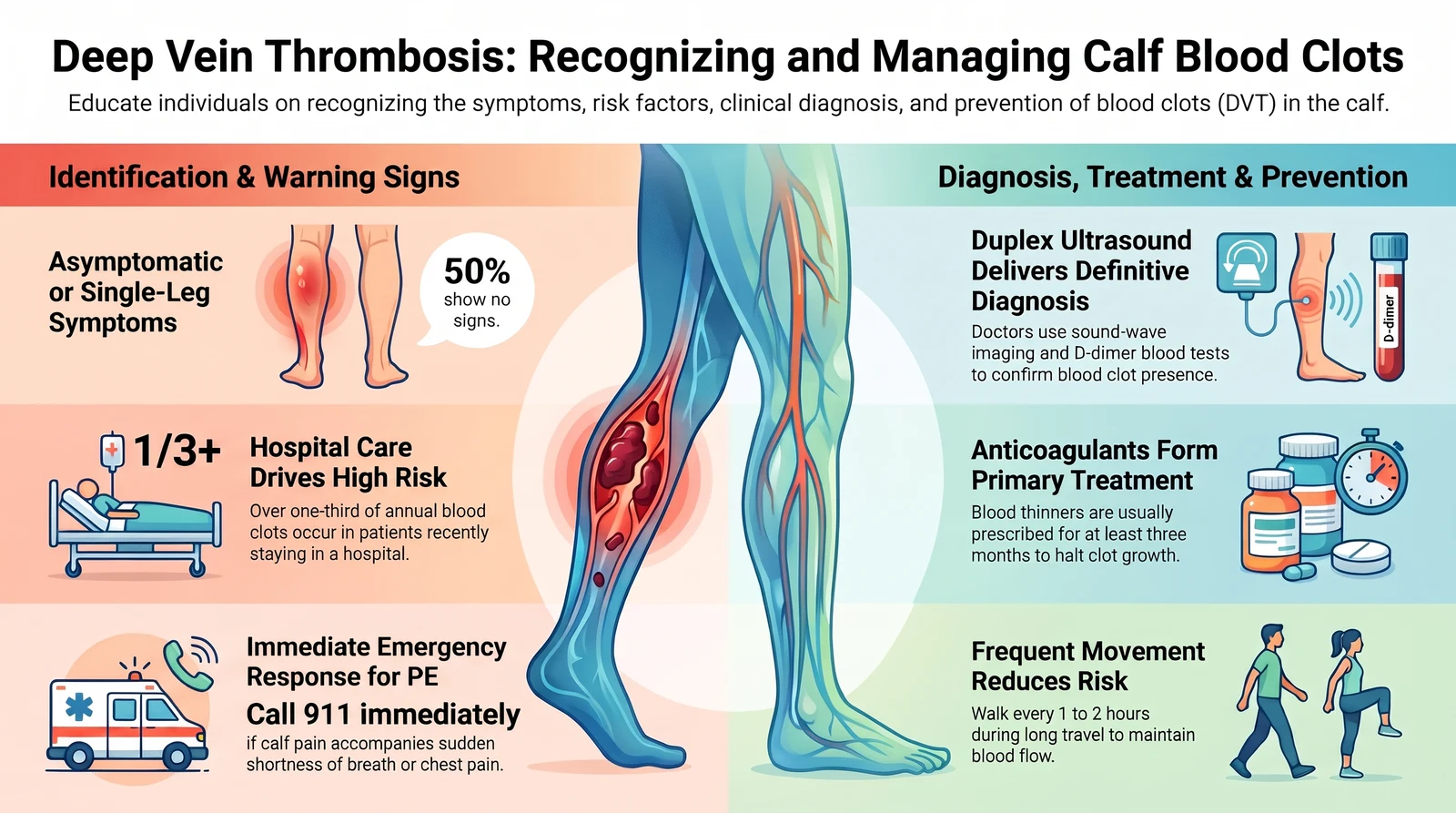
A blood clot in the calf is deep vein thrombosis (DVT) in the veins below the knee. Watch for calf pain or cramping that gets worse when you stand or walk, swelling in one leg, warmth or skin color changes, though about half of people have no symptoms. A duplex ultrasound is the main test, and most people take a blood thinner for at least three months. Sudden shortness of breath or chest pain means call 911.
A blood clot in the calf of the leg forms when blood clumps together inside one of the deep veins of the lower leg, a condition called deep vein thrombosis (DVT). Common symptoms include calf pain, swelling, warmth, and changes in skin color, though some people notice nothing at all. If part of a blood clot breaks off and travels to the lungs, it causes what is called a pulmonary embolism; therefore you should see a doctor if you have sudden calf pain or swelling in one leg.
Our board-certified specialists at CACVI have over 30 years of experience and have performed more than 15,000 procedures related to both vascular and heart health. We diagnose and treat vein conditions, including deep vein thrombosis, chronic venous insufficiency, leg swelling, and venous leg ulcers, with minimally invasive, office-based care. If you have calf pain, swelling, or other signs of a vein problem, schedule a consultation with our team.
This article discusses symptoms, causes and risk factors for blood clots in calves; diagnosis and treatment of deep vein thrombosis (DVT); possible complications; when to seek emergency care; and ways to reduce one's risk.
What Is a Blood Clot in the Calf of the Leg?
A blood clot in the calf is a cluster of blood that forms inside one of the deep veins in the lower part of the leg. The condition is called deep vein thrombosis (DVT) and involves clots that partially or completely obstruct blood flow back towards the heart. Clotting is how the body stops bleeding after an injury. A clot that forms inside a vein when there is no bleeding to stop is a problem. According to the Society for Vascular Surgery, nearly 300,000 first-time cases of DVT occur in the United States each year.
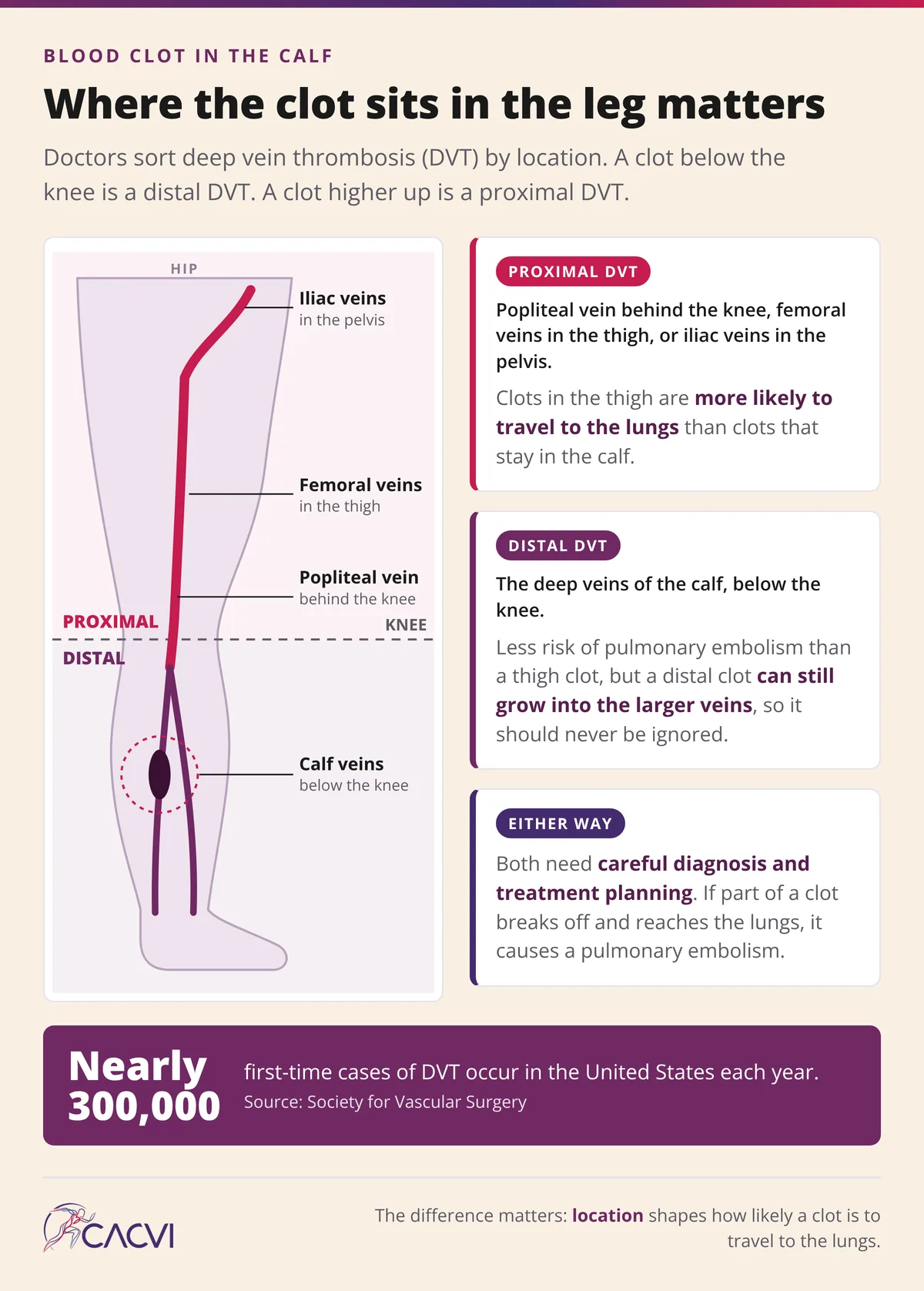
Doctors refer to deep vein thrombosis (DVT) that occurs at calf level as distal DVT. This clot sits below the knee. Proximal DVT forms higher up: in the popliteal vein behind the knee, the femoral veins in the thigh, or the iliac veins in the pelvis. The difference matters. Clots in your thigh are more likely to go to your lungs compared to clots that stay in your calves. A distal clot can still grow into the larger veins, though, so it should never be ignored.
When a clot blocks a major vein deep in the leg, circulation of blood becomes harder for that leg. If part of the clot breaks off and travels through the bloodstream to the lungs, it causes a pulmonary embolism (PE), which can be fatal and needs emergency care. Calf clots have less risk of pulmonary embolism (PE) compared to thigh clots, but both still need careful diagnosis and treatment planning.
What Are the Symptoms of a Blood Clot in the Calf?
Swelling and soreness in the calf can be symptoms of a blood clot. According to the Centers for Disease Control and Prevention, about half of people with DVT have no symptoms at all, which is why small changes are worth paying attention to.
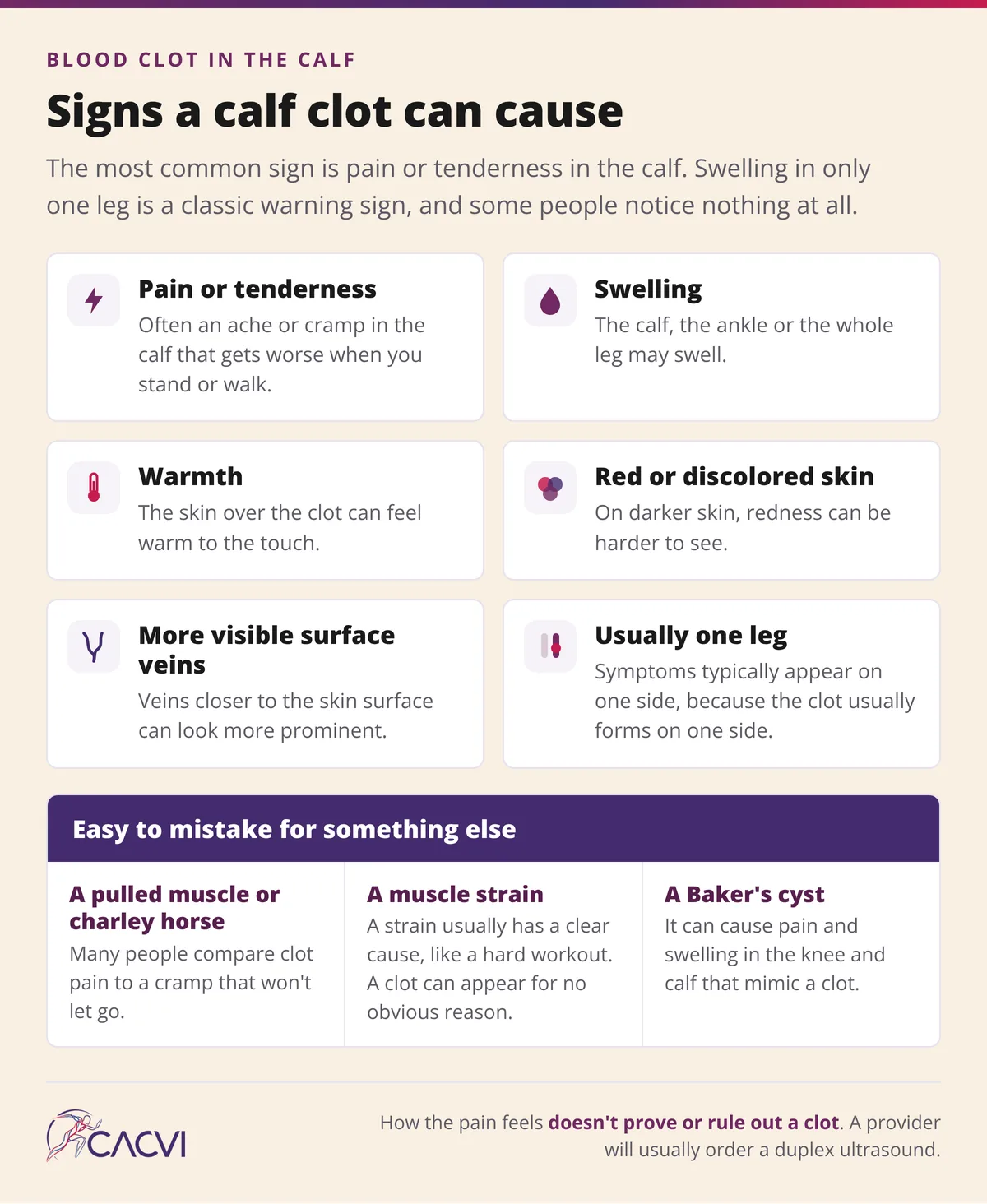
The most common sign is pain or tenderness in the calf, often an ache or cramp that gets worse when you stand or walk. The calf, ankle, or whole leg may swell. The skin over the clot can feel warm and may look red or discolored; on darker skin, redness can be harder to see. Skin discoloration on the lower leg has several possible causes, but new color changes alongside pain deserve a closer look. Some people also notice that veins closer to the skin surface look more prominent.
Symptoms typically appear in one leg because the clot usually forms on one side. Swelling in only one leg is a classic warning sign, but it can have other causes, and normal-looking legs don't rule out a clot.
If you develop unexplained calf pain, swelling, warmth, or discoloration, contact a healthcare provider the same day. Don't wait until things get worse before you do something about it.
What Does Calf Pain From a Blood Clot Feel Like?
Pain from clots in calves usually feels like a persistent ache, deep soreness, cramping or stiffness in the lower leg. Many people compare it to a pulled muscle or a charley horse that won't let go. It tends to get worse when you stand or walk, especially if the leg is also swollen.
The trouble is that DVT pain can feel a lot like a muscle strain, soreness after exercise, or an ordinary leg cramp. A muscle injury usually has a clear cause, like a hard workout, while a clot can appear for no obvious reason. Those differences aren't reliable enough to tell the two apart on your own. Other conditions, such as pain and swelling in the knee and calf from a Baker's cyst, can also mimic a clot.
How the pain feels doesn't prove or rule out that there's a clot. A provider will look at your medical history and examine your leg. They usually order a duplex ultrasound to figure this out.
Can You Have a Blood Clot in Your Calf Without Swelling?
Yes, a blood clot in the calf can form without any noticeable swelling. DVT doesn't always show up as obvious changes in the appearance of the leg, and some people have only mild discomfort or no symptoms. The CDC estimates that roughly half of people who have DVT have no symptoms at all.
Without swelling or color changes, it's easy to write off a clot as sore muscles. Even if there are no classic signs, a clot can still grow or cause complications.
Pay attention to new calf pain or tenderness you can't explain, especially if you've recently had surgery, been laid up for a while, had a previous DVT, or have a family history of blood clots. Have your legs checked even if they look fine.
If you suddenly start having trouble breathing, chest pain that gets worse when you take a breath, or if you start coughing up blood, please call 911 immediately. These can be signs of a pulmonary embolism, a life-threatening complication in which a clot travels to the lungs.
What Causes Blood Clots in the Calf?
A clot can form in calf veins if circulation slows down, if there's damage to vein walls, or if blood tends to clot more easily than normal. Doctors call these three conditions Virchow's triad, and they explain why DVT often follows surgery, long periods without moving, or certain illnesses. According to CDC data, up to 900,000 people in the United States are affected by venous thromboembolism (VTE) each year, which includes both deep vein thrombosis and pulmonary embolism.
Slowed Blood Flow
Your calf muscles act like a pump. Each time they contract as you walk or move, they force blood upward through the veins and towards the heart. If you sit still for a long time, blood tends to pool in deeper veins and there's a higher chance of a clot forming.
Long bed rest during an illness or after surgery, hours of sitting on a long trip, a leg cast, and hospital stays that limit movement all slow blood flow this way. That's one reason care teams get patients up and walking after surgery as soon as it's safe.
Damage to the Blood Vessel Walls
The lining inside veins helps blood flow smoothly and also controls clotting. When this lining gets damaged, the clotting system in the body switches on and forms a clot at the injury site.
Damage to veins can result from major surgery, fractures of bones, severe muscle injuries, or other traumas. Some illnesses can cause inflammation which can affect the lining of veins and make blood clots more likely too.
Increased Tendency for Blood to Clot
Sometimes the blood itself is more prone to clotting, a state called hypercoagulability. Conditions like Factor V Leiden, estrogen-containing birth control or hormone treatment, pregnancy, cancer and inflammatory bowel disease can all make the blood more likely to clot. When this happens, a clot can form even without an injury or a long stretch of inactivity.
Immediate Triggers vs. Underlying Risk Factors
It's not always clear why a calf clot happens. Sometimes there is a clear trigger such as surgery, an injury or long flights. Other times an underlying clotting disorder or chronic illness raises the risk even when there's no obvious trigger.
Often, multiple factors pile up together. Someone who inherits a tendency to form blood clots and then has surgery followed by lying around for several days runs a higher risk compared to someone who has just one of those risk factors.
A hospital stay is one of the biggest triggers. CDC data show that more than a third of VTE cases diagnosed each year are related to a recent hospital stay, and most of these don't appear until after the patient goes home. That's why clotting risks should be part of every plan for discharge and recovery.
Who Is at Risk of Developing a Calf Blood Clot?
Anyone can develop a blood clot in the calf, but some health conditions, medications, and situations make it more likely. Each one affects blood flow, the vein walls, or how easily the blood clots. The CDC's list of risk factors notes that the risk goes up when several are present together.
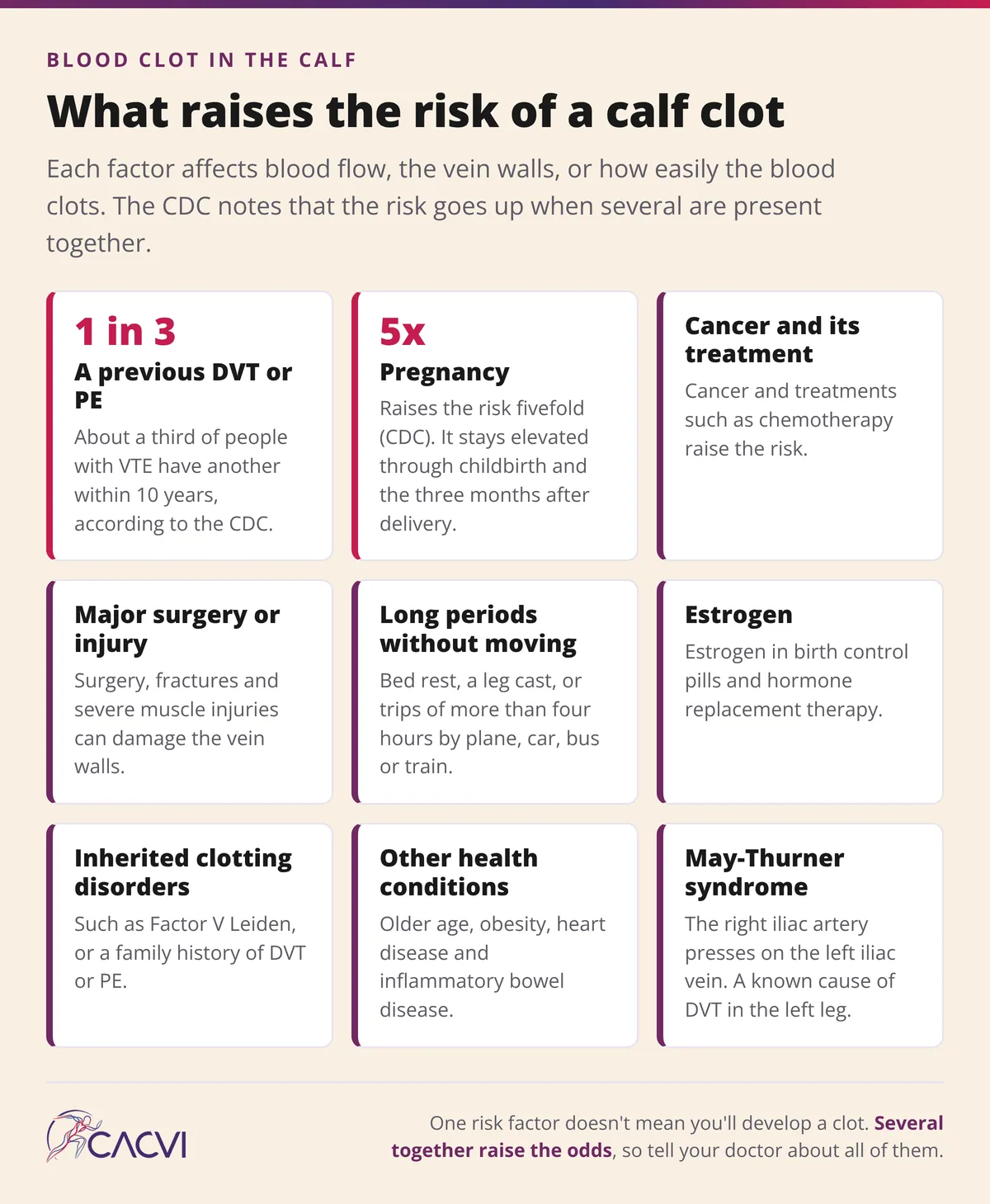
A previous DVT or pulmonary embolism is a major risk factor for another clot; according to the CDC, about a third of people with VTE have another within 10 years. Cancer and its treatment, such as chemotherapy, raise the risk, and so does major surgery. Older age, obesity, heart disease and inflammatory bowel disease also apply. A family history of DVT, PE, or an inherited clotting disorder such as Factor V Leiden is another warning sign worth telling your doctor about.
Pregnancy deserves special mention. The CDC reports that pregnancy increases the risk of blood clots fivefold, and the risk stays elevated through childbirth and the three months after delivery. Some people also run into risks with estrogen in birth control pills and hormone replacement therapies.
Vein issues can also be important. May-Thurner syndrome, in which the right iliac artery presses on the left iliac vein (the main vein that drains blood from the left leg), is a known cause of DVT on the left side.
How Do Multiple Risk Factors Affect Your Chances of DVT?
One risk factor doesn't mean you'll develop a clot. Several together raise the odds, especially when they affect both blood flow and clotting.
Someone taking estrogen-containing birth control who also smokes, carries extra weight, or just had surgery faces a higher risk than someone with none of those factors. A person with a previous DVT may need extra precautions before a hospital stay or a long trip.
Talk to your doctor about any number of risk factors that you have. They can review your history and decide if preventive steps are sensible for you.
Can Long Periods of Sitting Increase Your Risk of a Blood Clot?
Yes. Sitting still for hours slows blood flow in the deep veins of the legs, which gives a clot a chance to form. This can happen on long flights, car rides, bus or train trips, or long stretches at a desk or on the couch.
The CDC's travel guidance says anyone who travels more than four hours by plane, car, bus or train is at risk. For most travelers, the risk is generally very small. It is higher for people over 40 and for those with obesity, recent surgery or injury, pregnancy, hormone use, a previous clot or active cancer.
On a long trip, get up and walk every one to two hours when it's safe. While seated, straighten your legs and flex your ankles, pulling your toes toward you, and raise and lower your heels to work your calf muscles. When taking trips on the road, plan for some stops so you can get up and move around. If you have other risk factors, ask your doctor if using graduated compression stockings would be a good idea. If you've ever had blood clots before or if you know you have clotting problems, talk to your doctor before traveling.
How Is a Blood Clot in the Calf Diagnosed?
Diagnosing a calf clot usually follows a set sequence, from your history and exam through blood work and imaging. Here is how the process typically works.
Review Your Symptoms and Medical History
Your provider will ask when the calf pain or swelling started, whether it's in one leg, and whether you've recently traveled, had surgery, or spent long periods sitting or in bed.
They will also inquire about any personal or family history of blood clots, cancer, recent pregnancies, use of hormones, and other conditions that increase risk. Your answers help them judge how likely DVT is and which tests you need.
Perform a Physical Examination
The doctor will look at your leg for swelling, redness, warmth and changes in skin color and often compares this to the other leg. They will also consider whether there could be another cause for your symptoms like an injury to a muscle or inflammation of a superficial vein.
An exam isn't enough to prove or disprove that there's a clot. Even if your leg looks fine, you may still want to get tested if there are signs that suggest DVT based on your symptoms and medical history.
Consider a D-dimer Blood Test
A D-dimer test measures proteins that come from broken-down clots in the blood. High levels suggest that both clot formation and dissolution are occurring somewhere inside the body.
If your provider judges your chance of DVT to be low, a normal D-dimer can usually rule it out without imaging. A normal result is less reliable for small calf clots, so your provider may still order an ultrasound if symptoms persist. A positive result doesn't confirm DVT, though. MedlinePlus says that D-dimer levels also go up with pregnancy, heart disease, recent surgery, and older age, among other conditions. Those who have a high chance of DVT tend to go right to imaging.
Use Duplex Ultrasound to Look for a Clot
Duplex ultrasound is the main test used for diagnosing DVT. It creates images of veins using sound waves and measures flow of blood through them. A technician applies some gel to the leg and then uses a handheld probe to scan the skin surface, looking at each vein closely. CACVI performs vascular ultrasounds, including venous duplex scans, in our offices. The test is noninvasive and usually painless, though the probe pressing on a sore calf can be uncomfortable.
The scan checks if there's any blockage or constriction in veins and pinpoints precisely where something is located. Because a calf clot may be limited to the veins below the knee, your provider may order a whole-leg ultrasound that checks both the calf veins and the larger veins above them.
Arrange Additional Testing or Repeat the Ultrasound if Needed
Sometimes the very first ultrasound scan doesn't come out clear. A scan can come back negative while suspicion remains, especially if it only covered the veins above the knee. Swelling or body size can also make some veins hard to see.
If DVT is still a concern, your provider may repeat the ultrasound, often within five to seven days. Other imaging, such as venography, may be considered when results stay unclear or a clot is suspected in veins that are hard to reach.
How Is a Blood Clot in the Calf Treated?
Treatment depends on the clot's size and location, how severe your symptoms are, how likely the clot is to grow, and your overall health. Most people with DVT are treated with blood thinners (anticoagulants), which stop the clot from growing and prevent new ones while the body breaks it down. Some people with a clot limited to the calf can be watched closely with repeat ultrasounds instead of starting medication right away.
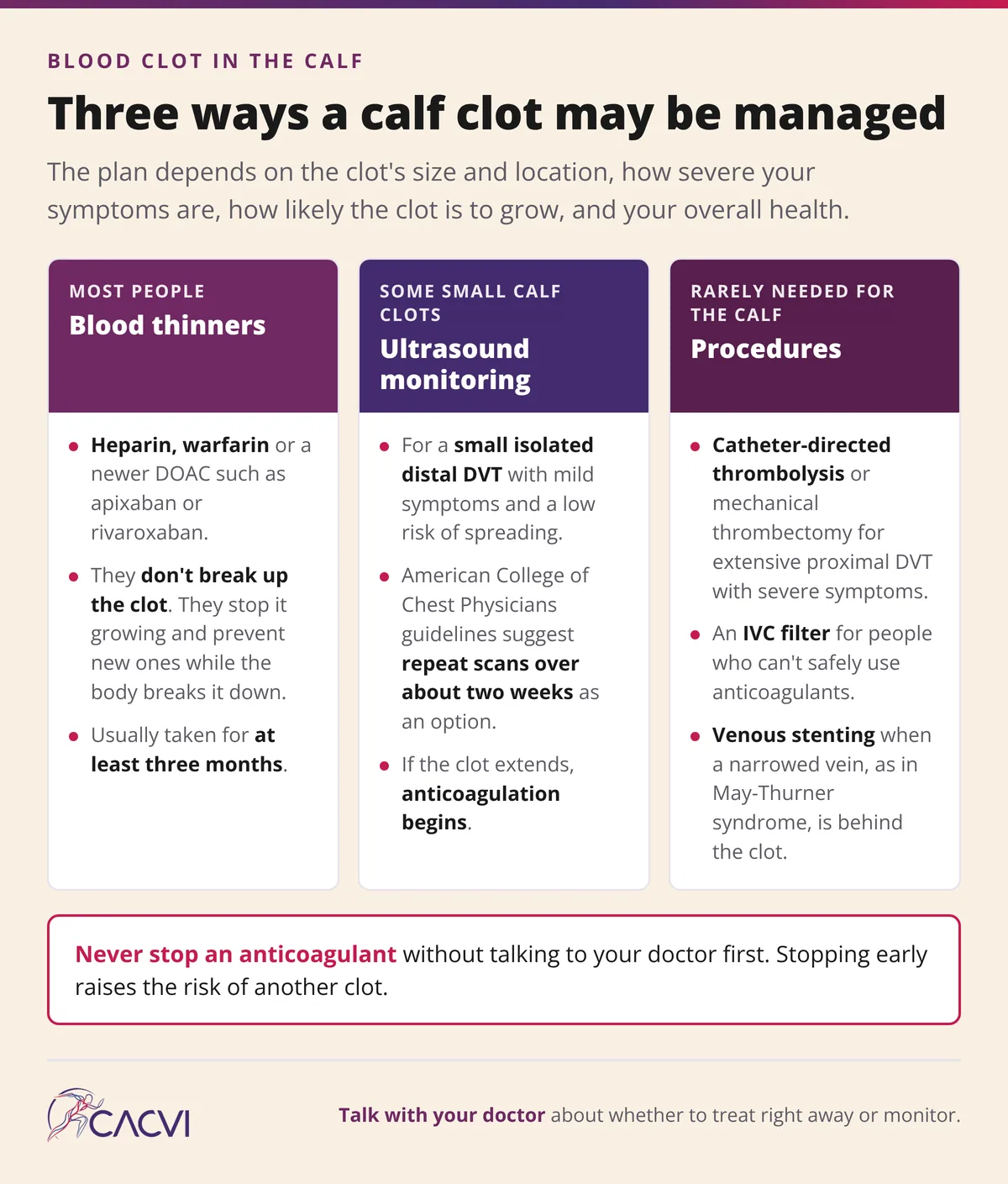
Anticoagulants are standard treatment. Options include heparin, warfarin and newer direct oral anticoagulants (DOACs), according to the National Heart, Lung, and Blood Institute; apixaban and rivaroxaban are examples of DOACs. These drugs don't break up the clot. They keep it from getting bigger while the body slowly breaks it down, which lowers the risk of complications such as pulmonary embolism. Your doctor will select a medicine based on your medical history, kidney function, other drugs you take and your risk of bleeding.
Most people with DVT (deep vein thrombosis) take a blood thinner for at least three months. The right length depends on why the clot formed and how likely another one is. A clot tied to a temporary trigger, such as surgery, is usually treated for a shorter period than one that formed for no clear reason. People with repeat clots, active cancer, or ongoing risk factors may need longer treatment. Your provider will weigh the benefit of preventing another clot against the risk of bleeding.
Not every calf clot needs treatment with blood thinners right away. For some people with a small isolated distal DVT, mild symptoms, and a low risk of the clot spreading, guidelines from the American College of Chest Physicians suggest serial ultrasound monitoring as an option. That usually means repeat scans over about two weeks to check whether the clot is growing into larger veins. If the clot extends, anticoagulation begins. People with severe symptoms or higher risk of worsening usually start treatment right away. This is something that should be decided with your doctor.
Procedures are generally reserved for larger clots higher in the leg or for people who can't take blood thinners, and they're rarely needed for a clot confined to the calf. For extensive proximal DVT with severe symptoms, a specialist may use catheter-directed thrombolysis, which delivers clot-dissolving medication straight into the clot, or mechanical thrombectomy, which removes the clot through a small catheter. People who can't safely use anticoagulants can have an IVC filter placed in a big vein in their belly. This device catches clots before they travel up to the lungs. When a narrowed vein is behind the clot, as in May-Thurner syndrome, venous stenting may be part of the plan.
Following up allows your doctor to monitor your recovery and adjust your treatment accordingly. Since anticoagulants increase the risk of bleeding, please follow the prescription exactly and consult your doctor before taking any new medications or supplements. If you notice unusual bruises, frequent nosebleeds, blood in urine, or black or bloody bowel movements, please contact your healthcare provider. Severe bleeding, vomiting blood, a bad headache after a head injury, or bleeding that won't stop needs emergency care. Never stop an anticoagulant without talking to your doctor first, because stopping early raises the risk of another clot.
Can a Blood Clot in the Calf Go Away on Its Own?
Over time, the body breaks down clots naturally using its own system for dissolving clots. Some small calf clots resolve without medication, which is why doctors sometimes choose ultrasound monitoring for carefully selected patients.
That doesn't mean a suspected clot is safe to leave alone. An untreated clot can grow bigger and increase the risk of a pulmonary embolism. Even if the pain eases or the swelling goes down, symptoms can't tell you whether the clot is gone. Our article about how long a blood clot can go untreated talks about the risks of delaying things.
If you think you have a DVT, get evaluated. A provider can decide whether you need anticoagulants, follow-up scans, or another approach.
Can You Walk With a Blood Clot in Your Calf?
Yes, generally speaking, after DVT is diagnosed and treatment has begun and your doctor says it's okay to do so. Walking keeps blood moving through the leg, and people recovering from DVT are usually encouraged to stay active rather than rest in bed.
That doesn't mean you should push through unexplained calf pain or start hard exercise before you've been checked. Before deciding how active to be, get yourself evaluated if you haven't already seen a doctor about this. If you have confirmed DVT (deep vein thrombosis), follow your doctor's advice about walking, leg exercises and whether to wear compression stockings.
If you ever feel like you're suddenly having trouble breathing, have chest pain, cough up blood, or faint, call 911 immediately. This may be an indication of pulmonary embolism.
What Are the Complications of a Blood Clot in the Calf?
A calf clot can cause complications if it grows, spreads into larger veins, or damages the veins over time. Some small clots dissolve on their own, but you can't tell which ones will, so any suspected deep vein thrombosis (DVT) needs medical evaluation.
The table below summarizes the main complications, what causes them, and the symptoms to watch for.
| Complication | What Happens | Symptoms and Potential Effects |
|---|---|---|
| Clot extension | A clot that begins in the calf expands to the larger veins above the knee, increasing the risk of pulmonary embolism. | Calf pain that gets worse, more swelling, warmth, and tenderness. |
| Pulmonary embolism (PE) | A clot breaks off, moves through the bloodstream, and obstructs an artery in the lungs. This can result in death. | Sudden shortness of breath, chest pain that gets worse with a deep breath, a fast heartbeat, dizziness, or coughing up blood. Call 911 immediately. |
| Post-thrombotic syndrome (PTS) | The clot damages the vein and its valves, so blood has trouble flowing back toward the heart and collects in the leg. | Ongoing swelling, aching, heaviness, skin discoloration, itching, and in severe cases leg ulcers. Symptoms can last months or years. |
| Recurrent DVT | A new clot forms in the same leg or the other leg, especially if risk factors remain. | New or returning leg pain, swelling, warmth, or tenderness that needs prompt evaluation. |
Early detection and treatment lowers the risk of clot growth and pulmonary embolism. Some people continue to have leg pain or swelling after treatment because of damage that persists in veins. Post-thrombotic syndrome can look a lot like chronic venous insufficiency, and a vein specialist can help manage the swelling, skin changes, and ulcers that come with it.
If you get new swelling in your legs or pain in your calves that you can't figure out, you should see a doctor. If you have sudden shortness of breath, chest pain or bloody sputum, please dial 911 immediately.
When Should You Seek Medical Attention for Calf Pain?
Check out any new sudden calf pain or swelling right away, especially if it's in one leg and is accompanied by warmth, tenderness, or changes in color. These can be signs of DVT. A muscle strain or cramp can feel similar, but you can't reliably tell a clot from a muscle injury by symptoms alone.
Call a healthcare provider the same day if you have unexplained leg pain or swelling and any risk factors, such as recent surgery, a long period of immobility, pregnancy, cancer, a previous DVT, or estrogen-containing medication. Don't wait until you see every symptom.
Get emergency help right away if you have signs of a pulmonary embolism, which happens when part of a clot breaks loose and travels to the lungs. Warning signs include:
- Sudden shortness of breath: trouble breathing that starts without warning, even at rest.
- Chest pain: pain or discomfort that may get worse when you breathe in deeply or cough.
- Coughing up blood: blood in your mucus or coughing up blood.
- Fainting or severe dizziness: feeling like you might pass out, or losing consciousness.
- Rapid or irregular heartbeat: a heartbeat that is unusually fast or feels off.
🚨 Seek Emergency Care
These symptoms can signal a life-threatening emergency. Call 911 in the United States or your local emergency number instead of driving yourself to the emergency room, and don't wait to see whether the symptoms pass. Call 911 too if your leg suddenly becomes very swollen and painful, turns pale or bluish, or feels cold.
How Can You Reduce Your Risk of a Calf Blood Clot?
While not every clot can be avoided, there are things you can do to keep blood flowing and reduce your risk of DVT. The CDC lists immobility, surgery, a past clot and certain medical conditions as risk factors. Its advice: move around as soon as you can after bed rest, walk every one to two hours on long trips, keep a healthy weight, avoid a sedentary lifestyle and ask your doctor whether you need prevention.
Stay active during long periods of sitting. If you're traveling for more than four hours by plane, car, bus, or train, get up and walk every one to two hours when you can. At a desk, take regular movement breaks instead of sitting for hours at a stretch.
Do some seated calf exercises. If you can't get up, raise and lower your heels with your toes on the floor, lift your toes with your heels down, and tighten and release your leg muscles every so often. These moves help most on long trips when space is tight.
Take preventative measures both before and after surgery. Surgery, hospital stays, and limited mobility all raise clot risk, and the CDC notes that most hospital-related clots appear only after discharge. Before a planned procedure, ask about your risk for deep vein thrombosis and if you should use preventive medications, start walking early, or use compression devices. During recovery, follow your care team's instructions on how to get moving again.
Use blood thinners or compression stockings only if recommended. People who are at high risk may benefit from taking preventive blood thinners or using graduated compression stockings. This isn't right for everybody and blood thinners can cause bleeding. Ask your doctor what fits your situation instead of taking aspirin or other medication on your own to prevent a clot.
Maintain a healthy weight and regular exercise routine. Staying active and keeping a healthy weight lower some of the risk factors for DVT. If you've been inactive, start with something manageable, like a daily walk, and build from there.
Talk to your healthcare provider about your personal risks. If you've ever had deep vein thrombosis (DVT) or a pulmonary embolism, if you have a family history of blood clots, if you're pregnant or recently delivered a baby, if you use birth control pills or hormone therapy, or if you have a chronic condition that increases your risk of blood clots, please ask for a personal prevention plan. You may need extra precautions for travel, surgery, or any time you're less mobile.
Prevention also means catching symptoms early. If you develop calf pain, swelling, warmth, or color changes you can't explain, get evaluated instead of relying on movement or stockings to fix a possible clot.
Got Questions About Blood Clot in the Calf of Leg?
It's tough to spot a calf clot; they often feel like pulled muscles or cramps. DVT can still result in a pulmonary embolism if part of the clot breaks away and travels to the lungs. Recognizing warning signs such as unexpected pain in your calves along with swelling, warmth and changes in color helps you seek medical attention early before complications arise.
Prompt diagnosis and treatment reduce the risk of serious outcomes. A provider may use a D-dimer test and a duplex ultrasound to find a clot, then recommend anticoagulants or close monitoring based on your situation. Regular movement, being careful during trips and after surgery, and also having a plan for dealing with risks all help.
If you have calf pain, swelling, or other signs of a possible clot, CACVI's vein specialists can evaluate your legs with an in-office ultrasound and explain your treatment options. Contact CACVI to schedule an appointment. If you have sudden shortness of breath or chest pain, call 911 immediately.
Talk to a CACVI Vein Specialist
If you have calf pain, swelling, or other signs of a vein problem, schedule a consultation with our team.
Contact CACVI Today →Frequently Asked Questions About Blood Clots in the Calf
A blood clot in the calf can raise questions about recovery, severity, and everyday activities. These answers cover common concerns and when to get care.
How Long Does a Blood Clot in the Calf Take to Heal?▾
Pain and swelling often start to ease within days to weeks of treatment, but the clot itself can take several months, sometimes more than a year, to break down, depending on its size, location, and your overall health. Anticoagulants keep the clot from growing while the body breaks it down, and treatment usually lasts at least three months.
Can a Blood Clot in the Calf Cause Permanent Damage?▾
Yes. DVT can damage the vein valves and lead to post-thrombotic syndrome, which can cause lasting leg swelling, pain, and skin discoloration. Early diagnosis and treatment lower the risk, although some people still have long-term symptoms.
Is a Blood Clot in the Calf More Dangerous Than a Blood Clot in the Thigh?▾
A clot in the thigh generally carries a higher risk of pulmonary embolism, because it sits in larger veins closer to the heart. A calf clot can still grow and cause a PE. Both need medical evaluation to decide on treatment.
Can a Calf Blood Clot Return After Treatment?▾
Yes. Clots can come back, especially in people with a previous DVT, cancer, an inherited clotting disorder, or other ongoing risk factors. Following your treatment plan and talking with your doctor about prevention lowers the chance of another clot.
Can a Blood Clot in the Calf Be Mistaken for a Muscle Strain?▾
Yes. A calf clot can cause pain, cramping, and tenderness much like a muscle strain or an exercise injury. Because symptoms alone can't reliably tell them apart, get evaluated if you have calf pain or swelling you can't explain.
Medical Disclaimer: This article is for informational purposes only and does not provide medical advice. Reading this does not establish a doctor-patient relationship with CACVI. Talk to a qualified healthcare provider about your symptoms, diagnosis and treatment options. If you think you're having an emergency medical situation like sudden trouble breathing or chest pain, please call 911 right away.

✓ Medically reviewed by
Dr. Vasim Lala
D.O., FACC, FSCAI, RPVI · Coronary, vascular and structural intervention
Trained at Mount Sinai in New York in advanced coronary, vascular and structural intervention. Focuses on minimally invasive heart and vascular procedures and on preventive cardiology, and writes for the American College of Cardiology.
View physician profile →
