
Blood Clot in Arm Symptoms
Quick answer
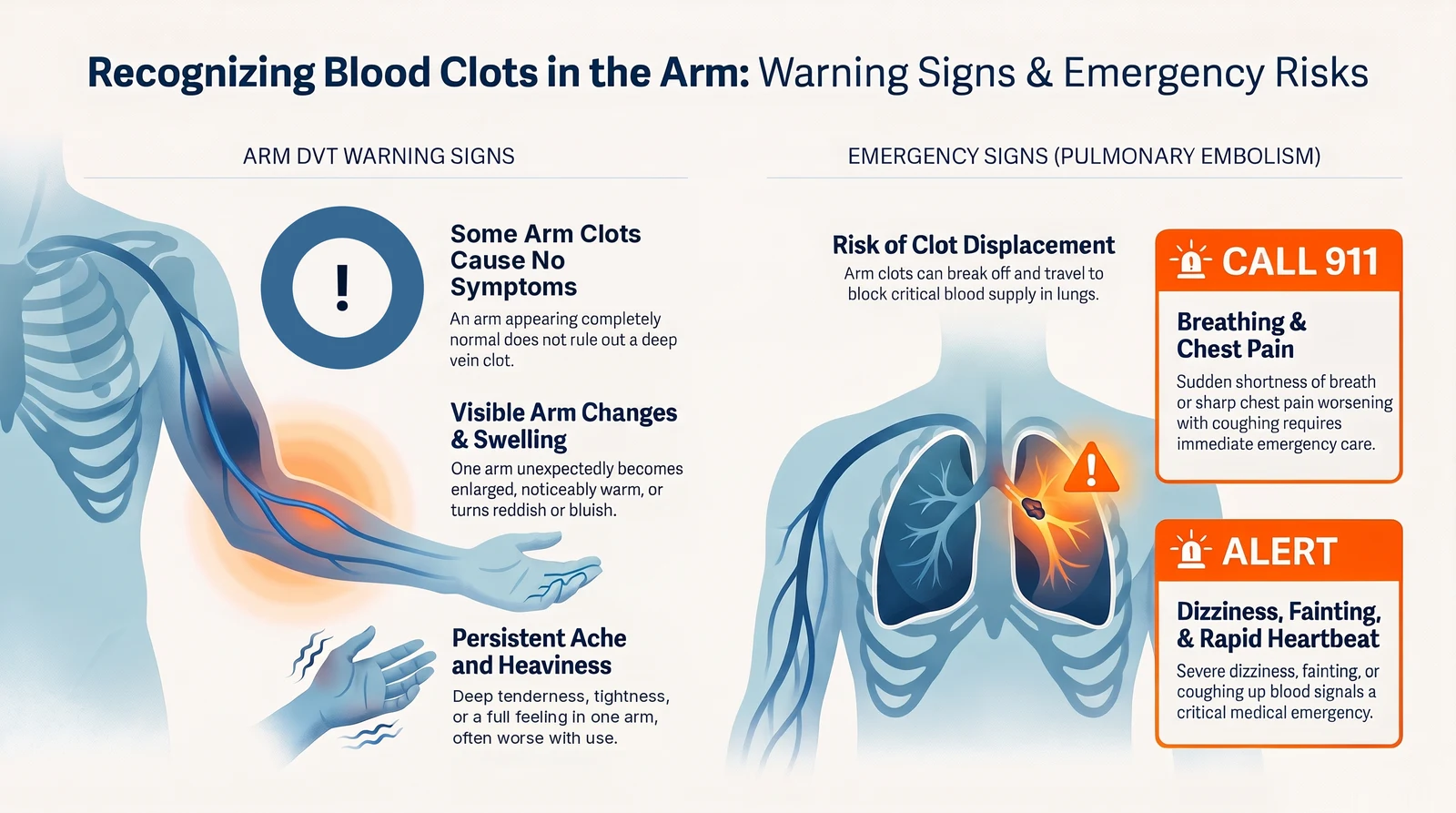
A blood clot in the arm is usually deep vein thrombosis (DVT) in the veins of the arm, shoulder or upper chest, often linked to IV lines, PICC lines or ports. Watch for swelling in one arm, an ache or heaviness, warmth, or reddish or bluish skin, though about half of people with DVT have no symptoms. A duplex ultrasound is the usual first test. Sudden shortness of breath or chest pain means call 911.
Swelling, pain, warmth, discoloration of skin and a heavy feeling can result from having a clot in an arm. Symptoms can start suddenly or come on gradually, and some people barely notice them at all. A clot in one of the deep veins (as opposed to a vein just under the skin) is called deep vein thrombosis, or DVT, and you should seek medical evaluation. If you experience pain in your arms along with sudden shortness of breath or chest pain, call 911 right away. That is because these symptoms can mean that a clot has traveled to your lungs.
At CACVI, our board-certified endovascular specialists bring over 30 years of experience and have completed more than 15,000 vascular and heart procedures. We evaluate and manage vein conditions, including deep vein thrombosis, swelling, and blocked or narrowed veins, with in-office ultrasound and minimally invasive vein care. If you have new swelling or pain in one arm, schedule a consultation with our team.
This guide explains some common signs of blood clots in the arm and how they differ from the signs of a strained muscle. We also look at what makes clots more likely to form. We also cover how arm clots are diagnosed and treated and which symptoms need emergency care.
What Does a Blood Clot in the Arm Look and Feel Like?
A blood clot in the arm may cause visible changes, such as swelling in one arm, reddish or bluish skin discoloration, and veins that look more prominent than usual. The affected arm may feel warmer than the other arm, especially near the swollen or sore areas. A clot in a deep arm vein blocks blood that is draining from the arm back toward the heart. According to the Centers for Disease Control and Prevention (CDC), about half of people with DVT have no symptoms at all, so an arm that looks normal doesn't rule out a clot.
How it feels varies from person to person. You may notice a dull ache, tenderness, tightness, or a heavy feeling that makes the arm uncomfortable to use. Unlike soreness after a workout or an injury, the discomfort often has no clear cause and shows up alongside swelling, warmth, or color changes. MedlinePlus, from the U.S. National Library of Medicine, lists sudden or gradual pain, swelling, tenderness, and warmth as possible signs of a clot in an arm or leg. Many of these are the same symptoms of blood clots in the legs, just in a different place.
These symptoms can look like a strained muscle, tendon irritation, or inflammation, so you can't confirm a clot by how your arm looks or feels. Get unexplained swelling, pain, warmth, or discoloration in one arm checked the same day, especially if you have risk factors for DVT.
6 Warning Signs of a Blood Clot in the Arm
A clot in your arm can affect both how it looks and feels in different ways. These signs can appear alone or together, and some people with DVT have none of them. The table below lists six signs to watch for and what each one may look or feel like.
| Warning Sign | What It May Look or Feel Like |
|---|---|
| 1. Arm swelling | One arm appears noticeably larger than the other, either entirely or in one area. A clot that blocks a vein causes blood and fluid to build up in the arm. |
| 2. Persistent pain or tenderness | A deep, dull ache, soreness, or tenderness with no clear cause, often alongside swelling or warmth. |
| 3. Skin discoloration | The skin appears reddish, bluish, purple, or darker than usual. On darker skin, color changes can be harder to see. |
| 4. Warmth in the affected arm | The area feels warmer than the skin around it or the same spot on your other arm. |
| 5. Prominent veins | Veins across the arm, shoulder, or upper chest appear more noticeable or prominent when blood flows around a blockage. |
| 6. Heaviness or tightness | The arm feels full, heavy, or tight, and everyday tasks become uncomfortable. In effort thrombosis, some people notice heaviness after overhead activity before the arm swells. |
Can a Blood Clot in the Arm Cause Shoulder, Neck, or Chest Symptoms?
Yes, a blood clot in the arm can cause symptoms around the shoulder, neck, or upper chest, especially when it forms in the veins near the collarbone. Veins such as the subclavian vein carry blood from the arm towards the heart. When a clot blocks them, you may notice aching or swelling in the arm, discomfort near the shoulder or armpit, or enlarged veins across the shoulder and chest.
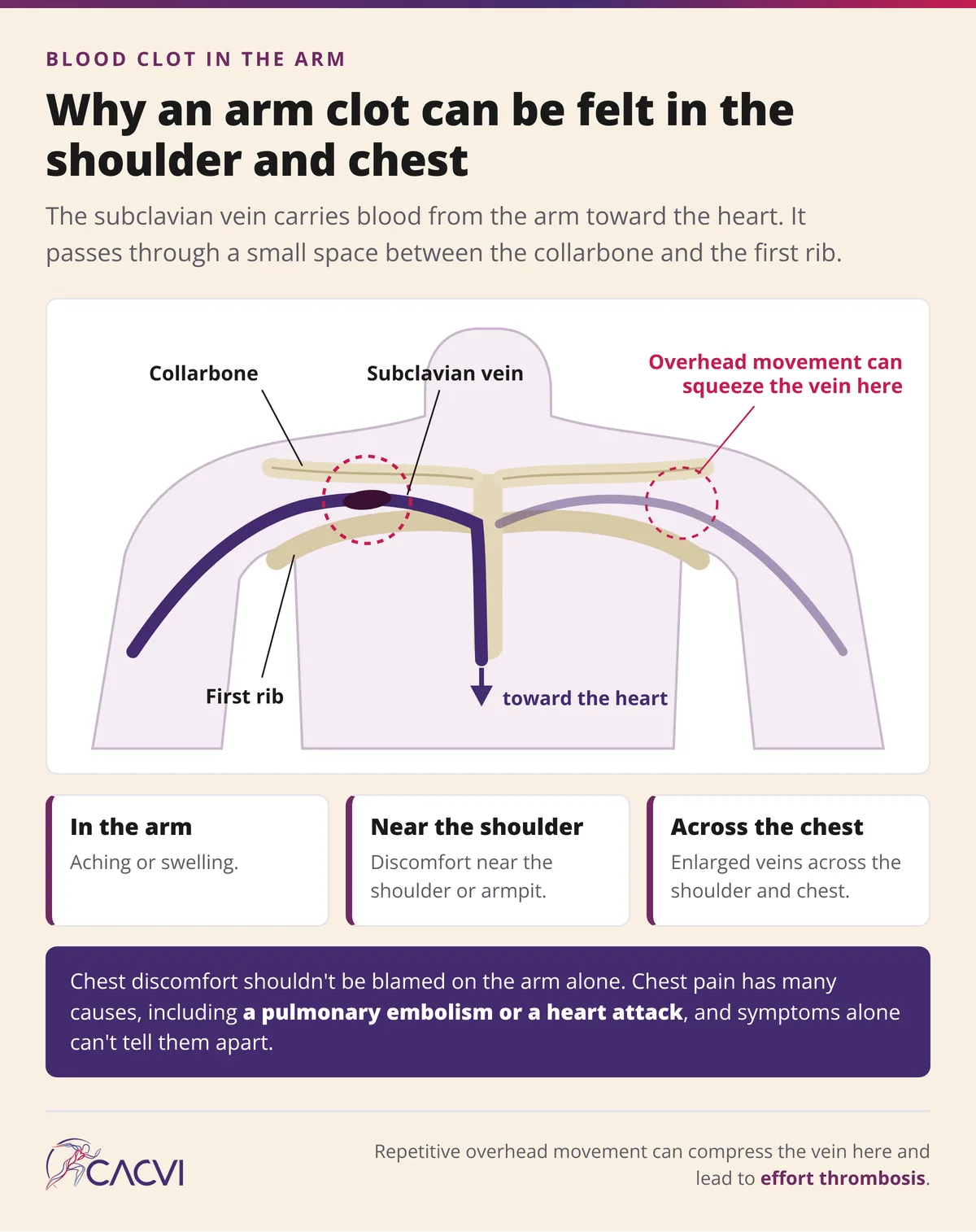
Repetitive movement overhead can compress veins near the collarbone and result in something called effort thrombosis of the arm; we explain that more closely below. However, discomfort in the chest or neck should not automatically be blamed solely on issues with the arms. Chest pain has many causes, including a pulmonary embolism or a heart attack, and symptoms alone can't tell them apart.
If you suddenly experience shortness of breath, sharp chest pains that worsen with coughing or breathing, a rapid heartbeat, bloody sputum, severe dizziness or fainting, call 911 immediately. These can be signs of a pulmonary embolism (PE), which happens when part of a clot travels to the lungs and blocks blood flow there. If you think there's an emergency, don't drive yourself to the hospital.
Blood Clot in the Arm vs. Muscle Strain: How Can You Tell the Difference?
Muscle strains, irritation of tendons, and blood clots in the upper extremities can all result in arm pain, but each tends to show up differently. Because they overlap, how your arm feels won't definitively prove or rule out a clot.
The table below compares the three side by side.
| Feature | Muscle Strain | Tendon Irritation | Upper-Extremity DVT (Blood Clot) |
|---|---|---|---|
| Common cause | Overstretching or tearing muscle fibers while lifting, exercising, or moving suddenly. | Repetitive motion or overuse that irritates a tendon where muscle attaches to bone. | A clot blocks blood flow through a deep vein in the arm, shoulder, or upper chest. |
| Pain pattern | Starts during or after an activity and stays in the injured muscle. | Localized pain near a joint, such as the shoulder or elbow, during certain movements. | Painful ache or sensitivity in the arm, armpit, or shoulder without a clear injury. |
| Swelling | Sometimes there is mild swelling over the injured muscle. | Sometimes there is mild swelling around the tendon or joint. | Noticeable swelling of one arm or hand, often affecting much of the limb. |
| Warmth or skin discoloration | Bruising after an injury, but widespread warmth or color change is unusual. | Widespread arm discoloration is unusual. | The arm may feel warm and look reddish or bluish. |
| Effect of movement | Pain increases when the muscle contracts or stretches. | Pain occurs with specific movements that load the tendon. | Using the arm, especially overhead, may make it worse, and the swelling often doesn't go away with rest the way strain pain does. |
| Visible veins | No new prominent veins. | No new prominent veins. | Veins may stand out as blood is rerouted around the blockage. |
It's also worth knowing about one more condition. Superficial thrombophlebitis is a clot in a vein just under the skin, and this kind of clot often appears near where there used to be an IV. It usually feels like a tender, firm cord along the vein, with redness right over it. It's generally less dangerous than DVT and often settles once an IV or catheter is removed, but it still deserves a look from a provider, because it can sometimes occur alongside a deeper clot. Our article on whether varicose veins can lead to blood clots explains more about how surface clots differ from deep ones.
Why Do Blood Clots Develop in the Arm?
Blood clots in the arm usually develop when something disrupts normal blood flow, damages a vein, or makes the blood more likely to clot. Deep vein clots that form in the upper part of the arm, shoulder or upper chest region are called upper extremity DVT, or UEDVT for short. Unlike blood clots that form in the legs, those that occur in the arms are most often linked to medical devices placed in veins. Other health issues and repetitive overhead movements can also cause them.
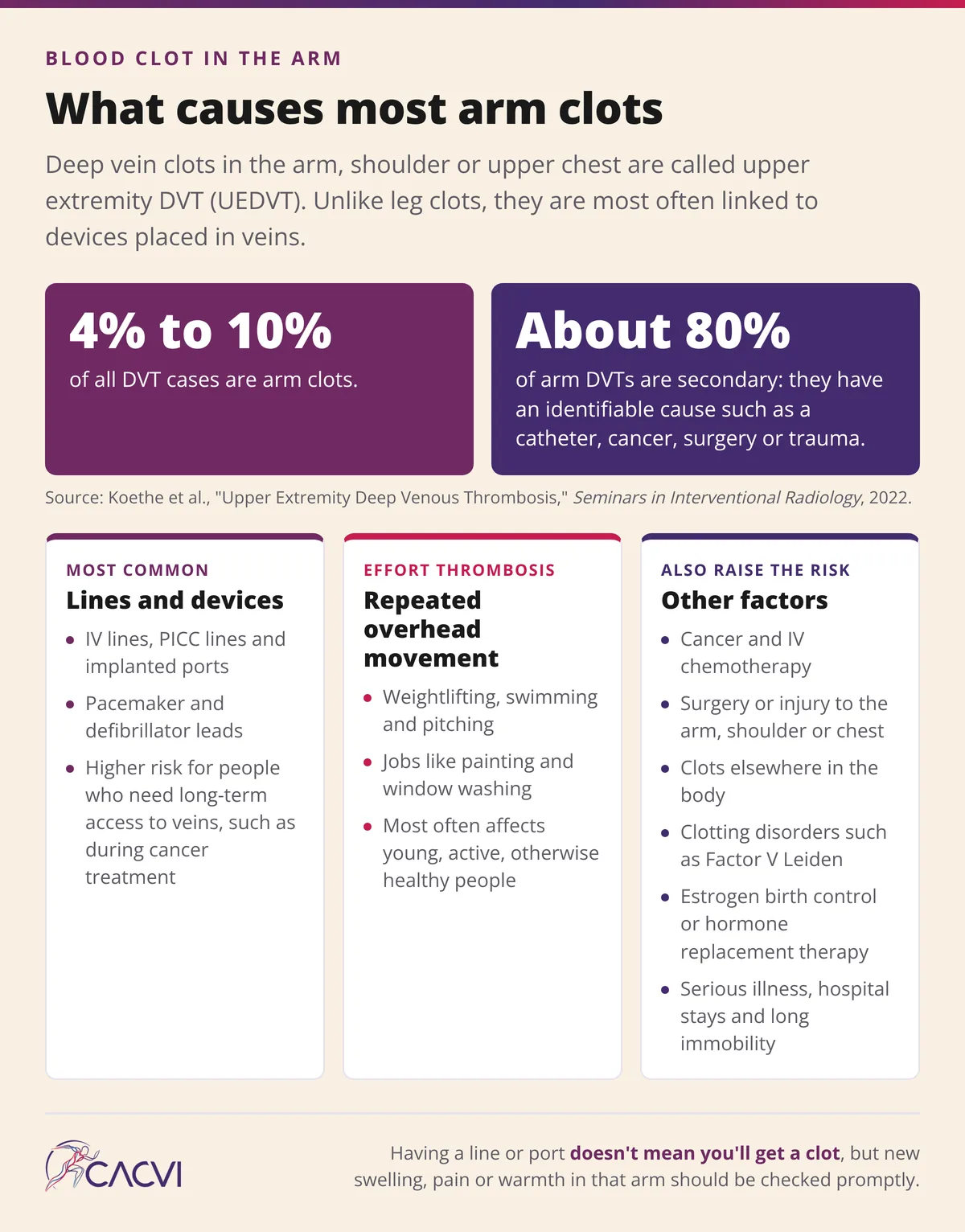
A 2022 review in Seminars in Interventional Radiology, "Upper Extremity Deep Venous Thrombosis: Etiologies, Diagnosis, and Updates in Therapeutic Strategies," reports that arm clots account for about 4% to 10% of all DVT cases. About 80% of arm DVTs are secondary, meaning they have an identifiable cause such as a catheter, cancer, surgery, or trauma. Among the most common reasons are indwelling catheters.
Intravenous Lines, PICC Lines, and Ports
IV lines, PICC lines (peripherally inserted central catheters) and implanted ports allow healthcare providers to inject medications, chemotherapy fluids, nutrition or fluids directly into veins. These devices can also irritate vein lining, slow down blood flow and provide an opportunity for clots to form.
People who need long term access to veins, like folks receiving cancer treatment or dialysis, face a greater risk. The wires (leads) from pacemakers and defibrillators run through these same veins and can also raise the risk of a clot. Having one of these devices doesn't mean you'll get a clot, but new swelling, pain, or warmth in the arm with the device should be checked promptly.
Repetitive Overhead Movements and Effort Thrombosis
Lifting your arms overhead again and again, as in weightlifting, swimming, pitching, or jobs like painting and window washing, can squeeze the subclavian vein. That vein runs through a small space between the collarbone and the first rib, where bone, muscle and ligaments can compress it.
Repeated pressure over time can damage vein walls and slow down blood flow until a clot develops. This is called effort thrombosis, or Paget-Schroetter syndrome, and it's a form of venous thoracic outlet syndrome. The Society for Vascular Surgery notes that thoracic outlet syndrome is uncommon, but it can develop in some athletes, such as baseball players and swimmers, and in people whose jobs involve lifting their arms overhead again and again, such as window washers. According to the 2022 Seminars in Interventional Radiology review, effort thrombosis most often affects young, active, otherwise healthy people.
Other Factors That Can Increase the Risk
Cancer causes the blood to clot more easily and chemotherapy drugs given via veins also increase this risk. Surgery or an injury to the arms, shoulders or chest can damage veins or limit movement. Having clots elsewhere in the body increases the risk of new ones forming. Inherited or acquired clotting disorders, such as Factor V Leiden, make the blood more likely to clot. Birth control that contains estrogen and hormone replacement therapy both raise the risk of clots, especially alongside other risk factors. Serious illnesses, hospital stays, and long stretches of being immobile complete this list.
How Is a Blood Clot in the Arm Diagnosed?
Typically, when doctors diagnose clots in the arm, they start by looking at your medical history and performing an examination. Imaging tests are also done, and sometimes blood tests as well. Here is how the process typically works.
Ask About Your Arm Symptoms and Any Lines or Devices
Your provider will ask when the symptoms started, whether they came on suddenly or slowly, and whether you've noticed swelling, tenderness, warmth, or color changes. They will also ask about any past blood clots, recent surgery, cancer treatment, hormone use, and whether you have a PICC line, port, or other central line catheter.
Examine Both Arms, the Shoulder, Neck and Chest
Your doctor will look at both arms and check swelling and large veins around your shoulders, neck and chest. An exam alone can't confirm or rule out a clot, but it helps decide how likely one is and which test comes next.
Weigh a D-dimer Test, Which Has Limits for Arm Clots
A D-dimer test measures protein pieces that come from breaking down clots in the body. If your doctor thinks clots are unlikely, a normal result can serve to rule out DVT. A high result doesn't confirm a clot, because pregnancy, heart disease, recent surgery, older age, and other conditions can also raise D-dimer, according to MedlinePlus. The test has also been studied less for arm clots than for leg clots, so many providers go straight to imaging when they suspect an arm DVT, especially in people with a catheter or cancer.
Duplex Ultrasound and Imaging Around the Collarbone
A duplex ultrasound is the usual first imaging test for a suspected arm clot. It uses sound waves to show the veins and measure blood flow, and it's painless and needs no incision. CACVI performs vascular ultrasounds in our offices.
The collarbone can block the ultrasound from seeing the veins underneath it. If the scan is unclear or a clot is still suspected, your provider may order MR venography, CT venography, or a contrast venogram, which uses dye and X-ray to outline the veins. A venogram also lets a specialist treat the vein during the same procedure if needed.
What Happens if a Blood Clot in the Arm Is Left Untreated?
Untreated clots in the arm can lead to serious complications, particularly if they block major veins that are deeper inside. Some clots stay small, but others extend into the larger veins near the shoulder and collarbone, which worsens the blockage.
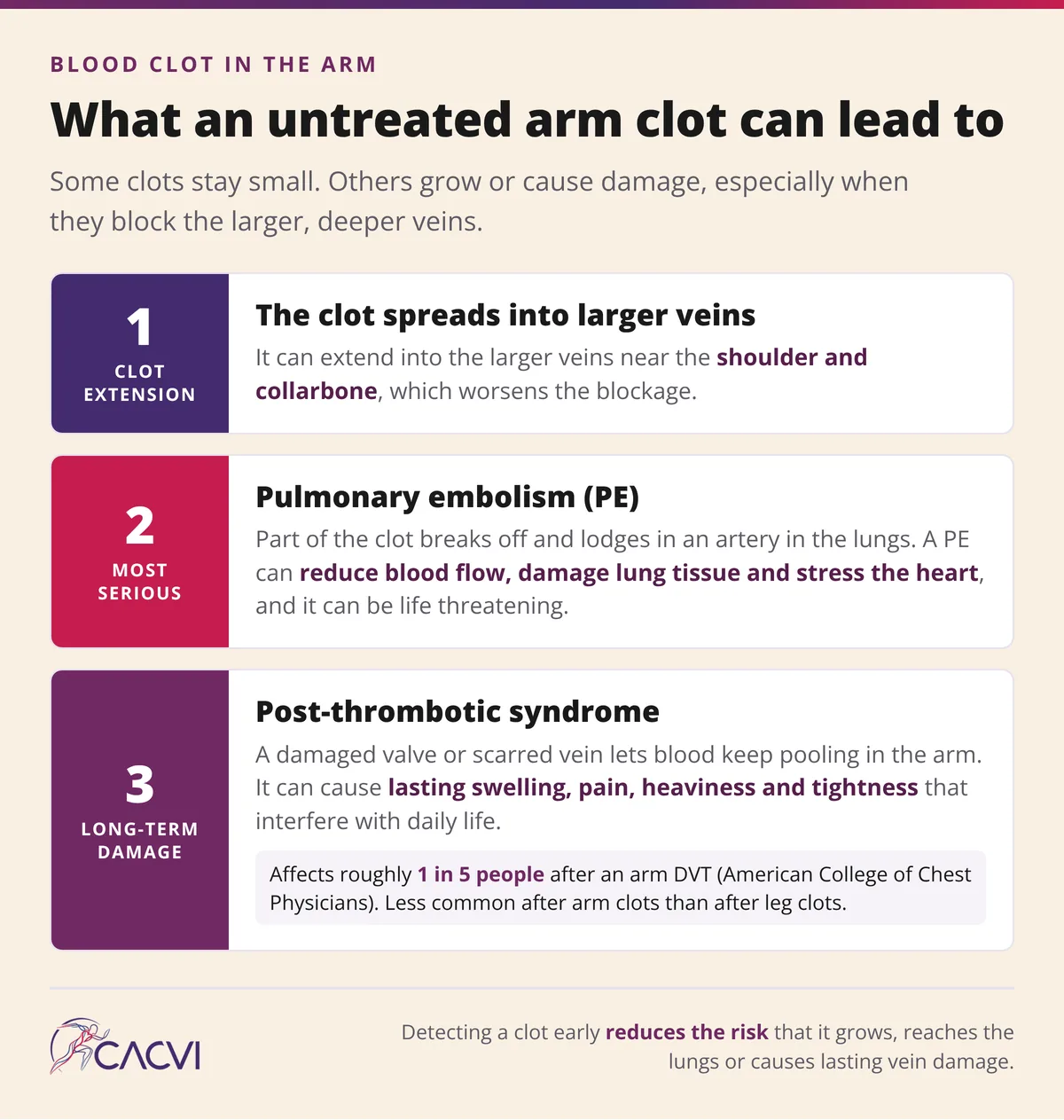
The most serious complication is a pulmonary embolism. Part of the clot breaks off, travels through the bloodstream, and lodges in an artery in the lungs. Pulmonary embolism (PE) can reduce blood flow, damage lung tissue, stress the heart and can be life threatening.
Another complication that can occur is post-thrombotic syndrome. When a clot damages a vein's valves or scars the vein, blood may keep pooling in the arm even after the clot is treated. Post-thrombotic syndrome affects roughly 1 in 5 people after an arm DVT, according to American College of Chest Physicians guidelines, and it is less common after arm clots than after leg clots. The lasting swelling, pain, heaviness and tightness can interfere with daily life.
How Is a Blood Clot in the Arm Treated?
Anticoagulants, also called blood thinners, are the first-line treatment. They stop the clot from growing and also prevent new clots as the body works on gradually breaking down the existing clot. According to the National Heart, Lung, and Blood Institute, options include heparin, warfarin and newer direct oral anticoagulants (DOACs). MedlinePlus lists apixaban and rivaroxaban among the DOACs. Treatment usually lasts at least three months, according to MedlinePlus and American College of Chest Physicians guidelines. It may last longer if an ongoing risk factor remains, such as active cancer or a catheter that needs to stay in place.
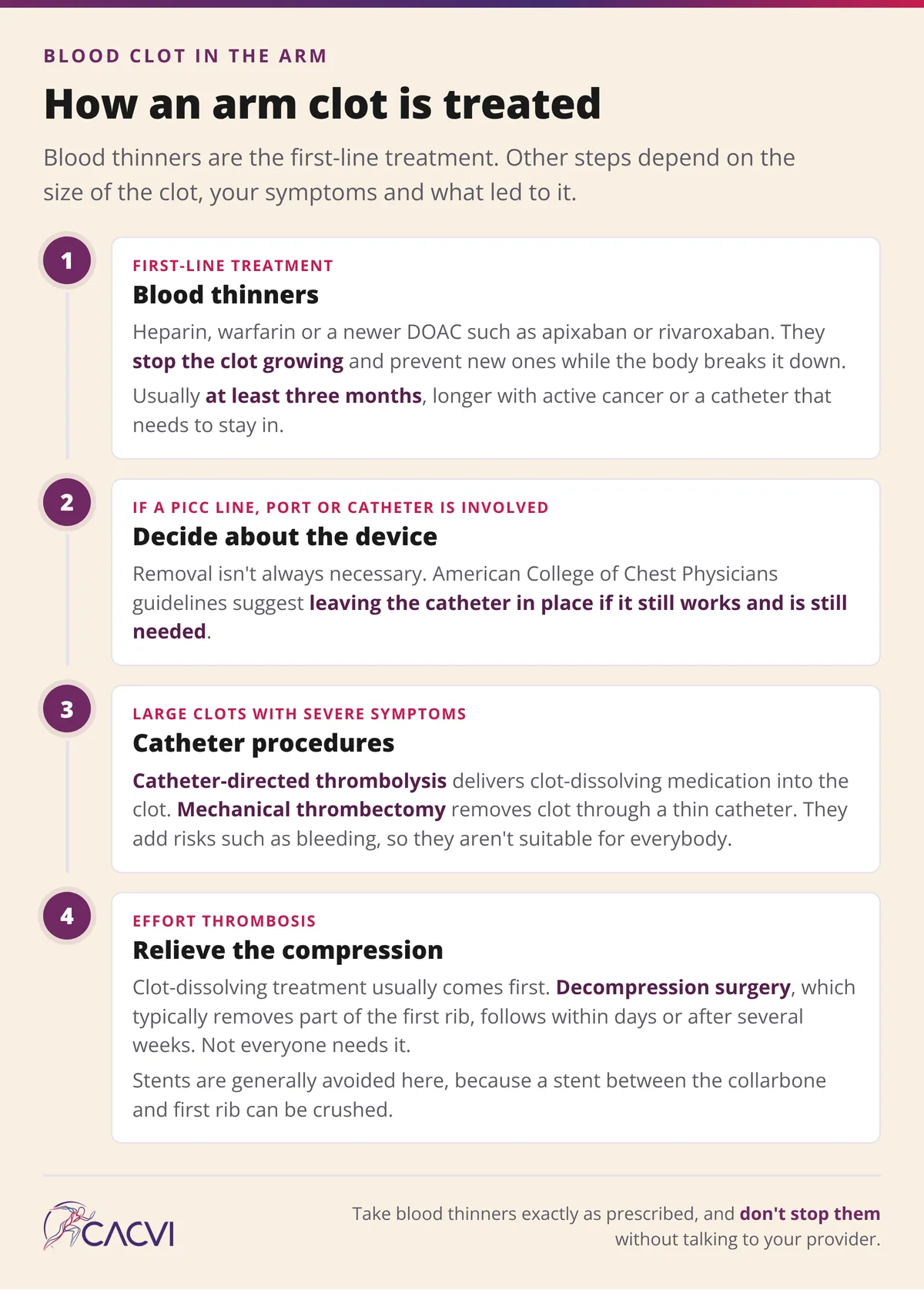
If the clot is related to a PICC line, port, or other catheter, your care team will decide whether the device should come out. Removal isn't always necessary. American College of Chest Physicians guidelines suggest leaving the catheter in place if it still works and is still needed.
For large clots with severe symptoms, a specialist may recommend catheter-directed thrombolysis, which delivers clot-dissolving medication straight into the clot, or mechanical thrombectomy, which removes clot through a thin catheter. Because there are some added risks such as bleeding, these procedures aren't suitable for everybody. If narrowing of a vein is part of the problem, venous stenting or balloon angioplasty may be considered. Stents are generally avoided when the narrowing comes from compression between the collarbone and the first rib, because a stent there can be crushed.
Effort thrombosis often needs more than medication. When clots form because the collarbone and first rib press on the vein, they can come back if that compression isn't relieved. The Society for Vascular Surgery notes that if a clot in the arm is due to compression in the thoracic outlet, decompressing that outlet is the next step. According to the 2022 Seminars in Interventional Radiology review, clot-dissolving treatment usually comes first, and the decompression surgery, which typically removes part of the first rib to give the vein more room, follows within days or after several weeks. Not everyone needs rib surgery; some people do well with clot-dissolving treatment and blood thinners alone.
During treatment, your healthcare team monitors symptoms, assesses how well you respond to medicine and looks into any medical condition that may have led to the clot. Take blood thinners exactly as prescribed, and don't stop them without talking to your provider. Most people do fine, but some have persistent swelling or discomfort that still needs ongoing care. A vein specialist can handle both the clot and any long-term damage to the veins.
When Should You Seek Medical Attention for Arm Symptoms?
Don't overlook swelling that comes on unexpectedly along with steady pain, warmth or changes in skin color in one arm, even if you can't figure out why. These can be signs of DVT. The CDC notes that about half of people with DVT have no symptoms, so a missing sign or two doesn't mean you're in the clear.
Call a provider the same day if one arm or hand is suddenly larger than the other, if your arm aches or feels tender without an injury, if it feels warm or looks red or bluish, or if new veins stand out across your arm, shoulder, or chest. These signs do not confirm that there is a clot, but a doctor can assess your risk level and decide if you need an ultrasound test. Problems with the veins in your arms can also be part of broader peripheral venous disease, and our guide on when to see a vein specialist can help you decide where to start.
Call 911 or your local emergency number if you have signs of a pulmonary embolism:
- Sudden shortness of breath or trouble breathing
- Chest pain, especially pain that gets worse when you breathe deeply or cough
- Coughing up blood
- Fainting, severe dizziness, or a fast or irregular heartbeat
🚨 Seek Emergency Care
A PE can develop even when your arm feels fine, so don't assume you're safe because the arm has no symptoms. Better to call an ambulance instead of driving yourself to the hospital.
Need To Know More About Blood Clot in Arm Symptoms?
Unexplained swelling, steady pain, warmth, color changes, or prominent veins in one arm can be signs of DVT. Detecting clots early reduces the risk that they will grow, go to the lungs, or cause long-lasting damage to veins. Knowing your own risk factors, such as a PICC line or port, cancer treatment, or repetitive overhead activity, helps you recognize when symptoms need a closer look.
CACVI's board-certified specialists can evaluate arm swelling and explain your treatment options, and we perform vascular ultrasound in our offices. Contact CACVI to schedule an appointment.
Talk to a CACVI Vein Specialist
If you have new swelling, pain, or other signs of a vein problem in one arm, schedule a consultation with our team.
Contact CACVI Today →Frequently Asked Questions About Blood Clot in Arm Symptoms
Arm symptoms can have several causes, and it isn't always clear when they need medical attention. These responses cover typical questions about spotting and getting back on track after an arm clot.
Can You Have a Blood Clot in Your Arm Without Swelling?▾
Yes. Arm clots can form and go unnoticed; some people have only pain, tenderness, warmth or no other symptoms at all. Get checked if you suspect a clot, even if your arm looks normal.
Can a Blood Clot in the Arm Go Away on Its Own?▾
The body does break down clots over time, but waiting for one to disappear without medical care is risky. Treatment with blood thinners or other kinds of treatment may be necessary to stop the clot from getting bigger or going to your lungs.
How Long Does a Blood Clot in the Arm Take to Heal?▾
Most people take blood thinners for at least three months, and the exact length depends on what caused the clot and your other risk factors. Pain and swelling often improve sooner, though some people have lingering symptoms that need more care.
Can You Move Your Arm if You Have a Blood Clot?▾
Usually yes, but swelling, pain or feeling heavy can make it uncomfortable. Listen to what your healthcare provider advises regarding activities and avoid doing anything too strenuous until you have been assessed and have a treatment plan in place. Don't massage or rub an arm you think may have a clot (here is why massage is risky).
Is a Blood Clot in the Arm as Dangerous as One in the Leg?▾
Both can cause a pulmonary embolism if part of the clot reaches the lungs, but it happens less often with arm clots than with a clot in the leg, such as a blood clot in the calf or thigh. In a large registry, about 9% of people with an arm DVT had a noticeable PE when diagnosed, compared with 29% of people with a leg DVT, and guideline data put symptomatic PE at about 5% after an arm DVT. Arm clots still need prompt treatment: after three months, outcomes were similar to leg clots, and people with cancer did worse. A suspected clot in either place needs prompt evaluation.
Medical Disclaimer: This article is for educational and informational purposes only and is not medical advice, a diagnosis, or a substitute for professional care. Reading this doesn't establish a doctor-patient relationship with CACVI. If you think you have a blood clot in your arm, talk to a qualified healthcare provider promptly, and call 911 or your local emergency number if you have sudden shortness of breath, chest pain, coughing up blood, or fainting.

✓ Medically reviewed by
Dr. Vasim Lala
D.O., FACC, FSCAI, RPVI · Coronary, vascular and structural intervention
Trained at Mount Sinai in New York in advanced coronary, vascular and structural intervention. Focuses on minimally invasive heart and vascular procedures and on preventive cardiology, and writes for the American College of Cardiology.
View physician profile →
