
How Do I Know If the Blood Clot Dislodged?
Quick answer
You usually cannot feel a blood clot break loose. If part of a clot in a deep leg vein breaks off, it travels to the lungs and causes a pulmonary embolism (PE). Call 911 for sudden shortness of breath, chest pain that gets worse when you breathe in, a racing heartbeat, coughing up blood, or fainting. About half of people with DVT have no symptoms, so only tests such as a D-dimer blood test or a CT scan of the lungs can show whether a clot has moved.
A blood clot dislodges when it breaks loose from where it formed and travels through the bloodstream, where it is called an embolus. If the clot reaches the lungs, it causes a pulmonary embolism (PE), a medical emergency that can be deadly if it isn't treated quickly.
At CACVI, our board-certified endovascular specialists bring more than 30 years of experience and have performed more than 15,000 vascular and heart procedures. Some of the people we see have already been diagnosed with a clot and want to know which signs to watch for. If you have been diagnosed with a clot or think you may have one, schedule a vascular evaluation with our team.
This guide explains how to recognize the signs of a dislodged blood clot, which symptoms point to a pulmonary embolism, and how doctors use imaging and blood tests to find out what is happening. It also covers what to do if symptoms start and when to call 911.
🚨 Call 911 Right Away If You Have
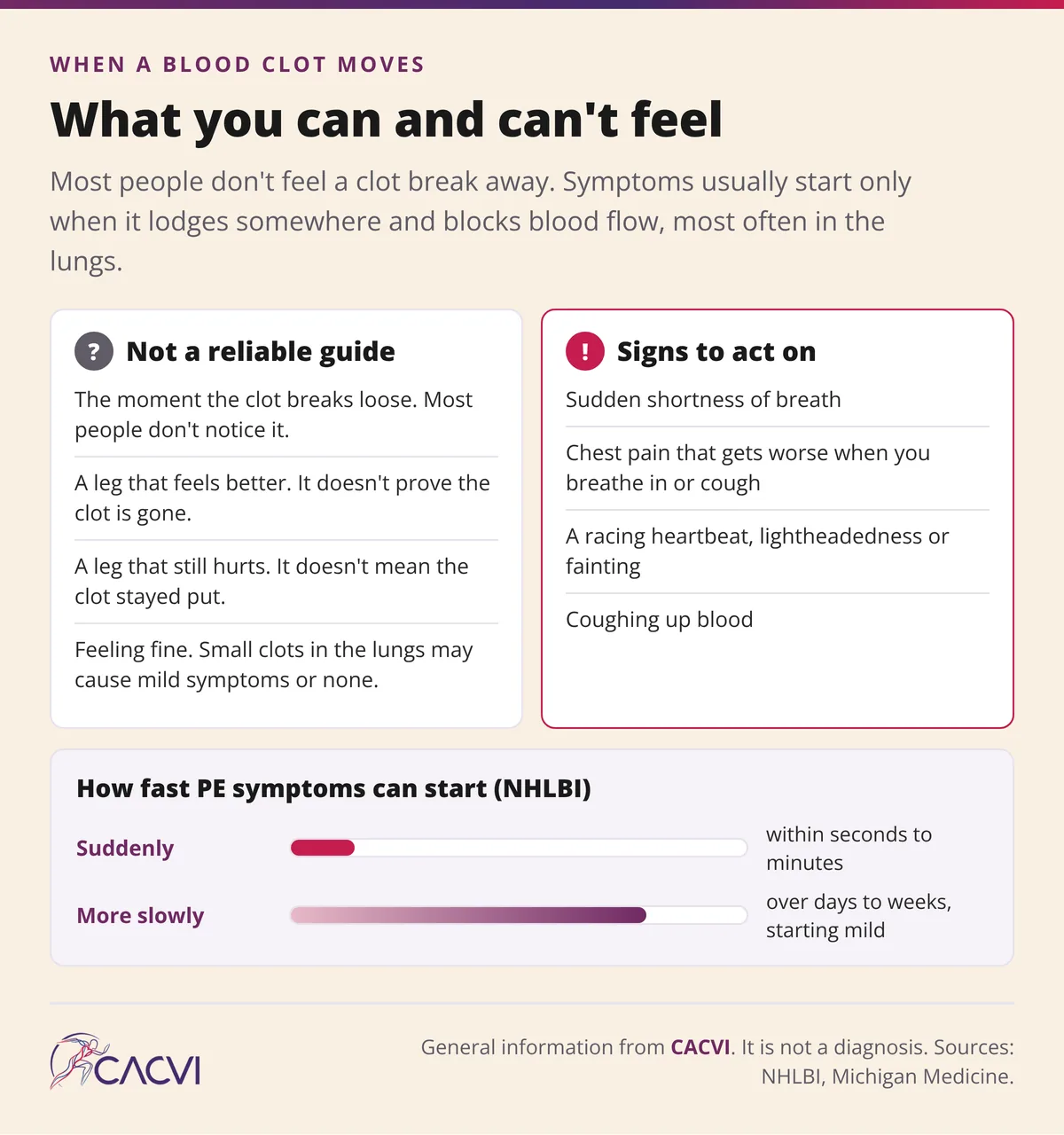
Sudden shortness of breath, chest pain that gets worse when you breathe in or cough, a racing heartbeat, coughing up blood, lightheadedness, or fainting. These can be signs that a clot has reached your lungs. Don't wait to see if they pass, and don't drive yourself to the hospital.
What Does It Mean When a Blood Clot Dislodges?
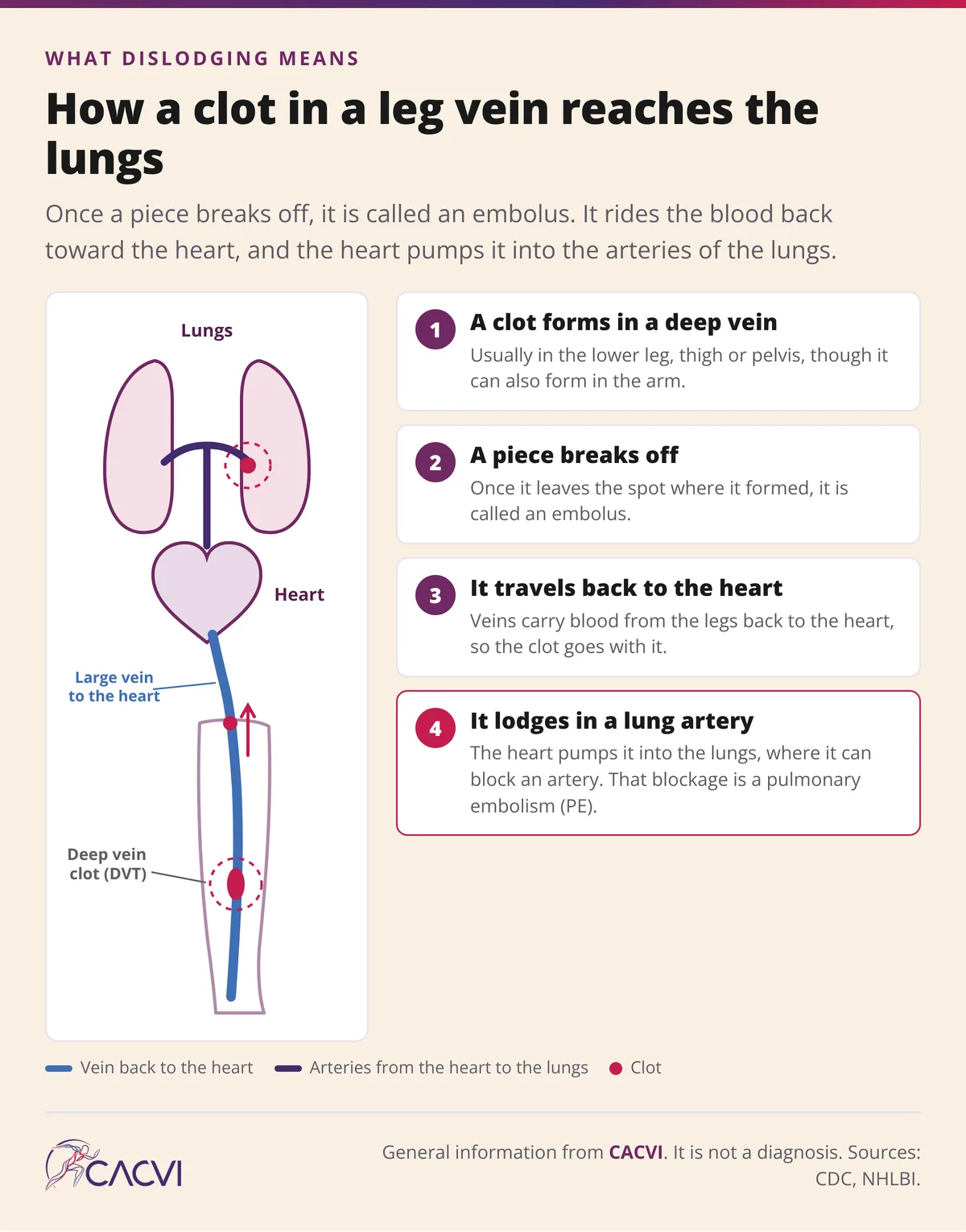
A blood clot forms when blood thickens and clumps together inside a blood vessel. Deep vein thrombosis (DVT) is a clot in one of the large veins deep in the body, usually in the lower leg, thigh, or pelvis, though it can also form in the arm. The Centers for Disease Control and Prevention (CDC) groups DVT and pulmonary embolism together as venous thromboembolism (VTE). Most pulmonary embolisms start as a DVT in the leg.
Sometimes all or part of a clot breaks off and travels through the bloodstream. Once it leaves the spot where it formed, it is called an embolus. A clot from a vein in the leg travels back to the heart, which pumps it into the lungs, where it can block an artery. That blockage is a pulmonary embolism.
A clot that stays in place can still block blood flow and cause symptoms in the affected leg, such as pain, swelling, warmth, or discoloration. When a clot moves, the symptoms depend on where it lands. Symptoms alone can't tell you for sure whether a clot has moved, and some people with DVT have no symptoms at all. Only a medical assessment and imaging can answer that question.
What Are the Signs That a Blood Clot May Have Dislodged?
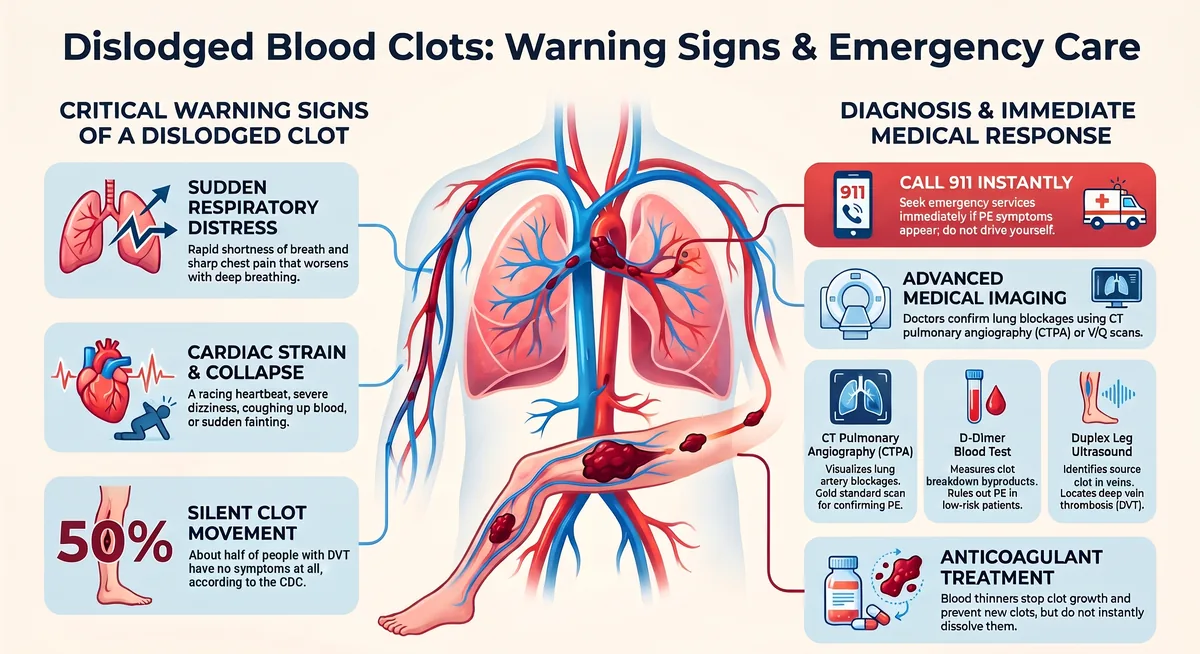
The signs depend on where the clot started. If a piece of a clot in a deep vein of the leg or thigh breaks loose, it travels to the lungs, so the warning signs of a dislodged leg clot are the signs of a pulmonary embolism, and they often come on suddenly. The National Heart, Lung, and Blood Institute (NHLBI) lists shortness of breath, pain with deep breathing, a fast heart rate, coughing (sometimes with blood), and lightheadedness or fainting among the symptoms of PE.
Where the clot sits matters too. A clot in the thigh, the pelvis, or the vein behind the knee (a proximal DVT) is more likely than a clot in the calf to lead to a pulmonary embolism, according to Michigan Medicine's adult venous thromboembolism guideline. That is one reason doctors treat these clots with blood thinners. If you have a known clot at or above the knee, take any of the signs below especially seriously.
The table describes what these symptoms can feel like. Any one of them is a reason to call 911.
| Warning sign | What it may feel or look like |
|---|---|
| Sudden shortness of breath | Trouble breathing that starts suddenly, even at rest or during light activity. |
| Sharp or stabbing chest pain | Chest pain that gets worse when you take a deep breath, cough, or move. |
| Rapid or irregular heartbeat | A racing, pounding, or uneven heartbeat. |
| Dizziness or lightheadedness | Feeling faint or unsteady, as if you might pass out. |
| Fainting or sudden collapse | Passing out, or sudden severe weakness. |
| Coughing up blood | Blood-streaked mucus or coughing up blood, sometimes with chest pain or breathlessness. |
Can a Blood Clot Dislodge Without Symptoms?
Yes. A blood clot can form, and even move, without causing symptoms you notice. The CDC reports that about half of people with DVT have no symptoms at all, and a pulmonary embolism can happen in someone who had no clear warning signs of a clot beforehand. According to CDC data, sudden death is the first symptom in about one quarter of people who have a PE.
Feeling fine doesn't prove a clot is stable. Small clots that reach the lungs may cause mild symptoms or none, while larger ones can be life-threatening. Because how you feel isn't a reliable guide, people who already have a clot need regular checkups with their doctor.
What Does It Feel Like When a Blood Clot Moves?
Most people don't feel a clot break away from where it formed. Symptoms usually start only when the clot lodges somewhere and blocks blood flow. That usually happens in the lungs, and symptoms such as trouble breathing and chest discomfort tend to appear quickly. The NHLBI notes that PE symptoms can start within seconds to minutes, or build more slowly over days to weeks, starting mild and getting worse.
Your leg won't necessarily give you clear clues either way. Leg symptoms aren't a reliable guide: a leg that feels better doesn't prove the clot is gone, and a leg that still hurts doesn't mean the clot has stayed put.
What Happens if a Blood Clot Travels to the Lungs?
When a clot reaches the lungs, it can block one or more of the pulmonary arteries, which carry blood from the heart to the lungs. That cuts off blood flow to part of the lung and makes it harder for the body to take in oxygen.
A pulmonary embolism also puts extra strain on the right side of the heart, which has to pump harder to push blood past the blockage. A large clot, or several smaller ones, can strain the heart enough to cause low blood pressure, shock, or death without prompt treatment. How severe a PE is depends on how much of the lung's blood supply is blocked and on the person's overall health. The CDC estimates that 60,000 to 100,000 Americans die of VTE each year.
Clots that travel to the brain, heart, or intestines are a different story. A clot from a leg vein normally stops in the lungs, because the lungs trap it before it can reach the arteries that feed the rest of the body. In rare cases, a clot from a vein passes through a small opening between the upper chambers of the heart, called a patent foramen ovale, and travels on to cause a stroke. Most strokes, heart attacks, and blockages of the arteries to the intestines (mesenteric ischemia) come from clots that form in the arteries or in the heart itself, not from DVT.
How Can Doctors Tell if a Blood Clot Has Dislodged?
Doctors can't tell whether a clot has moved from symptoms alone. They combine your symptoms, history, blood tests, and imaging to find out whether a clot has reached the lungs, a process the NHLBI describes in more detail.
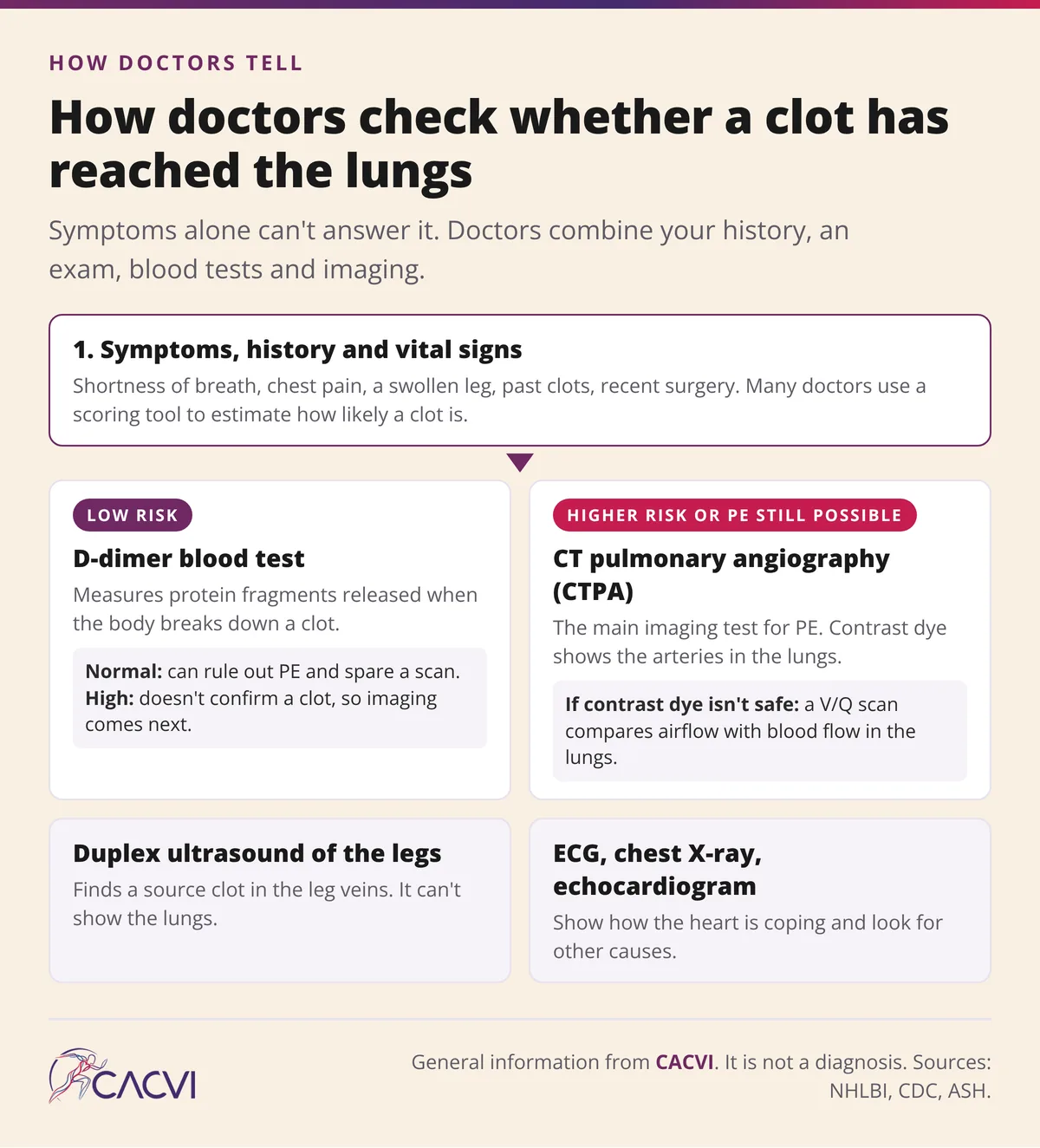
The assessment starts with your symptoms and medical history. Your doctor will ask about shortness of breath, chest pain, dizziness, coughing up blood, and any pain or swelling in one leg. They also ask about previous blood clots, recent surgery, long periods of sitting or bed rest, hormone use, and other medical conditions. Checking your heart rate, blood pressure, breathing rate, and blood oxygen level shows how urgent the situation is, but these numbers can't confirm or rule out a PE on their own. Many doctors use a scoring tool at this stage to estimate how likely a clot is.
For people at low risk, the next step is often a D-dimer blood test, which measures protein fragments released when the body breaks down a clot. A normal result can rule out a PE in someone at low risk and spare them a scan. A high result doesn't confirm a clot, because pregnancy, recent surgery, older age, and other illnesses can also raise D-dimer levels.
If a PE still seems possible, or the person's risk is high from the start, doctors usually order a CT pulmonary angiography (CTPA) scan, the main imaging test for PE. Contrast dye is given through a vein, and the scanner takes detailed pictures of the arteries in the lungs to look for blockages. If someone can't safely receive contrast dye, for example because of kidney problems or a contrast allergy, doctors may use a ventilation-perfusion (V/Q) scan instead. It compares airflow into the lungs with blood flow through them, and a mismatch between the two can point to a clot.
A duplex ultrasound of the legs can find a DVT that may be the source of the problem. It can't show whether a clot has already reached the lungs, but finding a leg clot in someone with chest symptoms makes a PE more likely and sometimes changes which scans are needed. Doctors may also order an electrocardiogram, a chest X-ray, or an echocardiogram to check how the heart is coping and to look for other causes of the symptoms. No single test settles it; doctors weigh all the results together.
What Should You Do if You Think a Blood Clot Has Dislodged?
What you do next depends on your symptoms.
If you suddenly have shortness of breath, sharp chest pain, bloody sputum, a racing heartbeat with lightheadedness, or you pass out, call 911 or your local emergency number immediately. Don't wait to see if the symptoms go away, and don't drive yourself to the hospital. Fast treatment can save your life.
If you have new or worsening pain, swelling, warmth, or discoloration in one limb and no emergency signs, get medical care promptly. Don't rub or massage the area, and don't try to treat a suspected clot at home. If you've already been diagnosed with a clot, keep following your treatment plan, and never stop or change your blood thinner without talking to your doctor first.
🚨 Seek Emergency Care
Rarely, a large clot in the thigh or pelvis can make the whole leg suddenly very swollen, very painful, and pale or bluish. This is called phlegmasia, and it is an emergency: call 911.
Can Blood Thinners Prevent a Blood Clot From Dislodging?
Blood thinners, also called anticoagulants, make it harder for blood to clot. They stop existing clots from getting bigger and lower the chance of new clots forming. The CDC notes that anticoagulants are the medications most commonly used to treat DVT and pulmonary embolism. They don't dissolve the clot. Instead, they keep it from growing while the body slowly reabsorbs it.
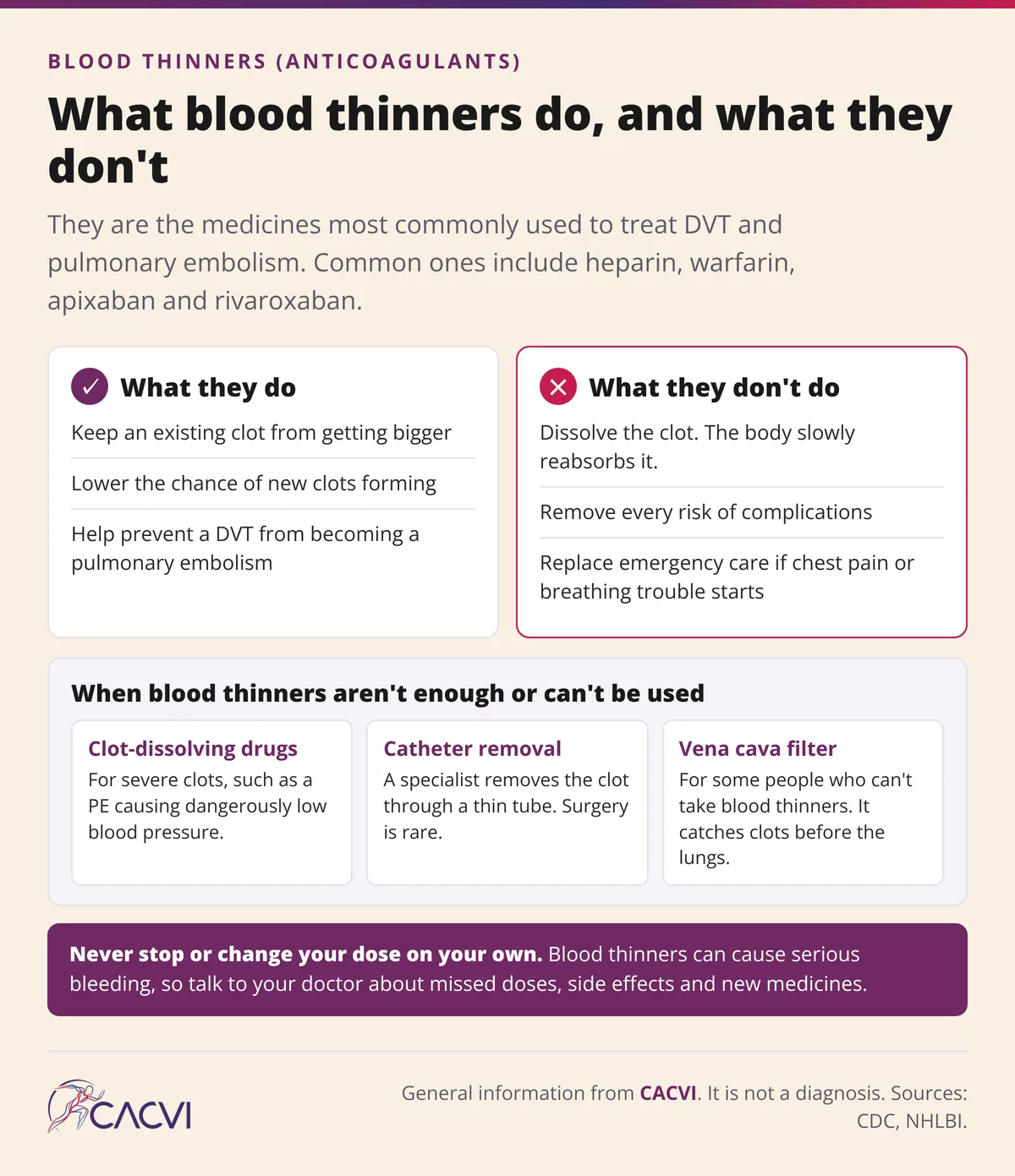
Common blood thinners include heparin, warfarin, apixaban, and rivaroxaban. They are used to treat existing clots and to prevent new ones. Whether you take one, and for how long, depends on where the clot is, why it formed, your medical history, and your risk of bleeding. Take your medicine on schedule, because missed doses raise the risk that a clot will grow, and follow your doctor's instructions for any lab work. Blood thinners can cause serious bleeding, so talk to your doctor about missed doses, side effects, and any new medicines or supplements before you change anything.
For severe or life-threatening clots, such as a pulmonary embolism that causes dangerously low blood pressure, specialists may use clot-dissolving drugs (thrombolytics), remove the clot through a catheter, or in rare cases remove it surgically. These treatments carry a higher risk of bleeding, so they are kept for severe cases. For some people who can't take blood thinners, the NHLBI notes that a device called an inferior vena cava filter can be placed in the large vein that returns blood to the heart to catch clots before they reach the lungs.
Blood thinners greatly lower the chance that a clot grows or a new one forms, but they don't remove every risk. Patients often ask about everyday concerns too, such as whether compression stockings can dislodge a clot. If breathing trouble or chest pain starts while you're on a blood thinner, treat it as an emergency rather than assuming the medication has you covered.
Worried a Blood Clot Has Moved?
When a dislodged clot does cause symptoms, they are usually sudden: trouble breathing, chest pain, a very fast heartbeat, or fainting. Those symptoms need emergency care, not a regular office visit. For a new clot diagnosis, leg symptoms that won't go away, or questions about treatment, a vascular specialist can explain your risks and plan the next steps. If you want to know how long a clot can safely wait, read our guide on how long a blood clot can go untreated.
The vascular team at CACVI diagnoses and treats DVT and other vein conditions across Southern California. If you are living with a blood clot or worried you might have one, book a visit as a new patient.
Talk to a CACVI Vascular Specialist
If you have a diagnosed clot, or new pain or swelling in one leg, schedule a consultation with our team.
Contact CACVI Today →Frequently Asked Questions
Blood clot symptoms vary with where the clot is and whether it moves. These answers cover what to watch for, how fast things can change, and when to get help.
Can You Feel a Blood Clot Break Loose?▾
Usually not. Most people don't notice the moment a clot breaks loose and travels in the bloodstream. Symptoms such as sudden shortness of breath, chest pain, dizziness, or fainting usually show up only once the clot blocks an artery in the lungs.
How Quickly Can a Dislodged Blood Clot Reach the Lungs?▾
Quickly. Blood from the legs flows back through the heart and straight into the lungs, so a piece of clot that breaks loose can lodge there soon after. PE symptoms can start within seconds to minutes, although they sometimes build over days. Never delay emergency care if you have signs of a pulmonary embolism.
Can a Blood Clot Dislodge While Taking Blood Thinners?▾
It can happen, but treatment makes it much less likely. The NHLBI notes that blood thinners keep clots from getting larger and help prevent a DVT from becoming a pulmonary embolism. They don't dissolve the existing clot right away, though. Take your medication as prescribed and call 911 if you have signs of a pulmonary embolism.
Can a Dislodged Blood Clot Be Fatal?▾
Yes. A clot that blocks blood flow through the lungs can strain the heart to the point of collapse. Prompt diagnosis and treatment improve the outlook, so call 911 right away if you have sudden shortness of breath, chest pain, coughing up blood, or fainting.
What Should You Do if Your Blood Clot Symptoms Suddenly Change?▾
Call 911 if you have sudden trouble breathing, sharp chest pain, coughing up blood, fainting, or signs of a stroke such as sudden weakness on one side of the body. If your leg pain or swelling gets worse without those warning signs, contact your doctor right away.
Medical Disclaimer: This article is for educational purposes only and is not a substitute for professional medical advice, diagnosis, or treatment. If you think you have a blood clot, see a doctor right away, and call 911 or your local emergency number if you have symptoms of a possible pulmonary embolism or another medical emergency.

✓ Medically reviewed by
Dr. Vasim Lala
D.O., FACC, FSCAI, RPVI · Coronary, vascular and structural intervention
Trained at Mount Sinai in New York in advanced coronary, vascular and structural intervention. Focuses on minimally invasive heart and vascular procedures and on preventive cardiology, and writes for the American College of Cardiology.
View physician profile →
